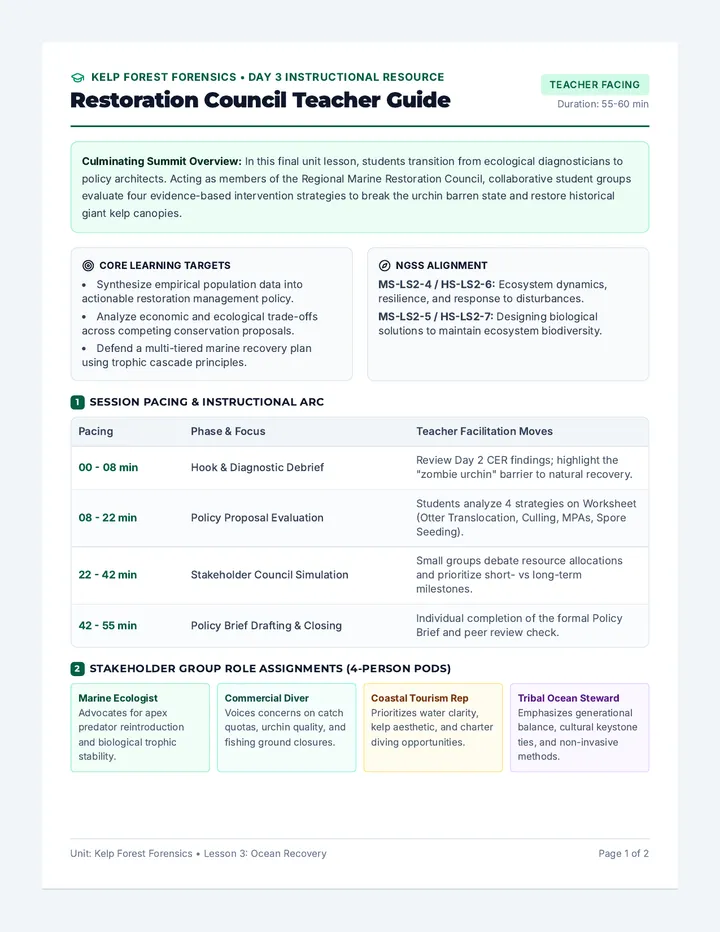
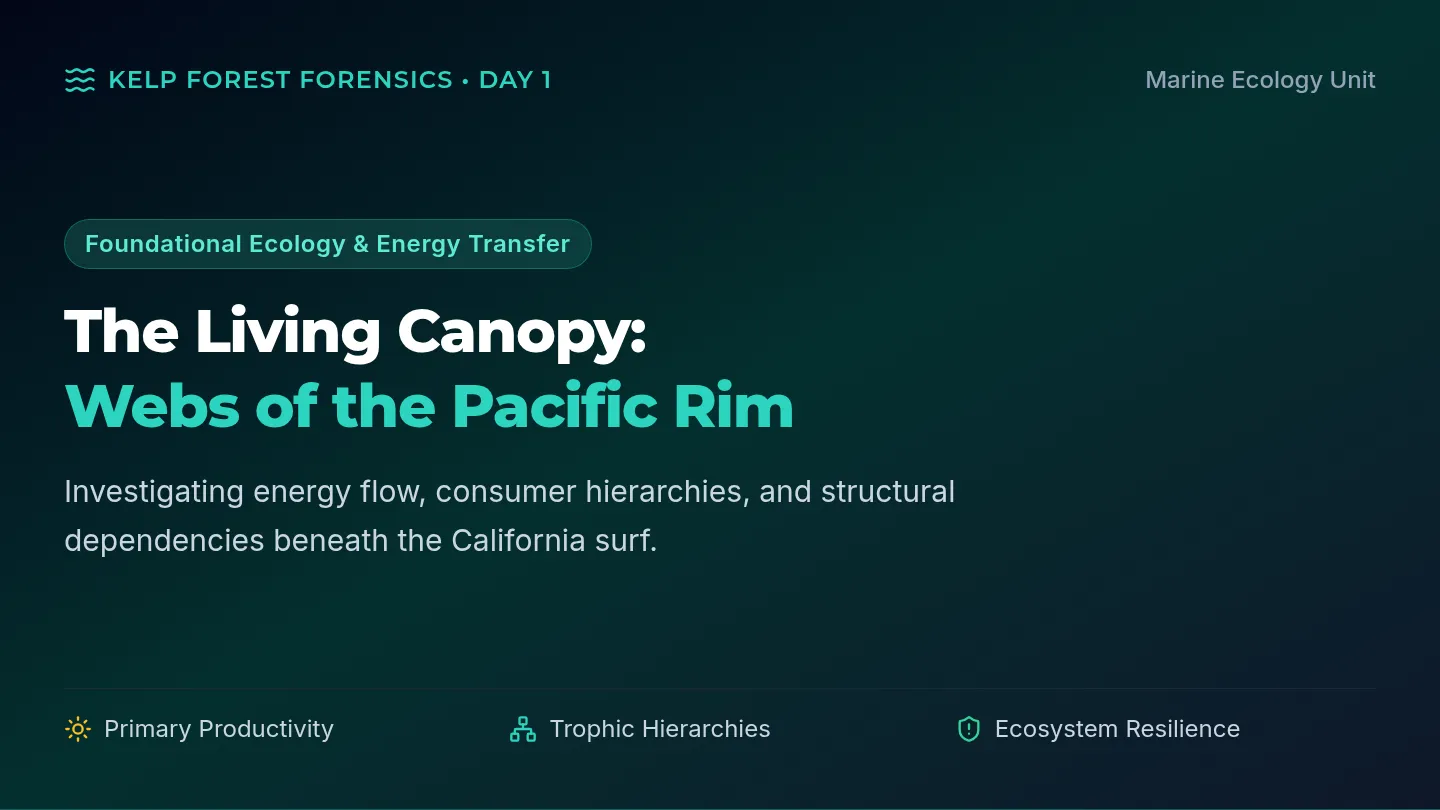
A comprehensive 3-day investigative life science sequence exploring trophic cascades, keystone species, and ecological balance in Pacific kelp forests. Students examine authentic ecological data to diagnose ecosystem collapse and design science-backed restoration policies.
Calculation: If the Giant Kelp bed fixes 250,000 kcal/m² of solar energy per year, calculate the maximum theoretical energy available to:
Purple Sea Urchins (10%): kcal/m²
Southern Sea Otters (1%): kcal/m²
Transient Orcas (0.1%): kcal/m²
Predictive Synthesis: What physiological factors cause roughly 90% of energy to be lost between trophic levels?
Unit: Kelp Forest Forensics • Lesson 1: Web of Life Page 2 of 2
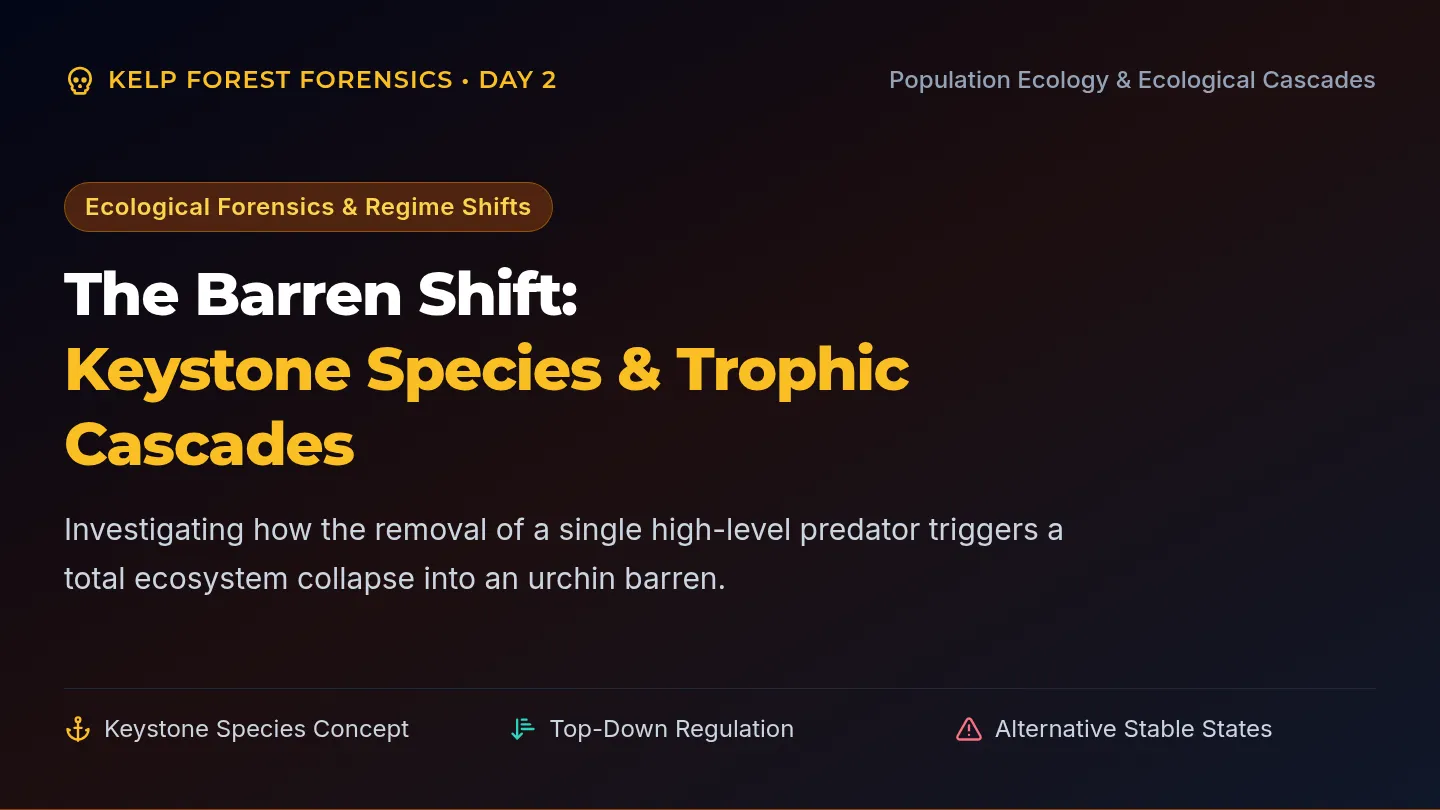
Urchin Barren
Desert-like reef populated only by "zombie" urchins.
⚠️ Warning: Urchins can survive years in a dormant starved state, preventing kelp spores from ever re-establishing.
Investigation Focus: This shift is a classic top-down trophic cascade (+ / - / + effect). Slide 4 of 5
DATA LAB PROTOCOL
Day 2 Investigation
The Barren Mystery:
Quantitative Evidence Analysis
You will examine 35 years of authentic field survey data from coastal California and the Aleutian Islands. Your task is to identify correlation, infer causation, and draft a formal scientific Claim-Evidence-Reasoning (CER) brief.
1. Trend Analysis
Identify the tipping points where kelp cover crashed.
2. Causal Cascade
Map the mathematical relationship between otters and urchins.
3. CER Conclusion
Provide an evidence-based verdict on keystone functionality.
Open your Barren Mystery Lab Reports! Slide 5 of 5
Fill in each box below to trace how a perturbation at the apex level cascades down to primary productivity:
Guiding Prompt: Construct a formal scientific argument answering: "Does the Southern Sea Otter act as a keystone species in maintaining the Pacific giant kelp forest ecosystem?"
1. Scientific Claim (Direct, clear answer to the investigative prompt): 1 concise sentence
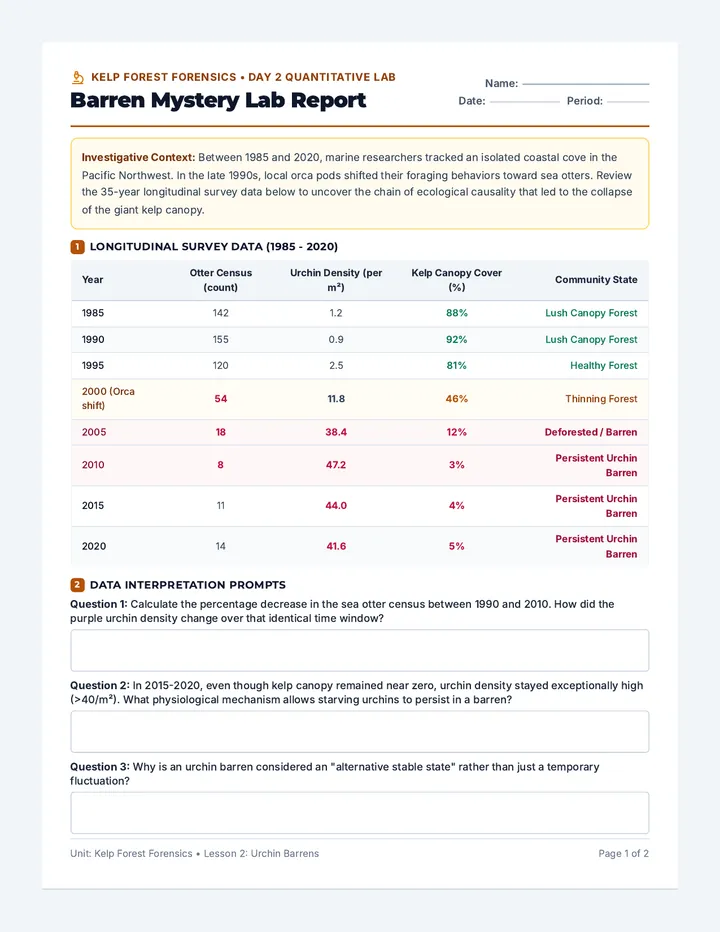
2. Quantitative Evidence (Cite specific numerical data points and years from the table): Include exact figures
3. Ecological Reasoning (Connect your evidence to keystone principles and trophic cascades): Explain the underlying mechanism
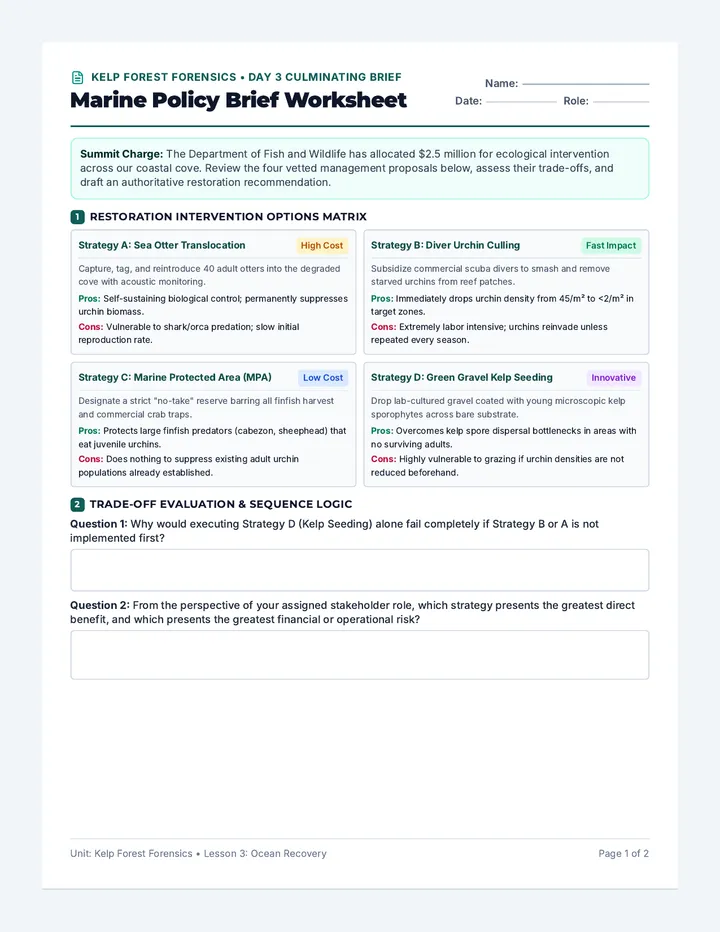
Require integration of both a biological control mechanism (predation) and a physical restoration component (grazer removal or kelp spore outplanting) with budget constraints.
Extension / Advanced:
Task students with modeling the effect of marine heatwaves (e.g., "The Blob" 2014-2016) on their proposed restoration policy and calculating annual carbon sequestration credits.
4 Target Misconceptions & Questioning Prompts
Misconception: "If we just plant more kelp, the forest will instantly regrow."
Correction Prompt: "Look back at the urchin density table. What will 45 starving urchins per square meter do to newly planted spores overnight before they can reproduce?"
Misconception: "Urchins are villains and should be completely eradicated from California."
Correction Prompt: "What was the urchin density during the healthy 1985-1990 baseline? Why is a moderate herbivore population essential for reef biodiversity and food webs?"
5 Culminating Policy Brief Scoring Rubric
Domain
Exemplary (4)
Proficient (3)
Developing (2)
Trophic Mechanism
Explicitly articulates top-down cascade and keystone regulation mechanics.
Identifies predator-prey relationship and urchin grazing reduction.
Vague mention of food chains without causal connection.
Data Integration
Directly incorporates baseline metrics (1985 vs 2010) to justify benchmarks.
References numbers from the lab data table accurately.
Relies on general assertions without numerical backing.
Feasibility & Trade-offs
Balancing ecological impact with cost, logistics, and stakeholder concerns.
Acknowledges at least one limitation or trade-off of the plan.
Presents an unrealistic solution without addressing hurdles.