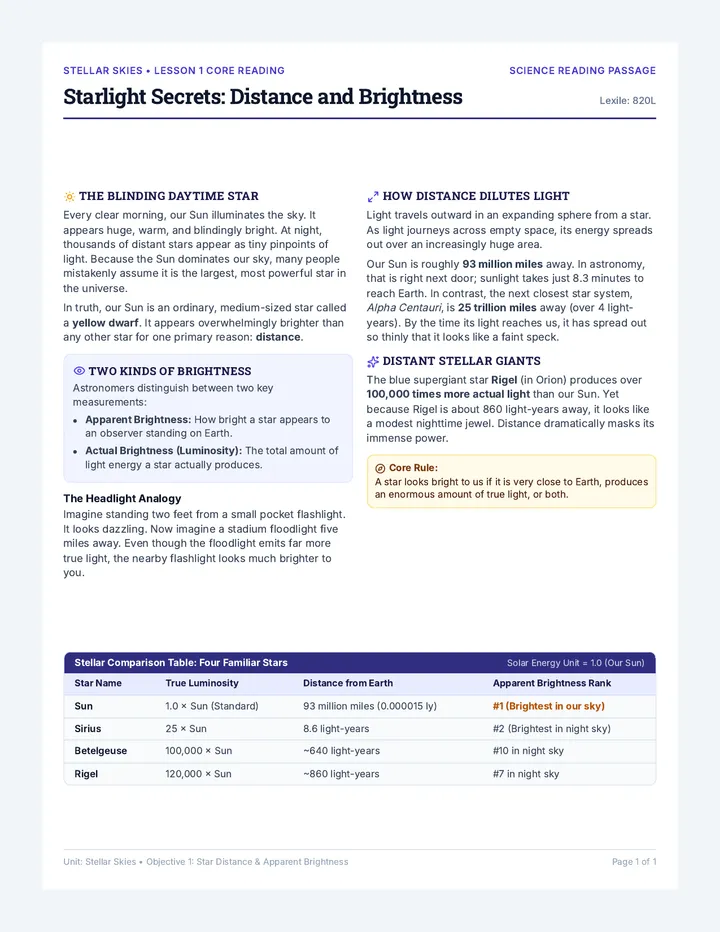
Starlight Secrets Reading Passage Stellar Skies • Lesson 1 Core Reading Science Reading Passage
Starlight Secrets: Distance and Brightness
Lexile: 820L
The Blinding Daytime Star
Every clear morning, our Sun illuminates the sky. It appears huge, warm, and blindingly bright. At night, thousands of distant stars appear as tiny pinpoints of light. Because the Sun dominates our sky, many people mistakenly assume it is the largest, most powerful star in the universe.
In truth, our Sun is an ordinary, medium-sized star called a yellow dwarf . It appears overwhelmingly brighter than any other star for one primary reason: distance .
Two Kinds of Brightness
Astronomers distinguish between two key measurements:
Apparent Brightness: How bright a star appears to an observer standing on Earth.Actual Brightness (Luminosity): The total amount of light energy a star actually produces.
The Headlight Analogy
Imagine standing two feet from a small pocket flashlight. It looks dazzling. Now imagine a stadium floodlight five miles away. Even though the floodlight emits far more true light, the nearby flashlight looks much brighter to you.
How Distance Dilutes Light
Light travels outward in an expanding sphere from a star. As light journeys across empty space, its energy spreads out over an increasingly huge area.
Our Sun is roughly 93 million miles away. In astronomy, that is right next door; sunlight takes just 8.3 minutes to reach Earth. In contrast, the next closest star system, Alpha Centauri , is 25 trillion miles away (over 4 light-years). By the time its light reaches us, it has spread out so thinly that it looks like a faint speck.
Distant Stellar Giants
The blue supergiant star Rigel (in Orion) produces over 100,000 times more actual light than our Sun. Yet because Rigel is about 860 light-years away, it looks like a modest nighttime jewel. Distance dramatically masks its immense power.
Core Rule: A star looks bright to us if it is very close to Earth, produces an enormous amount of true light, or both.
Stellar Comparison Table: Four Familiar Stars Solar Energy Unit = 1.0 (Our Sun)
Star Name True Luminosity Distance from Earth Apparent Brightness Rank Sun 1.0 × Sun (Standard) 93 million miles (0.000015 ly) #1 (Brightest in our sky) Sirius 25 × Sun 8.6 light-years #2 (Brightest in night sky) Betelgeuse 100,000 × Sun ~640 light-years #10 in night sky Rigel 120,000 × Sun ~860 light-years #7 in night sky
Unit: Stellar Skies • Objective 1: Star Distance & Apparent Brightness Page 1 of 1
Starlight Secrets Worksheet Stellar Skies • Lesson 1 Reading Assessment (10 Questions)
Starlight Secrets Worksheet
Name: Date:
Part 1: Key Concept Multiple Choice Circle the best answer for each question
1. Why does our Sun appear brighter than any other star visible from Earth?
A) It is the largest supergiant star in the Milky Way.
B) It is vastly closer to Earth than any other star.
C) It produces more actual light energy than Rigel.
D) Earth's atmosphere magnifies its light rays.
2. What is the definition of "apparent brightness"?
A) The actual energy a star generates at its core.
B) The surface temperature and color of a star.
C) How bright a star appears to an observer on Earth.
D) The physical diameter and volume of a star.
3. As light travels across empty space, what happens to its energy?
A) It spreads out over an increasingly large area.
B) It speeds up and concentrates into a narrow beam.
C) It changes from white light into radio waves.
D) It gains brightness the farther it travels.
4. Astronomers classify our Sun as which type of star?
A) Blue Supergiant
B) Red Giant
C) Yellow Dwarf
D) White Dwarf
Part 2: Star Data Analysis (Refer to Table in Reading) Short answer / fill-in
5. Which star has the greatest true luminosity ?
6. Which star is the brightest in our night sky?
7. Distance to the Sun vs. Alpha Centauri:
Part 3: Scientific Explanations & Applications
8. Compare & Contrast: Rigel produces 120,000 times more light energy than the Sun, yet the Sun lights up our entire day while Rigel is a small dot at night. Explain why.
9. The Headlight Analogy: How does comparing a pocket flashlight held up close to a distant stadium floodlight help someone understand apparent brightness?
10. Prediction Challenge: Star A and Star B produce the exact same amount of true light. If Star B is moved 10 times farther away from Earth than Star A, how will their apparent brightness compare?
Unit: Stellar Skies • Starlight Secrets Worksheet • Score: _____ / 10 Page 1 of 1
Flashlight Distance Activity Stellar Skies • Lesson 1 Visual Investigation Replaces Video Component • 5 Analysis Questions
Flashlight Distance Activity
Name: Date:
The Flashlight Beam Test: A Model for Star Brightness
To see how distance changes the way our eyes receive light, imagine testing a single flashlight in a dark room against a white wall at three distinct distances:
Position 1: 1 Foot Away
Intense
Light concentrated in a small circle. Very bright to observer.
Position 2: 4 Feet Away
Moderate
Circle expands to 4× the area. Light spreads thinner.
Position 3: 12 Feet Away
Faint Glow
Light is diluted over a huge space. Spot appears very dim.
Key Observation: The flashlight's bulb never changed its actual power output. The amount of light produced was constant, but because the beam spread out across space, the light hitting any single square inch became much weaker.
Investigation Questions (5 Questions) Answer based on the visual model and text above
1. Did the flashlight produce more total light energy at 1 foot than it did at 12 feet? Explain what remained constant.
2. Why did the circle on the wall appear so much dimmer when the flashlight was moved farther back?
3. In this model, which represents a star's actual brightness (luminosity) , and which represents its apparent brightness ?
4. If you had a tiny penlight at 1 foot and a heavy work spotlight at 100 feet, which could have a higher apparent brightness to you? Why?
5. Connect to Earth: How does this experiment explain why our Sun looks like a huge radiant ball while massive stars like Rigel look like tiny specks?
Unit: Stellar Skies • Flashlight Distance Activity • Score: _____ / 5 Page 1 of 1
Starlight Secrets Teacher Guide Stellar Skies • Lesson 1 Facilitation Guide Teacher Resource & Answer Keys
Starlight Secrets Teacher Guide
45-Minute Lesson
Learning Objective
Students will explain the relationship between a star's distance from Earth and how bright it appears, distinguishing between apparent and actual brightness (luminosity).
45-Minute Pacing Schedule
00–05 min: Hook — "Is the Sun our biggest star?"05–20 min: Core Reading Passage & 10-Question Worksheet20–35 min: Flashlight Visual Activity (5 Questions)35–45 min: Class Review, Synthesis, & Exit Check
Misconception Alert:
Students frequently assume the brightest stars in the night sky must be the biggest or closest. Clarify that apparent brightness is a product of both actual light output and distance: a modest star nearby can outshine a colossal hypergiant located light-centuries away.
Complete Answer Keys Grading & Discussion Guidance
Part A: Reading Worksheet (10 Qs)
B — It is vastly closer to Earth than any other star.C — How bright a star appears to an observer on Earth.A — It spreads out over an increasingly large area.C — Yellow Dwarf.Rigel (120,000× Sun luminosity).Sirius (Apparent rank #2 overall, #1 in night sky).93 million miles (Sun) vs. 25 trillion miles (Alpha Centauri).Sample: Rigel produces vastly more light, but its light travels 860 light-years and spreads extremely thin across space, whereas the Sun is only 8 light-minutes away.Sample: A small nearby light can seem brighter to human eyes than a massive beacon miles away because distance dilutes the distant light.Sample: Star B will appear significantly dimmer (1/100 as bright) because the light spreads out over a much greater distance.
Part B: Flashlight Activity (5 Qs)
No. The flashlight produced the same amount of light energy; the battery and bulb power remained constant.Spread / Dilution. Because the beam spreads out into a much larger circular patch, fewer light rays hit each square inch of the wall.
Sky Wheels Reading Passage Stellar Skies • Lesson 2 Core Reading Science Reading Passage
Sky Wheels: Rotation and Revolution
Lexile: 840L
The Nightly Carousel: Rotation
If you look at the stars at 8:00 PM and return at 2:00 AM, the night sky looks completely rearranged. Stars that were low on the eastern horizon have climbed high overhead, while stars that were high overhead have sank toward the west.
This nightly movement is an illusion. The stars are not racing across space; rather, Earth is spinning on its internal axis . This spinning motion is called rotation .
Earth rotates from west to east once every 24 hours . Because we are riding on this spinning sphere, celestial objects seem to travel in the opposite direction—rising in the east and setting in the west. In the Northern Hemisphere, the star Polaris (the North Star) sits directly above Earth's axis of spin, so all other stars appear to wheel counterclockwise around it throughout the night.
The Nightly Horizon Shift
As Earth rotates during the night, your local horizon tilts. New constellations gradually roll up into view in the east, while earlier constellations sink beneath the western horizon. A star visible at 9:00 PM may dip below the horizon before dawn.
The Cosmic Track: Revolution
While Earth spins daily like a top, it also travels in a giant orbit around the Sun. This orbital journey is called revolution and takes approximately 365.25 days (one full year).
During any given 24-hour day, we can only see nighttime stars when our side of Earth faces away from the Sun into the dark expanse of space. Because Earth is constantly moving along its yearly orbital path around the Sun, our nighttime window points toward a different region of the galaxy each month.
Seasonal Constellations
In the winter months (such as January), Earth's night side points toward the constellation Orion the Hunter . But six months later in July, Earth has moved halfway around the Sun. Now, Earth's night side points toward Scorpius the Scorpion .
Where is Orion in July? Orion is still there, but it is located in the daytime sky! The brilliant light from our nearby Sun completely overwhelms Orion's distant stars, making them invisible to us until winter returns.
Remember the Golden Rule: Rotation causes stars to shift across the sky hour by hour each night . Revolution causes different constellations to appear season by season each year .
Quick Reference: Earth's Two Cosmic Motions Comparing Rotation vs. Revolution
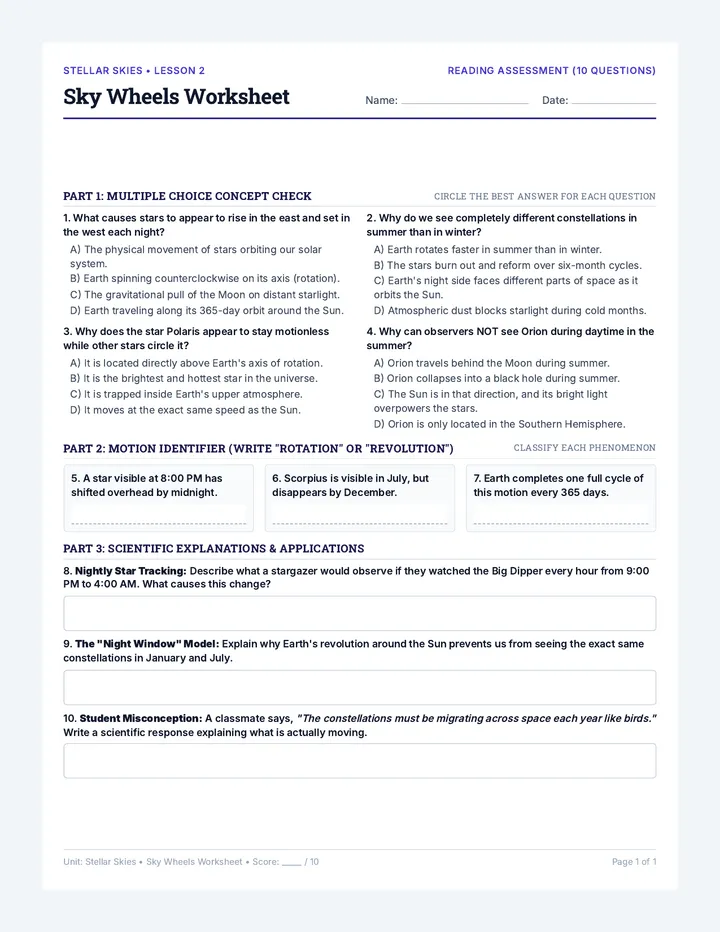
Sky Wheels Worksheet Stellar Skies • Lesson 2 Reading Assessment (10 Questions)
Sky Wheels Worksheet
Name: Date:
Part 1: Multiple Choice Concept Check Circle the best answer for each question
1. What causes stars to appear to rise in the east and set in the west each night?
A) The physical movement of stars orbiting our solar system.
B) Earth spinning counterclockwise on its axis (rotation).
C) The gravitational pull of the Moon on distant starlight.
D) Earth traveling along its 365-day orbit around the Sun.
2. Why do we see completely different constellations in summer than in winter?
A) Earth rotates faster in summer than in winter.
B) The stars burn out and reform over six-month cycles.
C) Earth's night side faces different parts of space as it orbits the Sun.
D) Atmospheric dust blocks starlight during cold months.
3. Why does the star Polaris appear to stay motionless while other stars circle it?
A) It is located directly above Earth's axis of rotation.
B) It is the brightest and hottest star in the universe.
C) It is trapped inside Earth's upper atmosphere.
D) It moves at the exact same speed as the Sun.
4. Why can observers NOT see Orion during daytime in the summer?
A) Orion travels behind the Moon during summer.
B) Orion collapses into a black hole during summer.
C) The Sun is in that direction, and its bright light overpowers the stars.
D) Orion is only located in the Southern Hemisphere.
Part 2: Motion Identifier (Write "Rotation" or "Revolution") Classify each phenomenon
5. A star visible at 8:00 PM has shifted overhead by midnight.
6. Scorpius is visible in July, but disappears by December.
7. Earth completes one full cycle of this motion every 365 days.
Part 3: Scientific Explanations & Applications
8. Nightly Star Tracking: Describe what a stargazer would observe if they watched the Big Dipper every hour from 9:00 PM to 4:00 AM. What causes this change?
9. The "Night Window" Model: Explain why Earth's revolution around the Sun prevents us from seeing the exact same constellations in January and July.
10. Student Misconception: A classmate says, "The constellations must be migrating across space each year like birds." Write a scientific response explaining what is actually moving.
Unit: Stellar Skies • Sky Wheels Worksheet • Score: _____ / 10 Page 1 of 1
Night Sky Tracker Activity Stellar Skies • Lesson 2 Visual Investigation Replaces Video Component • 5 Analysis Questions
Night Sky Tracker Activity
Name: Date:
Visual Model 1: Nightly Rotation
Looking north, Polaris remains fixed at the center while circumpolar constellations rotate counterclockwise every hour as Earth spins.
8:00 PM Big Dipper: Right
★
Polaris
4:00 AM Big Dipper: Left
Cause: Earth rotates 360° on its axis once every 24 hours.
Visual Model 2: Yearly Revolution
As Earth orbits the Sun, our night side looks out toward completely different cosmic directions at different points in the year.
January (Winter)
Night faces Orion
July (Summer)
Night faces Scorpius
Cause: Earth orbits the Sun once every 365.25 days.
Tracker Investigation Questions (5 Questions) Answer based on the models above
1. Based on Model 1, why does Polaris stay in the exact same spot while the Big Dipper appears to move in a circle around it throughout the night?
2. If you look at the stars at 9:00 PM and again at 3:00 AM, are the stars themselves flying across the galaxy? Explain what motion is actually taking place.
3. In Model 2, why can people on Earth NOT observe Scorpius at night in January? What is Earth's night side facing instead?
4. In July, Orion is still in space, yet we cannot see it. Why can't we see Orion during the day in July?
5. Synthesis: A student states: "Earth's rotation and Earth's revolution do the exact same thing to the stars." Explain how the timeframe and visual effect of each motion are different.
Unit: Stellar Skies • Night Sky Tracker Activity • Score: _____ / 5 Page 1 of 1
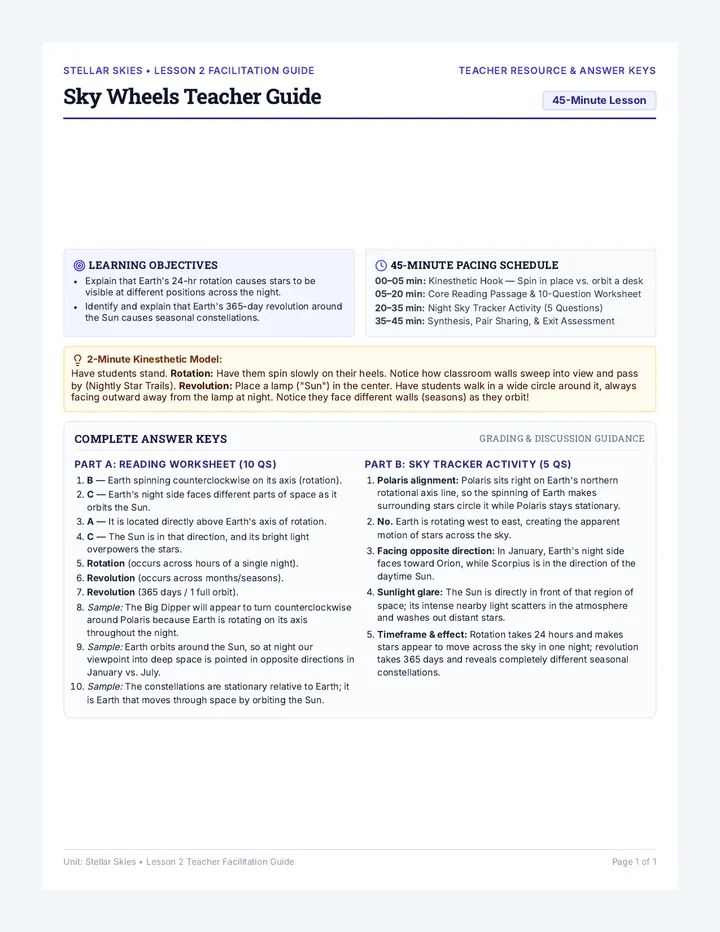
Sky Wheels Teacher Guide Stellar Skies • Lesson 2 Facilitation Guide Teacher Resource & Answer Keys
Sky Wheels Teacher Guide
45-Minute Lesson
Learning Objectives
Explain that Earth's 24-hr rotation causes stars to be visible at different positions across the night.
Identify and explain that Earth's 365-day revolution around the Sun causes seasonal constellations.
45-Minute Pacing Schedule
00–05 min: Kinesthetic Hook — Spin in place vs. orbit a desk05–20 min: Core Reading Passage & 10-Question Worksheet20–35 min: Night Sky Tracker Activity (5 Questions)35–45 min: Synthesis, Pair Sharing, & Exit Assessment
2-Minute Kinesthetic Model:
Have students stand. Rotation: Have them spin slowly on their heels. Notice how classroom walls sweep into view and pass by (Nightly Star Trails). Revolution: Place a lamp ("Sun") in the center. Have students walk in a wide circle around it, always facing outward away from the lamp at night. Notice they face different walls (seasons) as they orbit!
Complete Answer Keys Grading & Discussion Guidance
Part A: Reading Worksheet (10 Qs)
B — Earth spinning counterclockwise on its axis (rotation).C — Earth's night side faces different parts of space as it orbits the Sun.A — It is located directly above Earth's axis of rotation.C — The Sun is in that direction, and its bright light overpowers the stars.Rotation (occurs across hours of a single night).Revolution (occurs across months/seasons).Revolution (365 days / 1 full orbit).Sample: The Big Dipper will appear to turn counterclockwise around Polaris because Earth is rotating on its axis throughout the night.Sample: Earth orbits around the Sun, so at night our viewpoint into deep space is pointed in opposite directions in January vs. July.Sample: The constellations are stationary relative to Earth; it is Earth that moves through space by orbiting the Sun.
Part B: Sky Tracker Activity (5 Qs)
Polaris alignment: Polaris sits right on Earth's northern rotational axis line, so the spinning of Earth makes surrounding stars circle it while Polaris stays stationary.