Lenny.com
Explore
Create
ActivitiesNewMathEnglish Language ArtsScience & EngineeringSocial StudiesGlobal LanguagesHealth & Physical EducationSpecial EducationCounseling & Life SkillsArts & CreativityESL
Lenny.com
Lenny.com
Explore
Create
ActivitiesNewMathEnglish Language ArtsScience & EngineeringSocial StudiesGlobal LanguagesHealth & Physical EducationSpecial EducationCounseling & Life SkillsArts & CreativityESL
Lenny.com
Lenny.com

Solutions

Lenny for EducatorsLenny for SchoolsLenny for Districts

Product

ExploreSign inCreateSupportAbout

Resources

Getting startedMTSS Acceleration Program

Newsletters

School Funding Newsletter

© 2026 Lenny Learning Inc.

TermsPrivacyAccessibility
LinkedInInstagramX
Lenny
Science & EngineeringLife ScienceLiving ThingsAnimalsPlantsBody SystemsTraitsAdaptationsCellsEcosystemsHeredityGenes to TraitsCell DivisionPhysicsComparing MaterialsShapes and PropertiesMagnetsMagnetismLightSoundLight and SoundMatterStates of MatterChanges of StateMixturesPhysical and Chemical ChangeHeating and CoolingHeat and Thermal EnergyEnergyForce and MotionElectrical CircuitsAtoms and MoleculesPeriodic TableMotion in One DimensionMotion in Two DimensionsScalars and VectorsForces and Laws of MotionCircular Motion and GravityMomentum and ImpulseWork, Energy, and PowerWavesElectromagnetic WavesGeometric OpticsElectricity and MagnetismSimple Harmonic MotionThermodynamicsNuclear PhysicsEarth Science & AstronomyWeatherWater CycleRocks and MineralsFossilsEarth's FeaturesEarth's ResourcesEarth's StructureWeather and ClimateEarth EventsFossils and Geologic TimePlate TectonicsHuman ImpactsAstronomyChemistryUnits and MeasurementAtomic StructurePeriodic TrendsChemical BondingNomenclatureMolecular StructureIntermolecular ForcesThe MoleStoichiometryProperties of GasesSolutionsChemical ReactionsBalancing EquationsEnergy ChangesRates of ReactionsEquilibriumAcids and BasesQuantum ModelBiologyClassificationCell StructureThe Chemistry of LifeBiomoleculesCellular TransportCell EnergyCell Growth and DivisionDNAProtein SynthesisMeiosis and Sexual ReproductionPatterns of InheritanceMulticellular OrganismsEvolutionEcologyBiodiversityComputer ScienceAlgorithms and Computational ThinkingProgramming LanguagesComputing SystemsNetworks and InternetData AnalysisCybersecurityAI and Machine LearningSoftware Design and DevelopmentBlockchainEngineering & AIDesigning ExperimentsEngineering PracticesDesign ThinkingEngineering Design ProcessMechanical EngineeringElectrical EngineeringMaterials and StructuresCAD and 3D DesignRoboticsArtificial Intelligence BasicsVibe CodingMachine LearningAI Ethics and SocietySystems ThinkingEntrepreneurship & InnovationEntrepreneurial MindsetBusiness Idea DevelopmentBusiness Plan BasicsMarketing & Customer DiscoveryFinancial Management for Startups

Curriculum Unlocked

A sequence of high-interest, accessible 9th-grade reading lessons designed for students reading at a 5th-grade level across science and world history.

SHSarah Hunter
Motion Unlocked

A comprehensive physical science reading lesson introducing reference points, speed, and velocity for 9th-grade students reading at a 5th-grade level, featuring accessible high-interest texts, visual supports, and tiered comprehension tasks.

Evolution Unlocked

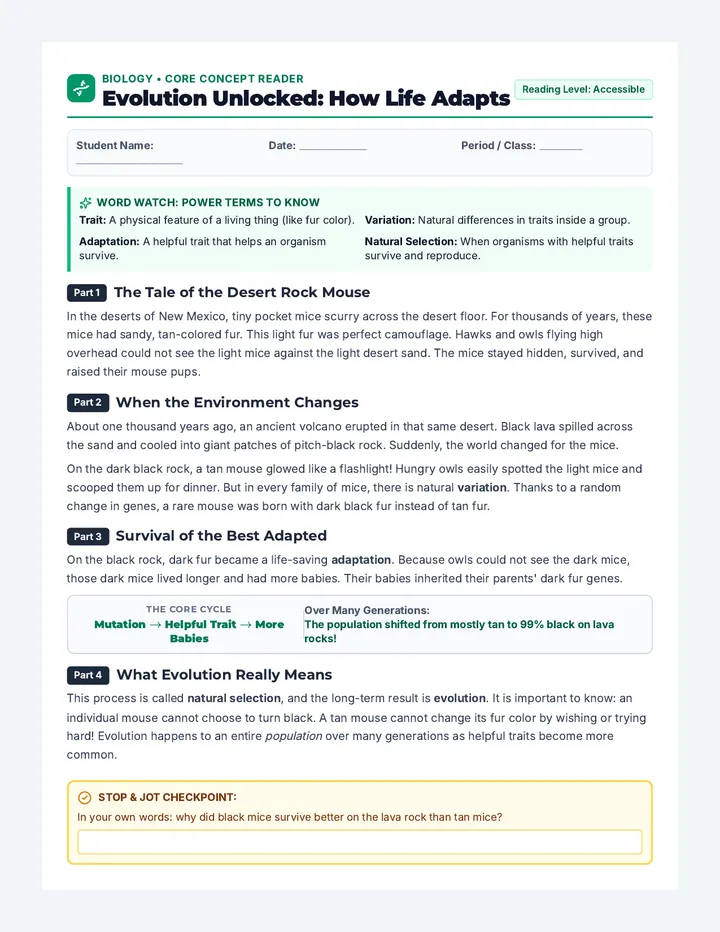
An accessible 9th-grade biology reading lesson exploring natural selection, adaptation, and variation for students reading at a 5th-grade level, complete with guided text and scaffolded comprehension tasks.

Two Medieval Worlds

An accessible 9th-grade world history reading lesson comparing and contrasting feudal Europe during the Middle Ages with the Islamic Golden Age in the Middle East for students reading at a 5th-grade level.

Curriculum Unlocked

A sequence of high-interest, accessible 9th-grade reading lessons designed for students reading at a 5th-grade level across science and world history.

SHSarah Hunter

Think: If two cars go 60 mph in opposite directions, their speed is the same, but velocities are different!


Student Mission Slide 6 of 6

Today's Reading & Practice Mission

Step 1

Read & Track

Read Page 1 with your partner. Circle the 4 bold power words as you encounter them.

Step 2

Stop & Jot

Pause at the bottom of Page 1. Name one classroom reference point before flipping the page.

Step 3

Solve & Check

Complete the matching, short answers, and the two speed math problems on Page 2.

Partner Time: 18 Minutes Raise hands if you need a formula clue!

  • • "If two runners travel at 8 m/s, do they necessarily have the same velocity?" (No; they could be running in opposite directions.)
  • Motion Unlocked Facilitator Guide • Page 1 of 2 Physical Science Curriculum Series

    Answer Key & Teacher Assessment Rubric

    Teacher Copy • Page 2 of 2

    Task 1: Vocabulary Match Key

    • 1. Reference Point \(\rightarrow\) [ D ] A still object used to check if something moved.
    • 2. Motion \(\rightarrow\) [ B ] A change in an object's position over time.
    • 3. Speed \(\rightarrow\) [ A ] Distance traveled divided by time.
    • 4. Velocity \(\rightarrow\) [ C ] Speed in a specific direction (e.g., 20 mph East).

    Task 2: Text Evidence Key

    5. Why still objects are better reference points:

    A still object doesn't change position. If the reference point itself moves, you cannot tell if you are moving or if the reference point is moving.

    6. Difference & Velocity identification:

    "60 mph" gives only speed. "60 mph West" gives speed plus direction, which makes it velocity.

    Task 3 & 4: Scenarios & Speed Calculations Key

    Scenario 1 (Maya on Plane):

    • Compared to seat: YES, she is in motion because her distance/position from the seat is changing as she walks.

    • Compared to house on ground: YES, she is moving very fast (over 500 mph) because the plane is moving across the Earth.

    Scenario 2 (Runners):

    Runner A had greater speed. Runner A: \(100 \div 20 = 5\text{ m/s}\). Runner B: \(100 \div 25 = 4\text{ m/s}\). Covering the same distance in fewer seconds means higher speed.

    Problem 7 (Soccer Ball):

    \(\text{Speed} = 30\text{ m} \div 6\text{ s} = \mathbf{5\text{ m/s}}\)

    Problem 8 (School Bus):

    \(\text{Speed} = 120\text{ mi} \div 3\text{ hr} = \mathbf{40\text{ mph}}\)

    Common Student Misconceptions & How to Address Them

    Misconception 1: "Motion is absolute." Students think an object is either moving or not moving universally.
    Fix: Remind students of the bus passenger vs. sidewalk observer.

    Misconception 2: "Speed and velocity are identical." Students drop direction.
    Fix: Ask if an evacuation warning would be useful if it only gave hurricane speed without compass direction.

    Misconception 3: "More time means faster." In Problem 2, students might guess 25s is faster because 25 is bigger than 20.
    Fix: Reframe as a race: smaller time wins!

    Formative Exit Ticket & 3-Tier Rubric

    Exit Ticket Prompt: "Give one example of an object moving at a high speed but zero velocity relative to its passenger."

    Proficient (3 pts) Identifies passenger on a plane/train/car; explains passenger moves relative to Earth but not relative to seat.

    Developing (2 pts) Names a moving vehicle but fails to clearly distinguish the two different reference points.

    Emerging (1 pt) Describes an object moving fast without referencing reference points or relative position.

    Motion Unlocked Facilitator Guide • Page 2 of 2 Physical Science Curriculum Series

    Comprehension & Practice Check

    Student Name: ________________________

    Task 1

    Vocabulary Match

    (Match each word to its description by writing the correct letter)

    1. Trait

    2. Variation

    3. Adaptation

    4. Natural Selection

    A. A helpful feature that improves survival.

    B. Physical characteristic passed from parent to offspring.

    C. Process where individuals with helpful traits have more offspring.

    D. Differences in traits among individuals of the same species.

    Task 2

    Reading Comprehension & Text Evidence

    5. According to the text, can a single tan mouse decide to turn black during its lifetime? Explain why or why not using evidence from Part 4.

    6. What role did predators (owls and hawks) play in causing the mouse population to evolve dark fur on the lava rock?

    Task 3

    Real-World Biology Scenarios

    Scenario: The Peppered Moth
    Before factories were built in England, tree trunks were pale and covered with lichen. Most peppered moths had speckled white wings. When factories began burning coal, black soot covered the tree trunks.

    Which moth color had the advantage on soot-covered trees? Explain:

    What happened to the number of dark moths over 50 years? Explain:

    Task 4

    Sequence the Story of Evolution

    (Put the steps in order from 1 to 4 by writing numbers in the boxes)

    Dark mice live longer and reproduce, passing the dark fur gene to their babies.

    A volcano covers light desert sand with dark black lava rock.

    A random gene mutation causes a mouse to be born with dark fur.

    Over many generations, nearly all the mice living on the black lava rock have dark fur.

    Self-Check: How well do you understand natural selection? 1 (Need Help) 2 (Getting There) 3 (Got It!)

    Biology Unit 3

    4. Pass

    Offspring

    Survivors pass helpful traits to their babies!

    Remember: Individuals do NOT evolve in their lifetimes. Populations evolve over generations!


    Student Mission Slide 6 of 6

    Today's Reading & Practice Mission

    Step 1

    Read & Track

    Read Page 1 with your partner. Circle the 4 bold power words in the Word Watch box.

    Step 2

    Stop & Jot

    Pause at the bottom of Page 1. Write why black mice survived better before flipping the page.

    Step 3

    Solve & Check

    Complete the vocabulary match, short answers, peppered moth scenario, and sequence tasks.

    Partner Time: 18 Minutes Think: How did the environment change?

  • • "What would happen to the black mice if a flood washed away the lava rock and exposed yellow sand again?" (Owls would start spotting the black mice; tan mice would survive better, reversing the trait frequency.)
  • Evolution Unlocked Facilitator Guide • Page 1 of 2 Biology Curriculum Series

    Answer Key & Teacher Assessment Rubric

    Teacher Copy • Page 2 of 2

    Task 1: Vocabulary Match Key

    • 1. Trait \(\rightarrow\) [ B ] Physical characteristic passed from parent to offspring.
    • 2. Variation \(\rightarrow\) [ D ] Differences in traits among individuals of same species.
    • 3. Adaptation \(\rightarrow\) [ A ] Helpful feature that improves survival.
    • 4. Natural Selection \(\rightarrow\) [ C ] Process where individuals with helpful traits reproduce more.

    Task 2: Text Evidence Key

    5. Can a single mouse choose to turn black?

    No. The text states an individual mouse cannot change its fur color by wishing or trying hard. Evolution happens to populations across generations through inherited genes.

    6. Role of predators (owls & hawks):

    Predators act as the "selecting force." By eating the tan mice that stick out on black rock, they allow dark mice to survive and reproduce.

    Task 3 & 4: Scenarios & Sequence Key

    Scenario: Peppered Moth Key:

    • Advantage: Dark moths had the advantage because the tree trunks were covered with dark coal soot, allowing them to camouflage from hungry birds.

    • Population shift: The number of dark moths increased dramatically while light moths decreased, because dark moths survived and laid more eggs.

    Task 4: Correct Chronological Order (1 to 4):

    [ Step 1 ] A volcano covers light desert sand with dark black lava rock.

    [ Step 2 ] A random gene mutation causes a mouse to be born with dark fur.

    [ Step 3 ] Dark mice live longer and reproduce, passing the dark fur gene to babies.

    [ Step 4 ] Over many generations, nearly all the mice on black lava rock have dark fur.

    Common Student Misconceptions & How to Address Them

    Misconception 1: "Organisms adapt on purpose." Students think mice change color because they "needed to."
    Fix: Stress that the dark mutation was an accident of DNA that happened to be helpful.

    Misconception 2: "Survival of the strongest." Students assume 'fittest' means biggest, meanest, or most muscular.
    Fix: In biology, 'fit' means best suited to survive and have babies (like camouflage).

    Misconception 3: "Evolution is instantaneous." Students expect to watch an animal morph like a cartoon.
    Fix: Use the timeline of generations: mouse parents \(\rightarrow\) babies \(\rightarrow\) grandbabies.

    Formative Exit Ticket & 3-Tier Rubric

    Exit Ticket Prompt: "Explain why evolution happens to an entire population over generations rather than to a single organism during its lifetime."

    Proficient (3 pts) States that individuals cannot change their genes/traits; explains that trait shifts occur as survivors reproduce across generations.

    Developing (2 pts) Recognizes that babies inherit traits, but implies an individual can slightly adapt during its own lifetime.

    Emerging (1 pt) Claims animals change colors or shapes whenever they need to survive.

    Evolution Unlocked Facilitator Guide • Page 2 of 2 Biology Curriculum Series

    Student Name: ________________________

    Task 1

    Vocabulary Match

    (Write the correct letter in each box)

    1. Feudalism

    2. Serf

    3. Caliphate

    4. Golden Age

    A. A period of high scientific achievement, wealth, and large cities.

    B. A peasant farmer tied to work on a lord's estate.

    C. A vast empire governed by a leader called a caliph.

    D. A social system trading land for loyalty and military service.

    Task 2

    Reading Comprehension & Text Evidence

    5. According to the text, why did Baghdad become a world center of learning while European towns had very few books?

    6. Describe how the daily life of a European serf differed from a merchant or scholar living in Baghdad.

    Task 3

    Side-by-Side Comparison Matrix

    CategoryWestern Europe (Middle Ages)Middle East (Islamic Golden Age)
    Government System

    | | Cities & Population |

    |

    | | Learning & Science |

    |

    |

    Task 4

    Historical Connection

    7. How did trade and contact between Europe and the Middle East during the Middle Ages help prepare Europe for the later Renaissance?

    Self-Check: How clearly can you compare these two medieval worlds? 1 (Need Help) 2 (Getting There) 3 (Got It!)

    World History Unit 4

    Feature

    Medieval Europe

    Islamic Middle East

    Government

    Feudalism (Kings, Lords, Knights)

    Caliphate (Caliph, Unified Empire)

    Cities & Trade

    Small rural towns; local barter

    Huge cities; Silk Road trade hubs

    Books & Learning

    Monastery scribes; rare parchment

    Vast libraries; paper; universities

    Takeaway: Preserving Greek and Roman ideas in Arabic helped birth the European Renaissance!


    Student Mission Slide 6 of 6

    Today's Reading & Practice Mission

    Step 1

    Read & Track

    Read Page 1 with your partner. Underline the contrasting details about European and Middle Eastern cities.

    Step 2

    Stop & Jot

    Pause at the bottom of Page 1. Decide whether you would visit London or Baghdad in 1000 CE and why.

    Step 3

    Compare & Contrast

    Complete the vocabulary match, evidence responses, and the comparison matrix on Page 2.

    Partner Time: 18 Minutes Look back at the text for city populations!

  • • "Why was the invention and spread of paper so revolutionary compared to writing on animal skin parchment?" (Paper was far cheaper and faster to produce, allowing ordinary scholars and libraries to own hundreds of books.)
  • Two Medieval Worlds Facilitator Guide • Page 1 of 2 World History Curriculum Series

    Answer Key & Teacher Assessment Rubric

    Teacher Copy • Page 2 of 2

    Task 1: Vocabulary Match Key

    • 1. Feudalism \(\rightarrow\) [ D ] System trading land for loyalty and military service.
    • 2. Serf \(\rightarrow\) [ B ] Peasant farmer tied to work on lord's estate.
    • 3. Caliphate \(\rightarrow\) [ C ] Vast empire governed by a caliph.
    • 4. Golden Age \(\rightarrow\) [ A ] Period of high scientific achievement and wealth.

    Task 2: Text Evidence Key

    5. Why Baghdad became learning center:

    Baghdad built the House of Wisdom, paid scholars to translate world knowledge, had affordable paper, and had a wealthy central government promoting science.

    6. Serf life vs. Baghdad resident:

    A serf was bound to rural farmland doing backbreaking labor with no reading skills. A Baghdad citizen had access to paved lit streets, public hospitals, bustling markets, and libraries.

    Task 3: Side-by-Side Comparison Matrix Key

    CategoryWestern EuropeMiddle East (Islamic Golden Age)
    GovernmentFeudal system; divided kingdoms ruled by lords and kingsCaliphate; unified empire governed by a central caliph
    CitiesSmall, muddy towns (e.g., London: ~15,000); rural farming manorsVast metropolis (Baghdad: 1,000,000+); paved roads, public hospitals
    LearningRare handwritten books in monasteries; very low literacyHouse of Wisdom; vast paper libraries; algebra, astronomy, medicine

    Common Student Misconceptions & How to Address Them

    Misconception 1: "The Dark Ages were worldwide." Students think every civilization on Earth collapsed.
    Fix: Emphasize that while Europe struggled, Baghdad, Cordoba, and Cairo were flourishing.

    Misconception 2: "Total isolation." Students assume medieval people never met outsiders.
    Fix: Point out the Silk Road trade routes carrying silk, paper, spices, and scientific books.

    Misconception 3: "Europe created algebra and modern medicine alone."
    Fix: Show how European doctors and universities relied directly on Ibn Sina's medical textbooks.

    Formative Exit Ticket & 3-Tier Rubric

    Exit Ticket Prompt: "Why is calling the years 500 to 1200 CE the 'Dark Ages' inaccurate when looking at world history as a whole?"

    Proficient (3 pts) Explicitly contrasts European rural stagnation with the Islamic Golden Age in Baghdad, mentioning science, cities, or libraries.

    Developing (2 pts) Mentions that the Middle East had cities or scholars, but does not clearly articulate why the 'Dark Age' label is Eurocentric.

    Emerging (1 pt) Only describes castles or knights without acknowledging the Middle East.

    Two Medieval Worlds Facilitator Guide • Page 2 of 2 World History Curriculum Series
    You might also like

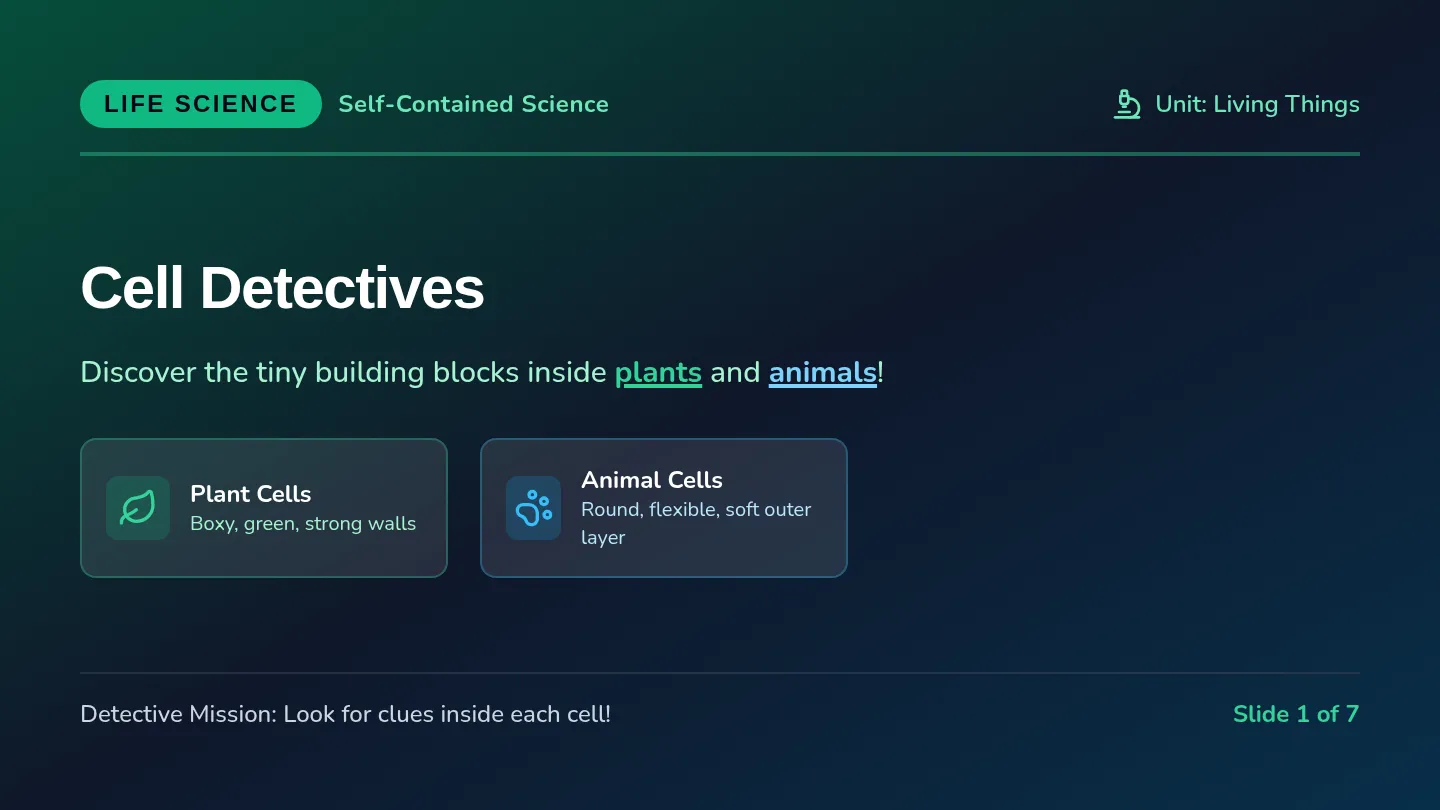
    Cell Detectives Slides

    Cell Explorers

    A foundational life science unit for self-contained learners exploring the microscopic world of cells, organelle jobs, and how specialized cells work in teams to build living things.

    CF

    Carissa Fenner

    8
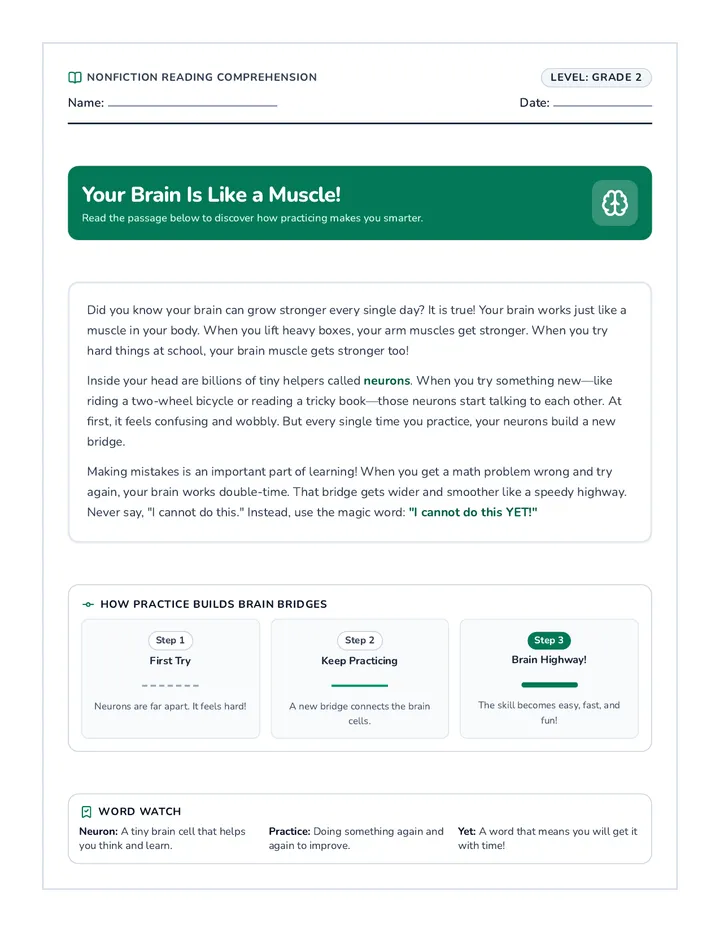
    Practice Power Grade 2 Worksheet

    Practice Power

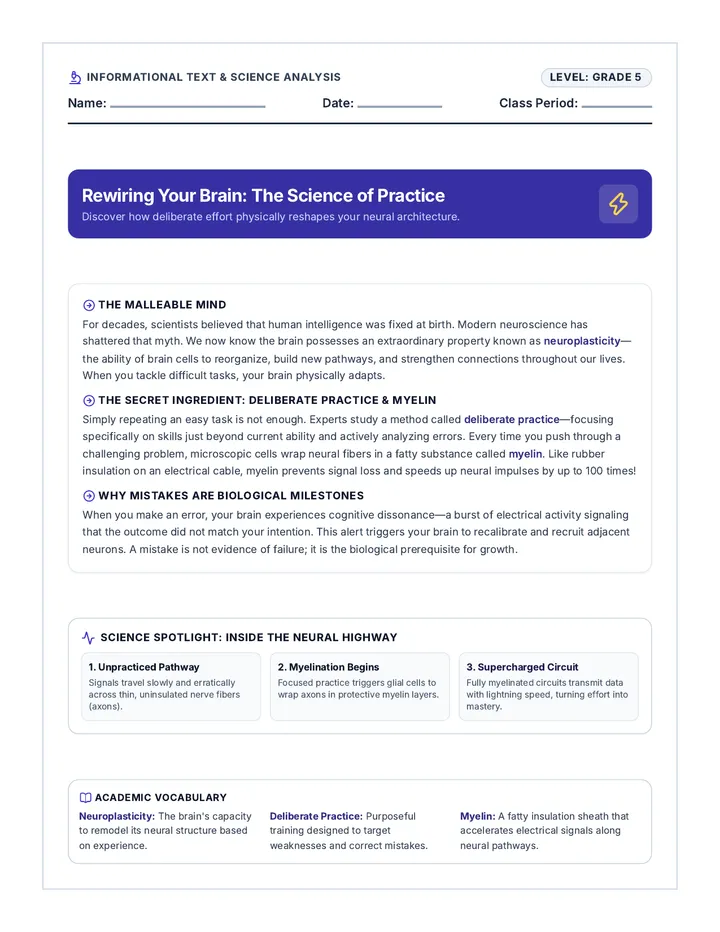
    A differentiated reading comprehension set exploring the science of neuroplasticity, deliberate practice, and perseverance for 2nd and 5th grade students.

    KS

    Kathleen Suther

    3
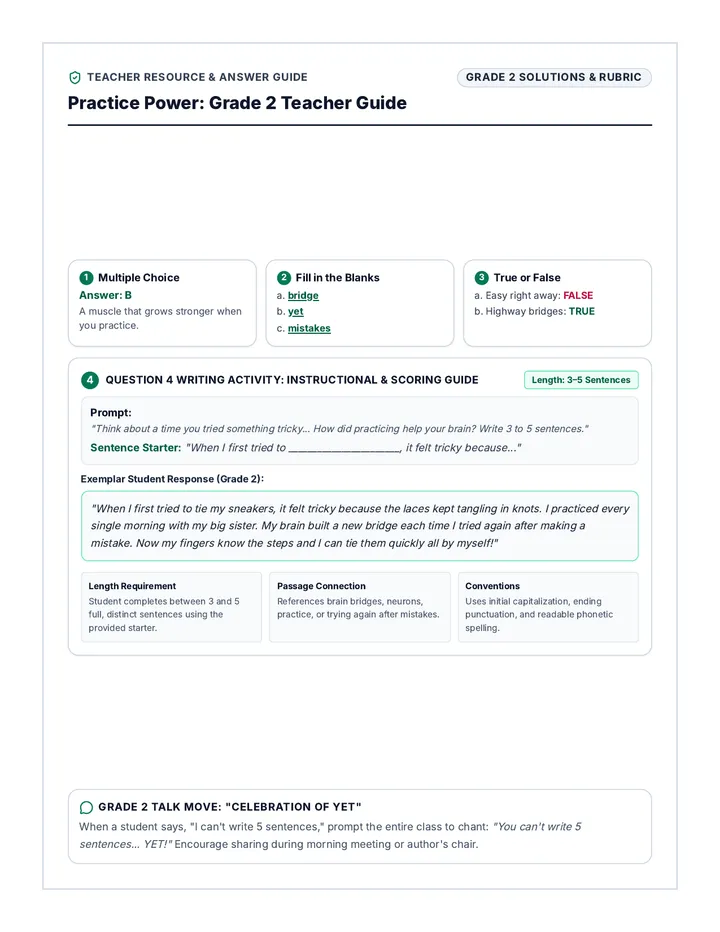
    Practice Power Answer Key

    Practice Power Answer Key

    A printer-friendly teacher answer key and scoring guide on white background providing solutions for questions 1-3 and rubrics with exemplar responses for the 3-5 sentence writing activities.

    KS

    Kathleen Suther

    Cell Foundations Slides

    Cell City Quest

    A two-part life science sequence exploring cell theory, cellular architecture, and organelle functions through the lens of a bustling microscopic city. Students progress from fundamental cell characteristics to intricate organelle operations across two interactive class sessions.

    CP

    Carmen Pavlovsky

    7
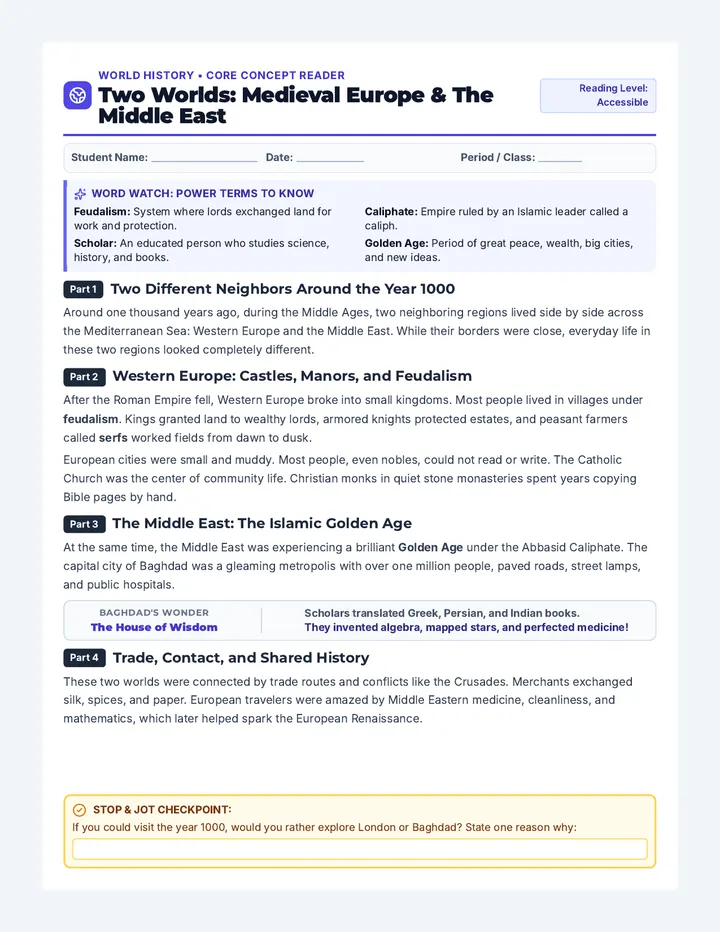
    Two Medieval Worlds Reading Packet

    Two Medieval Worlds

    An accessible 9th-grade world history reading lesson comparing and contrasting feudal Europe during the Middle Ages with the Islamic Golden Age in the Middle East for students reading at a 5th-grade level.

    SH

    Sarah Hunter

    3
    Practice Power Grade 5 Worksheet

    Practice Power Grade 5 Worksheet

    A printer-friendly 5th-grade reading comprehension worksheet on white background featuring the article on neuroplasticity, questions 1-3, and a 3-5 sentence text-based writing activity with a sentence starter.

    KS

    Kathleen Suther

    Starlight Secrets Reading Passage

    Stellar Skies

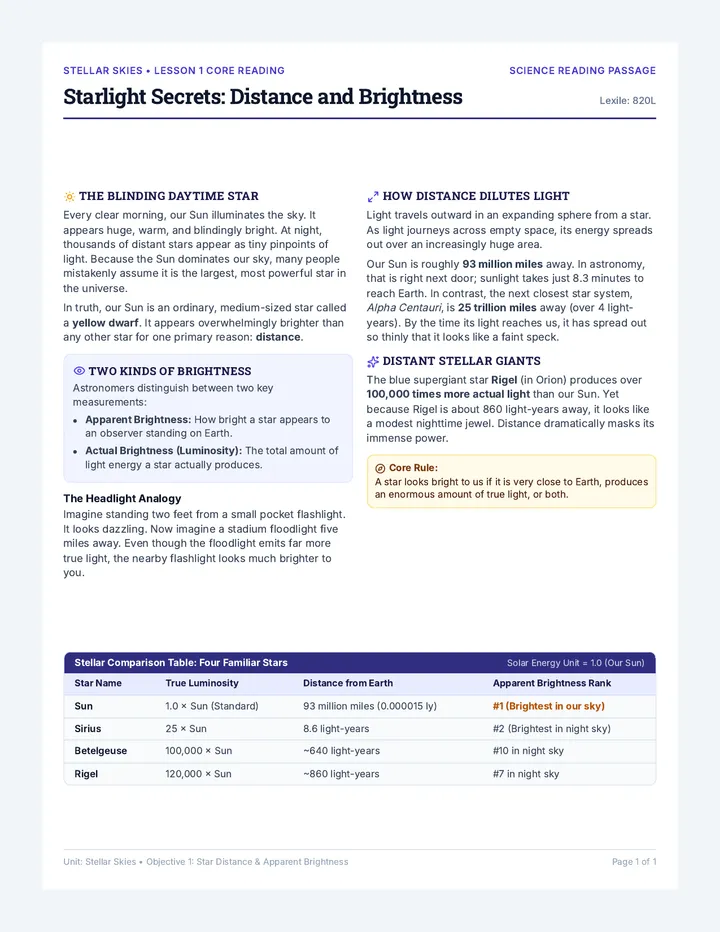
    A two-lesson science sequence investigating star brightness, apparent versus absolute luminosity, nightly sky rotation, and yearly seasonal constellations.

    DB

    Danny Brooks

    8
    Cycle Quest Game Board

    Cycle Quest

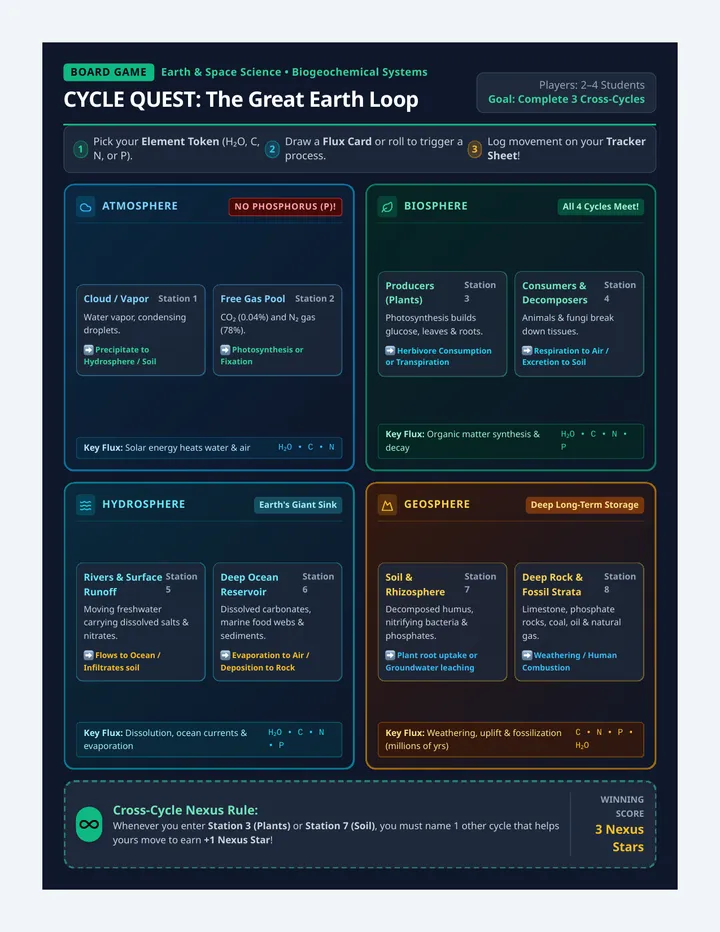
    An engaging, inquiry-driven 7th-grade science lesson where students explore the water, carbon, nitrogen, and phosphorus cycles through an interactive board game and systems-thinking simulation. Students trace matter flow across Earth's spheres, model biogeochemical interconnections, and analyze human impacts on nutrient balances.

    BL

    Burris Laboratory School

    4
    Practice Power Grade 2 Worksheet

    Practice Power Grade 2 Worksheet

    A printer-friendly 2nd-grade reading comprehension worksheet on white background featuring the passage on brain growth, questions 1-3, and a 3-5 sentence guided writing activity with a sentence starter.

    KS

    Kathleen Suther

    Helix Studio Slides

    Candy Code Sequence

    A multi-day competency-based biology sequence exploring DNA architecture, complementary base pairing, and semi-conservative replication through tactile candy modeling and evidence-based assessment.

    TM

    Teri Minami

    6
    Evolution Unlocked Reading Packet

    Evolution Unlocked

    An accessible 9th-grade biology reading lesson exploring natural selection, adaptation, and variation for students reading at a 5th-grade level, complete with guided text and scaffolded comprehension tasks.

    SH

    Sarah Hunter

    3
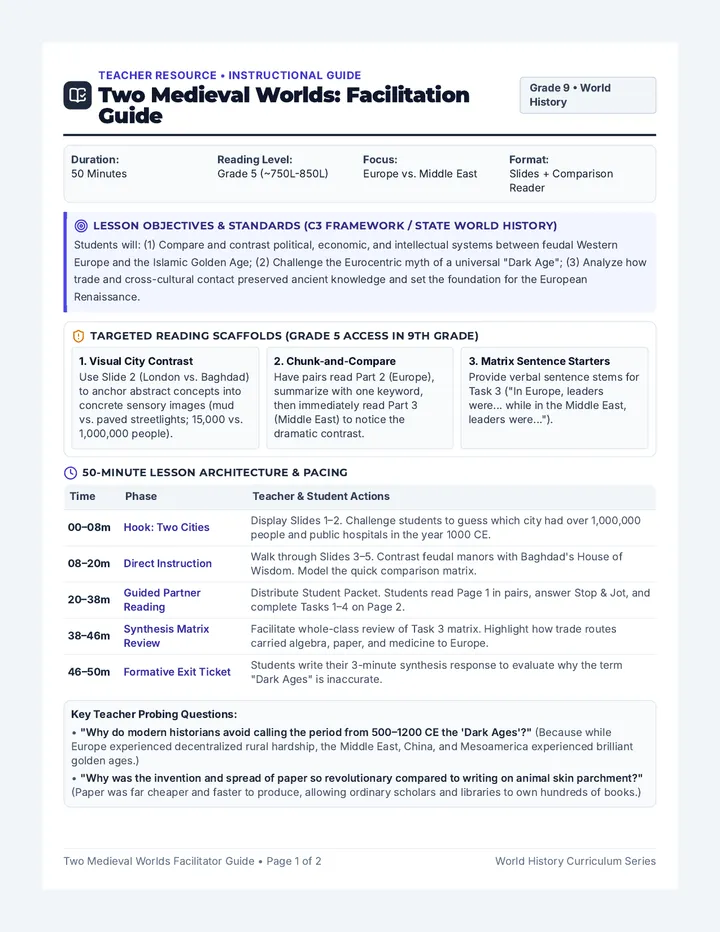
    Two Medieval Worlds Facilitator Guide

    Two Medieval Worlds Facilitator Guide

    A two-page teacher facilitation guide and answer key for the comparative medieval world history lesson, featuring 50-minute pacing, 5th-grade reading level scaffolds, common misconceptions, and exemplar student responses.

    SH

    Sarah Hunter