Both plant and animal cells share four key helpers. The nucleus is the boss that controls the cell. The cell membrane is the door that lets food in. The cytoplasm is the jelly that holds the parts. The mitochondria act like batteries to make power!
Plants cannot walk around to buy food or find shelter. Instead, plant cells have a stiff cell wall to stand tall like a brick house. Plant cells also have green chloroplasts that use sunlight to cook their own food! Animals do not have these two parts.
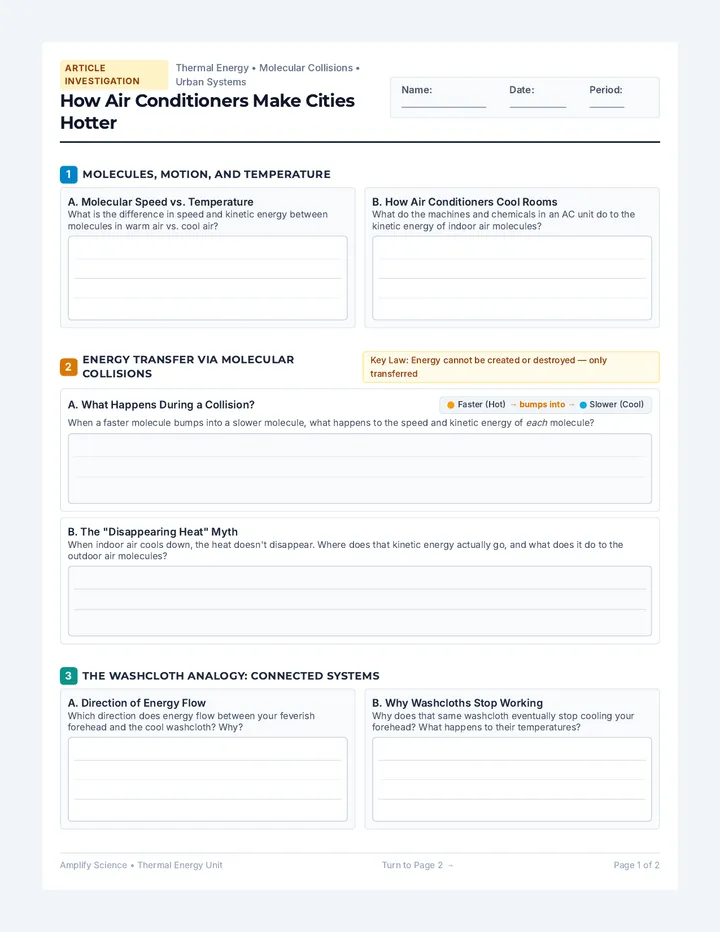
Use words from the bank
Nucleus Cell Wall Mitochondria Chloroplast
The boss or brain that controls the cell is the
The stiff outside layer found ONLY in plants is the
The battery that makes power and energy for the cell is the
The green kitchen that catches sunlight to make food is the
Circle the correct answer for each clue:
5. Which cell has a stiff, boxy shape and looks green?
Plant Cell Animal Cell
6. Which cell has a flexible round shape with NO cell wall?
Plant Cell Animal Cell
7. Can an animal cell make its own food using chloroplasts?
YES NO
Page 2 of 2 • Cell Detectives Reading & Check
The stiff outer wall that keeps plants standing tall.
The green kitchen using sunlight to make sugar food.
Cut-Out Badges: Cell Type Traits (3 Cards for Bottom Mat)
Has Cell Wall + Chloroplasts Makes own food with sun
Has Nucleus & Mitochondria Needs energy to live
Round & Flexible Edge Membrane only (No Wall)
Page 2 of 2 • Cell Match Cut-Out Sheet • Cut pieces carefully and paste onto Page 1!
Prompting & AAC Hierarchy: • Program AAC buttons: "Boss/Brain", "Door", "Battery", "Green Kitchen".
• Non-verbal students can hold up Green Card (Plant) or Blue Card (Animal) during slide mystery checks.
Page 1 of 2 • Cell Detectives Teacher Facilitation Guide
Teacher Reference Answer Keys & Assessment
Quick-reference solutions for student materials and assessment criteria.
Handout Page 2: Reading & Check Answer Key
Part A: Fill in the Blank
1. Boss/brain that controls cell = Nucleus
2. Stiff outside layer in plants = Cell Wall
3. Battery that makes energy = Mitochondria
4. Green kitchen making food = Chloroplast
Part B: Detective Circle Choice
5. Stiff, boxy shape & green = Plant Cell
6. Flexible round shape, no wall = Animal Cell
7. Animal cells make own food? = NO (Only plants)
Sorting Activity Mat Answer Key
| Cell Part | Picture Clue | Job Strip Match | Where Found? |
|---|---|---|---|
| Nucleus | Crown / Brain | Boss/brain that controls activities | Both Cells |
| Cell Membrane | Shield / Door | Front door controlling in & out | Both Cells |
| Cytoplasm | Waves / Jelly | Clear jelly fluid that cushions | Both Cells |
| Mitochondria | Lightning Battery | Power battery making energy | Both Cells |
| Cell Wall | Brick Wall | Stiff outer wall holding plants tall | Plant Only |
| Chloroplast | Sun Kitchen | Green kitchen making sugar food | Plant Only |
Venn Badges Placement: Plant Only = "Has Cell Wall + Chloroplasts" • Both Share = "Has Nucleus & Mitochondria" • Animal Only = "Round & Flexible Edge".
3-Tier Differentiation Guidelines
Tier 1: Maximum Support
Provide pre-cut tokens. Have student match picture-to-picture (icon on card to icon in teacher anchor chart). Verbal choices of 2 options.
Tier 2: Targeted Support
Students cut cards independently. Match organelle name to function clue. Complete fill-in-the-blank with word bank support.
Tier 3: Extension
Student explains orally or in writing why trees need a cell wall (to stand tall without bones) and why humans don't have green chloroplasts.
Exit Mastery Check: Student accurately differentiates at least 1 plant superpower (Wall or Chloroplast) and 2 core organelles.
80%+ Target
Page 2 of 2 • Cell Detectives Teacher Reference & Answer Keys
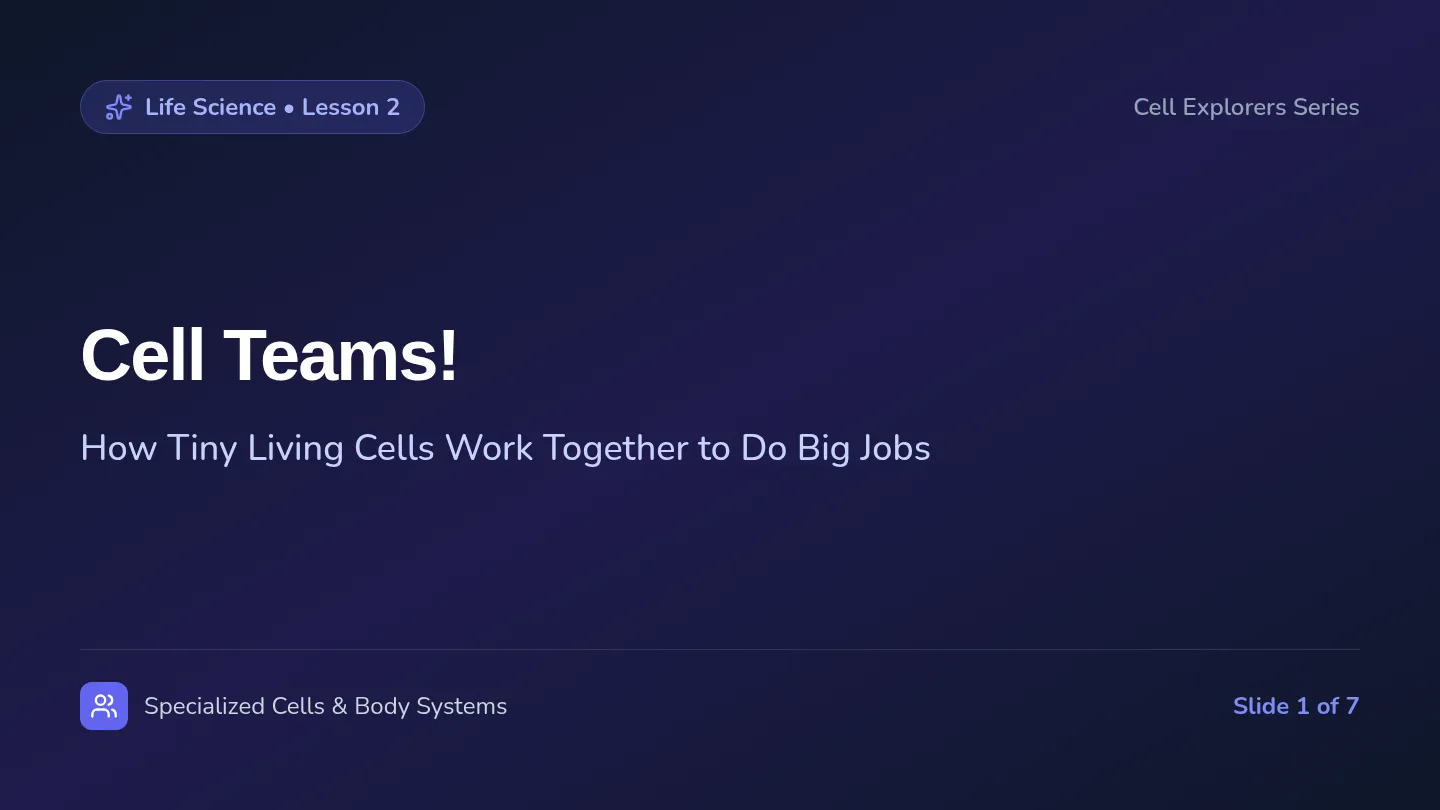
Slide 6 of 7
Step 1
One tiny living worker.
Ex: 1 muscle cell
Step 2
A group of identical cells.
Ex: Muscle sheet
Step 3
Tissues working together.
Ex: Heart, Stomach
Step 4
All organs working as you!
Ex: You or an Oak Tree
Cells build tissues → Tissues build organs → Organs build the whole body!
Slide 7 of 7
Clue #1
Which cell delivers oxygen to every part of your body?
Red Blood Cell
Clue #2
Which cell sends fast messages between brain and fingers?
Nerve Cell
Clue #3
Which cell squeezes and pulls so you can jump and run?
Muscle Cell
Ready for hands-on practice! Head to your sorting mats.
Your body needs to move and stay safe. Muscle cells are stretchy fibers that bunch up and relax to pull your bones. Bone cells are hard and build your strong skeleton. Without bone cells, you would be floppy like a jellyfish!
Plants also have specialized cell squads. Root cells dig deep into soil to suck up water like drinking straws. Leaf cells sit in the sunshine and use chloroplasts to cook food. When root and leaf cells share, the plant grows tall and strong!
Use words from the bank
Nerve Cell Red Blood Cell Muscle Cell Root Cell
The delivery truck cell that carries oxygen through blood is the
The wire-like cell that zaps fast signals to the brain is the
The stretchy fiber cell that squeezes and pulls bones is the
The plant cell that drinks water from underground soil is the
Circle the correct answer for each question:
5. Which cells team up to make a tough skeleton frame?
Bone Cells Leaf Cells
6. When a group of the same cells work together, they form a:
Tissue Chloroplast
7. Do all cells in your body have the exact same shape?
YES NO
Page 2 of 2 • Cell Squad Reading & Check
Long wires zapping quick signals to and from the brain.
Underground straws drinking up water from deep soil.
Green solar kitchens using sunlight to cook plant food.
Cut-Out Badges: Teamwork Ladder Levels (4 Cards for Bottom Mat)
1. CELL One tiny living worker
2. TISSUE Team of identical cells
3. ORGAN Tissues working (Heart, Leaf)
4. BODY All organs together (Organism)
Page 2 of 2 • Cell Squad Cut-Out Sheet • Cut pieces carefully and paste onto Page 1!
Concrete Manipulatives & AAC: • Concrete box with: rubber band (muscle), toy truck (blood cell), piece of string/wire (nerve cell), drinking straw (root cell).
• Program AAC speech buttons: "Movers", "Bones", "Oxygen Truck", "Wire".
Page 1 of 2 • Cell Teams Teacher Facilitation Guide
Teacher Reference Answer Keys & Assessment
Quick-reference solutions for student materials and assessment criteria.
Handout Page 2: Reading & Check Answer Key
Part A: Match Cell Member
1. Delivery truck carrying oxygen = Red Blood Cell
2. Wire zapping signals to brain = Nerve Cell
3. Stretchy fiber pulling bones = Muscle Cell
4. Drinks water underground = Root Cell
Part B: Detective Team Choice
5. Tough skeleton frame = Bone Cells
6. Group of identical cells working = Tissue
7. All cells exact same shape? = NO (Special shapes for jobs!)
Sorting Activity Mat Answer Key
| Cell Member | Picture Clue | Job Strip Match | Where Found? |
|---|---|---|---|
| Muscle Cell | Activity / Mover | Stretchy rubber bands that pull bones | Animal Body |
| Bone Cell | Shield / Frame | Hard mineral bricks making skeleton | Animal Body |
| Red Blood Cell | Truck / Saucer | Smooth trucks carrying oxygen in blood | Animal Body |
| Nerve Cell | Lightning / Wire | Long wires zapping quick brain signals | Animal Body |
| Root Cell | Droplet / Straw | Underground straws drinking soil water | Plant Body |
| Leaf Cell | Sun / Kitchen | Green solar kitchens cooking plant food | Plant Body |
Teamwork Ladder Sequence: Step 1 = 1. CELL • Step 2 = 2. TISSUE • Step 3 = 3. ORGAN • Step 4 = 4. BODY.
3-Tier Differentiation Guidelines
Tier 1: Maximum Support
Provide pre-cut tokens. Pair student 1:1 to match picture tokens to color-coded rows. Use physical props (rubber band, toy truck) as prompts.
Tier 2: Targeted Support
Student cuts cards independently with spring-loaded scissors. Matches cell name to job clue strip and checks Animal vs Plant body independently.
Tier 3: Extension
Student explains why a single cell cannot play soccer or grow an apple tree, and describes what happens if nerve wires get blocked.
Exit Mastery Check: Student identifies at least 2 specialized cell jobs and arranges at least 3 levels on the Teamwork Ladder.
80%+ Target
Page 2 of 2 • Cell Teams Teacher Reference & Answer Keys