Mystery Fossil Dossier
BIOLOGICAL ANTHROPOLOGY: Research Laboratory • Field Evidence Files
Hominin Clade Investigation
Document ID: ANT-9-EVO-2026 • Classification: Blind Case Study Evidence
Biological Anthroplogy
UNIT ASSESSMENT
Assessment Mission Briefing (Grade 9 Biological Anthropology)
You are analyzing four mystery hominin fossils recovered from different excavation sites. Each specimen belongs to one of four foundational hominin clades: Ardipithecus, Australopithecus, Paranthropus, or Homo. Note: the evidence files are NOT arranged in chronological order. You must synthesize each specimen’s physical anatomy, behavioral adaptations, and geochronological dating data to determine its clade.
Geochronology Primer: Dating Methods & Scientific Uncertainty
Determining when an organism lived is essential for constructing accurate evolutionary relationships. Paleontologists use absolute radiometric dating based on the constant half-life decay of unstable parent isotopes into stable daughter atoms. Study these dating boundaries:
Radiocarbon Dating (14C) Organic Material
- Decay Target: Carbon-14 decays to Nitrogen-14 (14N) with a half-life of 5,730 years.
- What It Dates: Preserved organic tissue: bone collagen, tooth dentin, wood, and charcoal hearths.
- The 50,000-Year Ceiling: After ~9 to 10 half-lives (~50,000 years), less than 0.1% of original 14C remains. Beyond this limit, radiocarbon testing is scientifically invalid because no measurable 14C atoms survive.
- Precision: Measured with direct Accelerator Mass Spectrometry (AMS).
Argon-Argon Dating (40Ar/39Ar) Volcanic Strata
- Decay Target: Potassium-40 decays to Argon-40 (40Ar) with a half-life of 1.25 billion years.
- What It Dates: Volcanic ash layers (tuffs) and lava beds containing potassium-bearing feldspar crystals.
- Deep-Time Range: Valid from ~20,000 years up to 4.5 billion years ago. Critical for ancient Pliocene and Pleistocene hominins.
- Volcanic Sandwiches: Geologists date volcanic layers directly above and below a fossil layer to bracket its age.
Understanding Radiometric Error Margins (±) & Geological Uncertainty
Every absolute radiometric date carries an error margin (e.g., “± 0.03 Ma” or “± 550 years”). This indicates statistical standard deviation in atomic measurement, not scientific error. Radiocarbon dates are calibrated (“cal BP” = calibrated years Before Present) against tree rings and coral bands to correct for past atmospheric carbon fluctuations.
Evidence Inventory (Non-Chronological Order)
Page 2 Specimen A
Page 3 Specimen B
Page 4 Specimen C
Page 5 Specimen D
Unit Assessment: Biological Anthropology Unit Assessment • Student Resource Dossier Page 1 of 5
Fossil Evidence Dossier • Case 01
Mystery Specimen A
Locality: Olduvai Gorge & Lake Turkana Basin • Preservation: Massive Cranium with Complete Dentition & Mandible
Geochronological Bracket 1.75 ± 0.03 Ma
Anatomical & Physical Skeletal Traits
Cranial & Chewing Architecture
- Endocranial Volume: Approximately 510–530 cm³ (cc).
- Sagittal Crest: Massive bony crest running longitudinally along skull apex for anchor of colossal temporalis chewing muscles.
- Zygomatic Arches: Enormously flared, forward-positioned cheekbones creating huge openings for powerful masseter muscles.
- Facial Architecture: Broad, flat, “dished” face with prominent nasal margins sunken behind flaring cheeks.
Megadont Dentition & Stature
- Megadontia: Huge post-canine molars and premolars (“megadont teeth”) roughly 4x the chewing surface of modern humans.
- Enamel Thickness: Thickest dental enamel of any known hominin clade; specialized to resist extreme crushing forces.
- Anterior Teeth: Tiny, crowded incisors and reduced canines set in a short, wide parabolic jaw.
- Postcranial Stature: Moderate body size (~40–50 kg); fully upright bipedal posture despite massive craniofacial robusticity.
Behavioral & Ecological Evidence
Extreme Dietary Specialization
Microscopic dental microwear analysis reveals heavy pitting and deep scratching produced by grinding tough, abrasive foods. Stable carbon isotope ratios show a diet composed of 75–80% C4 plants: tough savanna grasses, sedges, reeds, and hard-shelled seeds, earning this specimen the nickname “Nutcracker.”
Bone Digging Tools & Coexistence
In cave sites associated with this clade, polished horn cores and bone flakes show microscopic polish consistent with digging into hard ground to extract underground storage organs (tubers) or breaking open termite mounds. This lineage lived alongside early members of genus Homo without direct dietary competition.
Geochronology & Dating Analysis
Tested Radiocarbon (14C): INVALID • Exceeds 50,000 BP Limit (>300 Half-Lives) Method Code: AMS-RC-N/A
Radiocarbon Evaluation Note: At nearly 1.8 million years old, this specimen has zero surviving radiocarbon. Any test attempting 14C dating would produce a false reading or laboratory background noise.
Valid Alternative Method: Argon-Argon (40Ar/39Ar) Dating on volcanic ash crystals from Olduvai Bed I Tuff IB, cross-checked with Electron Spin Resonance (ESR) on tooth enamel.
Calculated Stratigraphic Age: 1.75 ± 0.03 Million Years Ago (Ma) Geologic Epoch: Early Pleistocene
Unit Assessment: Biological Anthropology Unit Assessment • Specimen A Page 2 of 5
Fossil Evidence Dossier • Case 02
Mystery Specimen B
Locality: Shanidar & Feldhofer Limestone Caves (Eurasia) • Preservation: Complete Cranium, Dentition & Articulated Postcranium
Geochronological Bracket 41,800 ± 550 cal BP
Anatomical & Physical Skeletal Traits
Advanced Encephalization & Skull
- Endocranial Volume: Massive brain size: ~1,450–1,520 cm³ (cc) (over three times earlier hominins).
- Cranial Architecture: Long, low cranial vault with an occipital bun (“chignon”) projection at the back; prominent double-arched supraorbital brow ridge.
- Facial Features: Mid-facial prognathism; massive nasal aperture adapted to warm frigid glacial air; retromolar gap behind 3rd molar.
- Dentition: Strongly reduced molars with taurodontism; incisors show heavy use-wear as a “third hand” vice.
Obligate Bipedal Postcranium
- Locomotion: Fully obligate biped; modern pelvis, rigid arch foot, straight non-curved hand and foot phalanges.
- Robusticity: Hyper-thick cortical bone walls in femora and humeri; bowed radius indicating immense forearm leverage.
- Body Proportions: Stocky, barrel-chested build with shortened distal limb segments (shorter lower legs/forearms; classic cold-climate adaptation).
- Hand Anatomy: Broad apical tufts (fingertips) capable of powerful, precision tool grip.
Behavioral, Symbolic & Cultural Evidence
Complex Tool Industry (Mousterian)
Specimen B mastered the Levallois prepared-core flaking technique: knappers pre-shaped flint nodules so a single final strike detached a predetermined triangular spear point. Micro-chemical residues show points were hafted onto wooden thrusting spears using boiled birch-bark pitch glue.
Intentional Burial & Social Healthcare
The skeleton was discovered resting in a deliberate flexed (fetal) posture inside an intentionally excavated pit inside a cave, surrounded by high concentrations of floral pollen. The individual survived severe trauma (crushed eye socket, amputated/withered forearm) for years, proving prolonged cooperative nursing.
Geochronology & Dating Analysis
Tested Radiocarbon (14C): VALID • Direct AMS Radiocarbon Dating Successful Method Code: AMS-14C-COLLAGEN
Radiocarbon Evaluation Note: Because this specimen lived approximately 41,800 years ago, it falls squarely inside the ~50,000-year functional window of radiocarbon dating. Around 0.6% of original atmospheric 14C remained in preserved bone collagen, enabling direct atom counting via Accelerator Mass Spectrometry (AMS).
Purification & Calibration: Bone collagen was isolated using ultrafiltration to remove modern soil contaminants. The raw measurement was calibrated against the IntCal20 atmospheric curve to produce calendar years.
Calibrated Calendar Age: 41,800 ± 550 cal BP (Years Before Present) Geologic Epoch: Late Pleistocene
Unit Assessment: Biological Anthropology Unit Assessment • Specimen B Page 3 of 5
Fossil Evidence Dossier • Case 03
Mystery Specimen C
Locality: Middle Awash Valley, Afar Depression • Preservation: Crushed Cranium, Pelvis, Hands, & Foot Complex
Geochronological Bracket 4.40 ± 0.05 Ma
Anatomical & Physical Skeletal Traits
Cranial & Dental Anatomy
- Endocranial Volume: Approximately 300–350 cm³ (cc) (comparable to a modern female chimpanzee).
- Cranial Base: Foramen magnum is positioned anteriorly beneath the base of the skull, signaling upright posture.
- Canine Morphology: Blunt, diamond-shaped canines with minimal sexual dimorphism (males and females have similarly small canines); lacks the canine-premolar honing complex.
- Enamel Thickness: Intermediate enamel thickness; neither hyper-thick nor paper-thin.
Postcranial & Locomotor Mosaic
- Pelvis Structure: Mosaic pelvis; the upper blade (ilium) is short, broad, and bowl-shaped for bipedal balance, but the lower ischium is long and ape-like.
- Foot Anatomy: Retains a fully divergent, opposable hallux (grasping big toe), yet foot contains rigid mid-foot bones for terrestrial propulsion.
- Hand & Wrist: Long curved finger bones; flexible wrists that lack the specialized locking ridges seen in knuckle-walking African apes.
- Locomotion Type: Facultative biped on ground; careful arboreal quadruped in trees.
Behavioral & Ecological Evidence
Social Structure & Dimorphism
The extreme reduction of male canine size indicates a major evolutionary shift in social behavior: reduced male-male aggressive canine-flashing displays. Biological anthropologists interpret this as evidence of increased male social tolerance, cooperative group living, and potential pair-bonding.
Paleoenvironment & Subsistence
Fossilized flora (seeds, wood) and associated animal fossils (colobine monkeys, woodland kudus) show Specimen C inhabited a closed woodland/forest canopy, not open grassland. Tooth carbon isotope ratios confirm an omnivorous woodland diet of fruits, soft leaves, and nuts. No manufactured stone tools exist in this horizon.
Geochronology & Dating Analysis
Tested Radiocarbon (14C): INVALID • Exceeds Method Limit by >4.3 Million Years Method Code: AMS-RC-N/A
Radiocarbon Evaluation Note: Radiocarbon dating is strictly impossible. Over 760 half-lives of Carbon-14 have elapsed since this individual died. Zero parent 14C atoms remain in the fossilized mineral matrix.
Valid Alternative Method: Argon-Argon (40Ar/39Ar) Laser Fusion Dating on volcanic feldspars extracted from the Daam Aatu Basaltic Tuff (underlying layer) and the Gàala Tuff (overlying layer).
Calculated Stratigraphic Age: 4.40 ± 0.05 Million Years Ago (Ma) Geologic Epoch: Early Pliocene
Unit Assessment: Biological Anthropology Unit Assessment • Specimen C Page 4 of 5
Fossil Evidence Dossier • Case 04
Mystery Specimen D
Locality: Hadar Basin & Laetoli Ash Deposits (East Africa) • Preservation: Partial Skeleton (40% complete), Cranium, Pelvis & Footprints
Geochronological Bracket 3.18 ± 0.04 Ma
Anatomical & Physical Skeletal Traits
Cranial & Dental Anatomy
- Endocranial Volume: Approximately 420–450 cm³ (cc).
- Facial Profile: Strong sub-nasal prognathism; face slopes prominently forward below nasal bridge.
- Dental Arcade: U-shaped (sub-parallel tooth rows); canines smaller than apes but retain a small diastema (gap) before premolars.
- Cranial Base: Foramen magnum is positioned anteriorly (forward beneath the cranium), balancing the head upright.
Postcranial & Locomotor Anatomy
- Pelvis: Short, broad iliac blades rotated laterally, forming a true supportive bowl for habitual bipedal walking.
- Knee Anatomy: Clear bicondylar (valgus) angle; femur slopes inward to align knee directly under the center of mass.
- Foot Structure: Hallux (big toe) is fully adducted (in line with the other toes; no grasping divergence); longitudinal arch present.
- Arboreal Retention: Curved finger and toe phalanges; cranially oriented shoulder socket for climbing trees.
Behavioral & Ecological Evidence
Habitual Terrestrial Striding
In a volcanic tuff layer 40 kilometers away, fossilized trackways show three individuals walking upright across wet ash. The prints reveal an efficient bipedal heel-strike and big-toe push-off without any hand knuckle prints. Curved fingers indicate arboreal climbing was maintained for nocturnal sleeping safe from predators.
Subsistence & Material Culture
No manufactured flaked stone tool industry is present. Associated bovid bones display occasional cut marks made by naturally sharp cobbles, but no systematic core flaking. Stable carbon isotope analysis reveals a mixed C3/C4 diet combining woodland foliage with open grassland sedges and roots.
Geochronology & Dating Analysis
Tested Radiocarbon (14C): INVALID • 0.00% 14C Remaining (>550 Half-Lives) Method Code: AMS-RC-N/A
Radiocarbon Evaluation Note: The sample is completely mineralized (petrified). Because radiocarbon expires around 50,000 years, attempting 14C dating on a 3-million-year-old fossil yields no detectable atomic signal.
Valid Alternative Method: Argon-Argon (40Ar/39Ar) Single-Crystal Laser Fusion on sanidine feldspars from the enclosing Sidi Hakoma and Kada Hadar volcanic ash tuffs.
Calculated Stratigraphic Age: 3.18 ± 0.04 Million Years Ago (Ma) Geologic Epoch: Late Pliocene
Unit Assessment: Biological Anthropology Unit Assessment • Specimen D Page 5 of 5
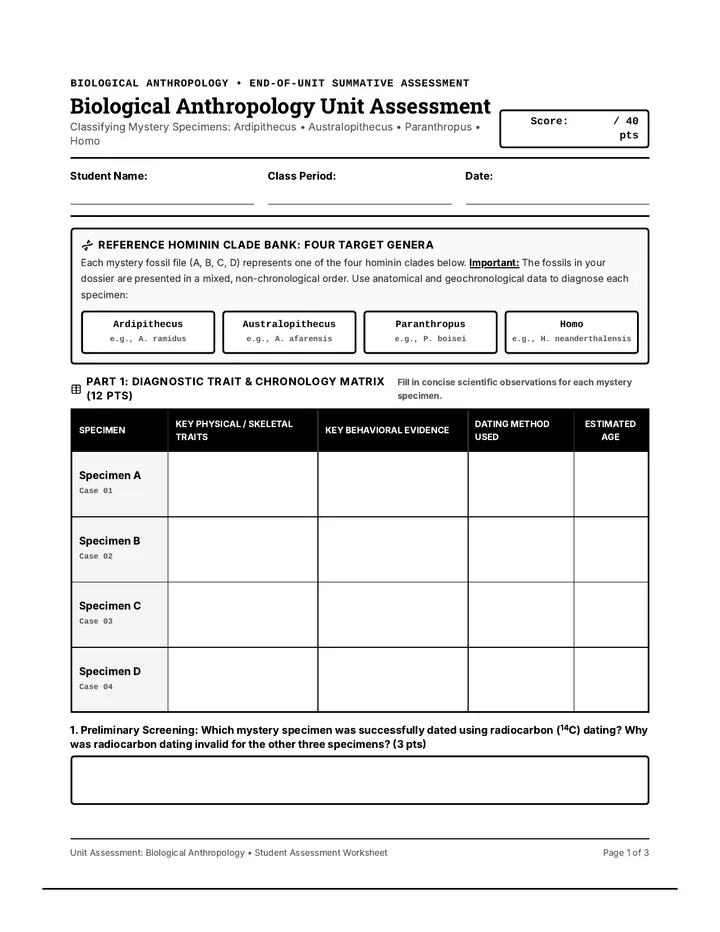
Fossil Argument Assessment Worksheet
Biological Anthropology • End-of-Unit Summative Assessment
Biological Anthropology Unit Assessment
Classifying Mystery Specimens: Ardipithecus • Australopithecus • Paranthropus • Homo
Score: / 40 pts
Student Name:
Class Period:
Date:
Reference Hominin Clade Bank: Four Target Genera
Each mystery fossil file (A, B, C, D) represents one of the four hominin clades below. Important: The fossils in your dossier are presented in a mixed, non-chronological order. Use anatomical and geochronological data to diagnose each specimen:
Ardipithecus e.g., A. ramidus
Australopithecus e.g., A. afarensis
Paranthropus e.g., P. boisei
Homo e.g., H. neanderthalensis
Part 1: Diagnostic Trait & Chronology Matrix (12 pts)
Fill in concise scientific observations for each mystery specimen.
| Specimen | Key Physical / Skeletal Traits | Key Behavioral Evidence | Dating Method Used | Estimated Age |
|---|
| Specimen A Case 01 | | | | |
| Specimen B Case 02 | | | | |
| Specimen C Case 03 | | | | |
| Specimen D Case 04 | | | | |
1. Preliminary Screening: Which mystery specimen was successfully dated using radiocarbon (14C) dating? Why was radiocarbon dating invalid for the other three specimens? (3 pts)
Unit Assessment: Biological Anthropology • Student Assessment Worksheet Page 1 of 3
Part 2 • Scientific Argumentation
Claim, Evidence & Reasoning (CER) Investigation (15 pts)
Clade Identification
Select ONE Mystery Specimen to formally argue:
Specimen A Specimen B Specimen C Specimen D
Section A: Scientific Claim (3 pts) Must identify one of: Ardipithecus, Australopithecus, Paranthropus, or Homo.
State which specific hominin clade (genus) your selected specimen belongs to and describe its evolutionary relationship to other hominins:
Section B: Anatomical & Physical Evidence (4 pts) Cite at least 2 diagnostic skeletal/dental features from the case file.
Cite specific anatomical traits (e.g., cranial capacity, sagittal crest, teeth, pelvic shape, foot digits) that uniquely diagnose this clade:
Section C: Behavioral & Ecological Evidence (4 pts) Cite diet, locomotion, tools, or social behavior.
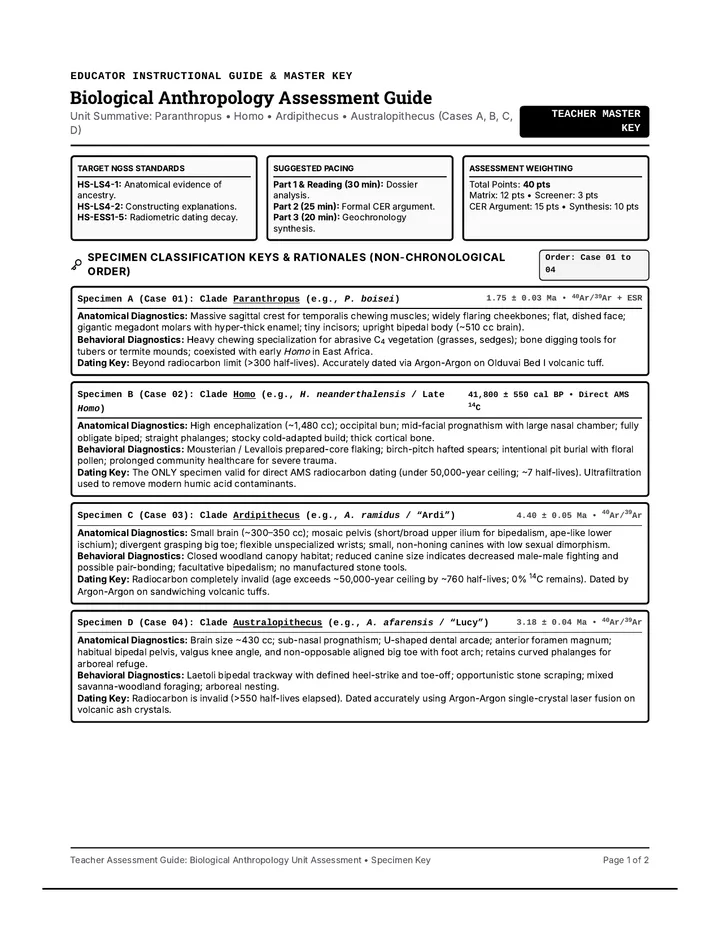
Fossil Assessment Teacher Guide
Educator Instructional Guide & Master Key
Biological Anthropology Assessment Guide
Unit Summative: Paranthropus • Homo • Ardipithecus • Australopithecus (Cases A, B, C, D)
Teacher Master Key
Target NGSS Standards
HS-LS4-1: Anatomical evidence of ancestry.
HS-LS4-2: Constructing explanations.
HS-ESS1-5: Radiometric dating decay.
Suggested Pacing
Part 1 & Reading (30 min): Dossier analysis.
Part 2 (25 min): Formal CER argument.
Part 3 (20 min): Geochronology synthesis.
Assessment Weighting
Total Points: 40 pts
Matrix: 12 pts • Screener: 3 pts
CER Argument: 15 pts • Synthesis: 10 pts
Specimen Classification Keys & Rationales (Non-Chronological Order)
Order: Case 01 to 04
Specimen A (Case 01): Clade Paranthropus (e.g., P. boisei) 1.75 ± 0.03 Ma • 40Ar/39Ar + ESR
Anatomical Diagnostics: Massive sagittal crest for temporalis chewing muscles; widely flaring cheekbones; flat, dished face; gigantic megadont molars with hyper-thick enamel; tiny incisors; upright bipedal body (~510 cc brain).
Behavioral Diagnostics: Heavy chewing specialization for abrasive C4 vegetation (grasses, sedges); bone digging tools for tubers or termite mounds; coexisted with early Homo in East Africa.
Dating Key: Beyond radiocarbon limit (>300 half-lives). Accurately dated via Argon-Argon on Olduvai Bed I volcanic tuff.
Specimen B (Case 02): Clade Homo (e.g., H. neanderthalensis / Late Homo) 41,800 ± 550 cal BP • Direct AMS 14C
Anatomical Diagnostics: High encephalization (~1,480 cc); occipital bun; mid-facial prognathism with large nasal chamber; fully obligate biped; straight phalanges; stocky cold-adapted build; thick cortical bone.
Behavioral Diagnostics: Mousterian / Levallois prepared-core flaking; birch-pitch hafted spears; intentional pit burial with floral pollen; prolonged community healthcare for severe trauma.
Dating Key: The ONLY specimen valid for direct AMS radiocarbon dating (under 50,000-year ceiling; ~7 half-lives). Ultrafiltration used to remove modern humic acid contaminants.
Specimen C (Case 03): Clade Ardipithecus (e.g., A. ramidus / “Ardi”) 4.40 ± 0.05 Ma • 40Ar/39Ar