Lenny.com
Explore
Create
ActivitiesNewMathEnglish Language ArtsScience & EngineeringSocial StudiesGlobal LanguagesHealth & Physical EducationSpecial EducationCounseling & Life SkillsArts & CreativityESL
Lenny.com
Lenny.com
Explore
Create
ActivitiesNewMathEnglish Language ArtsScience & EngineeringSocial StudiesGlobal LanguagesHealth & Physical EducationSpecial EducationCounseling & Life SkillsArts & CreativityESL
Lenny.com
Lenny.com

Solutions

Lenny for EducatorsLenny for SchoolsLenny for Districts

Product

ExploreSign inCreateSupportAbout

Resources

Getting startedMTSS Acceleration Program

Newsletters

School Funding Newsletter

© 2026 Lenny Learning Inc.

TermsPrivacyAccessibility
LinkedInInstagramX
Lenny
Science & EngineeringLife ScienceLiving ThingsAnimalsPlantsBody SystemsTraitsAdaptationsCellsEcosystemsHeredityGenes to TraitsCell DivisionPhysicsComparing MaterialsShapes and PropertiesMagnetsMagnetismLightSoundLight and SoundMatterStates of MatterChanges of StateMixturesPhysical and Chemical ChangeHeating and CoolingHeat and Thermal EnergyEnergyForce and MotionElectrical CircuitsAtoms and MoleculesPeriodic TableMotion in One DimensionMotion in Two DimensionsScalars and VectorsForces and Laws of MotionCircular Motion and GravityMomentum and ImpulseWork, Energy, and PowerWavesElectromagnetic WavesGeometric OpticsElectricity and MagnetismSimple Harmonic MotionThermodynamicsNuclear PhysicsEarth Science & AstronomyWeatherWater CycleRocks and MineralsFossilsEarth's FeaturesEarth's ResourcesEarth's StructureWeather and ClimateEarth EventsFossils and Geologic TimePlate TectonicsHuman ImpactsAstronomyChemistryUnits and MeasurementAtomic StructurePeriodic TrendsChemical BondingNomenclatureMolecular StructureIntermolecular ForcesThe MoleStoichiometryProperties of GasesSolutionsChemical ReactionsBalancing EquationsEnergy ChangesRates of ReactionsEquilibriumAcids and BasesQuantum ModelBiologyClassificationCell StructureThe Chemistry of LifeBiomoleculesCellular TransportCell EnergyCell Growth and DivisionDNAProtein SynthesisMeiosis and Sexual ReproductionPatterns of InheritanceMulticellular OrganismsEvolutionEcologyBiodiversityComputer ScienceAlgorithms and Computational ThinkingProgramming LanguagesComputing SystemsNetworks and InternetData AnalysisCybersecurityAI and Machine LearningSoftware Design and DevelopmentBlockchainEngineering & AIDesigning ExperimentsEngineering PracticesDesign ThinkingEngineering Design ProcessMechanical EngineeringElectrical EngineeringMaterials and StructuresCAD and 3D DesignRoboticsArtificial Intelligence BasicsVibe CodingMachine LearningAI Ethics and SocietySystems ThinkingEntrepreneurship & InnovationEntrepreneurial MindsetBusiness Idea DevelopmentBusiness Plan BasicsMarketing & Customer DiscoveryFinancial Management for Startups

Cell Division Duel

An introductory Life Science and Biology lesson for grades 7-9 exploring cell division and genetic recombination. Students compare mitosis and meiosis in biological purpose, chromosome counts, and the vital role of crossing over in creating genetic diversity.

KJKatelyn Johnson

Cell Division Duel

An introductory Life Science and Biology lesson for grades 7-9 exploring cell division and genetic recombination. Students compare mitosis and meiosis in biological purpose, chromosome counts, and the vital role of crossing over in creating genetic diversity.

KJKatelyn Johnson

SOL BIO.5 • High School Biology Bridge

Part A: Crossing Over Step-by-Step Labeling

Review the 3 stages of genetic exchange below. Use the word bank to fill in the correct scientific term for each blank line:

Word Bank: Tetrad (Synapsis) Chiasma Recombinant Chromatids Homologous Chromosomes

Step 1: Alignment

[ Maternal #1 ] <===> [ Paternal #1 ]
(4-stranded paired unit)

Scientific Name:

Step 2: The Physical Cross

[ Non-sister arms intertwine ]
>-- X --< (Point of overlap)

Overlap Point:

Step 3: Outcome

2 Original Parental Strands
+ 2 Hybrid Swapped Strands

Hybrid Strands:

Part B: Evolutionary Resilience Case Study (The Banana Blight)

Nearly all commercial Cavendish bananas are grown through mitosis (stem cuttings) with zero crossing over. Currently, a deadly fungus (Panama Disease Tropical Race 4) is spreading worldwide.

1. Why are all Cavendish plants vulnerable?

2. How does crossing over protect wild banana species?

Phase 5: EVALUATE 3-2-1 Crossing Over Exit Synthesis

3 Key Facts about Crossing Over:

2 Cell Division Types Compared:

Mitosis Crossing Over? Meiosis Crossing Over?

1 Primary Evolutionary Benefit of Crossing Over:

The Genetic Remix • Student Lab Sheet • Page 2 of 2 Virginia Standards of Learning LS.2, LS.3, BIO.5

55–60 Minute Lesson Delivery Flow

Active Engagement

1. ENGAGE (8 min) — The Trillion-Cell Mystery Slides 1–2 • Worksheet Phase 1

Active Strategy: Pair-Share Turn and Talk. Direct students to Prompt A and B on their sheet. Ask: "If every single body cell originates from one zygote, why don't you look exactly like your brother or sister?" Students jot predictions before sharing with the class.

2. EXPLORE (14 min) — Hands-On Manipulative Simulation Slide 3 • Worksheet Phase 2

Active Strategy: Desk Lab. Pairs physically manipulate blue and red pipe-cleaners. First, simulate Mitosis (1 division = identical pairs). Next, simulate Meiosis (crossing over tips, 2 division rounds). Students calculate the Ploidy Table on their sheet.

3. EXPLAIN (12 min) — Concept Synthesis & Choral Mnemonics Slides 4–5 • Worksheet Phase 3

Active Strategy: Call-and-Response & Whiteboard Checks. Teach mnemonic: Mitosis = "My Toes" (somatic/body cells); Meiosis = "Makes ME unique". Students complete the Master Showdown Matrix and practice rapid whiteboard ploidy math (Slide 5).

4. ELABORATE (14 min) — Bio-Detective Case Investigations Slide 6 • Worksheet Phase 4

Active Strategy: Collaborative Case Files. Pairs act as medical & evolutionary detectives solving Case 101 (Athlete Bone Healing), Case 102 (Coral Spawning), and Case 103 (Strawberry Runners), justifying their reasoning with ploidy evidence.

5. EVALUATE (7 min) — Showdown Check & 3-2-1 Exit Ticket Slide 7 • Worksheet Phase 5

Active Strategy: Rapid Thumbs-Up/Down Class Poll on Slide 7 statements, followed by independent completion of the 3-2-1 Rapid Exit Synthesis on Worksheet Page 2 as an individual formative assessment.

Critical Misconception Radar & Teacher Fixes

Misconception: "Meiosis happens all over the reproductive system." → Teacher Fix: Clarify that gonads contain regular body cells that undergo mitosis; meiosis is restricted exclusively to germline precursor cells producing gametes.

Misconception: "Haploid cells are half-damaged chromosomes." → Teacher Fix: Show pipe cleaner model: haploid cells possess complete, intact chromosomes—they simply lack their homologous partner.

Assessment Benchmark: Students accurately complete \(\ge 6/7\) matrix items and calculate all 4 ploidy scenarios correctly.

Proficiency Goal: 85%+

Cell Division Duel • 5E Educator Blueprint • Page 2 of 2 Virginia Department of Education Standards of Learning

Tetrad (Synapsis)

Homologous chromosome pairs align tightly gene-for-gene.

Step 2: The Physical Cross

Chiasma (pl. Chiasmata)

The precise X-shaped site where non-sister chromatids touch and break.

Step 3: Outcome

Recombinant Chromatids

Hybrid strands carrying combined maternal and paternal allele sets.

Part B: Evolutionary Resilience (Banana Blight) Key (4 pts)

1. Why all Cavendish are vulnerable (2 pts):

Because they reproduce only by mitosis, all plants share 100% identical DNA. There is zero genetic variation, so if a pathogen infects one, every plant lacks immune defense.

2. How crossing over protects wild species (2 pts):

Crossing over creates unique gene combinations in every generation. Some wild individuals inherit rare resistance alleles that protect them from fungal death.

Phase 5: 3-2-1 Exit Synthesis Model Answers (5 pts)

3 Facts about Crossing Over:

1. Occurs in Prophase I of Meiosis • 2. Non-sister chromatids trade DNA segments at chiasmata • 3. Creates brand new recombinant genetic combinations.

2 Cell Division Comparison:

Mitosis: NO • Meiosis: YES

1 Evolutionary Benefit:

Provides genetic diversity needed to survive environmental shifts and diseases.

The Genetic Remix Answer Key • Page 2 of 2 Virginia Department of Education Science Standards LS.2, LS.3, BIO.5

Diploid (2n) = The Complete Cookbook

Contains two complete sets of recipes. Human body cells have total chromosomes ( pairs).

Haploid (n) = Half the Recipe Pages

Contains one single set. Human gametes (sperm/egg) carry exactly chromosomes so fertilization restores the count.

Part 4: Speed Self-Check (Circle Correct Choice)

Cell division that repairs a cut:

[ Mitosis / Meiosis ]

Produces 4 unique daughter cells:

[ Mitosis / Meiosis ]

Ploidy of a human sperm cell:

[ Diploid (2n) / Haploid (n) ]

Division Clues Guided Vocabulary Notes • Life Science & Biology Keep this in your Science Binder for Unit Review!

1. MITOSIS • 2. MEIOSIS • 3. DIPLOID • 4. GAMETE

Riddle Answer: "Homologous partner"

Division Clues Notes & Activity Key • Virginia SOLs LS.2 & LS.3 Instructional Resource • Complete Diagnostic Guide

Activity 4: Anagram Decoder & Riddle Solutions (4 pts) 1 pt per word + riddle

1. T-I-M-O-S-I-S MITOSIS

2. M-E-S-I-O-I-S MEIOSIS

3. P-L-O-I-D-I-D DIPLOID

4. M-A-T-E-G-E GAMETE

🧬 Riddle Punchline: "Why did the chromosome go to the party?"

"To find its homologous partner!"

Division Showdown Activity Answer Key • Virginia SOLs LS.2 & LS.3 Complete Diagnostic and Evaluation Resource

You might also like

Cell Foundations Slides

Cell City Quest

A two-part life science sequence exploring cell theory, cellular architecture, and organelle functions through the lens of a bustling microscopic city. Students progress from fundamental cell characteristics to intricate organelle operations across two interactive class sessions.

CP

Carmen Pavlovsky

7
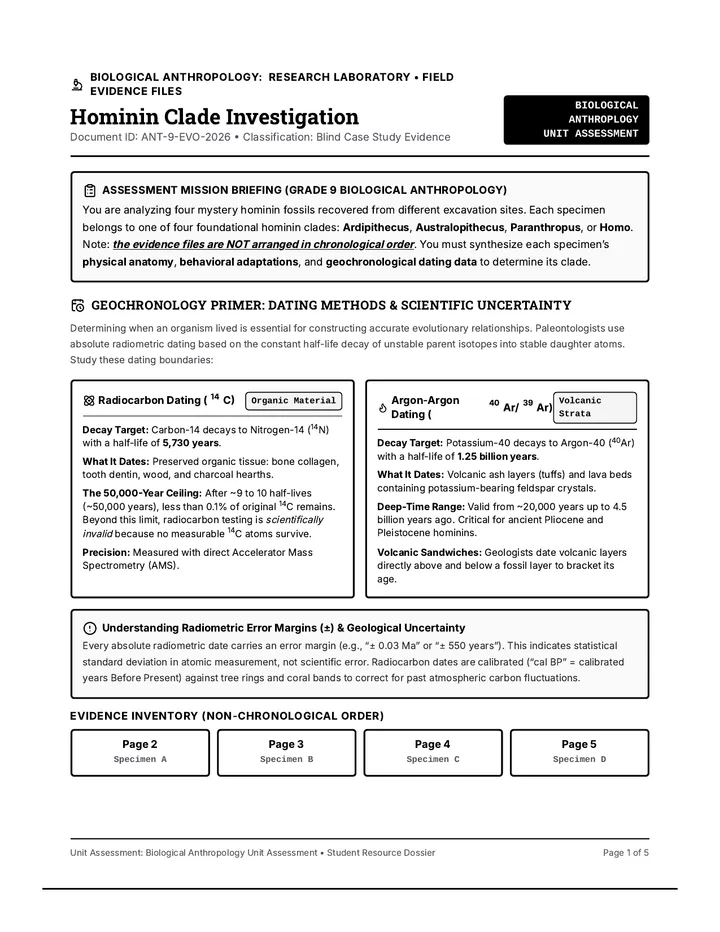
Mystery Fossil Dossier

Hominin Clade Clues

An end-of-unit assessment where 9th-grade biological anthropology students analyze mystery hominin fossil profiles. Students examine physical skeletal adaptations, behavioral artifacts, and geochronological dating data to construct evidence-based classification arguments within the hominin evolutionary lineage.

KT

Kyle Trocolla

3
Fossil Assessment Teacher Guide

Fossil Assessment Teacher Guide

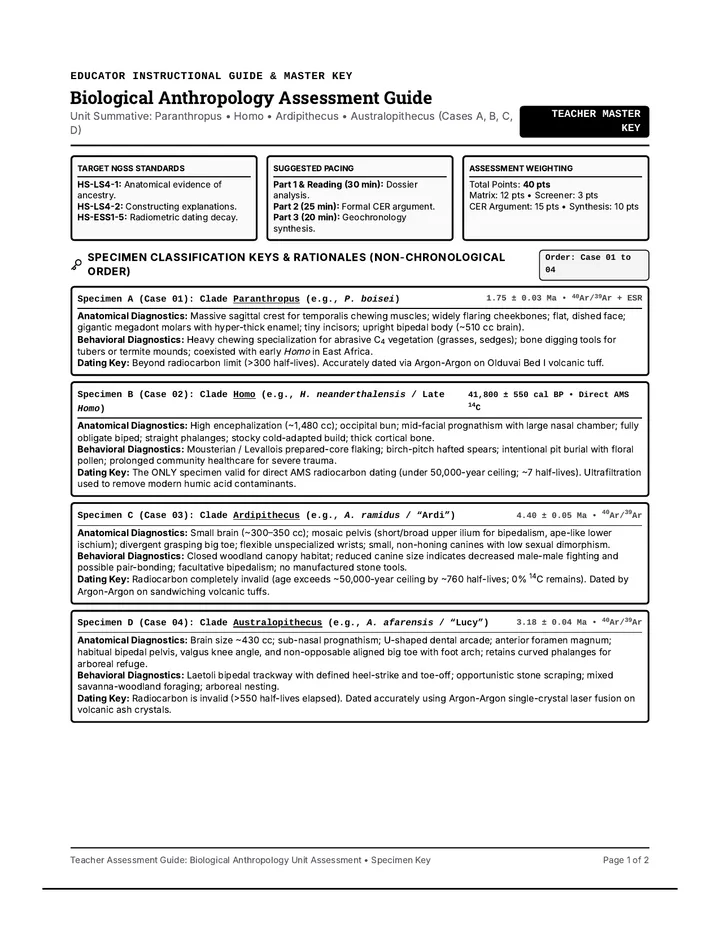
A two-page high-contrast black-and-white teacher assessment guide and scoring rubric for the hominin clade investigation. Features specimen classification keys for the non-chronological cases (Specimen A = Paranthropus, Specimen B = Homo, Specimen C = Ardipithecus, Specimen D = Australopithecus), diagnostic criteria, geochronology rationales, a four-tier rubric, and common ninth-grade misconceptions.

KT

Kyle Trocolla

Starlight Secrets Reading Passage

Stellar Skies

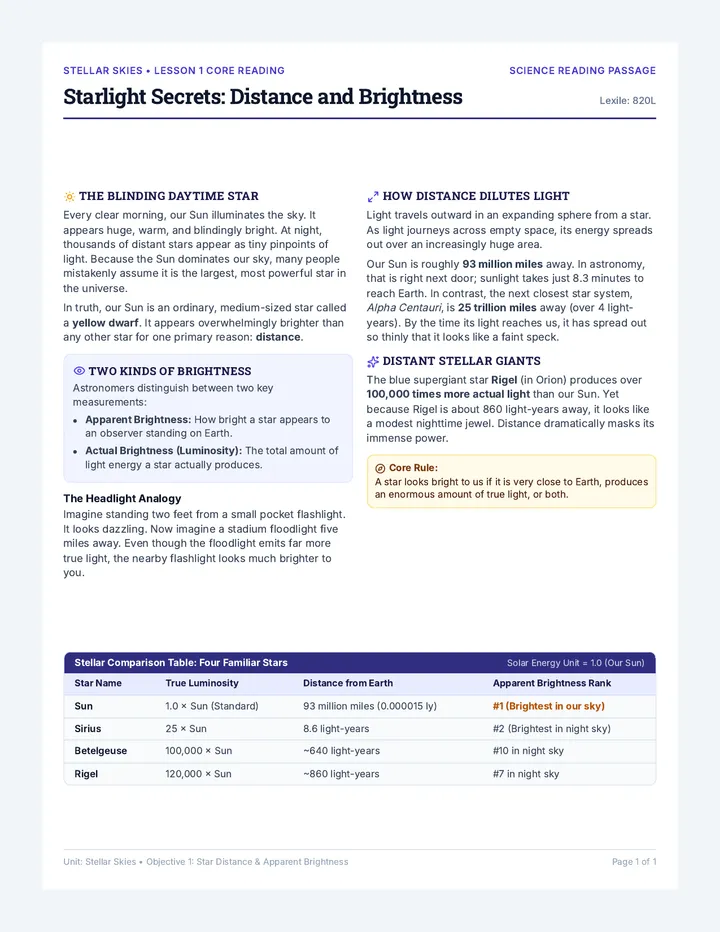
A two-lesson science sequence investigating star brightness, apparent versus absolute luminosity, nightly sky rotation, and yearly seasonal constellations.

DB

Danny Brooks

8
Churn and Change Lesson Plan

Churn and Change

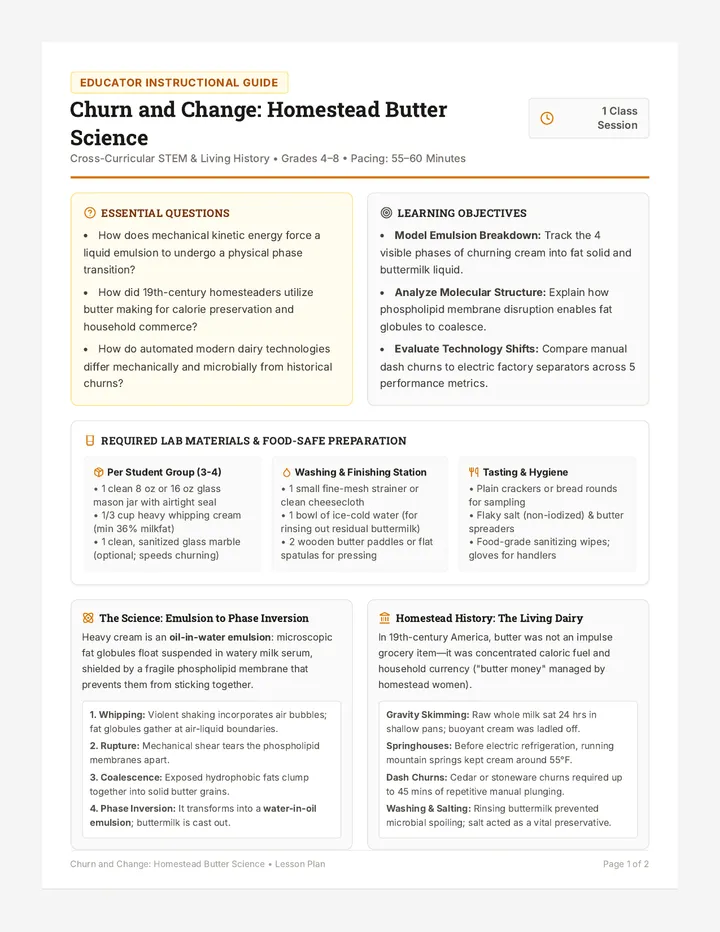
A cross-curricular STEM and history lesson investigating the science of emulsions, traditional homestead churning practices, and modern dairy technology through a hands-on mason jar butter lab.

CW

Carrie Williams

3
Fossil Argument Assessment Worksheet

Fossil Argument Assessment Worksheet

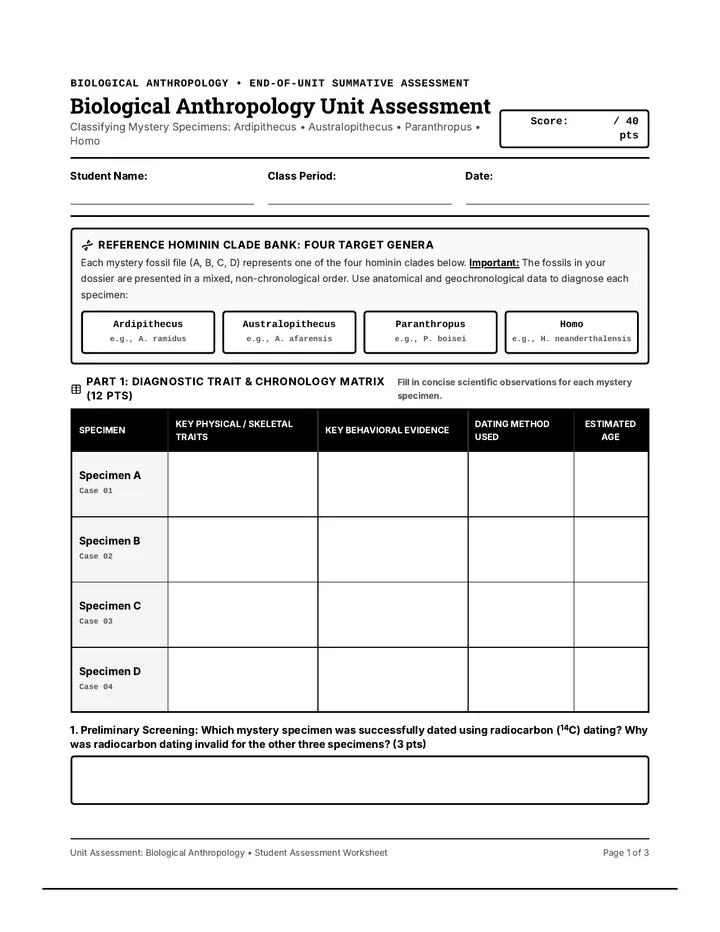
A three-page high-contrast black-and-white student assessment booklet where ninth graders synthesize evidence across four hominin clades (Ardipithecus, Australopithecus, Paranthropus, Homo) designated as Mystery Specimens A, B, C, and D. Students complete a comparative matrix, compose a formal CER classification argument, and evaluate radiometric dating boundaries.

KT

Kyle Trocolla

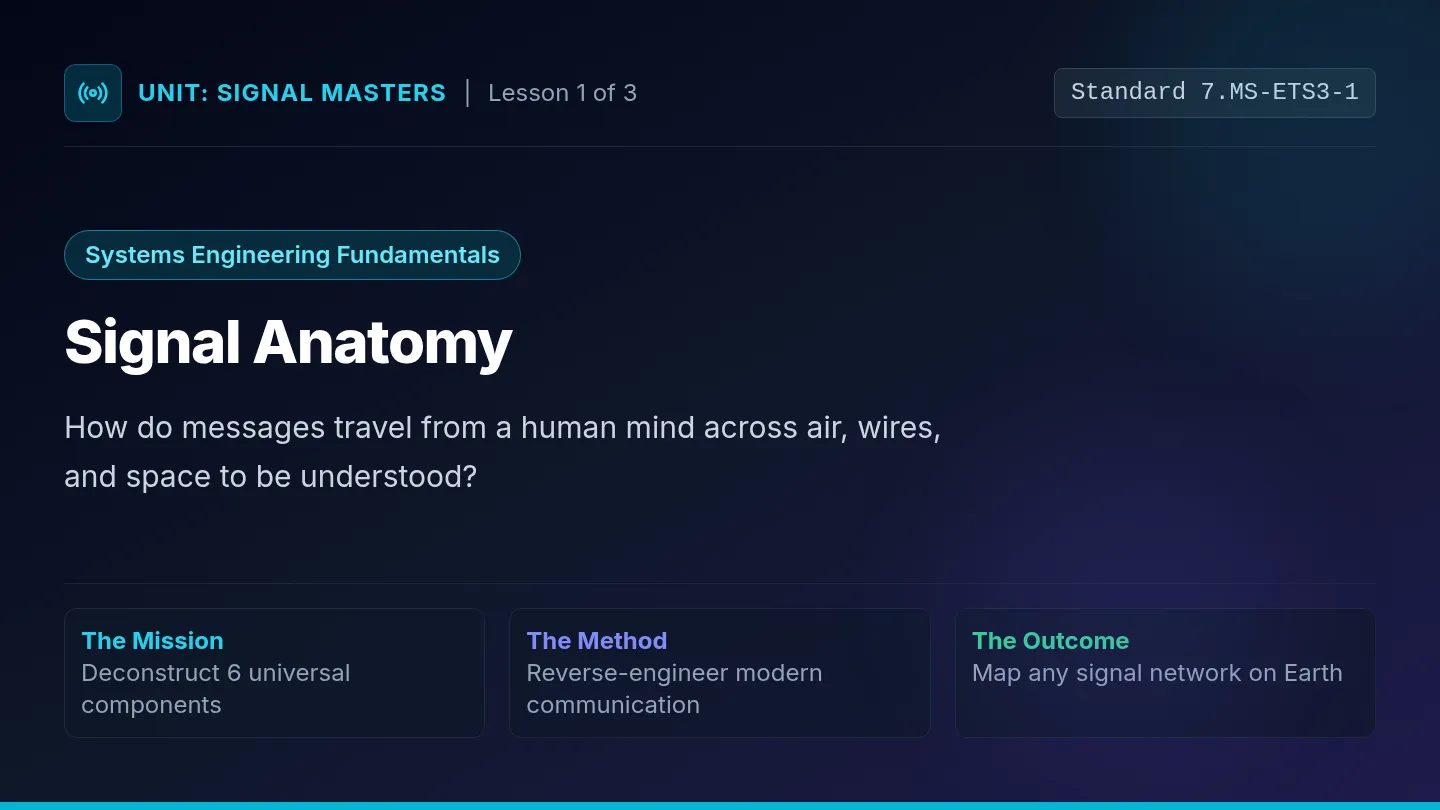
Signal Anatomy Slides

Signal Masters

A hands-on systems engineering unit where 7th-grade students deconstruct communication components, model feedback loops and signal degradation, and engineer a custom communication system to solve a real-world scenario.

TC

Theresa Crafts

8
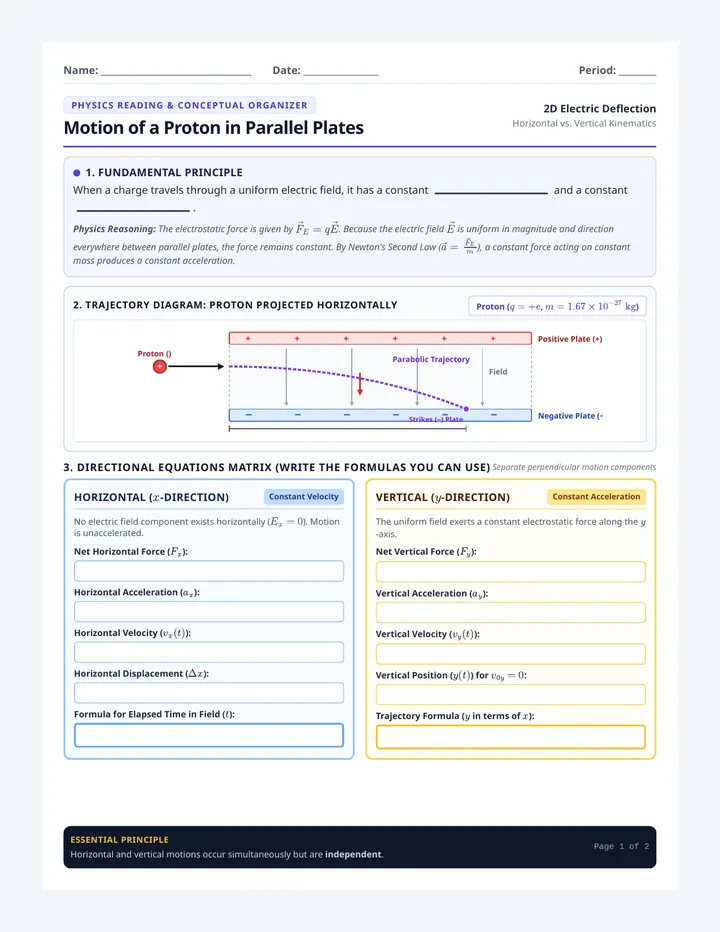
Electric Trajectories Reading Guide

Particle Trajectories

A comprehensive physics lesson exploring the 2D kinematics and forces acting on charged particles in uniform electric fields. Includes theoretical derivations, visual trajectory diagrams comparing protons and electrons, and practical application problems.

CM

Chuguna Murugesan

4
Mystery Fossil Dossier

Mystery Fossil Dossier

A five-page high-contrast black-and-white forensic paleontology evidence dossier for ninth-grade biological anthropology. Mystery specimens are designated A, B, C, and D in non-chronological order: Specimen A is Paranthropus, Specimen B is Homo, Specimen C is Ardipithecus, and Specimen D is Australopithecus.

KT

Kyle Trocolla

Helix Studio Slides

Candy Code Sequence

A multi-day competency-based biology sequence exploring DNA architecture, complementary base pairing, and semi-conservative replication through tactile candy modeling and evidence-based assessment.

TM

Teri Minami

6
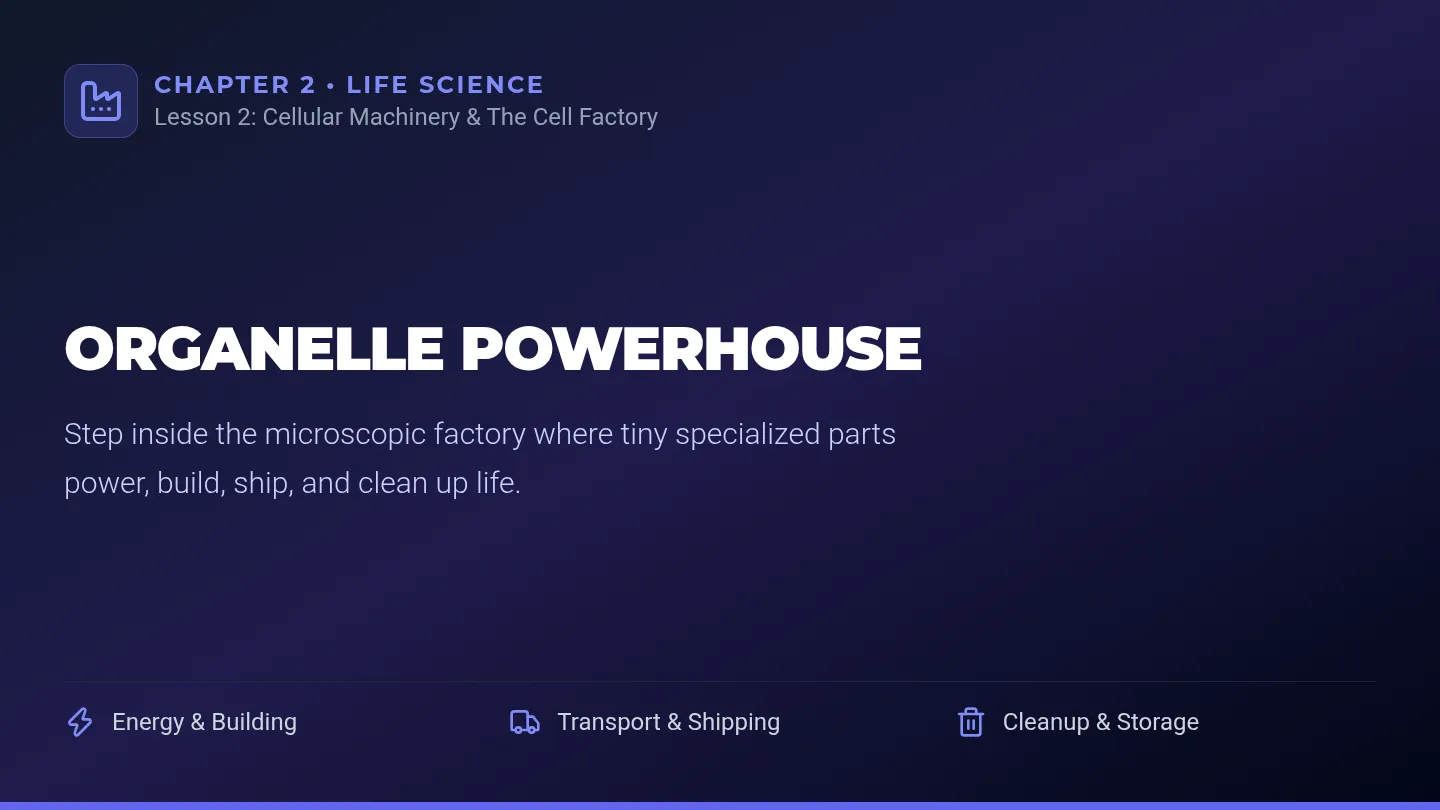
Organelle Powerhouse Slides

Organelle Powerhouse

Dives deep into internal cell machinery using the cell factory analogy to investigate energy release, protein synthesis, transport, and waste breakdown. Students master mitochondria, ribosomes, rough ER, smooth ER, Golgi bodies, lysosomes, vacuoles, and chloroplasts.

CP

Carmen Pavlovsky

4
Pesky Biters Slides

Bug Busters

A two-part fifth-grade science sequence investigating how insects can be annoying nuisances, bite and sting, and damage crops and homes. Specially scaffolded with high-visual supports, decodable text chunks, and guided practice for lower-literacy learners.

Lenny Avatar
Lenny
11