Lenny.com
Explore
Create
ActivitiesNewMathEnglish Language ArtsScience & EngineeringSocial StudiesGlobal LanguagesHealth & Physical EducationSpecial EducationCounseling & Life SkillsArts & CreativityESL
Lenny.com
Lenny.com
Explore
Create
ActivitiesNewMathEnglish Language ArtsScience & EngineeringSocial StudiesGlobal LanguagesHealth & Physical EducationSpecial EducationCounseling & Life SkillsArts & CreativityESL
Lenny.com
Lenny.com

Solutions

Lenny for EducatorsLenny for SchoolsLenny for Districts

Product

ExploreSign inCreateSupportAbout

Resources

Getting startedMTSS Acceleration Program

Newsletters

School Funding Newsletter

© 2026 Lenny Learning Inc.

TermsPrivacyAccessibility
LinkedInInstagramX
Lenny
Science & EngineeringLife ScienceLiving ThingsAnimalsPlantsBody SystemsTraitsAdaptationsCellsEcosystemsHeredityGenes to TraitsCell DivisionPhysicsComparing MaterialsShapes and PropertiesMagnetsMagnetismLightSoundLight and SoundMatterStates of MatterChanges of StateMixturesPhysical and Chemical ChangeHeating and CoolingHeat and Thermal EnergyEnergyForce and MotionElectrical CircuitsAtoms and MoleculesPeriodic TableMotion in One DimensionMotion in Two DimensionsScalars and VectorsForces and Laws of MotionCircular Motion and GravityMomentum and ImpulseWork, Energy, and PowerWavesElectromagnetic WavesGeometric OpticsElectricity and MagnetismSimple Harmonic MotionThermodynamicsNuclear PhysicsEarth Science & AstronomyWeatherWater CycleRocks and MineralsFossilsEarth's FeaturesEarth's ResourcesEarth's StructureWeather and ClimateEarth EventsFossils and Geologic TimePlate TectonicsHuman ImpactsAstronomyChemistryUnits and MeasurementAtomic StructurePeriodic TrendsChemical BondingNomenclatureMolecular StructureIntermolecular ForcesThe MoleStoichiometryProperties of GasesSolutionsChemical ReactionsBalancing EquationsEnergy ChangesRates of ReactionsEquilibriumAcids and BasesQuantum ModelBiologyClassificationCell StructureThe Chemistry of LifeBiomoleculesCellular TransportCell EnergyCell Growth and DivisionDNAProtein SynthesisMeiosis and Sexual ReproductionPatterns of InheritanceMulticellular OrganismsEvolutionEcologyBiodiversityComputer ScienceAlgorithms and Computational ThinkingProgramming LanguagesComputing SystemsNetworks and InternetData AnalysisCybersecurityAI and Machine LearningSoftware Design and DevelopmentBlockchainEngineering & AIDesigning ExperimentsEngineering PracticesDesign ThinkingEngineering Design ProcessMechanical EngineeringElectrical EngineeringMaterials and StructuresCAD and 3D DesignRoboticsArtificial Intelligence BasicsVibe CodingMachine LearningAI Ethics and SocietySystems ThinkingEntrepreneurship & InnovationEntrepreneurial MindsetBusiness Idea DevelopmentBusiness Plan BasicsMarketing & Customer DiscoveryFinancial Management for Startups

Churn and Change

A cross-curricular STEM and history lesson investigating the science of emulsions, traditional homestead churning practices, and modern dairy technology through a hands-on mason jar butter lab.

CWCarrie Williams

Churn and Change

A cross-curricular STEM and history lesson investigating the science of emulsions, traditional homestead churning practices, and modern dairy technology through a hands-on mason jar butter lab.

CWCarrie Williams

Centrifugal Mechanical Separators: High-speed spinning bowls spin at 6,000+ RPM to continuously separate cream from skim milk in seconds.

2. Churning Device & Power Source

Manual Wooden Dash Churn: Hand-powered wooden plunger (dasher) pumped vertically up and down in a cedar or stoneware crock (30–60 min).

Continuous Motorized Churns: High-capacity stainless steel cylinders churn thousands of pounds per hour via high-torque electric motors.

3. Temperature Control & Storage

Springhouses & Root Cellars: Stonework built over cool running stream water kept dairy containers around 50–58°F without ice.

Automated Refrigeration: Computerized chillers, flash-pasteurizers, and temperature probes maintain exact 38°F throughout processing.

4. Washing, Working & Preservation

Hand Paddles & Heavy Salt: Kneaded with wooden butter paddles in ice water to squeeze out every drop of buttermilk; heavily salted for preservation.

Vacuum Working & Sealed Foil: De-aerated in vacuum chambers to remove air pockets, lightly salted with micro-fine salt, and packed in barrier foil.

Part 4: Homestead Dairy Detective — Analysis & Application

1. The Spoilage Culprit: Why did homesteaders spend up to 15 minutes meticulously pressing their fresh butter with wooden paddles under cold water to squeeze out every trace of buttermilk? What happens chemically/microbiologically if buttermilk remains trapped inside the butter?

2. The Temperature Dilemma: Pioneer diaries record that in mid-winter, cream took hours to churn unless placed near the hearth fire. However, elders warned: "Warm the crock too much and you'll get greasy oil, not butter." Explain why churning fails when cream is both too cold (<45°F) and too hot (>75°F).

3. The Homestead Economy ("Butter Money"): Why was salted butter a vastly more valuable trade item for pioneer families traveling to town than raw liquid milk? Consider volume, density, preservation, and energy.

4. Byproduct Resourcefulness: Pioneers never threw anything away. What happened to the leftover buttermilk collected after churning, and how did it support homestead survival?

Churn and Change: Homestead Butter Lab • Student Investigation Page 2 of 2

water-in-oil emulsion

Churn and Change: Homestead Butter Lab • Teacher Answer Key Page 1 of 2

Part 3 & 4: Then vs. Now and Historical Inquiry Solutions

Grading benchmarks, historical depth, and key conceptual points for evaluation.

Part 3: Technology Matrix Core Conceptual Takeaways

Separation & Churning Efficiency

Homesteaders lost significant fat in skim milk and waited 24 hours. The 1878 De Laval centrifugal separator transformed dairying by using rotational centrifugal force (thousands of G's) to separate milk instantly, moving butter production from individual farm kitchens into centralized creameries.

Microbiology & Food Safety

Homestead butter relied on naturally occurring lactic acid bacteria in raw milk (giving it a tangy "cultured" flavor), but risked pathogens. Modern dairy relies on mandatory flash pasteurization (161°F for 15s) and strict cold chain maintenance for uniform shelf life and pathogen control.

Part 4: Homestead Dairy Detective — Scoring Criteria & Answers

1. Why Wash with Cold Water & Wooden Paddles? (The Spoilage Culprit) 5 Pts

Key Points: Buttermilk contains liquid milk serum, lactose (sugars), and proteins (casein/whey). If left inside the butter, bacteria and mold feed rapidly on these nutrients, producing butyric acid and turning the butter rancid, foul-smelling, and inedible within days. Washing with pure cold water removes water-soluble sugars and proteins. Pressing with paddles removes water pockets. Pure milkfat, devoid of water and nutrients, resists spoilage for months.

2. The Temperature Dilemma (<45°F vs. >75°F) 5 Pts

Key Points: Milkfat requires a semi-solid state (ideal ~55–60°F) to churn effectively. Too cold (<45°F): Fat globules are rock hard and crystalline; they bounce off each other without sticking or coalescing, making churning take hours. Too hot (>75°F): Butterfat melts completely into liquid oil. When the membranes break, the liquid fat simply disperses into an oily soup and cannot form a solid interlocking crystalline matrix.

3. The Economic Value of "Butter Money" vs. Whole Milk 5 Pts

Key Points: Raw whole milk is ~87% water, heavy and bulky to haul over rough frontier roads, and spoils within 24–48 hours without refrigeration. Butter concentrates the valuable caloric energy of ~20 lbs of milk into 1 lb of dense solid fat. Heavily salted, packed in stoneware crocks, and covered with brine or cloth, butter remained stable for months and could be transported to town to trade for essentials (flour, salt, tools, fabric).

4. Byproduct Resourcefulness: Uses for Traditional Buttermilk 5 Pts

Key Points: Authentic traditional buttermilk was rich in protein, vitamins, and lactic acid. Homesteaders used it immediately for baking (the lactic acid reacted with wood-ash saleratus or baking soda to leaven soda bread and biscuits), drank it as a refreshing probiotic beverage, made pot cheese/curds, or fed it to calves, hogs, and chickens to fatten livestock efficiently.

Churn and Change: Homestead Butter Lab • Teacher Answer Key Page 2 of 2

You might also like

Cell Foundations Slides

Cell City Quest

A two-part life science sequence exploring cell theory, cellular architecture, and organelle functions through the lens of a bustling microscopic city. Students progress from fundamental cell characteristics to intricate organelle operations across two interactive class sessions.

CP

Carmen Pavlovsky

7
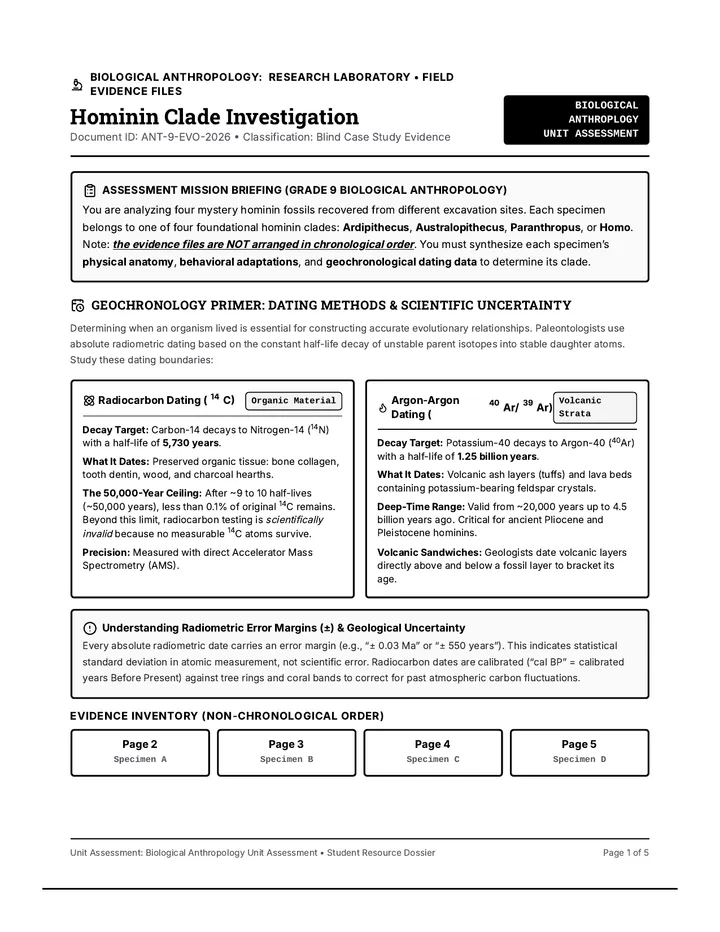
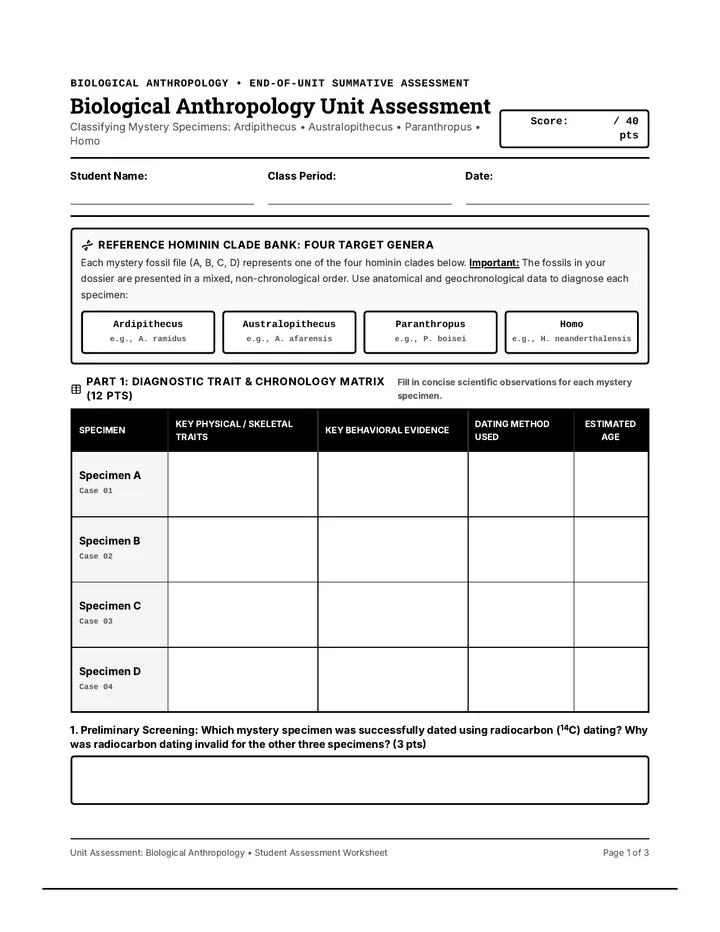
Mystery Fossil Dossier

Biological Anthropology Unit Assessment

An end-of-unit assessment where 9th-grade biological anthropology students analyze mystery hominin fossil profiles. Students examine physical skeletal adaptations, behavioral artifacts, and geochronological dating data to construct evidence-based classification arguments within the hominin evolutionary lineage.

KT

Kyle Trocolla

3
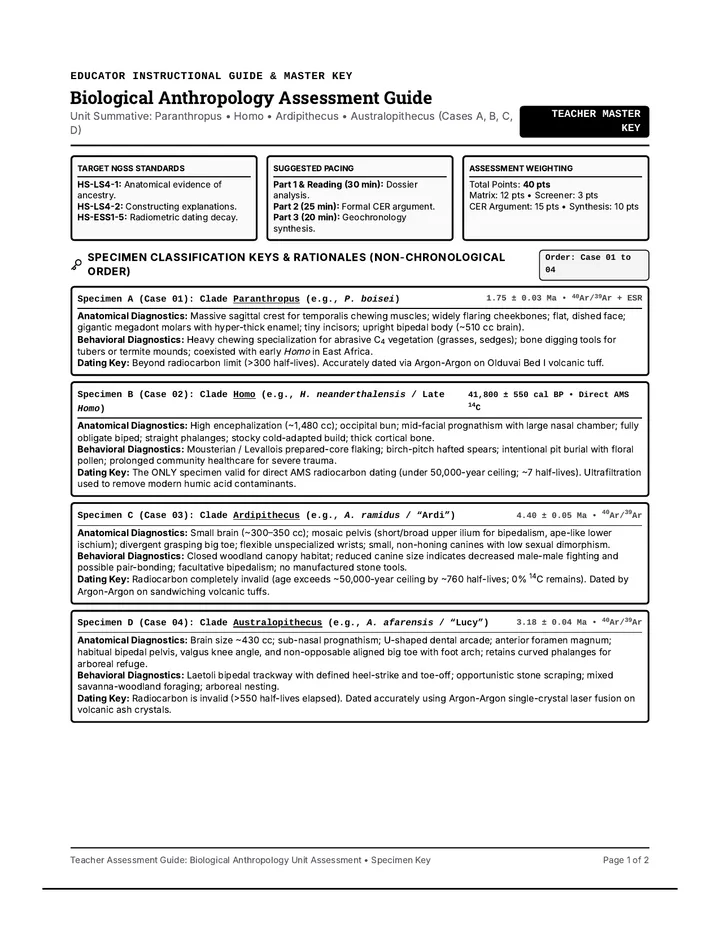
Fossil Assessment Teacher Guide

Fossil Assessment Teacher Guide

A two-page high-contrast black-and-white teacher assessment guide and scoring rubric for the hominin clade investigation. Features specimen classification keys for the non-chronological cases (Specimen A = Paranthropus, Specimen B = Homo, Specimen C = Ardipithecus, Specimen D = Australopithecus), diagnostic criteria, geochronology rationales, a four-tier rubric, and common ninth-grade misconceptions.

KT

Kyle Trocolla

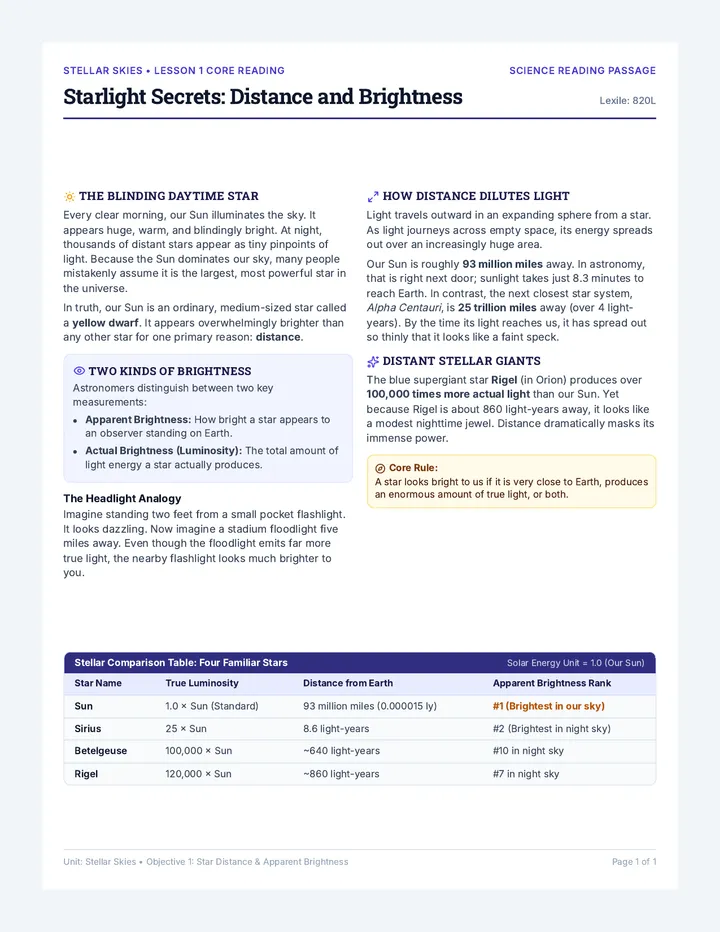
Starlight Secrets Reading Passage

Stellar Skies

A two-lesson science sequence investigating star brightness, apparent versus absolute luminosity, nightly sky rotation, and yearly seasonal constellations.

DB

Danny Brooks

8
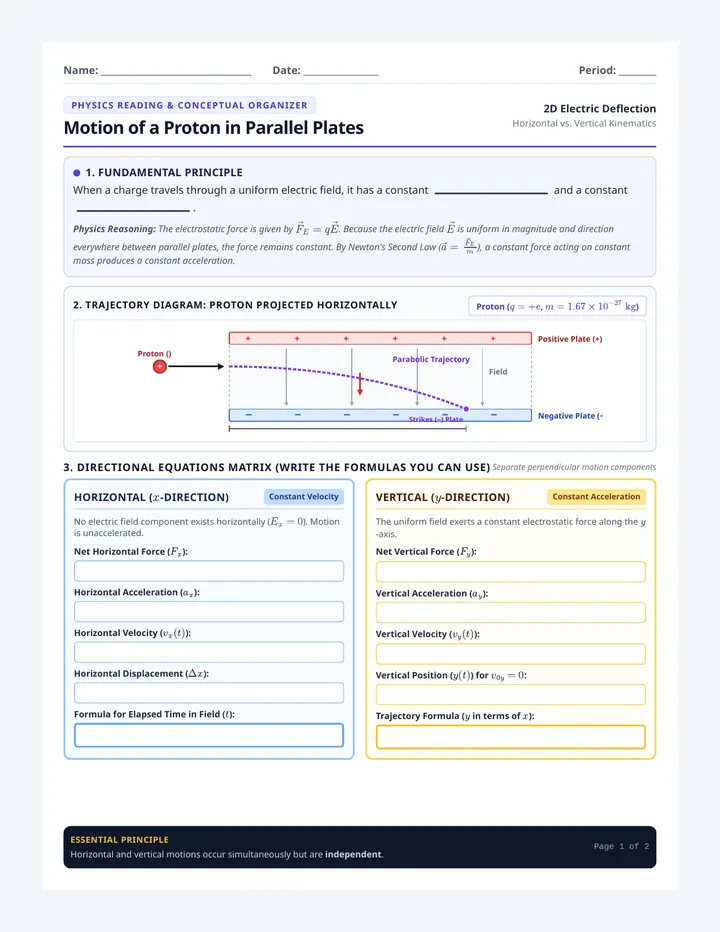
Electric Trajectories Reading Guide

Particle Trajectories

A comprehensive physics lesson exploring the 2D kinematics and forces acting on charged particles in uniform electric fields. Includes theoretical derivations, visual trajectory diagrams comparing protons and electrons, and practical application problems.

CM

Chuguna Murugesan

4
Fossil Argument Assessment Worksheet

Fossil Argument Assessment Worksheet

A three-page high-contrast black-and-white student assessment booklet where ninth graders synthesize evidence across four hominin clades (Ardipithecus, Australopithecus, Paranthropus, Homo) designated as Mystery Specimens A, B, C, and D. Students complete a comparative matrix, compose a formal CER classification argument, and evaluate radiometric dating boundaries.

KT

Kyle Trocolla

Binary Bytes Slides

Code Sparks

A four-week computer science enrichment unit for 4th graders introducing computational thinking fundamentals. Students progress from binary code and digital data representation to block-based algorithm logic, physical computing, and sensor-driven inventions with the micro:bit.

BK

Becky Krug

8
Cell Division Slides

Cell Division Duel

An introductory Life Science and Biology lesson for grades 7-9 exploring cell division and genetic recombination. Students compare mitosis and meiosis in biological purpose, chromosome counts, and the vital role of crossing over in creating genetic diversity.

KJ

Katelyn Johnson

8
Mystery Fossil Dossier

Mystery Fossil Dossier

A five-page high-contrast black-and-white forensic paleontology evidence dossier for ninth-grade biological anthropology. Mystery specimens are designated A, B, C, and D in non-chronological order: Specimen A is Paranthropus, Specimen B is Homo, Specimen C is Ardipithecus, and Specimen D is Australopithecus.

KT

Kyle Trocolla

Signal Anatomy Slides

Signal Masters

A hands-on systems engineering unit where 7th-grade students deconstruct communication components, model feedback loops and signal degradation, and engineer a custom communication system to solve a real-world scenario.

TC

Theresa Crafts

8
Organelle Powerhouse Slides

Organelle Powerhouse

Dives deep into internal cell machinery using the cell factory analogy to investigate energy release, protein synthesis, transport, and waste breakdown. Students master mitochondria, ribosomes, rough ER, smooth ER, Golgi bodies, lysosomes, vacuoles, and chloroplasts.

CP

Carmen Pavlovsky

4
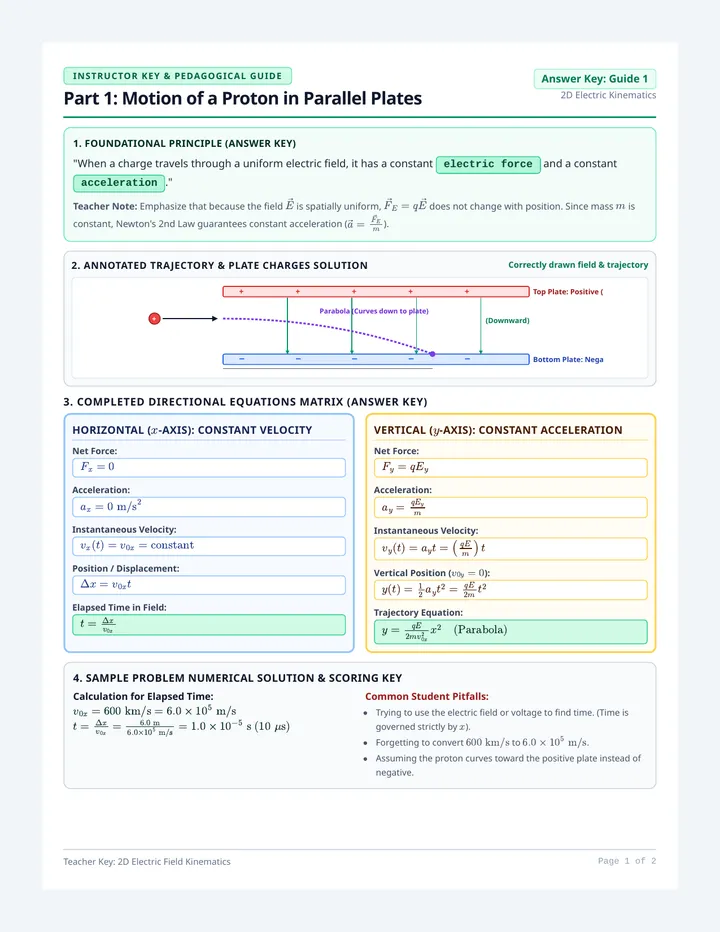
Particle Dynamics Teacher Key

Particle Dynamics Teacher Key

A comprehensive two-page teacher answer key and scoring guide providing complete solutions, filled equation matrices, annotated diagrams, pedagogical notes, and common misconception callouts for both the parallel plate deflection guide and the suspended charge equilibrium guide.

CM

Chuguna Murugesan