Electric Trajectories Reading Guide Name: ________________________________ Date: ________________
Period: ________
Physics Reading & Conceptual Organizer
Motion of a Proton in Parallel Plates
2D Electric Deflection
Horizontal vs. Vertical Kinematics
1. Fundamental Principle
When a charge travels through a uniform electric field, it has a constant and a constant .
Physics Reasoning: The electrostatic force is given by \(\vec{F}_E = q\vec{E}\). Because the electric field \(\vec{E}\) is uniform in magnitude and direction everywhere between parallel plates, the force remains constant. By Newton's Second Law (\(\vec{a} = \frac{\vec{F}_E}{m}\)), a constant force acting on constant mass produces a constant acceleration.
2. Trajectory Diagram: Proton Projected Horizontally Proton (\(q = +e\), \(m = 1.67 \times 10^{-27}\text{ kg}\))
Positive Plate (+) − − − − − − Negative Plate (−) \(\vec{E}\) Field + Proton (\(p^+\)) \(v_{0x} = 600\text{ km/s}\) Parabolic Trajectory Strikes (−) Plate \(\vec{F}_E = q\vec{E}\) \(\Delta x = 6\text{ m}\)
3. Directional Equations Matrix (Write the Formulas You Can Use)
Separate perpendicular motion components
Horizontal (\(x\)-Direction) Constant Velocity
No electric field component exists horizontally (\(E_x = 0\)). Motion is unaccelerated.
Net Horizontal Force (\(F_x\)):
Horizontal Acceleration (\(a_x\)):
Horizontal Velocity (\(v_x(t)\)):
Horizontal Displacement (\(\Delta x\)):
Formula for Elapsed Time in Field (\(t\)):
Vertical (\(y\)-Direction) Constant Acceleration
The uniform field exerts a constant electrostatic force along the \(y\)-axis.
Net Vertical Force (\(F_y\)):
Vertical Acceleration (\(a_y\)):
Vertical Velocity (\(v_y(t)\)):
Vertical Position (\(y(t)\)) for \(v_{0y} = 0\):
Trajectory Formula (\(y\) in terms of \(x\)):
Essential Principle
Horizontal and vertical motions occur simultaneously but are independent .
Page 1 of 2
Analytical Reading & Understanding
Field Rules, Trajectories & Time of Flight
Conceptual Mastery
Proton Beam Deflection
4. Determining Plate Charges and Field Direction
1. Field Line Rule Electric field lines \(\vec{E}\) always point from the positive \((+)\) plate toward the negative \((-)\) plate (high potential to low potential).
2. Proton Charge Rule A proton carries a positive charge (\(q = +e\)). By \(\vec{F}_E = q\vec{E}\), the force is in the exact same direction as the electric field.
3. Deflection Target The positive proton is repelled by the \((+)\) plate and attracted to the \((-)\) plate. Therefore, the plate it strikes must be negatively charged !
5. Why Is the Path Parabolic?
Because the force acts exclusively along the vertical axis, we have:
\(x(t) = v_{0x} t \implies t = \frac{x}{v_{0x}}\) and \(y(t) = \frac{1}{2} a_y t^2\)
Substituting \(t\) into the vertical position yields the trajectory equation: \(y = \left(\frac{qE}{2m v_{0x}^2}\right) x^2\). Because \(y\) is directly proportional to \(x^2\), the path is a parabola , mathematically identical to gravitational projectile motion.
6. Calculating Elapsed Time: The Power of Horizontal Independence Key Insight
Students often mistakenly think that the electric field strength or plate voltage determines how long the proton remains between the plates. This is incorrect!
Because there is no horizontal acceleration (\(a_x = 0\)), the proton continues to glide forward at constant speed \(v_{0x}\) regardless of how strongly it accelerates downward. The time \(t\) required to travel horizontal distance \(\Delta x = 6\text{ m}\) depends solely on horizontal motion:
\[t = \frac{\Delta x}{v_{0x}}\]
SI Conversion: \(v_{0x} = 600\text{ km/s} = 6.0 \times 10^5\text{ m/s}\)
Elapsed Time Result: \(t = \frac{6.0\text{ m}}{6.0 \times 10^5\text{ m/s}} = 1.0 \times 10^{-5}\text{ s} \; (10\text{ }\mu\text{s})\)
Energy Cross-Check: Accelerating a proton to \(6.0 \times 10^5\text{ m/s}\) requires kinetic energy: \(K = \frac{1}{2} m_p v^2 = \frac{1}{2}(1.67 \times 10^{-27})(6.0 \times 10^5)^2 \approx 3.0 \times 10^{-16}\text{ J}\).
Confirmed!
Summary Rule: Horizontal motion determines time of flight (\(t\)); vertical motion determines impact deflection (\(y\)). Page 2 of 2
Particle Deflection Visual Diagram Visual Anchor Chart & Reference
Charged Particle Deflection in a Uniform \(\vec{E}\) Field
Parallel Plate Dynamics
Proton (\(p^+\)) vs. Electron (\(e^-\))
Comparative Trajectory Schematic Both entering with identical speed \(v_{0x}\)
Proton (\(+e\)) Electron (\(-e\))
Positive Plate (\(+V\)) − − − − − − − Negative Plate (\(0\text{ V}\)) Uniform \(\vec{E}\) Field Direction: \((+) \to (-)\) \(d\) Initial Velocity \(\vec{v}_{0x}\) + Proton \(\vec{F}_p = +e\vec{E}\) Gentle Parabolic Path − Electron \(\vec{F}_e = -e\vec{E}\) Strikes Top Plate Early!
Proton (\(p^+\)) Heavy / Positive
Charge (\(q\)): \(+1.602 \times 10^{-19}\text{ C} \; (+e)\)Mass (\(m_p\)): \(1.673 \times 10^{-27}\text{ kg}\)Force Direction: Same direction as \(\vec{E}\) (downward, toward \(-\) plate).Acceleration: \(a_p = \frac{eE}{m_p}\)Deflection Path: Mild, gentle curvature. Moves much farther horizontally before striking.
Electron (\(e^-\)) Light / Negative
Charge (\(q\)): \(-1.602 \times 10^{-19}\text{ C} \; (-e)\)Mass (\(m_e\)): \(9.109 \times 10^{-31}\text{ kg}\)Force Direction: Opposite to \(\vec{E}\) (upward, toward \(+\) plate).Acceleration: \(a_e = \frac{eE}{m_e} \approx 1836 \cdot a_p\)Deflection Path: Sharp, intense curvature. Strikes the positive plate almost immediately.
# Why Is the Electron Deflected so Much More?
Both particles experience an electrostatic force of the exact same magnitude because they possess the same elementary charge magnitude \(e\):
\(|\vec{F}_p| = |\vec{F}_e| = eE\) BUT \(\frac{a_e}{a_p} = \frac{m_p}{m_e} \approx 1836\)
Because the proton is 1,836 times more massive than the electron, its inertia is vastly greater. Under the same force, the electron accelerates 1,836 times faster, producing an intensely curved trajectory compared to the proton's gentle deflection.
Three Golden Rules for Field Trajectory Problems
1. Field Points \(+ \to -\) Electric field vectors always initiate on positive plates and terminate on negative plates.
Suspended Charge Reading Guide Name: ________________________________ Date: ________________
Period: ________
Physics Reading & Conceptual Organizer
Equilibrium of a Suspended Charge in an \(\vec{E}\) Field
Static Equilibrium
String at Angle \(\theta\) with Wall
1. The Physics of Being "Held in Place" (Static Equilibrium)
When a charged mass is suspended by a string in a uniform electric field and remains stationary at a constant angle, it is in static equilibrium (\(\vec{a} = 0\)). By Newton's First Law, all forces along every independent direction must sum to zero:
\(\Sigma F_x = 0\) (Horizontal Balance) \(\Sigma F_y = 0\) (Vertical Balance)
2. Physical Setup & Free-Body Diagram (FBD) Draw all force vectors on the empty FBD
− − − − − Charged Wall \(\theta = 37^\circ\) − \(m = 0.04\text{ kg}\) \(q = -2\text{ }\mu\text{C}\) Free-Body Diagram (FBD) [Draw & label: \(\vec{T}\), \(\vec{F}_g\), \(\vec{F}_E\)] Sphere (\(-q\)) +x +y
3. Directional Equations Matrix (Formulas You Can Use)
Resolve forces along each axis independently
Vertical (\(y\)-Axis Balance) \(\Sigma F_y = 0\)
Upward component of tension balances downward gravity.
1. Tension Vertical Component:
2. Gravity Force Formula (\(F_g\)):
3. Vertical Equilibrium Equation (\(\Sigma F_y = 0\)):
4. Solved for String Tension (\(T\)):
Horizontal (\(x\)-Axis Balance) \(\Sigma F_x = 0\)
Horizontal component of tension balances electrostatic force.
1. Tension Horizontal Component:
2. Electric Force Formula (\(F_E\)):
3. Horizontal Equilibrium Equation (\(\Sigma F_x = 0\)):
4. Equating \(F_E\) to Tension Component:
Angle Measurement Note
Because \(\theta\) is measured from the vertical wall , the vertical component is \(\cos\theta\) and the horizontal component is \(\sin\theta\).
Page 1 of 2
Step-by-Step Problem Strategy
Determining \(\vec{E}\) Direction & Solving for Magnitude
Analytical Methods
Negative Charge & Field Vectors
4. How to Determine the Direction of the Electric Field (\(\vec{E}\))
Step 1: Identify \(\vec{F}_E\) The string is pushed outward away from the wall. Therefore, the electrostatic force \(\vec{F}_E\) must point to the right (away from wall) .
Step 2: Apply \(\vec{F}_E = q\vec{E}\) For a
Particle Dynamics Teacher Key Instructor Key & Pedagogical Guide
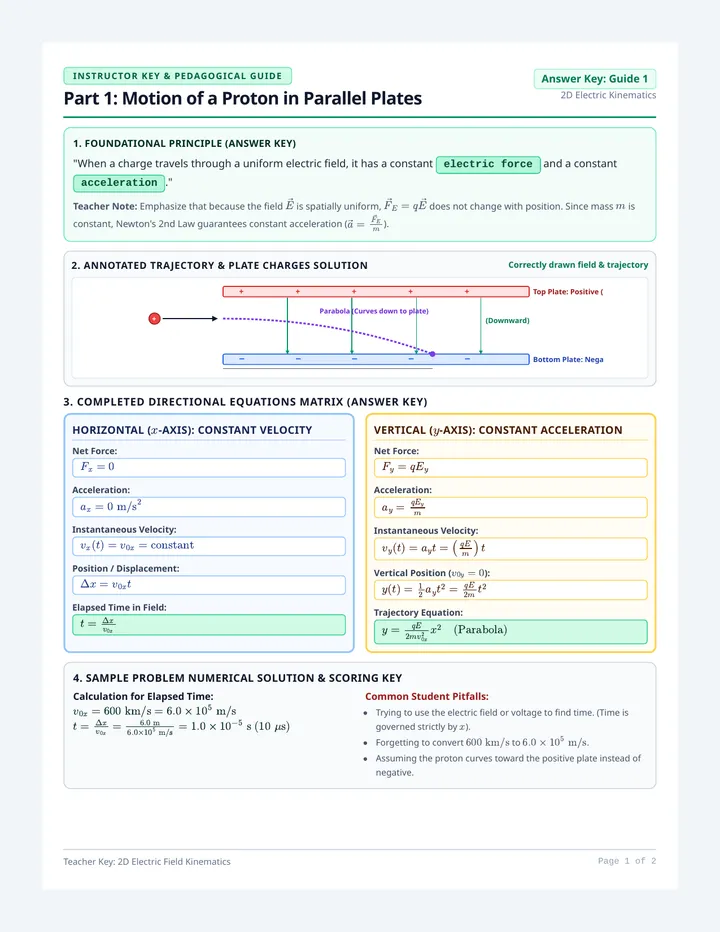
Part 1: Motion of a Proton in Parallel Plates
Answer Key: Guide 1
2D Electric Kinematics
1. Foundational Principle (Answer Key)
"When a charge travels through a uniform electric field, it has a constant electric force and a constant acceleration."
Teacher Note: Emphasize that because the field \(\vec{E}\) is spatially uniform, \(\vec{F}_E = q\vec{E}\) does not change with position. Since mass \(m\) is constant, Newton's 2nd Law guarantees constant acceleration (\(\vec{a} = \frac{\vec{F}_E}{m}\)).
2. Annotated Trajectory & Plate Charges Solution Correctly drawn field & trajectory
Top Plate: Positive (+) − − − − − Bottom Plate: Negative (−) \(\vec{E}\) (Downward) + \(v_{0x} = 600\text{ km/s}\) Parabola (Curves down to \(-\) plate) \(\Delta x = 6\text{ m}\)
3. Completed Directional Equations Matrix (Answer Key)
Horizontal (\(x\)-Axis): Constant Velocity
Net Force:
\(F_x = 0\)
Acceleration:
\(a_x = 0\text{ m/s}^2\)
Instantaneous Velocity:
\(v_x(t) = v_{0x} = \text{constant}\)
Position / Displacement:
\(\Delta x = v_{0x} t\)
Elapsed Time in Field:
\(t = \frac{\Delta x}{v_{0x}}\)
Vertical (\(y\)-Axis): Constant Acceleration
Net Force:
\(F_y = qE_y\)
Acceleration:
\(a_y = \frac{qE_y}{m}\)
Instantaneous Velocity:
\(v_y(t) = a_y t = \left(\frac{qE}{m}\right)t\)
Vertical Position (\(v_{0y}=0\)):
\(y(t) = \frac{1}{2} a_y t^2 = \frac{qE}{2m} t^2\)
Trajectory Equation:
\(y = \frac{qE}{2m v_{0x}^2} x^2 \quad \text{(Parabola)}\)
4. Sample Problem Numerical Solution & Scoring Key
Calculation for Elapsed Time:
\(v_{0x} = 600\text{ km/s} = 6.0 \times 10^5\text{ m/s}\)
Common Student Pitfalls:
Trying to use the electric field or voltage to find time. (Time is governed strictly by \(x\)).
Forgetting to convert \(600\text{ km/s}\) to \(6.0 \times 10^5\text{ m/s}\).
Assuming the proton curves toward the positive plate instead of negative.