OSU Space Sub Plan
Grade 3 • Science Emergency Sub Packet
OSU Space: Substitute Lesson Guide
Total Duration: 50 Minutes
Format: 100% Independent
Substitute Mission Briefing:
Students will complete a 3-page independent workbook about the Solar System, Deep Space, and Galaxies. Your only job is to hand out the packets, give the initial prompt, keep time, and collect completed work at the 50-minute mark. No prep, special materials, or science background required.
50-Minute Pacing Schedule
Launch 0–5 min
Distribute workbook. Have students write name and date. Read aloud the 30-second script.
Part 1: Solar 5–20 min
Students read "Our Cosmic Neighborhood" and complete Section A comprehension check.
Part 2: Deep 20–35 min
Students read "Beyond Our System" and write short answers for Section B.
Part 3 & Wrap 35–50 min
Complete vocabulary match & planet sort. Early finishers do mystery decode. Collect work.
Teacher Script (Read Aloud to Class at Start)
"Good morning! Today you are embarking on an independent space mission called 'OSU Space.' Everything you need is inside this packet. Read both articles carefully, take your time with each question, and work quietly on your own. If you have a question, reread the passage first. You will have exactly 45 minutes to finish all three pages. Mission starts now!"
Classroom Guidelines
- • Independent focus: Level 0 (silent) or Level 1 (whisper) independent desk work.
- • Restroom policy: Follow standard classroom hall pass rules; one student at a time.
- • Early Finishers: Must finish the Page 3 bonus challenge, then read a silent book at their desk.
Student Accommodations & Support
- • Reading Support: If a student struggles with decoding, you may read passage sentences aloud to them quietly.
- • Word Banks: All fill-in-the-blanks provide clear word banks directly above the question area.
- • Answer Key: Refer to the separate "OSU Space Answer Key" page for swift check-in.
Packets should be collected at the end of class and placed in the teacher mailbox.
Doc ID: OSU-SPACE-SUB
OSU Space Student Workbook
OSU Science • Independent Packet
OSU Space: Student Workbook
Name:
Date:
Mission Checklist:
Part 1: Solar System Part 2: Deep Space Part 3: Vocab & Sort
Reading 1
Our Cosmic Neighborhood: The Solar System
Read carefully
Our solar system is our home in space. In the very center sits the Sun, a super-hot ball of glowing gas that provides light and heat to our world. Eight planets travel around the Sun in curved circular paths called orbits. A powerful pulling force called gravity keeps each planet locked in its orbit so it does not drift away into the dark.
The four planets closest to the Sun are Mercury, Venus, Earth, and Mars. Scientists call these the inner planets because they are made of solid rock and metal. Earth is the only known planet with liquid water, air, and living things!
Past Mars, you will find Jupiter, Saturn, Uranus, and Neptune. These are the four outer planets. They are gigantic worlds made mostly of gas and ice. Jupiter is the largest planet of all, while Saturn is famous for its bright, shining rings made of ice chunks and dust.
Section A: Solar System Check (Fill in the correct bubble or write T/F)
- What invisible force keeps the planets traveling in orbit around the Sun?
A) Wind pressure
B) Gravity
C) Sunlight
D) Magnetism
- Which planet is an inner planet made of solid rock?
A) Jupiter
B) Mars
C) Neptune
D) Saturn
- True or False: The outer planets are made mostly of solid rock.
TRUE
FALSE
- True or False: Earth is the only known planet with liquid water and life.
TRUE
FALSE
OSU Space • Grade 3 Independent Packet Page 1 of 3
Part 2
Deep Space & Galaxies
Name:
Reading 2
Beyond Our Neighborhood: Deep Space
Read carefully
When you look into the night sky, you are peering into deep space. The universe is unfathomably huge! The distances between stars are so gigantic that standard miles or kilometers are too tiny to use. Instead, astronomers measure distance using light-years. A single light-year is the distance light travels in one entire year—nearly 6 trillion miles!
In deep space, you can find colorful glowing clouds called nebulae (one is called a nebula). These cosmic clouds are made of gas and stardust. Nebulae are like star nurseries because gravity pulls the dust together until a brand-new star ignites and shines!
Stars do not float alone. Billions of stars, gas, and dust are held together by gravity into massive swirling collections called galaxies. Our solar system lives inside a galaxy called the Milky Way. If you could view it from above, the Milky Way looks like a giant spinning pinwheel spiral. Scientists estimate there are more than two trillion galaxies across the entire universe!
Section B: Deep Space Comprehension
-
What is a nebula, and why do scientists often call it a "star nursery"?
-
What is the name of our home galaxy, and what does it look like from above?
-
Complete each sentence using the Word Bank:
Word Bank: Light-Year • Galaxy • Gravity
a) A is the distance that light travels in one full year.
b) A huge collection of billions of stars, dust, and gas held together is a .
c) The pulling force that holds stars and planets together in space is .
OSU Space • Grade 3 Independent Packet Page 2 of 3
Part 3
Vocabulary Mastery & Space Challenge
Name:
Activity 1: Vocabulary Match (write the correct letter on each blank line)
1. Orbit
2. Gravity
3. Nebula
4. Galaxy
5. Light-Year
A. A giant cloud of gas and dust where new stars form.
B. The curved circular path an object takes around a star.
C. A massive system of billions of stars, dust, and gas.
D. The distance that light travels through space in one year.
E. An invisible pulling force that keeps objects in orbit.
Activity 2: Solar System Planet Sort (write each planet in its correct category)
Planet Bank: Earth • Jupiter • Mars • Mercury • Neptune • Saturn • Uranus • Venus
Inner Planets (Solid Rock & Metal)
Outer Planets (Giant Gas & Ice)
Early Finisher Mission: Secret Astronaut Code!
Bonus
Use the letter key to crack the mystery message: 1=S, 2=P, 3=A, 4=C, 5=E, 6=E, 7=X, 8=P, 9=L, 10=O, 11=R, 12=E, 13=R
1
2
3
4
5
•
6
7
8
9
10
11
12
13
OSU Space • Grade 3 Independent Packet Page 3 of 3 (Final Page)
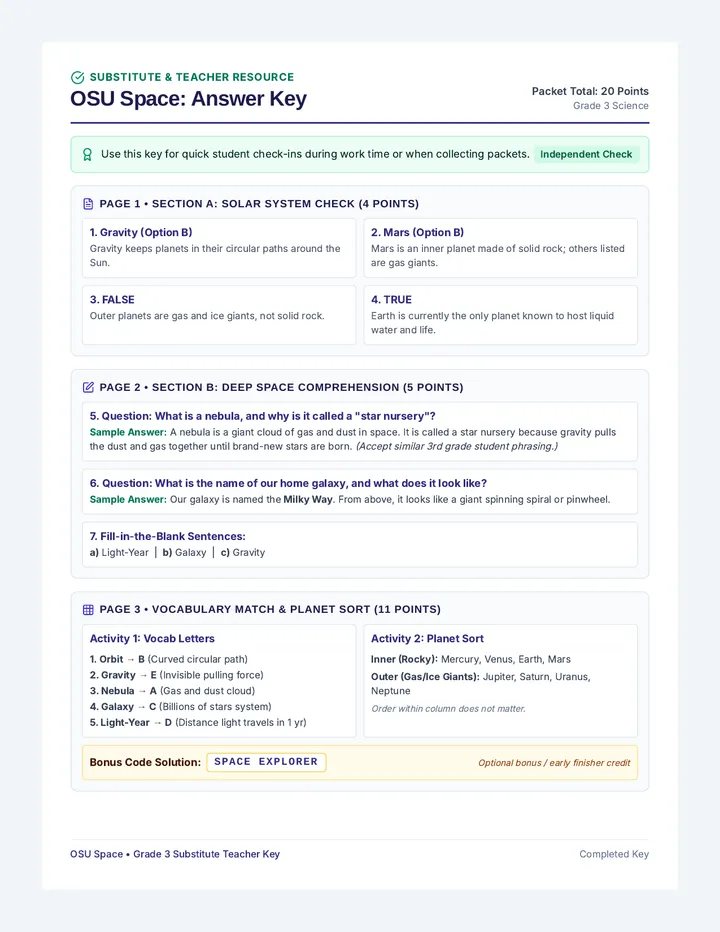
OSU Space Answer Key
Substitute & Teacher Resource
OSU Space: Answer Key
Packet Total: 20 Points
Grade 3 Science
Use this key for quick student check-ins during work time or when collecting packets.
Independent Check
Page 1 • Section A: Solar System Check (4 Points)
1. Gravity (Option B)
Gravity keeps planets in their circular paths around the Sun.
2. Mars (Option B)
Mars is an inner planet made of solid rock; others listed are gas giants.
3. FALSE
Outer planets are gas and ice giants, not solid rock.
4. TRUE
Earth is currently the only planet known to host liquid water and life.
Page 2 • Section B: Deep Space Comprehension (5 Points)
5. Question: What is a nebula, and why is it called a "star nursery"?
Sample Answer: A nebula is a giant cloud of gas and dust in space. It is called a star nursery because gravity pulls the dust and gas together until brand-new stars are born. (Accept similar 3rd grade student phrasing.)
6. Question: What is the name of our home galaxy, and what does it look like?
Sample Answer: Our galaxy is named the Milky Way. From above, it looks like a giant spinning spiral or pinwheel.
7. Fill-in-the-Blank Sentences:
a) Light-Year | b) Galaxy | c) Gravity
Page 3 • Vocabulary Match & Planet Sort (11 Points)
Activity 1: Vocab Letters
- 1. Orbit → B (Curved circular path)
- 2. Gravity → E (Invisible pulling force)
- 3. Nebula → A (Gas and dust cloud)
- 4. Galaxy → C (Billions of stars system)
- 5. Light-Year → D (Distance light travels in 1 yr)
Activity 2: Planet Sort
Inner (Rocky): Mercury, Venus, Earth, Mars
Outer (Gas/Ice Giants): Jupiter, Saturn, Uranus, Neptune
Order within column does not matter.
Bonus Code Solution: SPACE EXPLORER
Optional bonus / early finisher credit
OSU Space • Grade 3 Substitute Teacher Key Completed Key