Gear Spin Lab Worksheet VEX IQ STEM Robotics Lab
Gear Spin Lab Worksheet
Name:
Date:
Team / Kit #:
Plate Pitch:
Mission Objective: Mount one large gear and one small gear on your VEX IQ plate so their teeth interlock smoothly. Place a sticker dot at the 12 o'clock position on each gear to track rotations, verify gear ratios, and solve mechanical troubleshooting challenges.
Phase 1: Build & Sticker Setup
1 Mount on Plate
Insert two shafts into your pitch plate. Test hole spacing until teeth mesh cleanly without binding.
2 Add Sticker Dots
Stick one dot at top (12 o'clock) of Gear A. Stick dot at top (12 o'clock) of Gear B before turning.
3 Friction Check
Spin gently by hand. If it feels tight or skips teeth, adjust shaft position by exactly 1 pitch hole.
Gear Inventory & Initial Prediction
Count teeth carefully around each gear
Gear A (Smaller Gear):
Tooth count (\(T_A\)):
Diameter / Color:
Gear B (Larger Gear):
Tooth count (\(T_B\)):
Diameter / Color:
Hypothesis: If you rotate the small gear 1 full turn, the large gear will make:
More than 1 turn Exactly 1 turn Less than 1 turn
Test 1
Small Gear Drives Large Gear (Speed Reduction)
Driver = Small (Gear A) | Follower = Large (Gear B)
Set both stickers pointing straight up at 12 o'clock . Turn the Small Gear clockwise for the specified turns. Observe where the sticker on the Large Gear travels.
Trial
Driver Turns (Gear A)
Follower Sticker Position (Gear B)
Follower Turns (Gear B)
Follower Direction
Trial 1A
1 Full Turn Clockwise
Sticker stops at: ____ o'clock
Fraction / Dec: ______
CW / CCW
Trial 1B
2 Full Turns Clockwise
Sticker stops at: ____ o'clock
Total turns: ______
CW / CCW
Trial 1C
Turns to complete 1 full turn of B:
Sticker returns to 12 o'clock!
Exactly 1.0 Full Turn
Gear A turns = ____
1. Rotation Direction Check: When you turn the driver gear clockwise, which way does the meshed follower gear spin? Explain why meshing teeth cause this behavior.
2. Speed vs. Power Observation: Did the large follower gear spin faster or slower than your hand turning the small gear? How would this affect robot lifting power (torque)?
VEX IQ Curriculum Resource • Mechanical Transmission Series Page 1 of 2
Phase 2: Overdrive Testing & Troubleshooting Clinic
Student Name:
Test 2
Large Gear Drives Small Gear (Speed Multiplier / Overdrive)
Driver = Large (Gear B) | Follower = Small (Gear A)
Align stickers at 12 o'clock . Turn the Large Gear clockwise exactly 1 full rotation . Count how many complete spins the Small Gear sticker completes before returning to top.
Trial
Driver Turns (Gear B)
Follower Full Spins (Gear A)
Calculated Ratio (\(T_B \div T_A\))
Observed Speed
Trial 2A
1 Full Turn Clockwise
Sticker completes: _____ spins
Ratio: _____ : 1
Faster / Slower
Trial 2B
2 Full Turns Clockwise
Sticker completes: _____ spins
Total spins counted: _____
Faster / Slower
Key Finding: How does turning the large gear compare to turning the small gear in terms of effort needed and output speed?
Troubleshooting Clinic: Solve Common VEX IQ Gear Faults
! Fault A: Binding & Hard to Turn
Symptoms: Shafts feel locked or click stiffly when turned by hand.
Diagnostic & Plate Fix:
! Fault B: Gear Slipping / Skipping Teeth
Symptoms: Driver turns but follower sticker misses spins or slips.
Diagnostic & Plate Fix:
! Fault C: Axle Slop & Walking Gears
Symptoms: Gear slides horizontally along the shaft out of alignment.
Which VEX IQ piece fixes this?
! Fault D: Reverse Drive In Drivetrain
Symptoms: Robot motor spins forward, but the wheel rotates backward.
How to correct wheel direction?
The Golden Rules of Gear Ratios
Ratio = Follower Teeth ÷ Driver Teeth
When Small Gear Drives Large Gear:
• Output Speed: Decreases (takes more driver turns)Increases (great for lifting arms!)
When Large Gear Drives Small Gear:
• Output Speed: Increases (overdrive for fast drivetrains!)Decreases (can stall under heavy loads)
Design Challenge: Your robot needs to climb a steep 30° ramp carrying heavy balls. Would you configure your motor gear as the Small Gear or Large Gear ? Explain why.
Inspector Check
PASSED [ ]
Initials / Stamp
VEX IQ Curriculum Resource • Mechanical Transmission Series Page 2 of 2
Gear Systems Unit Slides VEX IQ STEM Robotics • Unit of Study
Engineering & Physics
Gear Systems & Speed Testing
From bench plates to timed robot sprints: master how gear ratios control speed, torque, and drivetrain velocity.
1 Bench Plate Ratio Lab
2 Clawbot Motor Relocation
3 Speed Trials (\(s = \frac{d}{t}\))
The Engineering Dilemma
Why Can't One Motor Do Everything?
Need 1: Maximum Speed
In competition, your robot must sprint across the arena to pick up game objects before the opponent.
Challenge: Direct motors spin at fixed RPM!
Need 2: Heavy Pushing Force
Other times, your robot must climb steep ramps, push heavy crates, or defend against opponent bots.
Challenge: Motors stall out under heavy load!
The Solution: Gear Ratios! Transform your motor's output without buying any new electronics.
Phase 1: Foundations
Bench Plate & Sticker Tracking
First Investigation
1
Mount on Plate
Place two shafts on a VEX IQ pitch plate. Mesh a small gear and large gear with zero binding.
2
Sticker Tracking
Place dot stickers at 12 o'clock. Turn the driver gear 1 full rotation and count output spins.
3
Direction Flip
Notice how meshing teeth reverse rotation! Clockwise driver creates counter-clockwise output.
Deliverable: Complete the Gear Spin Lab Worksheet and troubleshoot physical gear alignment faults.
Core Physics Principle
The Golden Trade-Off: Speed vs. Torque
Torque
Small Drives Large
Speed: Decreases (Takes more motor spins)
Torque (Power): Multiplies (Lifts heavy loads)
Formula: \(\text{Ratio} = \frac{T_{\text{driven}}}{T_{\text{driver}}} > 1\) (e.g., 3:1 or 5:1)
Overdrive
Large Drives Small
Speed: Multiplies (Super fast output)
Torque (Power): Decreases (Easy to stall motor)
Formula: \(\text{Ratio} = \frac{T_{\text{driven}}}{T_{\text{driver}}} < 1\) (e.g., 1:3 or 1:5)
Core Rule: You never get something for free in mechanics. Speed and torque always trade!
Phase 2: Mobile Robotics
Clawbot Base Bot Modifications
Why Modify the Base?
Standard VEX Clawbots direct-drive the wheel shaft. To test gear ratios on a real moving robot, we must create room for gear pairs between the motor and the wheel!
Keep it light: Remove the claw and arm tower for pure sprint speed testing.
1
Strip to Base Bot: Rolling chassis, Brain, battery, and 2 Smart Motors only.
2
Shift Motors Backward: Relocate Smart Motors 2 to 4 pitch holes back on the side beams.
3
Insert Gear Transmission: Lock gears onto motor and wheel shafts with shaft collars.
Deliverable: Adapt both left and right drivetrains symmetrically so the robot drives straight!
Phase 3: Velocity Science
Timed Sprints & The Speed Equation
The Speed Formula
\(\text{Speed} = \frac{\text{Distance}}{\text{Time}} \quad \left(s = \frac{d}{t}\right)\)
Measure how many inches or centimeters your Clawbot travels per second across the standardized track.
\(d = s \times t\) (Distance)
\(t = \frac{d}{s}\) (Time)
Standardized Track Test
Set fixed distance (e.g., 120 in or 300 cm).
Run bot at 100% velocity across finish line.
Run 3 timed trials per gear configuration.
Plot distance vs. time graphs to compare slope!
Deliverable: Complete the Clawbot Speed Worksheet and the Speed Equation Explorer Worksheet.
Engineering Mindset
Real Robots Encounter Problems!
!
Gear Binding
Shafts placed too close together pinch teeth and cause high friction.
!
Chassis Flex
Long beams twist under motor load, making gears separate and skip.
!
Motor Thermal Cut
Extreme overdrive gear ratios demand excessive current and shut motors off.
!
Steering Veer
Slight friction differences cause high-speed bots to pull left or right.
When something doesn't work, don't guess—diagnose the physical cause and iterate your design!
Unit Roadmap
Your Engineering Mission
Mission 1
Plate Ratio Lab
Test gear pairs on the bench. Track sticker rotations and master ratio calculations.
Mission 2
Clawbot Speed Sprints
Shift motors backward, install gear pairs, and conduct timed track speed runs.
Mission 3
The Speed Formula
Calculate velocity using \(s = \frac{d}{t}\), analyze distance-time graphs, and optimize bots.
Team Up with Your Lab Partner • Collect Your VEX IQ Kit Let's Build, Test & Race! →
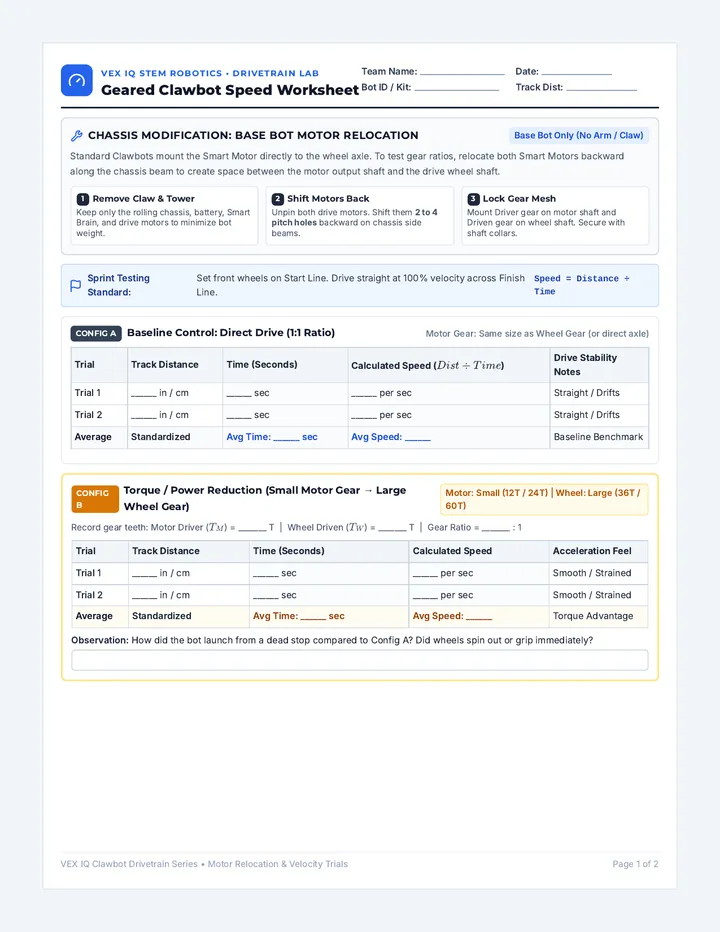
Geared Clawbot Speed Worksheet VEX IQ STEM Robotics • Drivetrain Lab
Geared Clawbot Speed Worksheet
Team Name:
Date:
Bot ID / Kit:
Track Dist:
Chassis Modification: Base Bot Motor Relocation
Base Bot Only (No Arm / Claw)
Standard Clawbots mount the Smart Motor directly to the wheel axle. To test gear ratios, relocate both Smart Motors backward along the chassis beam to create space between the motor output shaft and the drive wheel shaft.
1 Remove Claw & Tower
Keep only the rolling chassis, battery, Smart Brain, and drive motors to minimize bot weight.
2 Shift Motors Back
Unpin both drive motors. Shift them 2 to 4 pitch holes backward on chassis side beams.
3 Lock Gear Mesh
Mount Driver gear on motor shaft and Driven gear on wheel shaft. Secure with shaft collars.
Sprint Testing Standard: Set front wheels on Start Line. Drive straight at 100% velocity across Finish Line.
Speed = Distance ÷ Time
Config A
Baseline Control: Direct Drive (1:1 Ratio)
Motor Gear: Same size as Wheel Gear (or direct axle)
Trial
Track Distance
Time (Seconds)
Calculated Speed (\(Dist \div Time\))
Drive Stability Notes
Trial 1
______ in / cm
______ sec
______ per sec
Straight / Drifts
Trial 2
______ in / cm
______ sec
______ per sec
Straight / Drifts
Average
Standardized
Avg Time: ______ sec
Avg Speed: ______
Baseline Benchmark
Config B
Torque / Power Reduction (Small Motor Gear → Large Wheel Gear)
Motor: Small (12T / 24T) | Wheel: Large (36T / 60T)
Record gear teeth: Motor Driver (\(T_M\)) = _______ T | Wheel Driven (\(T_W\)) = _______ T | Gear Ratio = _______ : 1
Trial
Track Distance
Time (Seconds)
Calculated Speed
Acceleration Feel
Trial 1
______ in / cm
______ sec
______ per sec
Smooth / Strained
Trial 2
______ in / cm
______ sec
______ per sec
Smooth / Strained
Average
Standardized
Avg Time: ______ sec
Avg Speed: ______
Torque Advantage
Observation: How did the bot launch from a dead stop compared to Config A? Did wheels spin out or grip immediately?
VEX IQ Clawbot Drivetrain Series • Motor Relocation & Velocity Trials Page 1 of 2
Phase 2: Speed Overdrive Trials & Drivetrain Diagnostics
Team:
Config C
Speed Overdrive (Large Motor Gear → Small Wheel Gear)
Motor: Large (36T / 60T) | Wheel: Small (12T / 24T)
Record gear teeth: Motor Driver (\(T_M\)) = _______ T | Wheel Driven (\(T_W\)) = _______ T | Gear Ratio = 1 : _______
Trial
Track Distance
Time (Seconds)
Calculated Speed
Motor Strain / Whine
Trial 1
______ in / cm
______ sec
______ per sec
None / Loud Whine
Trial 2
______ in / cm
______ sec
______ per sec
None / Loud Whine
Average
Standardized
Avg Time: ______ sec
Avg Speed: ______
Overdrive Sprint
Observation: Did you notice an acceleration lag before reaching top speed? Did the bot steer straight at high velocity?
Drivetrain Velocity & Power Showdown
Configuration
Gear Ratio
Avg Time
Rank (1=Fastest)
Startup Acceleration
Estimated Pushing Power
Config A (Direct 1:1)
1 : 1
______ s
Rank: ____
Medium
Medium
Config B (Torque / Slow)
_____ : 1
______ s
Rank: ____
Instant / High
Maximum Push
Config C (Overdrive Speed)
1 : _____
______ s
Rank: ____
Sluggish Start
Weak / Stalls Easy
Drivetrain Troubleshooting Clinic: Diagnose & Solve
1. Chassis Beam Flex
Moving motors back made the chassis twist, causing gears to separate under load.
Structural Fix:
2. Motor Overcurrent Stall
In Config C, the Smart Motor clicked off after 3 seconds due to internal thermal fuse.
Physical Cause:
3. Severe Left/Right Pull
Robot veers heavily to one side even though both sides use identical gear pairs.
Friction Check:
Engineering Game Decision:
In the upcoming robot competition, your Clawbot must push a 2 lb heavy crate into a scoring zone while defending against defense bots. Which gear configuration would you choose and why?
Pit Crew Inspection
CERTIFIED [ ]
Sign / Stamp
VEX IQ Clawbot Drivetrain Series • Motor Relocation & Velocity Trials Page 2 of 2
Speed Equation Explorer Worksheet VEX IQ STEM Math & Physics
Speed Equation Explorer Worksheet
Name:
Date:
Team #:
Period:
The Speed Triangle: Connecting \(s\), \(d\), and \(t\)
Units: in/s, cm/s, or m/s
Formula Triangle
\(d\) (Distance)
\(s\) (Spd) × \(t\) (Time)
Cover the variable you want to solve!
1. Find Speed (\(s\))
\(s = \frac{d}{t}\)
Divide distance traveled by time taken.
2. Find Distance (\(d\))
\(d = s \times t\)
Multiply speed by total driving time.
3. Find Time (\(t\))
\(t = \frac{d}{s}\)
Divide distance by the robot's speed.
Predicting Proportions: What Controls Speed?
Scenario A: Same Distance, Less Time
Bot A and Bot B both travel 100 cm. Bot A finishes in 5 seconds; Bot B finishes in 10 seconds.
Which robot traveled faster? [ ] Bot A [ ] Bot B
When time (\(t\)) decreases for the same distance, speed (\(s\)) will: Increase / Decrease
Scenario B: Same Time, More Distance
Both robots run for exactly 4 seconds. Bot C covers 80 inches while Bot D covers 160 inches.
Which robot traveled faster? [ ] Bot C [ ] Bot D
When distance (\(d\)) increases in the same time, speed (\(s\)) will: Increase / Decrease
Guided Example 1 Goal: Solve for Speed (\(s\))
Prompt: A VEX IQ Clawbot with a 1:1 direct gear ratio drives along a testing track of 120 inches . A student's stopwatch measures the run at 4.0 seconds . What is the robot's average speed?
Step 1: Identify Knowns
\(d\) = ________ in
Step 2: Choose Formula
\(s = \frac{d}{t}\)
Step 3: Solve with Units
\(s =\) ________ ÷ ________Final: ________ in/s
Practice Problem 2 Goal: Solve for Distance (\(d\))
Prompt: An overdrive geared robot moves at a measured speed of 35 cm/s . If the driver runs the motor for 5.0 seconds , how far does the robot travel?
Formula & Setup:
Calculation & Final Answer (with units):
VEX IQ STEM Curriculum • Physics of Robotics Series Page 1 of 2
Phase 2: Speed Data Lab & Autonomous Mission Calculations
Student Name:
Robotics Lab Speed Run Calculations
Fill in the missing values in the data table using the appropriate variation of the speed triangle (\(s = \frac{d}{t}\), \(d = s \times t\), or \(t = \frac{d}{s}\)).
Robot Setup
Distance (\(d\))
Time (\(t\))
Show Your Work
Calculated Value
Speed Rank (1-4)
Sprint Bot A
180 cm
3.0 s
\(s = 180 \div 3.0\)
\(s =\) ______ cm/s
_____
Torque Bot B
120 cm
6.0 s
\(s =\) ____________
\(s =\) ______ cm/s
_____
Overdrive Bot C
Find \(d\)
4.0 s
\(d = 50 \times 4.0\) (if \(s=50\))
\(d =\) ______ cm
--
Cruiser Bot D
240 cm
Find \(t\)
\(t = 240 \div 40\) (if \(s=40\))
\(t =\) ______ s
--
Distance vs. Time Graph Analysis
Position vs. Time
Bot 1 (Steep) Bot 2 Bot 3 (Gentle) Distance Time (s)
Slope = Rate of Speed (\(\frac{\Delta d}{\Delta t}\))
1. Graph Slope Connection: Why does a steeper line represent a faster robot? Connect your answer to distance covered over time.
2. Gear Ratio Match: Which line (Bot 1, Bot 2, or Bot 3) represents the robot with a large motor gear driving a small wheel gear ? Explain.
Mission Control Challenge Autonomous Period Planning
In a VEX IQ competition, the autonomous routine lasts 15.0 seconds . Your team programmed your Clawbot to drive toward a scoring cube located 180 inches away. During practice, your bot clocked a constant speed of 14.0 in/s .
Part A: Calculate Time Needed Use \(t = \frac{d}{s}\):
Part B: Will it Reach in Time? Compare calculated time to 15.0 s:
Part C: Engineering Fix What gear adjustment would fix this?
Quick Check:
If you want your Clawbot to finish a 200 cm race in 4.0 seconds, what speed must it achieve? Speed = _______ cm/s
Teacher Sign-Off
CHECKED [ ]
VEX IQ STEM Curriculum • Physics of Robotics Series Page 2 of 2