A comprehensive emergency substitute curriculum spanning core reading strategies, earth science weather systems, and middle school mathematics on ratios and rates. Features step-by-step substitute plans, student passages and worksheets with extensive practice problems, and full answer keys.
[¶6] This discovery altered astrobiology—the search for life beyond Earth. If ecosystems can thrive in total darkness fueled by volcanic heat and sulfur, living things do not need sunny planetary surfaces. Scientists now suspect that icy moons like Jupiter’s Europa and Saturn’s Enceladus harbor liquid oceans over geothermal seafloors. If vents exist under those alien ice crusts, chemosynthetic alien life may already exist in our solar system.
6. What was the specific name of the research submarine that made the 1977 discovery?
Submarine Name: __________________________________ (Found in Paragraph: _____)
7. Extended Response: Detail Synthesis
Write at least 3 complete sentences
Explain how the discovery of hydrothermal vents changed scientists’ understanding of the requirements for life. Cite at least two specific details from the passage in your answer.
Detail Detectives ELA Unit • Grade 5-7 Page 2 of 2 • Submit completed packet to substitute teacher
Notes on student engagement: ____________________________________________________________________
[¶5] Similarly, medical engineers examined why sharks never accumulate algae, barnacles, or bacterial slime despite swimming slowly in microbe-infested oceans. Shark skin is covered in microscopic riblet scales called denticles arranged in a distinct diamond pattern. These ridges physically disrupt liquid flow and prevent bacterial cells from latching onto surfaces and forming sticky biofilms. Hospital manufacturers adapted this texture into Sharklet adhesive film, which lines operating room doors and trays, reducing bacterial growth by over 94% without the use of chemical disinfectants or antibiotics.
[¶6] These examples reveal an essential truth: nature represents an open-source patent office containing solutions tested over millions of generations. As humans face pressing environmental challenges—from fossil fuel consumption to urban heating—biomimicry encourages researchers to stop viewing nature merely as a warehouse of raw materials to extract, and instead treat it as a master teacher offering sustainable design wisdom.
Directions: Complete each section using specific textual evidence from Page 1. Record the paragraph number where you found your answer.
1. What specific physical problem did the original Shinkansen bullet train cause in mountain tunnels? Found in: ¶ _____
A) Metal wheels overheated from extreme tunnel friction.
B) Compressed air produced a loud sonic boom upon exit.
C) Tunnel dust clogged the train's electrical engine filters.
D) Passengers experienced severe disorientation in the dark.
2. Why do African termites construct intricate vertical flues inside their mounds? Found in: ¶ _____
A) To trap rainwater during severe desert flash floods.
B) To maintain a constant temperature for their delicate fungal gardens.
C) To escape burrowing predatory anteaters and snakes.
D) To let sunlight directly heat the queen termite's chamber.
3. How does the gecko lizard cling to smooth vertical surfaces without chemical glue? Found in: ¶ _____
A) Billions of nanoscale spatulae use molecular van der Waals forces.
B) Tiny suction cups on each claw create vacuum pressure.
C) Specialized sweat glands secrete microscopic silk anchors.
D) Strong magnetic mineral deposits in its bones attract glass silica.
4. How does shark skin prevent bacteria from multiplying on hospital surfaces? Found in: ¶ _____
A) It releases microscopic doses of chemical antibiotic toxins.
B) Diamond-patterned denticle ridges physically disrupt bacterial settlement.
C) Microscopic scales generate an electrical charge that zaps germs.
D) The texture absorbs moisture so rapidly that bacteria dehydrate.
Part B: Evidence Matching Matrix (Fill in all columns)
Organism / Animal
Key Biological Detail / Adaptation
Human Invention / Application
Paragraph
Kingfisher
Wedge-shaped, tapering beak enters water cleanly
______________________________________
¶ 2
Mound Termite
Vertical flues and vents for thermosiphon airflow
______________________________________
¶ _____
Gecko Lizard
Microscopic setae hairs and nanoscale spatulae
______________________________________
¶ _____
5. Extended Response: Detail-Based Explanation
Write at least 3 complete sentences
Choose one of the inventions described in the text. Explain how the engineers proved that natural biological adaptations were superior to conventional mechanical solutions. Cite at least two key details.
Evidence Trackers ELA Unit • Grade 5-7 Page 2 of 2 • Submit completed packet to substitute teacher
3 Points:
2 Points: Identifies the invention and animal, but provides only 1 supporting detail or vague explanation.
1 Point: Mentions an animal or invention without explaining the engineering benefit.
Class engagement level: [ Outstanding / Normal / Restless ] | Notes on specific students: ___________________________
rear flank downdraft (RFD)
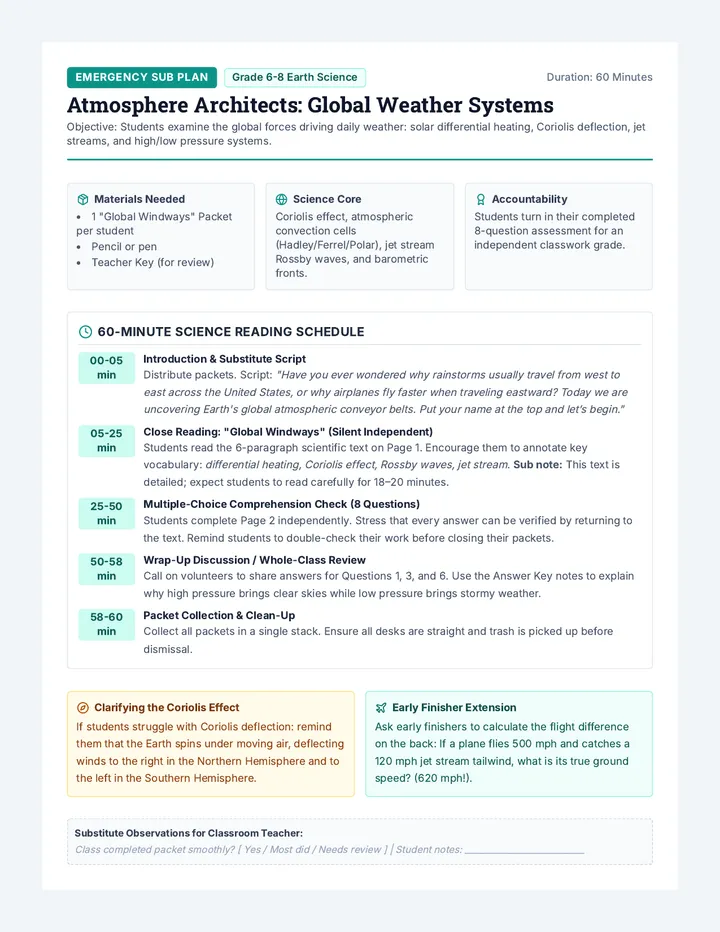
[¶5] When this violently rotating column of air touches the ground, it officially becomes a tornado. Meteorologists rank tornadoes on the Enhanced Fujita (EF) scale, which estimates wind speeds from EF-0 (gales of 65–85 mph) to EF-5 (catastrophic winds exceeding 200 mph capable of sweeping well-built homes clean off their foundations). Within the tornado’s central funnel, barometric air pressure plummets dramatically, creating a partial vacuum that causes debris, trees, and vehicles to be sucked upward into the vortex.
[¶6] Supercells are also electrical factories. In the frigid upper levels of the thunderhead, turbulent updrafts violently fling lighter ice crystals into heavier, semi-frozen pellets called graupel. During these millions of microscopic collisions, electrons are stripped from ascending ice crystals and deposited onto descending graupel. Consequently, the top of the storm cloud develops a massive positive electrical charge, while the base becomes intensely negative. When the electric potential difference overcomes atmospheric resistance, a blinding channel of plasma—lightning—discharges, heating the surrounding air to 30,000°C (54,000°F) in a fraction of a second and creating the shockwave we hear as thunder.
Directions: Select the best answer for each question based on the text. Write your answer letter in the bracket provided [ ].
1. What serves as the primary "fuel" that accelerates a thunderstorm’s updraft into the upper atmosphere? [ ]
A) Friction from surface debris entering the funnel
B) Latent heat released when water vapor condenses
C) Solar ultraviolet radiation heating cloud tops
D) Cold air falling rapidly during the downdraft
2. What is the key atmospheric ingredient that causes an updraft to begin rotating into a mesocyclone? [ ]
A) Extreme oceanic tides pulling air downward
B) Rapid freezing of rainwater into large hail
C) Vertical wind shear from differing wind speeds/directions
D) The total absence of horizontal air currents
3. Why are supercells able to last for hours, whereas ordinary single-cell thunderstorms die within 60 minutes? [ ]
A) The tilted rotating structure prevents cold downdrafts from choking the warm updraft
B) Supercells generate electrical heat that prevents any rain from falling
C) Ground friction completely stops the wind beneath supercells
D) Supercells only form over warm tropical oceans without land barriers
4. According to Paragraph 4, why does rotating air spin faster as it is squeezed toward the ground? [ ]
A) Chemical reactions with ozone gas accelerate wind
B) Conservation of angular momentum narrows the rotating radius
C) Warm raindrops heat the center of the spinning cylinder
D) The Earth’s gravitational field pulls the cloud sideways
5. What physical threshold must be crossed for a rotating funnel cloud to be classified as a tornado? [ ]
A) The rotating column of air must make physical contact with the ground
B) Wind speeds must exceed 300 miles per hour
C) Hail must reach the size of baseballs
D) Lightning must strike the center of the vortex at least three times
6. What happens to barometric air pressure inside a tornado’s central funnel? [ ]
A) It increases dramatically, pushing downward on buildings
B) It remains completely identical to surrounding air pressure
C) It plummets steeply, producing a strong upward partial vacuum
D) It fluctuates between positive and negative magnetic charges
7. How does electrical charge become separated to create lightning inside a thunderhead? [ ]
A) Solar rays charge the exterior edges of the storm anvil
B) Fast-moving water drops react chemically with sulfur dioxide
C) Violent collisions between rising ice crystals and falling graupel strip electrons
D) Radar waves emitted from meteorology towers energize cloud particles
8. What produces the loud sonic boom heard as thunder? [ ]
A) Giant hailstones crashing into one another in midair
B) Rapid thermal expansion of air superheated to 30,000°C by lightning plasma
C) The collapse of the mesocyclone when it strikes mountain peaks
D) Soundwaves bouncing off the stratosphere from high-altitude jet streams
Storm Chasers Science Unit • Grade 6-8 Page 2 of 2 • Turn in completed assessment to substitute teacher
Prompt 2:"What is the difference between a Tornado Watch and a Tornado Warning?" (Watch = conditions are favorable for supercells; Warning = a funnel or rotating mesocyclone has been spotted or detected on Doppler radar).
Class completed packet smoothly? [ Yes / Most did / Needs review ] | Student notes: ___________________________
Rossby waves
[¶5] Daily local weather is dictated by the passage of high and low pressure systems beneath these upper winds. In a low-pressure system (a depression or cyclone), warm air converges and spirals upward in a counter-clockwise direction (in the Northern Hemisphere). As this air ascends, it cools, forcing moisture to condense into heavy clouds and precipitation. Conversely, in a high-pressure system (an anticyclone), cool air gently sinks toward the ground and spirals clockwise outward. Sinking air compresses and warms, preventing clouds from forming and producing crisp, sunny skies.
[¶6] Finally, the atmosphere does not operate in isolation—it is intimately coupled to Earth’s world ocean. Vast oceanic currents, such as the Gulf Stream, act as liquid conveyor belts transporting immense stores of tropical heat toward Northern Europe. When warm seawater warms the overlying air, it alters barometric pressure gradients, demonstrating that Earth's weather is an interconnected, planet-wide fluid system.
Global Windways: Comprehension Assessment Student Name: ___________________________________
Directions: Read each question and choose the best scientific answer based on Page 1. Write your letter in the bracket [ ].
1. Why does the equator receive significantly more concentrated thermal energy than the poles? [ ]
A) Sunlight strikes the equator at a direct 90-degree angle rather than an oblique angle
B) The equator is 50 million kilometers closer to the sun than the poles
C) The atmospheric ozone layer is completely absent over the equator
D) Volcanic seafloor vents only heat the equatorial ocean waters
2. What causes moving air in the Northern Hemisphere to curve toward the right? [ ]
A) The gravitational pull of the moon during full moon phases
B) Earth’s rotation on its axis creating the Coriolis effect
C) Friction generated by towering mountain ranges
D) Magnetic currents flowing from the South Pole to the North Pole
3. Which global wind belt is primarily responsible for steering weather systems from west to east across North America? [ ]
A) The Tropical Trade Winds
B) The Polar Easterlies
C) The Prevailing Westerlies
D) The Doldrums Calms
4. What are Rossby waves as described in Paragraph 4? [ ]
A) Gigantic undulating meanders in the high-altitude jet stream
B) Underwater tsunami waves generated by oceanic earthquakes
C) Soundwaves produced by lightning discharges in the stratosphere
D) Periodic solar flares that disrupt satellite communications
5. Why do low-pressure systems typically bring cloudy, overcast, or rainy weather? [ ]
A) Air sinks rapidly, compressing water vapor into dry gas
B) Converging warm air rises and cools, causing water vapor to condense
C) Low pressure absorbs all ozone gas, letting in cold space vacuum
D) Sinking cold air pushes existing clouds down to ground level as fog
6. What weather conditions are typically associated with an anticyclone (high-pressure system)? [ ]
A) Prolonged blizzards and severe gale-force winds
B) Rapidly building supercell thunderstorms and tornadoes
C) Sinking air that warms and prevents cloud formation, bringing clear skies
D) Heavy continuous downpours and low cloud ceilings
7. What happens when the Polar Jet Stream takes a deep southward dip into the central United States? [ ]
A) It draws freezing arctic air masses down into temperate regions
B) It immediately stops all global ocean currents from circulating
C) It pushes warm tropical hurricanes across Canada
D) It reverses the spin of the Earth’s Hadley Cells
8. How does the Gulf Stream ocean current influence weather in Northern Europe? [ ]
A) It freezes the North Atlantic, causing permanent sub-zero blizzards
B) It transports warm tropical seawater northward, moderating coastal European climates
C) It blows dry desert dust across the Atlantic Ocean into London
D) It pulls cold water from the Arctic into the Caribbean Sea
Atmosphere Architects Science Unit • Grade 6-8 Page 2 of 2 • Turn in completed assessment to substitute teacher
"Why do commercial airplanes flying from Los Angeles to New York take about an hour less time than flying from New York to Los Angeles?"
Prompt 2:"Why are most of the world's great deserts located around 30 degrees latitude north and south?" (Answer: Descending air from the dry edge of Hadley cells creates permanent high-pressure belts where sinking air prevents rain clouds from forming).