Reason for Seasons Notes Earth & Space Science Investigation
Reason for Seasons
Name:
Date:
Period:
Score:
Directions: Use the provided reading passage to complete all questions, diagrams, and data analyses below. Support your answers with text evidence.
Part 1: Earth Mechanics
1
Busting the Distance Myth
1. Many people mistakenly believe Earth has summer because it is physically closer to the Sun. What specific orbital evidence from the text disproves this claim?
2. If distance from the Sun were the actual cause of seasons, what seasonal phenomenon would occur across the entire globe in December?
2
Solar Angle, Intensity, & Atmosphere
High Sun Angle (Summer) Direct Rays
Sun strikes at a steep, direct angle. Rays pass through less atmosphere.
Intensity of solar radiation:
Low Sun Angle (Winter) Slanted Rays
Sun strikes at a shallow angle. Rays pass through more atmosphere.
Intensity of solar radiation:
3. Why does sunlight passing through more atmosphere result in cooler surface temperatures? Explain the two factors described in the reading.
3
Solstices & Equinoxes Identification
Match each celestial event with its correct description and approximate calendar date based on the passage.
Astronomical Event
Approx. Date(s)
Hemisphere Orientation & Daylight Characteristics
Summer Solstice (Northern Hem.)
Northern Hemisphere tilts maximally toward Sun; longest period of daylight of the year.
Winter Solstice (Northern Hem.)
| Northern Hemisphere tilts away; shortest period of daylight; first day of summer in Southern Hem. |
| Equinoxes ("Equal Night") |
| Sun is directly over the Equator; neither hemisphere tilts toward Sun; ~12 hours of day and night. |
4. How many degrees is Earth's rotational axis currently tilted relative to the plane of its orbit?
0.1° 23.5° 42.0° 98.0°
Unit: Earth, Sun, & Seasonal Dynamics Page 1 of 2
Earth & Space Science Investigation
Planetary Seasons & Deep Analysis
Student Name:
Directions: Apply thermal principles, hemisphere comparisons, and planetary obliquity data to answer Parts 4 through 6.
Part 2: Climate & Planets
4
Understanding "Seasonal Lag"
5. On average, December 21 has the shortest period of daylight in the Northern Hemisphere. However, it is rarely the coldest day of the year. According to the text, why does the coldest weather usually not arrive until late January or early February?
Hint: What physical bodies on Earth take several weeks to lose their stored heat?
5
Hemisphere Comparison Scenario
6. Imagine it is July 15th. Complete the comparison table below for someone living in Chicago (Northern Hemisphere) versus someone living in Melbourne, Australia (Southern Hemisphere):
Comparison Factor
Chicago (Northern Hem.)
Melbourne (Southern Hem.)
Hemisphere Tilt Direction
Tilted toward / away
Tilted toward / away
Sunlight Ray Angle
Direct / Slanted
Direct / Slanted
Daylight Length
Longer / Shorter days
Longer / Shorter days
Current Season
|
6
Planetary Obliquity Data Lab
The table at the bottom of the reading provides the axial tilt (obliquity) of different planets in our solar system:
Mercury 0.1°
Jupiter 3°
Earth 23.5°
Saturn 27°
Uranus 98°
7. Uranus has an extreme axial tilt of approximately 98° and takes 84 Earth years to orbit the Sun. How does this tilt create 42-year long seasons on Uranus?
8. Based on axial tilt alone, which planet (Mercury or Jupiter) would experience almost no noticeable seasonal temperature changes as it orbits the Sun? Explain why.
Unit: Earth, Sun, & Seasonal Dynamics Page 2 of 2
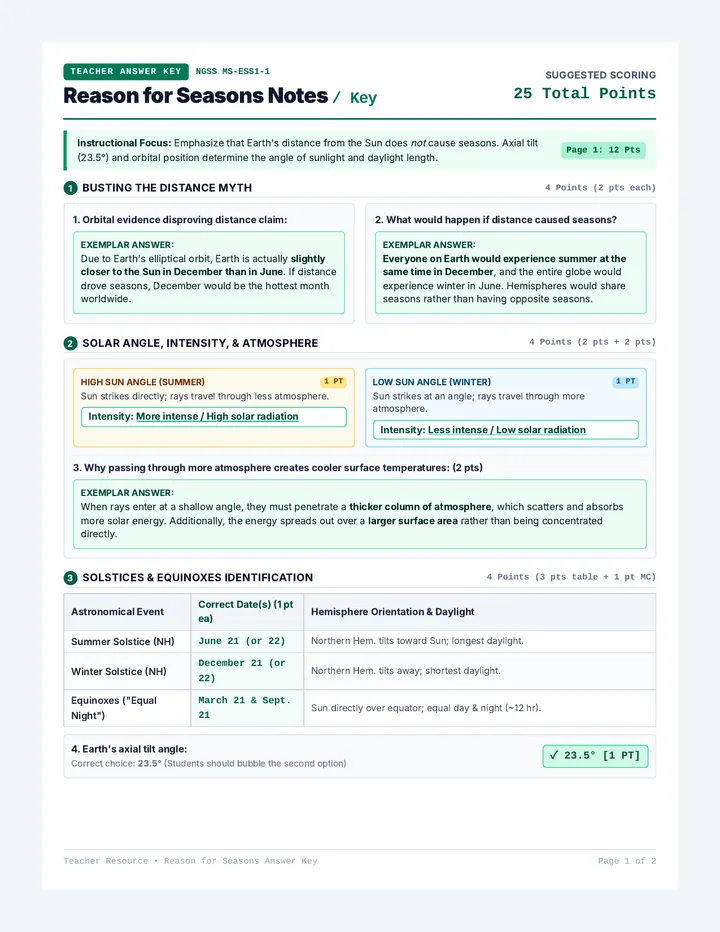
Reason for Seasons Answer Key Teacher Answer Key NGSS MS-ESS1-1
Reason for Seasons Notes / Key
Suggested Scoring
25 Total Points
Instructional Focus: Emphasize that Earth's distance from the Sun does not cause seasons. Axial tilt (23.5°) and orbital position determine the angle of sunlight and daylight length.
Page 1: 12 Pts
1
Busting the Distance Myth
4 Points (2 pts each)
1. Orbital evidence disproving distance claim:
Exemplar Answer: Due to Earth's elliptical orbit, Earth is actually slightly closer to the Sun in December than in June . If distance drove seasons, December would be the hottest month worldwide.
2. What would happen if distance caused seasons?
Exemplar Answer: Everyone on Earth would experience summer at the same time in December , and the entire globe would experience winter in June. Hemispheres would share seasons rather than having opposite seasons.
2
Solar Angle, Intensity, & Atmosphere
4 Points (2 pts + 2 pts)
High Sun Angle (Summer) 1 PT
Sun strikes directly; rays travel through less atmosphere.
Intensity: More intense / High solar radiation
Low Sun Angle (Winter) 1 PT
Sun strikes at an angle; rays travel through more atmosphere.
Intensity: Less intense / Low solar radiation
3. Why passing through more atmosphere creates cooler surface temperatures: (2 pts)
Exemplar Answer: When rays enter at a shallow angle, they must penetrate a thicker column of atmosphere , which scatters and absorbs more solar energy. Additionally, the energy spreads out over a larger surface area rather than being concentrated directly.
3
Solstices & Equinoxes Identification
4 Points (3 pts table + 1 pt MC)
Astronomical Event
Correct Date(s) (1 pt ea)
Hemisphere Orientation & Daylight
Summer Solstice (NH)
June 21 (or 22)
Northern Hem. tilts toward Sun; longest daylight.
Winter Solstice (NH)
December 21 (or 22)
Northern Hem. tilts away; shortest daylight.
Equinoxes ("Equal Night")
March 21 & Sept. 21
Sun directly over equator; equal day & night (~12 hr).
4. Earth's axial tilt angle:
Correct choice: 23.5° (Students should bubble the second option)
✓ 23.5° [1 PT]
Teacher Resource • Reason for Seasons Answer Key Page 1 of 2
Teacher Answer Key Climate & Solar System
Planetary Seasons & Deep Analysis / Key
Page 2: 13 Pts
4
Understanding "Seasonal Lag"
3 Points
5. Why coldest weather arrives in late January/February rather than Dec 21:
Exemplar Answer: Even though December 21 receives the least daylight, there is a thermal delay (seasonal lag) . It takes several weeks for Earth's atmosphere and oceans to cool down and lose heat accumulated during summer/fall. Earth continues to lose more heat than it absorbs through January.
5
Hemisphere Comparison Scenario (July 15)
4 Points (0.5 pt per cell)
July 15 occurs between June Solstice and September Equinox:
Factor
Chicago (Northern Hem.)
Melbourne (Southern Hem.)
Hemisphere Tilt
Tilted toward Sun
Tilted away from Sun
Sunlight Ray Angle
Direct (Steep angle)
Slanted (Shallow angle)
Daylight Length
Longer days (>12 hours)
Shorter days (<12 hours)
Current Season
Summer
Winter
6
Planetary Obliquity Data Lab
6 Points (3 pts each)
7. How Uranus's 98° tilt creates 42-year seasons during its 84-year orbit:
Exemplar Answer: Because Uranus is tilted 98°, it rotates virtually on its side. As it travels its 84-year orbit, one hemisphere points almost directly toward the Sun for half the orbit (42 Earth years of continuous summer daylight) , while the other hemisphere points away in complete darkness and frigid winter.
8. Planet with almost NO seasonal changes (Mercury or Jupiter):
Exemplar Answer: Either Mercury (tilt 0.1°) or Jupiter (tilt 3°) . With virtually no axial tilt, neither hemisphere tilts toward or away from the Sun at any point during its orbit. Therefore, the angle of incoming sunlight and the length of daylight remain constant year-round.
Teacher Tips & Common Student Misconceptions:
Watch for: Students writing "distance" anywhere as an explanation for temperature changes. Remind them perihelion occurs in January!Sun angle vs. distance: Reiterate that angle changes both energy concentration per unit area and atmospheric filtration .Uranus distinction: Highlight that extreme tilt creates extreme seasons, whereas near-zero tilt creates no seasons at all.
Teacher Resource • Reason for Seasons Answer Key Page 2 of 2
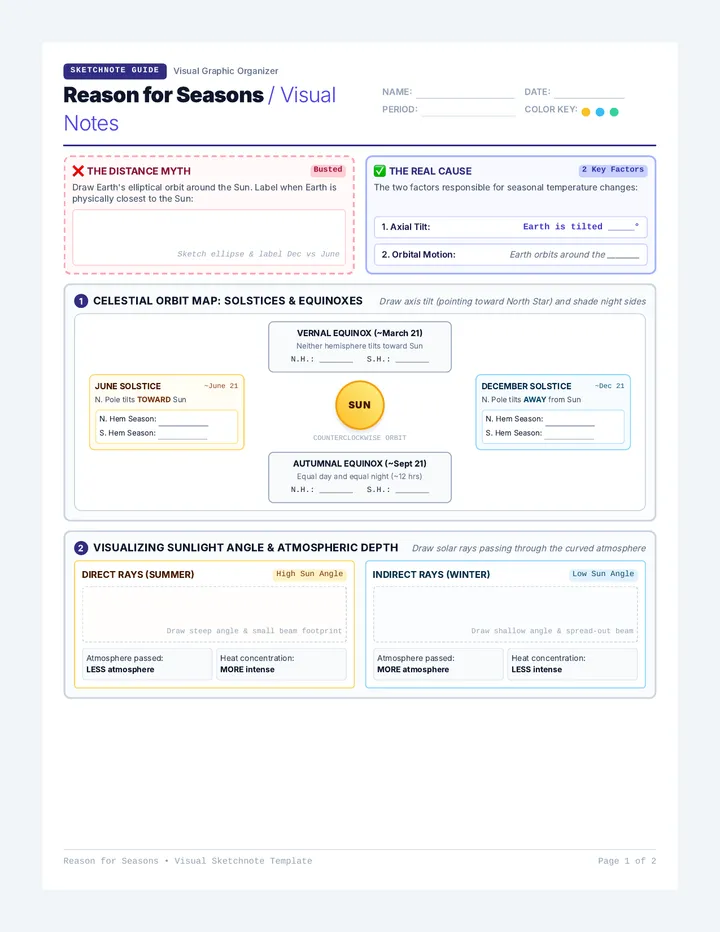
Seasons Visual Notes Template Sketchnote Guide Visual Graphic Organizer
Reason for Seasons / Visual Notes
NAME:
DATE:
PERIOD:
COLOR KEY:
❌ THE DISTANCE MYTH Busted
Draw Earth's elliptical orbit around the Sun. Label when Earth is physically closest to the Sun:
Sketch ellipse & label Dec vs June
✅ THE REAL CAUSE 2 Key Factors
The two factors responsible for seasonal temperature changes:
1. Axial Tilt: Earth is tilted _____°
2. Orbital Motion: Earth orbits around the ________
1
Celestial Orbit Map: Solstices & Equinoxes
Draw axis tilt (pointing toward North Star) and shade night sides
VERNAL EQUINOX (~March 21) Neither hemisphere tilts toward Sun
N.H.: _______ S.H.: _______
JUNE SOLSTICE ~June 21
N. Pole tilts TOWARD Sun
N. Hem Season:
S. Hem Season:
SUN
Counterclockwise Orbit
DECEMBER SOLSTICE ~Dec 21
N. Pole tilts AWAY from Sun
N. Hem Season:
S. Hem Season:
AUTUMNAL EQUINOX (~Sept 21) Equal day and equal night (~12 hrs)
N.H.: _______ S.H.: _______
2
Visualizing Sunlight Angle & Atmospheric Depth
Draw solar rays passing through the curved atmosphere
Direct Rays (Summer) High Sun Angle
Draw steep angle & small beam footprint
Atmosphere passed: LESS atmosphere
Heat concentration: MORE intense
Indirect Rays (Winter) Low Sun Angle
Draw shallow angle & spread-out beam
Atmosphere passed: MORE atmosphere
Heat concentration: LESS intense
Reason for Seasons • Visual Sketchnote Template Page 1 of 2
Sketchnote Guide Part 2: Climate & Solar System
Thermal Lag & Planetary Obliquity
STUDENT NAME:
3
The Equinox: "Equal Night" Worldwide
Direct rays strike the Equator
Equator Alignment
Sketch Earth with rays striking equator directly
Key Characteristics of Equinoxes:
• Dates: March 21 (Vernal) and September 21 (Autumnal).
• Tilt Direction: Neither hemisphere tilts toward or away from Sun.
• Daylight: Exactly ~12 hours of day and ~12 hours of night everywhere.
"Equi-" (equal) + "-nox" (night) = Occurs midway between solstices!
4
Seasonal Lag: Why Isn't Dec 21 the Coldest Day?
Thermal Delay / Earth's Heat Storage
Heat Battery Diagram
Doodle Earth's oceans & atmosphere storing vs slowly releasing heat
The Cooling & Warming Delay:
December 21 has the shortest daylight, but cold peaks weeks later in early February . Why?
• Large bodies of water (oceans ) lose heat slowly.
• Earth radiates out more energy than it takes in until late winter.
The same lag occurs in summer (June solstice vs August peak heat)!
5
Planetary Tilt Showcase (Obliquity)
How axial tilt shapes seasons on other worlds
JUPITER / MERCURY 0.1° – 3°
Virtually NO tilt relative to orbit.
Result: NO SEASONS
EARTH / MARS 23.5° / 25°
Moderate tilt creates dynamic seasons.
Result: 4 SEASONS
URANUS 98° TILT
Spins completely on its side!
Result: 42-YR SEASONS
Uranus's Extreme 84-Year Orbit Diagram: 84-yr orbit = 42 yrs Summer + 42 yrs Winter
Sketch Uranus sideways: Pole points directly at Sun for half the orbit (42 yrs continuous daylight)
💡 Big Takeaway:
23.5° Axial Tilt + Orbit Around Sun = The Reason for Seasons!
Reason for Seasons • Visual Sketchnote Template Page 2 of 2