Forms of Energy Reference Notes Complete Study Notes Physical Science • Energy Unit
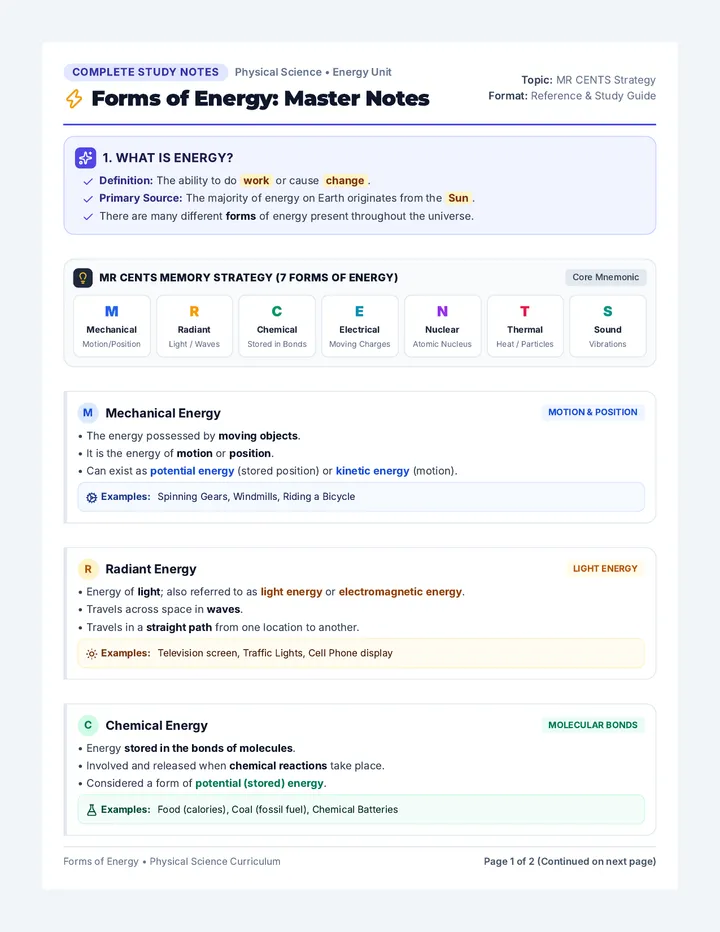
Forms of Energy: Master Notes
Topic: MR CENTS Strategy
Format: Reference & Study Guide
1. What is Energy?
Definition: The ability to do work or cause change.Primary Source: The majority of energy on Earth originates from the Sun.There are many different forms of energy present throughout the universe.
MR CENTS Memory Strategy (7 Forms of Energy)
Core Mnemonic
M Mechanical Motion/Position
R Radiant Light / Waves
C Chemical Stored in Bonds
E Electrical Moving Charges
N Nuclear Atomic Nucleus
T Thermal Heat / Particles
S Sound Vibrations
M
Mechanical Energy
Motion & Position
• The energy possessed by moving objects .
• It is the energy of motion or position .
• Can exist as potential energy (stored position) or kinetic energy (motion).
Examples: Spinning Gears, Windmills, Riding a Bicycle
R
Radiant Energy
Light Energy
• Energy of light ; also referred to as light energy or electromagnetic energy .
• Travels across space in waves .
• Travels in a straight path from one location to another.
Examples: Television screen, Traffic Lights, Cell Phone display
C
Chemical Energy
Molecular Bonds
• Energy stored in the bonds of molecules .
• Involved and released when chemical reactions take place.
• Considered a form of potential (stored) energy .
Examples: Food (calories), Coal (fossil fuel), Chemical Batteries
Forms of Energy • Physical Science Curriculum Page 1 of 2 (Continued on next page)
Complete Study Notes
Energy Forms (E, N, T, S) & Checkpoint Analysis
Reference Guide Part 2
E
Electrical Energy
• The energy of moving electrons or electric charges .
• Used by countless objects in our daily modern lives.
• First widely introduced into homes in the late 1800s .
Examples: Lamps, Wall Outlets, Device Chargers
N
Nuclear Energy
• Energy locked in the nucleus of an atom.
• Nuclear Fission: The process of splitting an atom.
• Nuclear Fusion: Two or more atoms violently joined to make a larger atom.
Examples: The Sun (Stars), Nuclear Power Plants, Atomic Weapons
T
Thermal Energy
• The energy of heat .
• Particles of hot objects move faster than particles of cooler objects.
• Hot = More thermal energy; Cold = Less thermal energy.
Examples: Clothes Iron, Bread Toaster, Campfire
S
Sound Energy
• The energy from vibrations in matter .
• Can travel through solids, liquids, and gases .
• Sound must have matter (medium) to travel through; cannot travel in a vacuum.
Examples: Bullhorn, Alarm Clock, Radio Speaker
Checkpoint Questions & Exemplar Explanations
Q1: What form of energy is produced by a musical instrument?
Exemplar Answer: Sound energy . When strings, reeds, or drums are plucked, blown, or struck, they create physical vibrations in the surrounding air.
Q2: Identify and describe 3 different forms of energy found within this room.
Exemplar Answer: 1) Electrical energy powering ceiling lights and projector; 2) Radiant energy emitted as visible light from screens; 3) Thermal energy radiating from students and computers; 4) Sound energy from classroom discussions.
Q3: Is it possible for an object to use or contain more than one form of energy? Explain.
Exemplar Answer: Yes . Objects frequently store or convert multiple forms of energy simultaneously. For instance, a television uses electrical energy and transforms it into radiant energy (picture) and sound energy (audio), with waste thermal energy (heat).
Q4: What forms of energy are used by a flashlight?
Exemplar Answer: A flashlight uses chemical energy stored in its battery, converts it into electrical energy through the circuit, and outputs radiant energy (visible light beam) along with thermal energy (heat).
Q5: Which form of energy do you believe is most important for survival? Why?
Exemplar Answer: Radiant/Thermal energy from the Sun (or Chemical energy from food). Solar radiant energy drives photosynthesis in plants and keeps Earth warm enough for liquid water, creating the chemical energy (food) all living organisms depend on.
Forms of Energy • Physical Science Curriculum Page 2 of 2 • Teacher & Accommodated Reference Key
Forms of Energy Guided Notes Scaffolded Guided Notes Physical Science • Energy Unit
Use presentation & word banks
Forms of Energy: Guided Notes
Name: Date: Period:
Energy Fundamentals
Word Bank: change • forms • Sun • work
• The ability to do or cause .
• The majority of energy on Earth originates from the .
• There are many different of energy.
MR CENTS Strategy — 7 Forms of Energy
Fill in the 7 energy forms
M Motion
R Light
C Bonds
E Charges
N Nucleus
T Heat
S Vibrations
M
Mechanical Energy
Word Bank: kinetic • motion • moving objects • position • potential
• The energy in .
• Energy of or .
• Can be energy or energy.
Examples:
R
Radiant Energy
Word Bank: electromagnetic • light • straight path • waves
• Energy of ; also called energy or energy.
• Travels in .
• Travels in a from one place to another.
Examples:
C
Chemical Energy
Word Bank: bonds • chemical reactions • molecules • potential • stored
• Energy in the of .
• Involved when take place.
• A form of energy.
Examples:
Forms of Energy • Guided Notes with Word Banks Page 1 of 2 (Turn over for Part 2)
Scaffolded Guided Notes
Part 2: Energy Forms (E, N, T, S) & Checkpoint
Student Name:
E Electrical Energy
Bank: 1800s • electric charges • Electricity • electrons • homes
• Energy of moving or .
• is used by many objects in daily life.
• First used in in the late .
Ex:
N Nuclear Energy
Bank: atom • locked • Nuclear Fission • Nuclear Fusion • nucleus
• Energy in the of an .
• = splitting an atom.
• = atoms joined together.
Ex:
T Thermal Energy
Bank: Cold • cooler • faster • heat • hot • less • more
• The energy of .
• Particles of objects move than objects.
• Hot = thermal energy; = thermal energy.
Ex:
S Sound Energy
Bank: gases • liquids • matter • solids • vibrations
• Energy from in .
• Travels through , , & .
• Sound must have to travel through.
Ex:
Checkpoint Partner Questions
Sentence starters provided
Question 1: What form of energy is produced by a musical instrument?
A musical instrument produces energy because its parts create .
Question 2: Identify and describe 3 different forms of energy found within this room.
1. Form:
Found in:
2. Form:
Found in:
3. Form:
Found in:
Question 3: Is it possible for an object to use or contain more than one form of energy? Explain.
[ ] Yes [ ] No. For example, a television uses energy and gives off energy and energy.
Question 4: What forms of energy are used by a flashlight?
A flashlight uses energy in its battery, changes it to energy, and produces energy (light).
Question 5: Which form of energy do you believe is most important for survival? Why?
I believe energy is most important because .
Forms of Energy • Guided Notes with Sentence Starters Page 2 of 2 • Student Handout
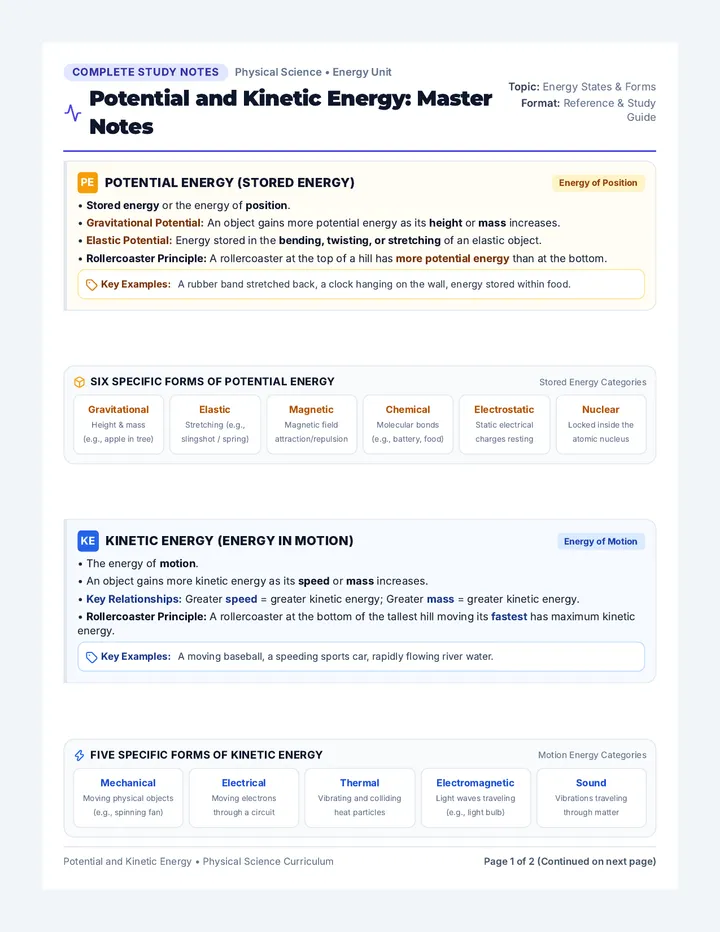
Potential Kinetic Reference Notes Complete Study Notes Physical Science • Energy Unit
Potential and Kinetic Energy: Master Notes
Topic: Energy States & Forms
Format: Reference & Study Guide
PE
Potential Energy (Stored Energy)
Energy of Position
• Stored energy or the energy of position .
• Gravitational Potential: An object gains more potential energy as its height or mass increases.
• Elastic Potential: Energy stored in the bending, twisting, or stretching of an elastic object.
• Rollercoaster Principle: A rollercoaster at the top of a hill has more potential energy than at the bottom.
Key Examples: A rubber band stretched back, a clock hanging on the wall, energy stored within food.
Six Specific Forms of Potential Energy
Stored Energy Categories
Gravitational Height & mass (e.g., apple in tree)
Elastic Stretching (e.g., slingshot / spring)
Magnetic Magnetic field attraction/repulsion
Chemical Molecular bonds (e.g., battery, food)
Electrostatic Static electrical charges resting
Nuclear Locked inside the atomic nucleus
KE
Kinetic Energy (Energy in Motion)
Energy of Motion
• The energy of motion .
• An object gains more kinetic energy as its speed or mass increases.
• Key Relationships: Greater speed = greater kinetic energy; Greater mass = greater kinetic energy.
• Rollercoaster Principle: A rollercoaster at the bottom of the tallest hill moving its fastest has maximum kinetic energy.
Key Examples: A moving baseball, a speeding sports car, rapidly flowing river water.
Five Specific Forms of Kinetic Energy
Motion Energy Categories
Mechanical Moving physical objects (e.g., spinning fan)
Electrical Moving electrons through a circuit
Thermal Vibrating and colliding heat particles
Electromagnetic Light waves traveling (e.g., light bulb)
Sound Vibrations traveling through matter
Potential and Kinetic Energy • Physical Science Curriculum Page 1 of 2 (Continued on next page)
Complete Study Notes
Energy Transformations & Checkpoint Analysis
Reference Guide Part 2
Potential vs. Kinetic Rollercoaster Principle
Core Transformation Law
"As potential energy increases , kinetic energy decreases and vice versa."
Top of Hill Greatest Potential • Least Kinetic
Halfway Down Slope Equal Potential & Kinetic Energy
Bottom of Hill (Fastest) Greatest Kinetic • Least Potential
Potential (P) or Kinetic (K)? Scenario Key
1. A skier at the top of a mountain. P (Potential)
2. The movement of wind during a storm. K (Kinetic)
3. Swinging a hammer toward a nail. K (Kinetic)
4. A boulder at the top of a cliff. P (Potential)
5. A compressed spring. P (Potential)
6. A sprinter running a race. K (Kinetic)
7. A catapult ready to launch an object. P (Potential)
8. A pencil falling off of a desk. K (Kinetic)
Checkpoint Questions & Exemplar Explanations
Q1: Describe potential energy in your own words.
Answer: Potential energy is energy that is stored and waiting to be released, determined by an object's position, height, or physical tension.
Q2: Describe kinetic energy in your own words.
Answer: Kinetic energy is the energy of active motion. Any object that is moving possesses kinetic energy, which increases with more mass or higher speed.
Q3: What is the relationship between the potential and kinetic energy of an object?
Answer: They have an inverse relationship; as potential energy increases, kinetic energy decreases, and as kinetic energy increases, potential energy decreases.
Q4: Explain the difference between elastic and gravitational potential energy.
Answer: Gravitational potential depends on an object's height above Earth's surface and mass, whereas elastic potential depends on stretching, compressing, or bending a flexible material.
Q5: List 3 examples of potential energy and 3 examples of kinetic energy.
Answer: Potential: A boulder on a cliff, a stretched rubber band, chemical energy in a battery. Kinetic: A rolling soccer ball, a speeding car, sound waves vibrating.
Potential and Kinetic Energy • Physical Science Curriculum Page 2 of 2 • Teacher & Accommodated Reference Key
Potential Kinetic Guided Notes Scaffolded Guided Notes Physical Science • Energy Unit
Use presentation & word banks
Potential and Kinetic Energy: Guided Notes
Name: Date: Period:
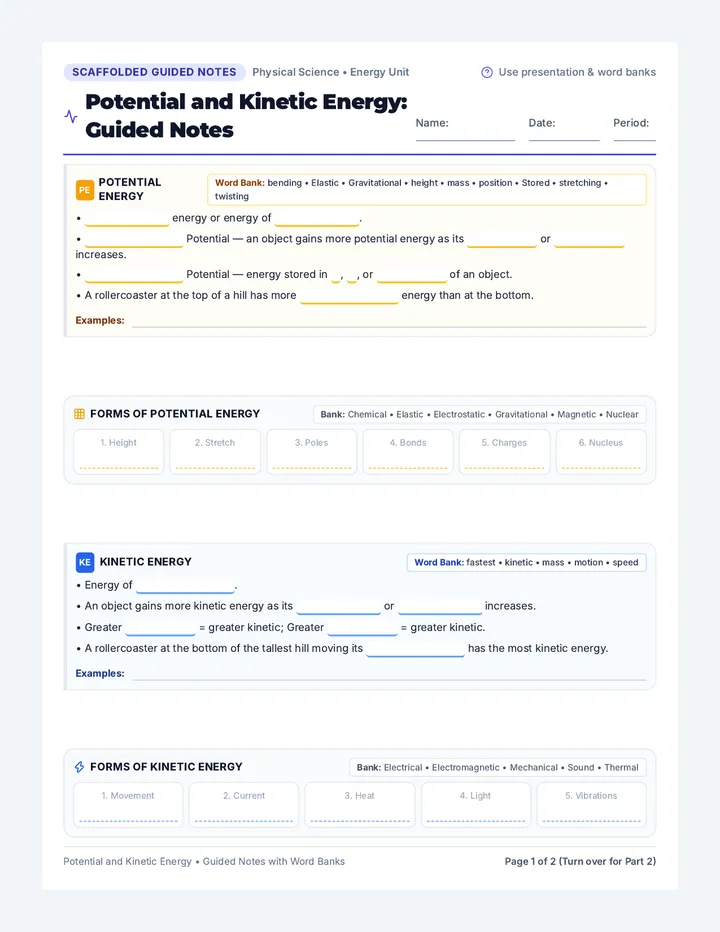
PE
Potential Energy
Word Bank: bending • Elastic • Gravitational • height • mass • position • Stored • stretching • twisting
• energy or energy of .
• Potential — an object gains more potential energy as its or increases.
• Potential — energy stored in , , or of an object.
• A rollercoaster at the top of a hill has more energy than at the bottom.
Examples:
Forms of Potential Energy
Bank: Chemical • Elastic • Electrostatic • Gravitational • Magnetic • Nuclear
1. Height
2. Stretch
3. Poles
4. Bonds
5. Charges
6. Nucleus
KE
Kinetic Energy
Word Bank: fastest • kinetic • mass • motion • speed
• Energy of .
• An object gains more kinetic energy as its or increases.
• Greater = greater kinetic; Greater = greater kinetic.
• A rollercoaster at the bottom of the tallest hill moving its has the most kinetic energy.
Examples:
Forms of Kinetic Energy
Bank: Electrical • Electromagnetic • Mechanical • Sound • Thermal
1. Movement
2. Current
3. Heat
4. Light
5. Vibrations
Potential and Kinetic Energy • Guided Notes with Word Banks Page 1 of 2 (Turn over for Part 2)
Scaffolded Guided Notes
Part 2: Rollercoaster Diagram, Scenarios & Checkpoints
Student Name:
Potential vs. Kinetic Rollercoaster Activity
Label the 3 locations
Rule: As potential energy increases, kinetic energy and vice versa.
Top Arrow (Highest Hill):
Middle Arrow (Halfway Slope):
Bottom Arrow (Lowest Track):
Options: Greatest Potential / Least Kinetic • Equal Potential & Kinetic • Greatest Kinetic / Least Potential
Potential or Kinetic? Write "P" for Potential or "K" for Kinetic
1. A skier at the top of a mountain. [ ]
2. The movement of wind during a storm. [ ]
3. Swinging a hammer toward a nail. [ ]
4. A boulder at the top of a cliff. [ ]
5. A compressed spring. [ ]
6. A sprinter running a race. [ ]
7. A catapult ready to launch an object. [ ]
8. A pencil falling off of a desk. [ ]
Checkpoint Partner Questions
Sentence starters provided
Question 1: Describe potential energy in your own words.
Potential energy is energy that depends on an object's .
Question 2: Describe kinetic energy in your own words.
Kinetic energy is the energy of . Any object that is has it.
Question 3: What is the relationship between potential and kinetic energy?
As potential energy increases, kinetic energy ; they have an relationship.
Question 4: Explain the difference between elastic and gravitational potential energy.
Gravitational depends on , while elastic depends on .
Question 5: List 3 examples of potential energy and 3 examples of kinetic energy.
3 Potential Examples:
3 Kinetic Examples:
Potential and Kinetic Energy • Guided Notes with Sentence Starters Page 2 of 2 • Student Handout