Earth Crust Review Packet
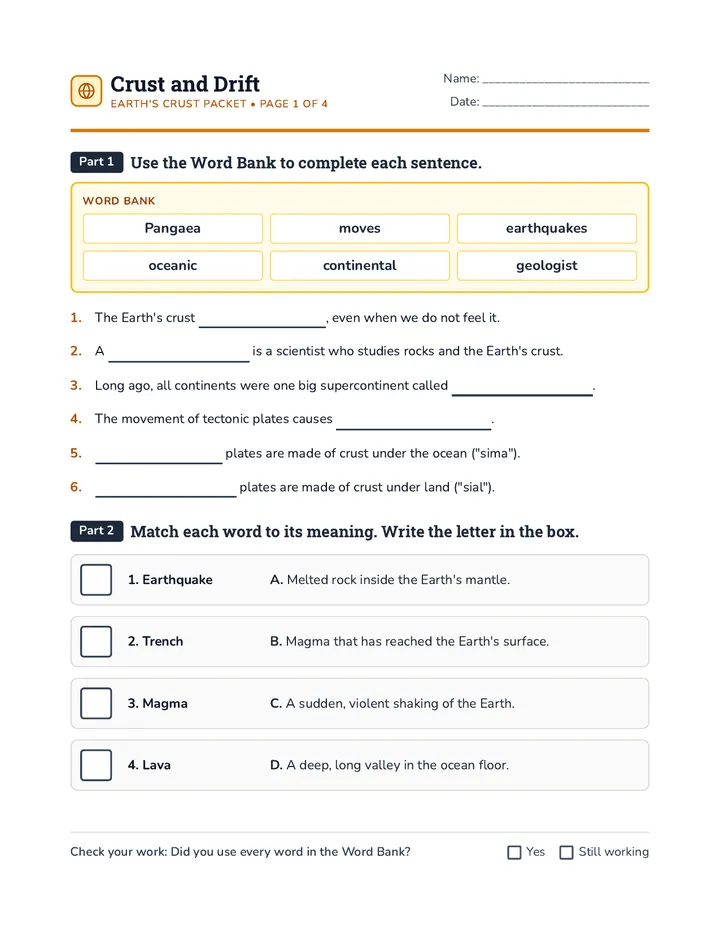
Crust and Drift
Earth's Crust Packet • Page 1 of 4
Name: ___________________________
Date: ___________________________
Part 1
Use the Word Bank to complete each sentence.
Word Bank
Pangaea
moves
earthquakes
oceanic
continental
geologist
-
- The Earth's crust , even when we do not feel it.
-
- A is a scientist who studies rocks and the Earth's crust.
-
- Long ago, all continents were one big supercontinent called .
-
- The movement of tectonic plates causes .
-
- plates are made of crust under the ocean ("sima").
-
- plates are made of crust under land ("sial").
Part 2
Match each word to its meaning. Write the letter in the box.
1. Earthquake
A. Melted rock inside the Earth's mantle.
2. Trench
B. Magma that has reached the Earth's surface.
3. Magma
C. A sudden, violent shaking of the Earth.
4. Lava
D. A deep, long valley in the ocean floor.
Check your work: Did you use every word in the Word Bank?
Yes Still working
Layers of the Earth
Earth's Crust Packet • Page 2 of 4
Name: ___________________________
Date: ___________________________
Part 1
Use the Word Bank to label the four layers of the Earth.
Word Bank:
Crust
Mantle
Outer Core
Inner Core
1 2 3 4
1. Outermost thin layer:
2. Thick layer of hot rock:
3. Layer around the inner core:
4. Very center of the Earth:
Part 2
Circle the correct word to finish each sentence.
- Which layer is on the outside where we live?
Crust
Mantle
Inner Core
- The Earth's crust floats on the hot, softer rock of the:
Inner Core
Mantle
Ocean floor
- Melted rock formed inside the mantle is called:
Lava
Magma
Trench
Tip: Think of the Earth like an egg—thin crust on the outside, thick mantle, and core in the center! Keep going!
Plate Boundaries
Earth's Crust Packet • Page 3 of 4
Name: ___________________________
Date: ___________________________
Part 1
Look at each picture. Write the boundary name and circle how the plates move.
Word Bank:
Convergent
Divergent
Transform

- Boundary Name:
Circle how the plates move:
push together pushed apart slide past

- Boundary Name:
Circle how the plates move:
push together pushed apart slide past

- Boundary Name:
Circle how the plates move:
push together pushed apart slide past
Part 2
Circle True or False for each sentence.
1. Subduction happens when one plate moves under another.
True False
2. A rift forms on land when two plates push together.
True False
3. Transform boundaries are often called faults and cause earthquakes.
True False
4. Colliding plates on land can pile up to form mountain ranges.
True False
Tip: Look at the arrows in each diagram to see which way the plates move. Almost done!
Mountains and Volcanoes
Earth's Crust Packet • Page 4 of 4
Name: ___________________________
Date: ___________________________
Part 1
Circle the best answer for each question.
- Which mountains form when two plates collide and the crust crumples and folds?
A. Fold mountains
B. Fault-block mountains
C. Dome mountains
- Which mountains form when magma builds up below the surface and pushes rock out?
A. Fold mountains
B. Dome mountains
C. Fault-block mountains
- What are the openings in the Earth's surface where magma comes up?
A. Vents
B. Trenches
C. Faults
- Which type of fault has side-to-side movement?
A. Normal dip-slip fault
B. Reverse fault
C. Strike-slip fault
Part 2
Write your answers in the boxes below.
- How are magma and lava different?
Sentence starter: "Magma is melted rock ______, while lava is magma that ______."
-
Name the two types of volcanic mountains:
Tip: Check your notes on Mountains and Volcanoes if you get stuck! Packet Complete!
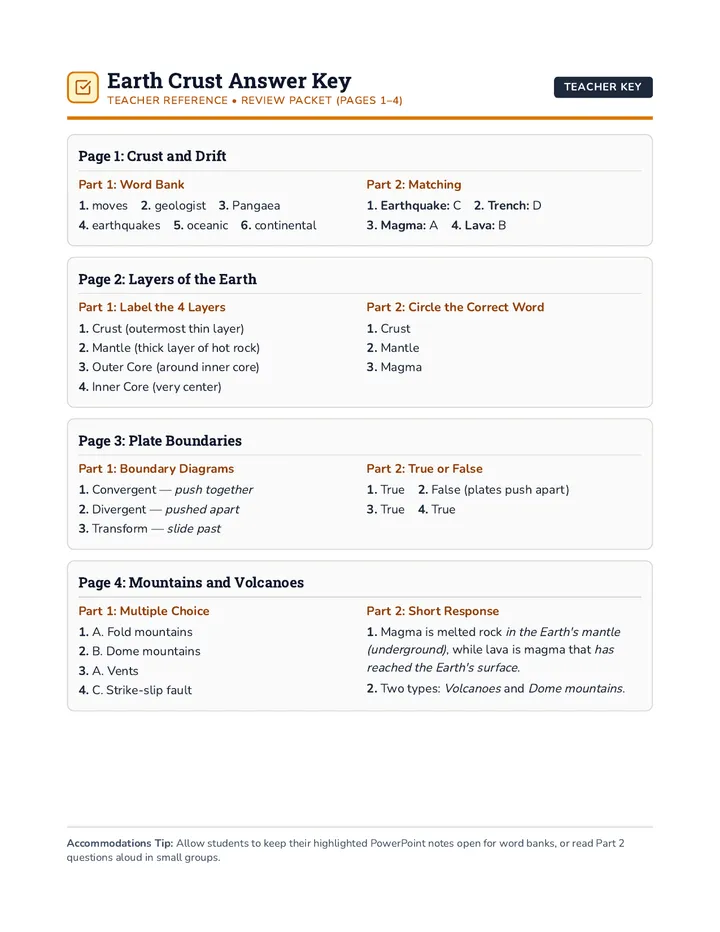
Earth Crust Answer Key
Earth Crust Answer Key
Teacher Reference • Review Packet (Pages 1–4)
Teacher Key
Page 1: Crust and Drift
Part 1: Word Bank
- 1. moves 2. geologist 3. Pangaea
- 4. earthquakes 5. oceanic 6. continental
Part 2: Matching
- 1. Earthquake: C 2. Trench: D
- 3. Magma: A 4. Lava: B
Page 2: Layers of the Earth
Part 1: Label the 4 Layers
- 1. Crust (outermost thin layer)
- 2. Mantle (thick layer of hot rock)
- 3. Outer Core (around inner core)
- 4. Inner Core (very center)
Part 2: Circle the Correct Word
- 1. Crust
- 2. Mantle
- 3. Magma
Page 3: Plate Boundaries
Part 1: Boundary Diagrams
- 1. Convergent — push together
- 2. Divergent — pushed apart
- 3. Transform — slide past
Part 2: True or False
- 1. True 2. False (plates push apart)
- 3. True 4. True
Page 4: Mountains and Volcanoes
Part 1: Multiple Choice
- 1. A. Fold mountains
- 2. B. Dome mountains
- 3. A. Vents
- 4. C. Strike-slip fault
Part 2: Short Response
1. Magma is melted rock in the Earth's mantle (underground), while lava is magma that has reached the Earth's surface.
2. Two types: Volcanoes and Dome mountains.
Accommodations Tip: Allow students to keep their highlighted PowerPoint notes open for word banks, or read Part 2 questions aloud in small groups.