Sun Powered Chains Slides Day 1 • 20-Minute Science AZ 3.L2U1.7
☀️
Sun Powered Chains
How does energy flow from the Sun through living things in an ecosystem?
Today's Goal
I can trace how energy moves from the Sun to plants and animals in a food chain.
Quick Spark (2 Mins)
🌵
A desert jackrabbit munches on a prickly pear cactus. Where did the jackrabbit's energy originally come from?
💧
A. Rainwater
☀️
B. The Sun
🪨
C. Desert Rocks
Turn and tell a partner your pick and why!
Big Ideas (4 Mins)
Field Guide Notes
☀️
Energy
The power living things need to grow, move, and stay alive.
🏜️
Ecosystem
All the living and nonliving things interacting in one place.
🔗
Food Chain
The path energy takes as one organism eats another.
Almost every food chain on Earth starts with energy from the Sun!
Follow the Arrows (3 Mins)
Model It
Arrows in a food chain point in the direction energy moves!
☀️
Sun
Gives light energy
➜
🌵
Prickly Pear
Makes food
➜
🐇
Jackrabbit
Eats plant
➜
🦅
Hawk
Eats rabbit
Remember: Arrow = "gives energy to"
Your Turn! (11 Mins)
Sun Powered Chains Worksheet
1. Read (5 Mins)
Read "Where Does All the Energy Start?" on Page 1. Underline how plants catch sunlight.
2. Answer & Draw (4 Mins)
Complete the questions and draw your own Sun-powered food chain on Page 2.
Wrap-Up (2 Mins): Share one food chain arrow with your table!
Sun Powered Chains Worksheet Day 1 • Desert Energy Webs • AZ 3.L2U1.7
Sun Powered Chains
☀️
Name: ____________________________________
Date: __________________
📖 Where Does All the Energy Start?
Every living thing in the Sonoran Desert needs energy to grow, move, and survive. Whether it is a tall saguaro cactus, a fast jackrabbit, or a soaring hawk, they all need fuel. Where does that energy begin? Almost every food chain on Earth starts with the Sun !
Plants have a special superpower. Green plants—like prickly pear cacti and desert grasses—catch sunlight using their leaves or stems. They mix sunlight with water and air to make their own food. This is how the Sun's energy enters an ecosystem , which is a community of living and nonliving things interacting in one place.
Animals cannot make food from sunlight. Instead, they get energy by eating plants or other animals. When a jackrabbit nibbles on a prickly pear pad, energy moves from the plant into the rabbit. Later, when a red-tailed hawk catches the jackrabbit, that same energy moves into the hawk.
Scientists draw a food chain to model this path. In a food chain, arrows always point in the direction energy flows: from the Sun, to the plant, to the animal that eats it.
Field Guide Key Words
Energy
The power living things need to grow and move.
Ecosystem
Living and nonliving things interacting in one area.
Food Chain
A model showing how energy flows from one organism to another.
Check Your Understanding
Page 2
1. Where does almost every food chain on Earth begin?
A. With a hawk
B. With the Sun
C. With desert rocks
D. With a jackrabbit
2. What do the arrows in a food chain show?
A. Which animal runs the fastest
B. The direction energy moves from one thing to another
C. How much water is in the desert
3. How do plants get energy differently from animals? Use evidence from the text.
4. Model the Energy Flow! Draw or write a 4-part desert food chain in the boxes below. Draw arrows between the boxes to show how energy moves.
Word ideas: Sun, Desert Grass, Kangaroo Rat, Rattlesnake, Prickly Pear, Jackrabbit, Hawk
Quick Check: Circle how confident you feel tracing energy from the Sun.
🌱 Still Learning 🌵 Getting There ☀️ Ready to Teach It!
Sun Powered Chains Answer Key Day 1 Teacher Resource • AZ 3.L2U1.7
Sun Powered Chains Answer Key
🔑
20-Minute Pacing Guide
0–2 Min
Slide 2 Spark (Sun is the source)
2–9 Min
Slides 3–4 Vocab & Arrow Model
9–18 Min
Read Passage & Complete Worksheet
18–20 Min
Table Share Wrap-Up
Worksheet Answers
1. Where does almost every food chain on Earth begin?
B. With the Sun.
2. What do the arrows in a food chain show?
B. The direction energy moves from one thing to another.
3. How do plants get energy differently from animals?
Sample Answer: Plants catch sunlight using their leaves or stems and mix it with water and air to make their own food. Animals cannot make food from sunlight, so they must eat plants or other animals.
4. Model the Energy Flow (4-part food chain)
Look for: Sun ➜ Plant (e.g., Prickly Pear or Desert Grass) ➜ Plant-eater (e.g., Jackrabbit or Kangaroo Rat) ➜ Predator (e.g., Hawk or Rattlesnake). Check that arrows point right (toward what gets the energy).
Quick Differentiation Tip:
For emerging readers, read Page 1 aloud chorally during minutes 9–12, then let students complete Page 2 with a partner.
Ecosystem Crew Roles Slides Day 2 • 20-Minute Science AZ 3.L2U1.7
🍄
Ecosystem Crew Roles
What jobs do producers, consumers, and decomposers have in a food chain?
Today's Goal
I can identify producers, consumers, and decomposers and explain how they help an ecosystem.
Quick Spark (2 Mins)
🍂
Every autumn, millions of leaves fall to the ground. Why isn't Earth buried under giant piles of dead leaves?
Think about tiny living things in the soil! Who cleans up nature's leftovers?
Share your idea with a partner!
Meet the Crew (4 Mins)
3 Ecosystem Jobs
🌿
Producers
Plants that make their own food using sunlight, water, and air.
🦎
Consumers
Animals that eat plants or other animals to get energy.
🪲
Decomposers
Fungi, bacteria, and beetles that break down dead matter into soil nutrients.
Decomposers are nature's recyclers—they return nutrients to help new plants grow!
Consumer Clues (3 Mins)
What Do They Eat?
🐢
Herbivore
Eats only plants (like a desert tortoise).
🐍
Carnivore
Eats only animals (like a rattlesnake).
🦊
Omnivore
Eats both plants and animals (like a coyote).
Every role keeps the ecosystem clean and energized!
Your Turn! (11 Mins)
Ecosystem Crew Roles Worksheet
1. Read (5 Mins)
Read "Meet the Ecosystem Crew" on Page 1. Circle the three main ecosystem jobs.
2. Sort & Explain (4 Mins)
Sort each desert organism by its role and answer the recycling question on Page 2.
Wrap-Up (2 Mins): Why would plants struggle without decomposers?
Ecosystem Crew Roles Worksheet Day 2 • Desert Energy Webs • AZ 3.L2U1.7
Ecosystem Crew Roles
🍄
Name: ____________________________________
Date: __________________
📖 Meet the Ecosystem Crew
Every organism in an ecosystem has an important job to do. Scientists group living things into three main roles: producers , consumers , and decomposers .
Producers are plants, like mesquite trees and cacti. They are called producers because they produce , or make, their own food using sunlight. Without producers, no other living things could get energy from the Sun!
Consumers cannot make their own food, so they must eat other organisms. Some consumers, like desert tortoises, are herbivores that eat only plants. Others, like rattlesnakes, are carnivores that eat only animals. Animals like coyotes are omnivores because they eat both plants and animals.
Finally, decomposers are nature's clean-up crew and recyclers. Fungi, bacteria, and dung beetles break down dead plants, fallen leaves, and animal waste. As they do, they release rich nutrients back into the soil so new producers can grow strong!
Crew Job Summary
🌿 Producers
Make food using sunlight, water, and air.
🦎 Consumers
Eat plants, animals, or both for energy.
🪲 Decomposers
Break down dead matter and recycle soil nutrients.
Check Your Understanding
Page 2
1. Which group is called "nature's recyclers" because they return nutrients to the soil?
A. Producers
B. Herbivores
C. Decomposers
D. Carnivores
2. A coyote eats cactus fruit, mice, and insects. What kind of consumer is a coyote?
A. Herbivore
B. Carnivore
C. Omnivore
3. Sort the Crew! Write each organism in the matching column below.
Organisms: Saguaro Cactus • Dung Beetle • Desert Tortoise • Bacteria • Mesquite Tree • Rattlesnake
Producers
Consumers
Decomposers
4. Why would desert plants have trouble growing if all the decomposers disappeared?
Bonus Thought: Name one decomposer you might find under a rock or log! ___________________________
Ecosystem Crew Roles Answer Key Day 2 Teacher Resource • AZ 3.L2U1.7
Ecosystem Crew Roles Answer Key
🔑
20-Minute Pacing Guide
0–2 Min
Slide 2 Spark (Dead leaves puzzle)
2–9 Min
Slides 3–4 Roles & Consumer Types
9–18 Min
Read Passage & Sort Organisms
18–20 Min
Debrief Decomposer Role
Worksheet Answers
1. Which group is called "nature's recyclers"?
C. Decomposers.
2. What kind of consumer is a coyote?
C. Omnivore (eats both plants and animals).
3. Sort the Crew!
Producers: Saguaro Cactus, Mesquite TreeConsumers: Desert Tortoise, RattlesnakeDecomposers: Dung Beetle, Bacteria
4. Why would desert plants have trouble growing if decomposers disappeared?
Sample Answer: Decomposers break down dead plants and waste to put rich nutrients back into the soil. Without them, the soil would lack nutrients new plants need to grow.
Quick Misconception Check:
Remind students that decomposers are living organisms too—not just "dirt." Fungi, bacteria, worms, and beetles all need energy!
Tangled Food Webs Slides Day 3 • 20-Minute Science AZ 3.L2U1.7
🕸️
Tangled Food Webs
How do food chains connect into a food web, and how do organisms keep populations balanced?
Today's Goal
I can explain how food chains connect into a food web and how predators help control populations.
Quick Spark (2 Mins)
🦉
Does a desert hawk ONLY eat jackrabbits? Or does it eat mice, lizards, and snakes too?
When animals eat more than one kind of food, what happens to all those separate food chains?
Discuss with your partner for 30 seconds!
Chains Connect (4 Mins)
Key Concepts
🕸️
Food Web
A group of overlapping food chains in an ecosystem. One plant or animal can be part of many chains!
⚖️
Population Control
Predators keep prey numbers from getting too high, so plants aren't all eaten up.
Predators + Prey + Producers work together to keep the ecosystem balanced!
Desert Food Web (3 Mins)
See the Connections
🦅
Red-Tailed Hawk
🦊
Coyote
↖️ eats ⬆️ eats ↗️ eats
🐇
Jackrabbit
🐁
Kangaroo Rat
🦎
Desert Lizard
All three get energy from 🌵 Prickly Pear & 🌾 Desert Grasses (powered by ☀️ Sun)!
Your Turn! (11 Mins)
Tangled Food Webs Worksheet
1. Read (5 Mins)
Read "Chains Become a Web" on Page 1. Highlight how hawks and coyotes help control prey populations.
2. Connect (4 Mins)
Answer the comprehension questions and draw web arrows on Page 2.
Wrap-Up (2 Mins): What would happen to desert grass if there were no predators?
Tangled Food Webs Worksheet Day 3 • Desert Energy Webs • AZ 3.L2U1.7
Tangled Food Webs
🕸️
Name: ____________________________________
Date: __________________
📖 Chains Become a Web
A single food chain is a helpful start, but real ecosystems are much busier! Most animals eat more than one kind of food. For example, a desert lizard eats insects and flowers. A hawk might eat lizards, kangaroo rats, and jackrabbits.
When many food chains overlap and cross each other, they form a food web . A food web shows all the connected paths that energy can take through an ecosystem. One plant, like a prickly pear cactus, might give energy to tortoises, rabbits, and birds at the same time.
Food webs also help with population control . A population is a group of the same kind of organism living in one area. Predators—animals that hunt other animals—keep prey populations from growing too large.
If hawks and coyotes did not hunt jackrabbits, the rabbit population would grow huge! Too many rabbits would eat up all the desert grasses. By hunting prey, predators help protect the plants and keep the whole food web in balance.
Field Guide Key Words
Food Web
Overlapping food chains that show many ways energy moves in an ecosystem.
Population Control
How predators, food limits, and space keep organism numbers balanced.
Check Your Understanding
Page 2
1. How is a food web different from a single food chain?
A. A food web only includes plants and no animals
B. A food web shows many overlapping food chains connected together
C. A food web does not start with the Sun
2. Why are predators important for plants in an ecosystem?
3. Connect the Web! Draw arrows from what gives energy to what gets energy.
🦅 Hawk
🦊 Coyote
🐇 Jackrabbit
🐁 Kangaroo Rat
🦎 Lizard
🌵 Prickly Pear
🌾 Desert Grass
4. Circle one animal in Question 3 that is BOTH prey and a consumer of plants: _____________________
Tangled Food Webs Answer Key Day 3 Teacher Resource • AZ 3.L2U1.7
Tangled Food Webs Answer Key
🔑
20-Minute Pacing Guide
0–2 Min
Slide 2 Spark (Hawk diet)
2–9 Min
Slides 3–4 Webs & Balance
9–18 Min
Read & Connect Food Web
18–20 Min
Wrap-Up Discussion
Worksheet Answers
1. How is a food web different from a single food chain?
B. A food web shows many overlapping food chains connected together.
2. Why are predators important for plants in an ecosystem?
Sample Answer: Predators hunt plant-eaters (prey) and keep their populations from getting too big. If there were too many rabbits or rats, they would eat up all the plants.
3. Connect the Web!
Look for upward arrows: Prickly Pear & Desert Grass ➜ Jackrabbit, Kangaroo Rat, Lizard ➜ Hawk & Coyote (arrows should point from food source toward the eater).
4. Circle one animal that is BOTH prey and a consumer of plants:
Acceptable Answers: Jackrabbit, Kangaroo Rat, or Lizard.
Quick Arrow Check:
Circulate during Question 3 to ensure students draw arrows upward (energy flowing from producer to consumer to predator), not backward.
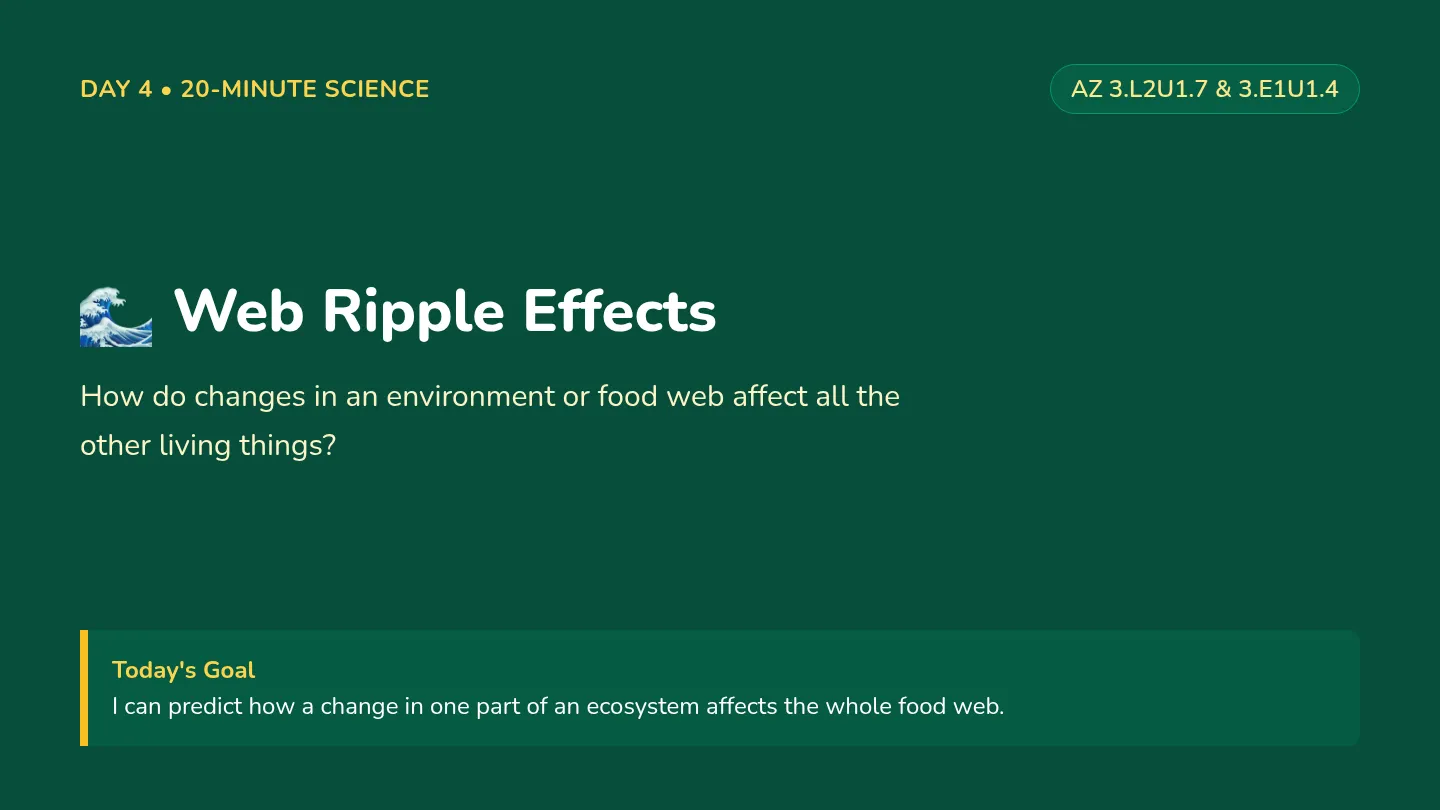
Web Ripple Effects Slides Day 4 • 20-Minute Science AZ 3.L2U1.7 & 3.E1U1.4
🌊
Web Ripple Effects
How do changes in an environment or food web affect all the other living things?
Today's Goal
I can predict how a change in one part of an ecosystem affects the whole food web.
Quick Spark (2 Mins)
🏜️
Imagine a long drought dries up most of the desert grasses.
Will only the grass be affected, or will animals like rabbits, snakes, and hawks feel the change too?
Thumbs up if the whole web is affected!
Ripple Effects (4 Mins)
Chain Reaction
🌧️
1. Habitat Change
Drought, fire, or extra rain changes how many producers can grow.
🐇
2. Prey Shifts
If plants shrink, herbivores have less food and their numbers drop.
🦅
3. Predator Shifts
When prey becomes scarce, predators must move or their numbers drop too.
Because food webs are connected, a change to one part ripples through the whole system!
Think Like a Scientist (3 Mins)
Predict!
Scenario: What if all the coyotes left the desert?
Step 1: Jackrabbits
Fewer predators mean jackrabbit numbers go UP.
Step 2: Desert Plants
More rabbits eat more plants, so plants go DOWN.
Every organism—big or small—matters to ecosystem balance!
Your Turn! (11 Mins)
Web Ripple Effects Worksheet
1. Read (5 Mins)
Read "When One Part Changes" on Page 1. Look for how rain, drought, and predators affect the web.
2. Predict (4 Mins)
Complete the cause-and-effect questions and final ecosystem check on Page 2.
Wrap-Up (2 Mins): Share one way you can help protect local habitats!
Web Ripple Effects Worksheet Day 4 • Desert Energy Webs • AZ 3.L2U1.7 & 3.E1U1.4
Web Ripple Effects
🌊
Name: ____________________________________
Date: __________________
📖 When One Part Changes
Imagine dropping a pebble into a pond. The splash makes ripples that spread across the whole water. In a food web, a change to just one living or nonliving part can send ripple effects through the entire ecosystem!
Changes in weather and water are big examples. During a long drought —a time with very little rain—desert grasses and wildflowers cannot grow well. With fewer producers, herbivores like jackrabbits and tortoises have less food to eat, so their populations shrink. Soon, predators like hawks and coyotes also struggle to find enough prey.
Changes can happen to animals, too. Suppose a disease wipes out most of the desert snakes. With fewer snakes hunting them, kangaroo rat populations may grow very large. Then those rats eat more seeds and grasses, leaving less food for birds and insects.
On the bright side, when Arizona gets healthy monsoon rains, plants bloom, insects multiply, and the whole food web thrives together!
Big Takeaway
Living things depend on each other and on nonliving parts of their environment like sunlight, water, and soil. Protecting habitats keeps every link in the food web strong!
Check Your Understanding
Page 2
1. During a long drought, what happens first in the desert food web?
A. Hawks start eating rocks
B. Producers like grasses and wildflowers cannot grow well
C. The Sun stops shining on the desert
2. If most of the snakes disappeared from the desert, what would likely happen to the kangaroo rat population? Why?
3. Healthy monsoon rains arrive! Predict how TWO different organisms in the food web will be affected.
Organism 1 (Producer)
Organism 2 (Consumer)
4. Unit Wrap-Up: Write one sentence explaining how the Sun, plants, animals, and decomposers are all connected.
Web Ripple Effects Answer Key Day 4 Teacher Resource • AZ 3.L2U1.7 & 3.E1U1.4
Web Ripple Effects Answer Key
🔑
20-Minute Pacing Guide
0–2 Min
Slide 2 Spark (Drought ripple)
2–9 Min
Slides 3–4 Cause & Effect
9–18 Min
Read & Predict Outcomes
18–20 Min
4-Day Synthesis Share
Worksheet Answers
1. During a long drought, what happens first in the desert food web?
B. Producers like grasses and wildflowers cannot grow well.
2. If most of the snakes disappeared, what would happen to kangaroo rats?
Sample Answer: Kangaroo rat populations would grow very large because fewer snakes are hunting them.
3. Healthy monsoon rains arrive! Predict how TWO organisms are affected.
Sample Answer: Producer (e.g., desert grass/cacti) grows and blooms more with extra water. Consumer (e.g., jackrabbit, insect, or hawk) has more food and its population stays healthy or grows.
4. Unit Wrap-Up Sentence
Look for: Students connect that the Sun gives energy to plants (producers), animals (consumers) eat plants/each other, and decomposers recycle nutrients back to the soil for plants.
Assessment Note:
Question 4 serves as a quick 4-day exit ticket to check mastery of Arizona standard 3.L2U1.7 (energy flow from Sun) and 3.E1U1.4 (environmental impacts).