Element Explorers Lesson Plan Middle School Physical Science • Lesson Plan
Element Explorers
Cracking the Code of the Periodic Table
Grade Level
Grades 6–8
45–50 Minutes
Learning Objectives
Read the Table: Locate element names, symbols, atomic numbers, and masses.Groups & Periods: Explain how columns (groups) and rows (periods) organize elements.Element Families: Compare metals, nonmetals, and noble gases.Patterns & Properties: Spot how properties shift across rows and down columns.
Materials
• Element Detective Activity
• Answer Key (teacher copy)
• Pencils & 3 highlighters
• Periodic Table poster (opt.)
Key Vocabulary
Atomic Number: Number of protons; sets element order.
Chemical Symbol: 1–2 letter code (Cap + lowercase).
Period: Horizontal row on the periodic table.
Group (Family): Vertical column with similar properties.
Metals & Nonmetals: Shiny conductors (left) vs. dull/gases (right).
Noble Gases: Group 18 gases that rarely react.
Lesson Pacing & Instructional Flow
1. Warm-Up: Everyday Elements 5 min
Write He, O, Na, Fe on the board. Have students guess each element and where they've seen it (balloons, air, salt, nails). Introduce the periodic table as chemistry's shared map.
2. Mini-Lesson: Anatomy of a Tile & Table Grid 12 min
Model reading a tile (atomic number, symbol, name, mass). Contrast periods (rows) with groups (columns) and point out metals (left), nonmetals (upper right), and noble gases (Group 18).
3. Partner Activity: Element Detective 20 min
Hand out the Element Detective Activity . Complete Part 1 Row 1 together, then have pairs finish Parts 1–4 using the Mini Periodic Table (Elements 1–18). Circulate to check group vs. period accuracy.
4. Wrap-Up & Pattern Debrief 8 min
Review Part 4 together. Ask students to state one pattern moving left-to-right across a period and one pattern moving top-to-bottom down a group.
Element Explorers • Teacher Guide
Facilitation, Misconceptions & Supports
Page 2 of 2
Key Facilitation Questions
Q1:
"Why organize elements by atomic number instead of alphabetically?" Listen for: Atomic number groups elements with similar properties into predictable neighborhoods.
Q2:
"If you need a material to wire a house, which side of the table would you check?" Listen for: Left/center (metals), because metals conduct electricity and can be shaped into wires.
Q3:
"Neon and Helium are both in Group 18. What do they share?" Listen for: Both are stable, unreactive noble gases.
Common Student Misconceptions & Fixes
Misconception 1: Mixing up groups (columns) and periods (rows).Fix: Memory cue: "A sentence ends with a period and goes across (row); a group stands together in a column."
Misconception 2: Thinking Hydrogen (H) is a metal because it sits in Group 1.Fix: Note that Hydrogen is a nonmetal gas placed in Group 1 due to its atomic structure—a special exception.
Misconception 3: Confusing atomic number with atomic mass.Fix: Atomic number is always a whole counting number (1, 2, 3...) at the top; atomic mass usually has decimals.
Scaffolds & Support
• Pre-highlight the Mini Periodic Table families in 3 colors before starting.
• Provide sentence frames for Part 4: "Moving left to right, elements change from ___ to ___."
• Pair ELL or developing readers with a partner to read clues aloud.
Extensions (Early Finishers)
• Research why symbols like Na (Natrium ) and K (Kalium ) differ from English names.
• Predict the family and properties of Element 19 (K) and Element 20 (Ca) using Group 1 & 2 patterns.
Element Detective Activity Middle School Science • Student Activity
Element Detective
Name:
Date:
Reference: Mini Periodic Table (Elements 1–18)
Metals Nonmetals Noble Gases Metalloids
Period
Grp 1
Grp 2
Grp 13
Grp 14
Grp 15
Grp 16
Grp 17
Grp 18
1
1
H
Hydrogen
1.01
6
C
Carbon
12.01
How to Read a Tile: Top = Atomic Number (6), Center = Symbol (C), Below = Name , Bottom = Atomic Mass (12.01).
2
He
Helium
4.00
2
3
Li
Lithium
6.94
4
Be
Beryllium
9.01
5
B
Boron
10.81
6
C
Carbon
12.01
7
N
Nitrogen
14.01
8
O
Oxygen
16.00
9
F
Fluorine
19.00
10
Ne
Neon
20.18
3
11
Na
Sodium
22.99
12
Mg
Magnesium
24.31
13
Al
Aluminum
26.98
14
Si
Silicon
28.09
15
P
Phosphorus
30.97
16
S
Sulfur
32.06
17
Cl
Chlorine
35.45
18
Ar
Argon
39.95
Note: Transition Metals (Groups 3–12) appear between Group 2 and Group 13 starting in Period 4.
Part 1 Reading Element Tiles
Use the Mini Periodic Table above to fill in the missing information for each element.
Element Name
Symbol
Atomic Number
Atomic Mass
Oxygen
Na
13
35.45
Part 2 Groups & Periods
1. Which element is located in Period 2, Group 15 ? Give its name and symbol.
2. List all three elements shown in Group 1 (Column 1). Which one is not a metal?
3. As you move from left to right across Period 3 , what happens to the atomic number?
Element Detective • Student Activity
Page 2 of 2
Part 3 Element Family Sort
For each element below, use the Mini Periodic Table to classify it as a Metal , Nonmetal , or Noble Gas , then write one typical property of that family (e.g., shiny and conducts electricity , dull/gas and poor conductor , or unreactive gas ).
Element (Symbol)
Family
One Typical Property
Magnesium (Mg)
Neon (Ne)
Carbon (C)
Lithium (Li)
Sulfur (S)
Helium (He)
Part 4 Spotting Patterns & Properties
1. Moving from left to right across Period 2 or Period 3, how do element families change?
A. Noble gases → nonmetals → metals
B. Metals → nonmetals → noble gases
C. Nonmetals → metals → noble gases
D. All elements in a period are metals
2. Why are Fluorine (F) and Chlorine (Cl) placed in the same vertical column (Group 17)?
A. They have the exact same atomic mass
B. They are both unreactive noble gases
C. They share similar chemical properties
D. They are both shiny, solid metals
3. Predict the Element: Element 19 is Potassium (K), which sits directly below Sodium (Na) in Group 1. Based on its group, would you expect Potassium to be a metal , nonmetal , or noble gas ? Explain your reasoning.
Element Detective Answer Key Teacher Resource • Answer Key
Element Detective Answer Key
Page 1 of 2 (Parts 1–2)
Part 1 Reading Element Tiles — Key
Element Name
Symbol
Atomic Number
Atomic Mass
Oxygen
O
8
16.00
Sodium
Na
11
22.99
Aluminum
Al
13
26.98
Chlorine
Cl
17
35.45
Grading Note: Check that students capitalize the first letter of two-letter symbols and lowercase the second (e.g., Na, Al, Cl—not NA or AL).
Part 2 Groups & Periods — Key
1. Which element is located in Period 2, Group 15? Give its name and symbol.
Answer: Nitrogen (N)
Teacher Note: If a student writes Phosphorus (P), they looked in Period 3 instead of Period 2.
2. List all three elements shown in Group 1 (Column 1). Which one is not a metal?
Answer: Hydrogen (H), Lithium (Li), and Sodium (Na). Hydrogen (H) is not a metal (it is a nonmetal).
Teacher Note: Reinforce that Hydrogen sits in Group 1 because of its electron structure, even though it is a nonmetal gas.
3. As you move from left to right across Period 3, what happens to the atomic number?
Answer: The atomic number increases by 1 with each element (from 11 for Sodium up to 18 for Argon).
Element Detective Answer Key
Page 2 of 2 (Parts 3–4)
Part 3 Element Family Sort — Key
Element (Symbol)
Family
Sample Acceptable Property
Magnesium (Mg)
Metal
Shiny, solid, good conductor of heat/electricity, malleable
Neon (Ne)
Noble Gas
Colorless gas, unreactive / very stable
Carbon (C)
Nonmetal
Dull, brittle solid, poor conductor of heat/electricity
Lithium (Li)
Metal
Shiny, soft solid, conducts electricity, reactive
Sulfur (S)
Nonmetal
Dull, brittle solid, poor conductor of heat/electricity
Helium (He)
Noble Gas
Colorless gas, unreactive / does not easily form compounds
Part 4 Spotting Patterns & Properties — Key
1. Moving from left to right across Period 2 or Period 3, how do element families change?
Correct Answer: B. Metals → nonmetals → noble gases
Explanation: Elements transition from reactive metals on the left, through metalloids and nonmetals, to unreactive noble gases on the far right.
2. Why are Fluorine (F) and Chlorine (Cl) placed in the same vertical column (Group 17)?
Correct Answer: C. They share similar chemical properties
Explanation: Elements in the same group (vertical column) belong to the same family and behave in similar ways.
3. Predict the Element (Potassium, K):
Sample Answer: Potassium (K) is a metal . Because it is in Group 1 directly below Sodium (Na) and Lithium (Li), it belongs to the same family and shares similar metallic properties (shiny, conducts electricity, reactive).
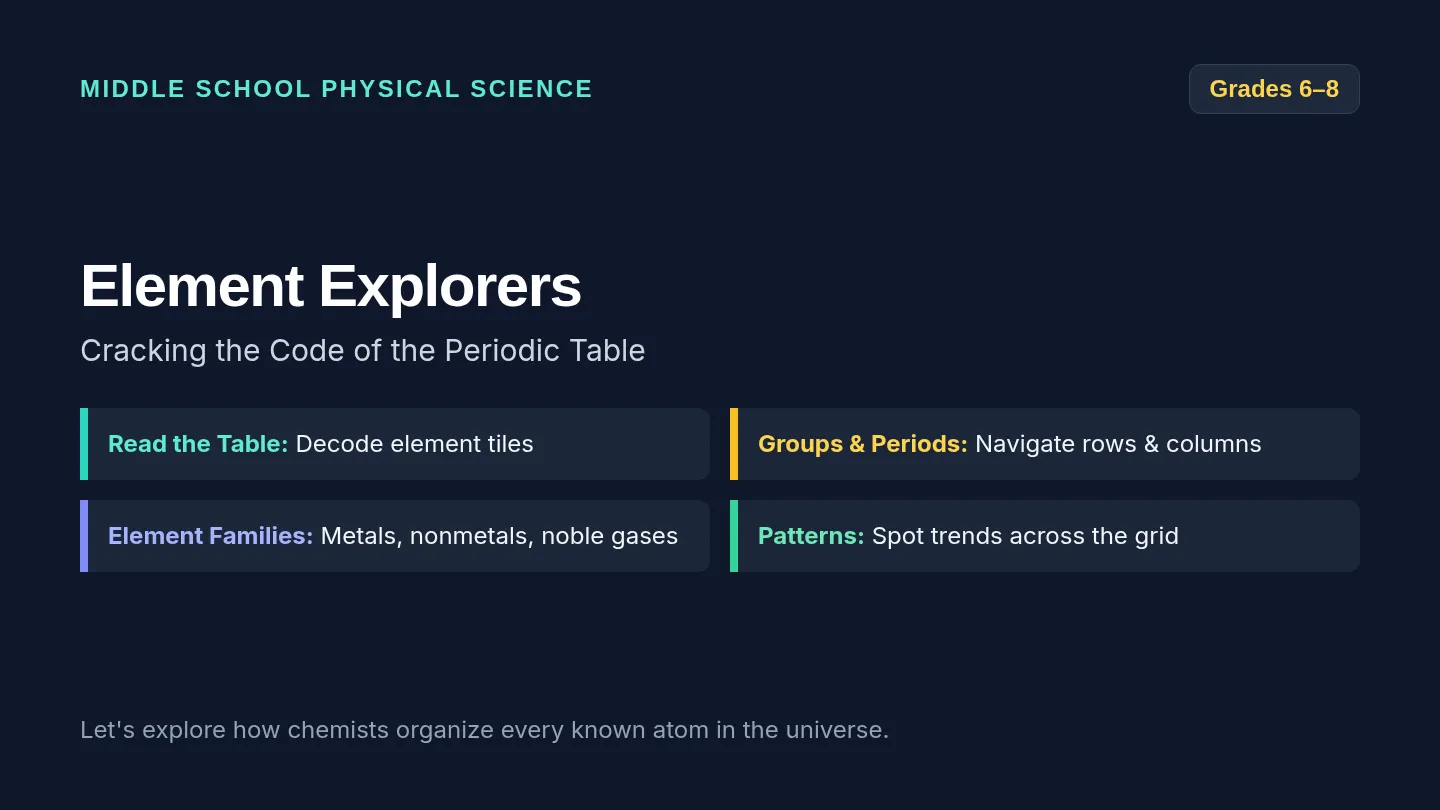
Element Explorers Slides Middle School Physical Science
Grades 6–8
Element Explorers
Cracking the Code of the Periodic Table
Read the Table: Decode element tiles
Groups & Periods: Navigate rows & columns
Element Families: Metals, nonmetals, noble gases
Patterns: Spot trends across the grid
Let's explore how chemists organize every known atom in the universe.
Warm-Up
Everyday Elements
2
He
Party Balloons
8
O
Air We Breathe
11
Na
Table Salt
26
Fe
Steel & Nails
Turn & Talk: What do these symbols stand for, and why do scientists use short codes?
Objective 1 • Read the Table
Anatomy of an Element Tile
6
C
Carbon
12.01
6
Atomic Number: Number of protons; sets the element's order.
C
Chemical Symbol: 1–2 letters (1st capital, 2nd lowercase).
Name
Element Name: The official name of the element.
12.01
Atomic Mass: Average mass of one atom.
Objective 2 • Grid Structure
Groups & Periods
Periods (Rows)
Horizontal rows that run left to right across the table (Periods 1–7).
Memory Cue: A sentence ends with a period and goes across!
Groups (Columns)
Vertical columns numbered 1–18 from top to bottom.
Key Idea: Elements in the same group act like a family !
Objective 3 • Element Families
Three Broad Families
Metals
Left & Center
• Shiny & mostly solid
• Conduct heat & electricity
• Bendable (malleable)
Examples: Li, Na, Mg, Fe
Nonmetals
Upper Right (+ H)
• Dull solids or gases
• Poor conductors
• Brittle when solid
Examples: H, C, N, O, Cl
Noble Gases
Group 18 (Far Right)
• Colorless, odorless gases
• Very stable
• Rarely react with others
Examples: He, Ne, Ar
Objective 4 • Patterns & Properties
Spotting Periodic Patterns
1. Across a Period (Left → Right)
Atomic number increases by +1 each step, and elements shift from metals → nonmetals → noble gases .
2. Down a Group (Top → Bottom)
Elements in the same column share similar chemical properties —so we can predict how an element behaves just by its column!
Example: Potassium (K) sits below Sodium (Na) in Group 1—both are soft, reactive metals.
Partner Investigation
Your Turn: Element Detective
Part 1: Reading Tiles
Find names, symbols, atomic numbers, and masses.
Part 2: Groups & Periods
Locate elements by row and column.
Part 3: Family Sort
Classify metals, nonmetals, and noble gases.
Part 4: Spot Patterns
Predict element properties from trends.
Tip: Use the built-in Mini Periodic Table (Elements 1–18) on Page 1 of your activity!