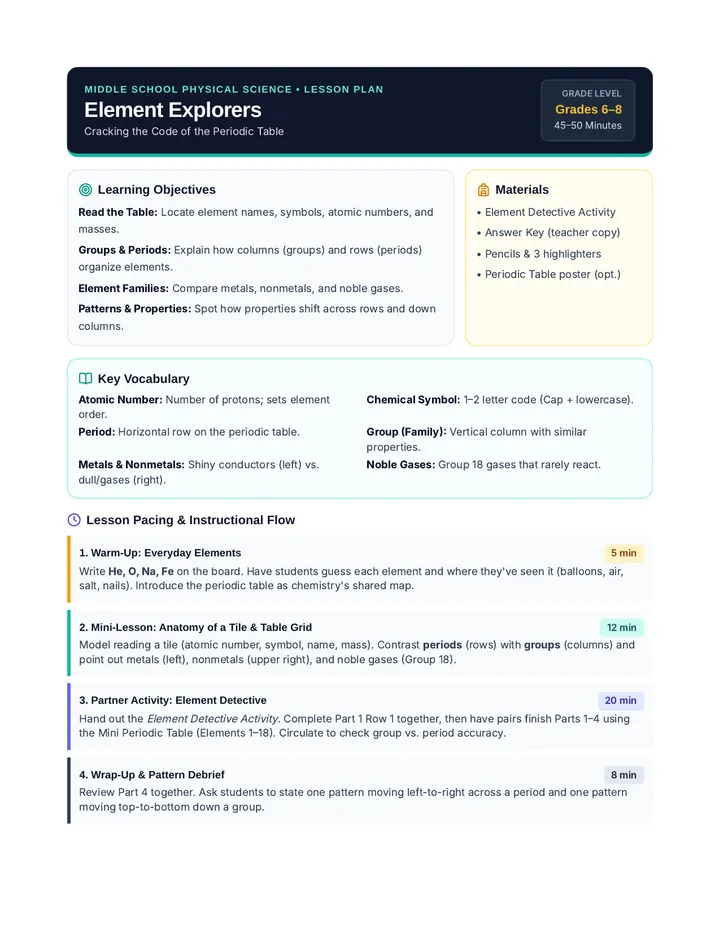
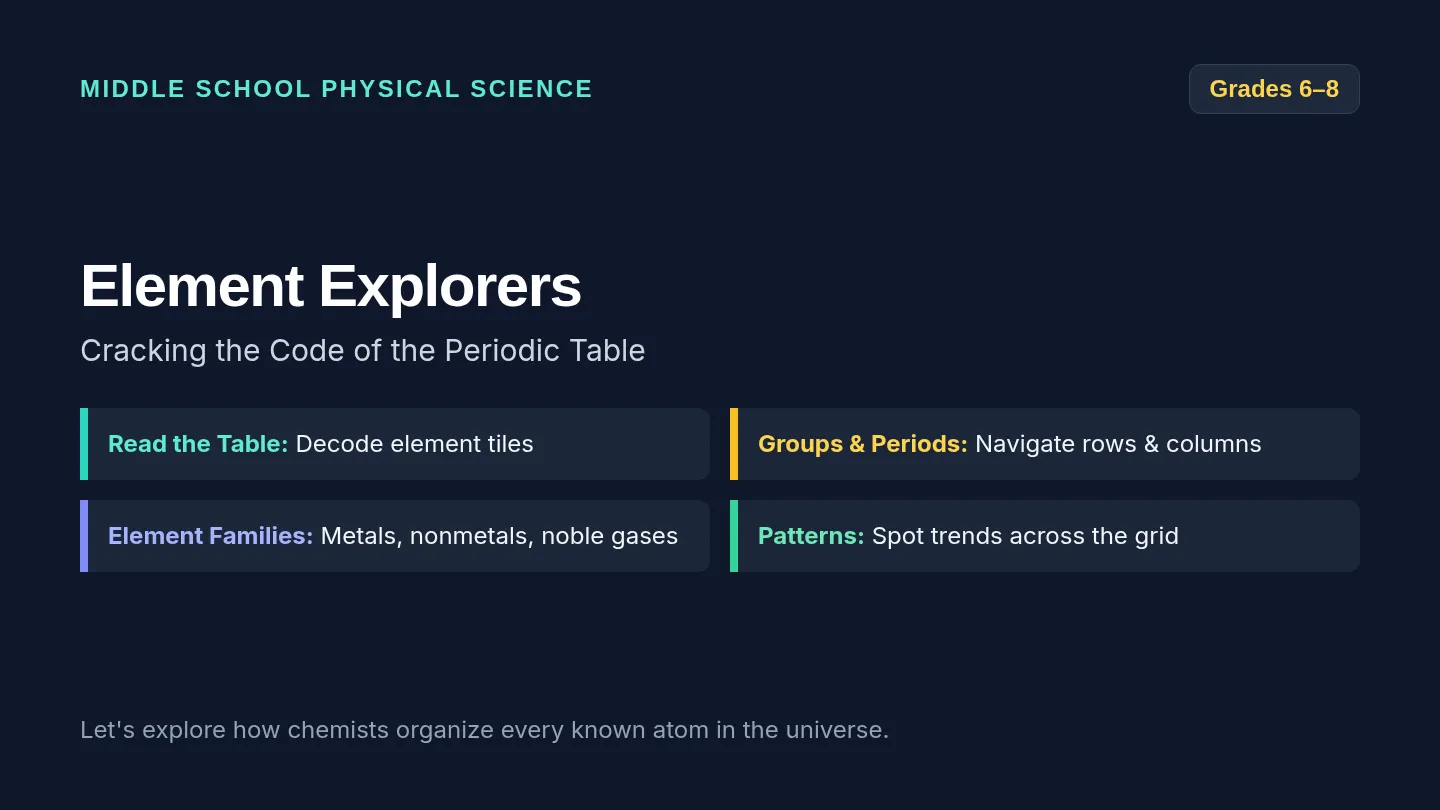
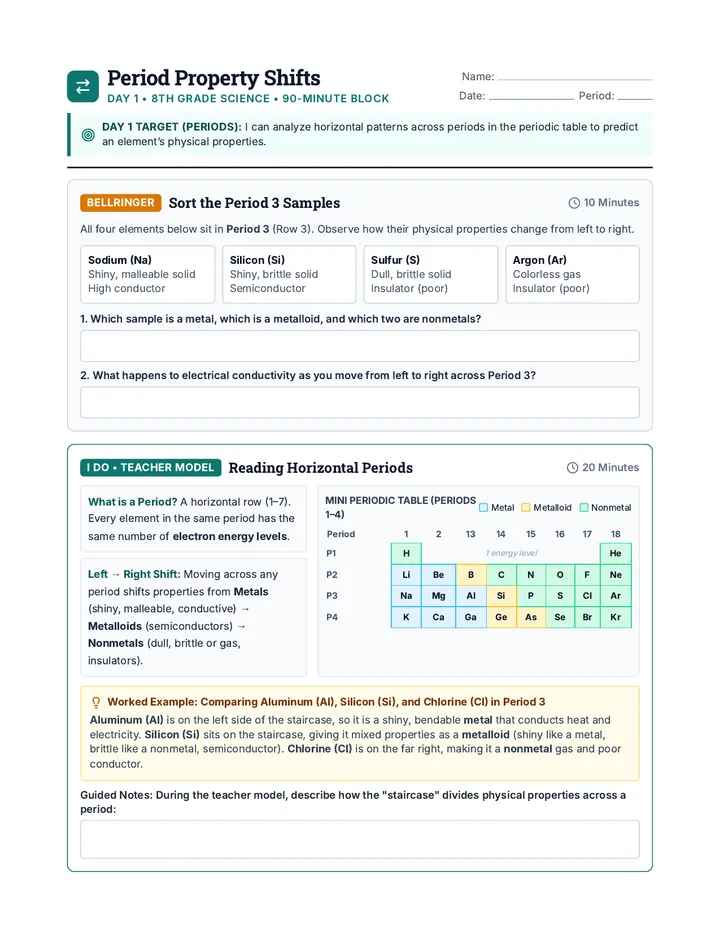
Ion Charge Slides
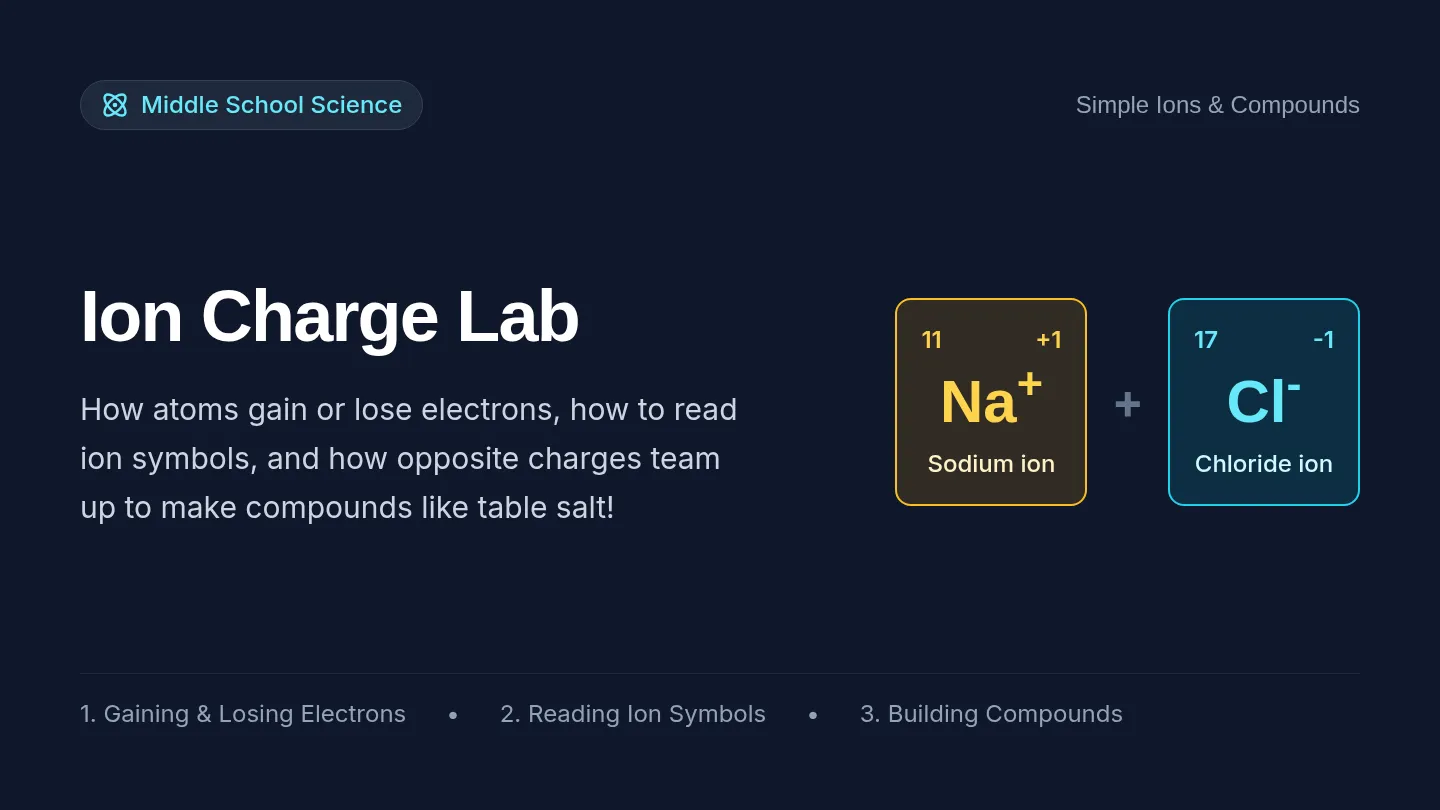
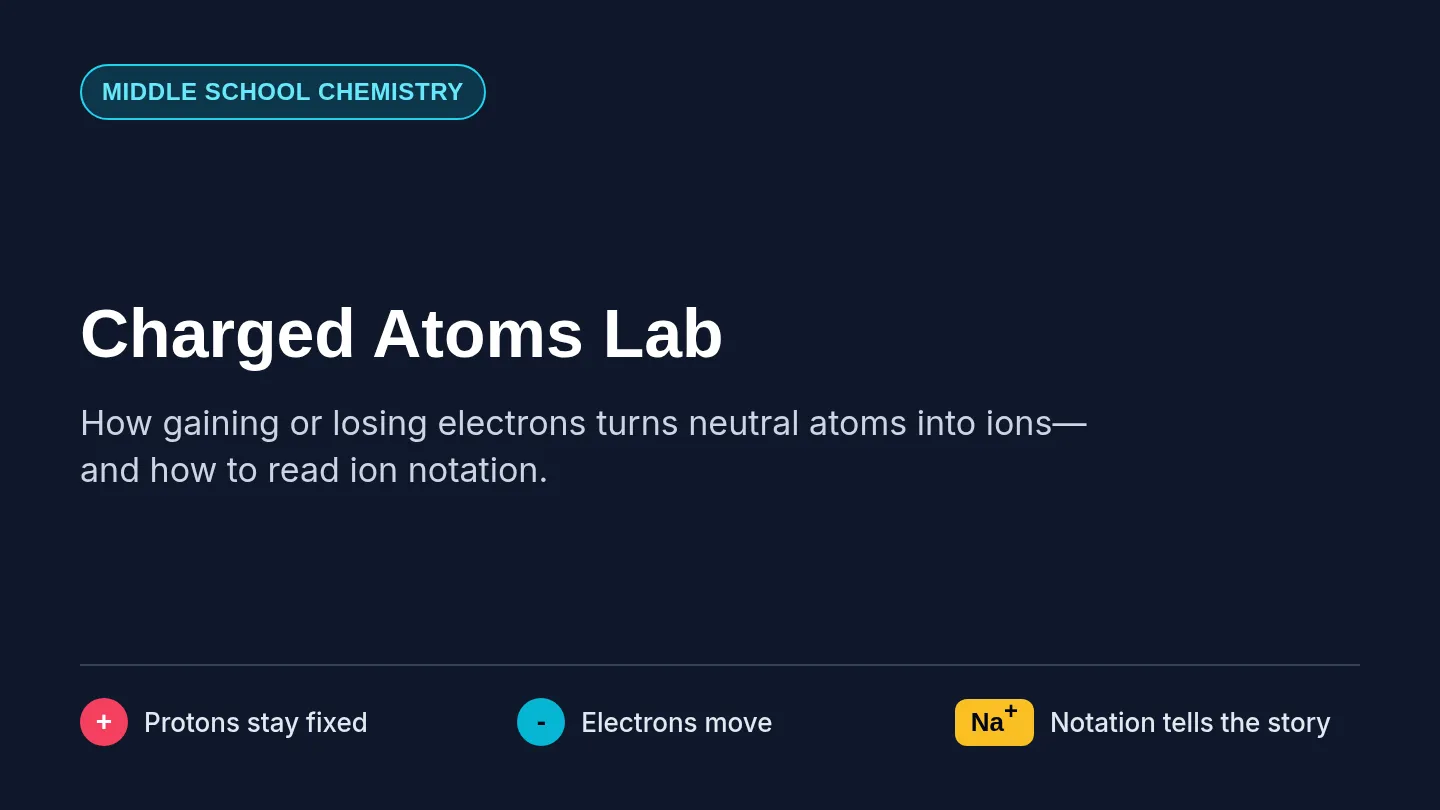
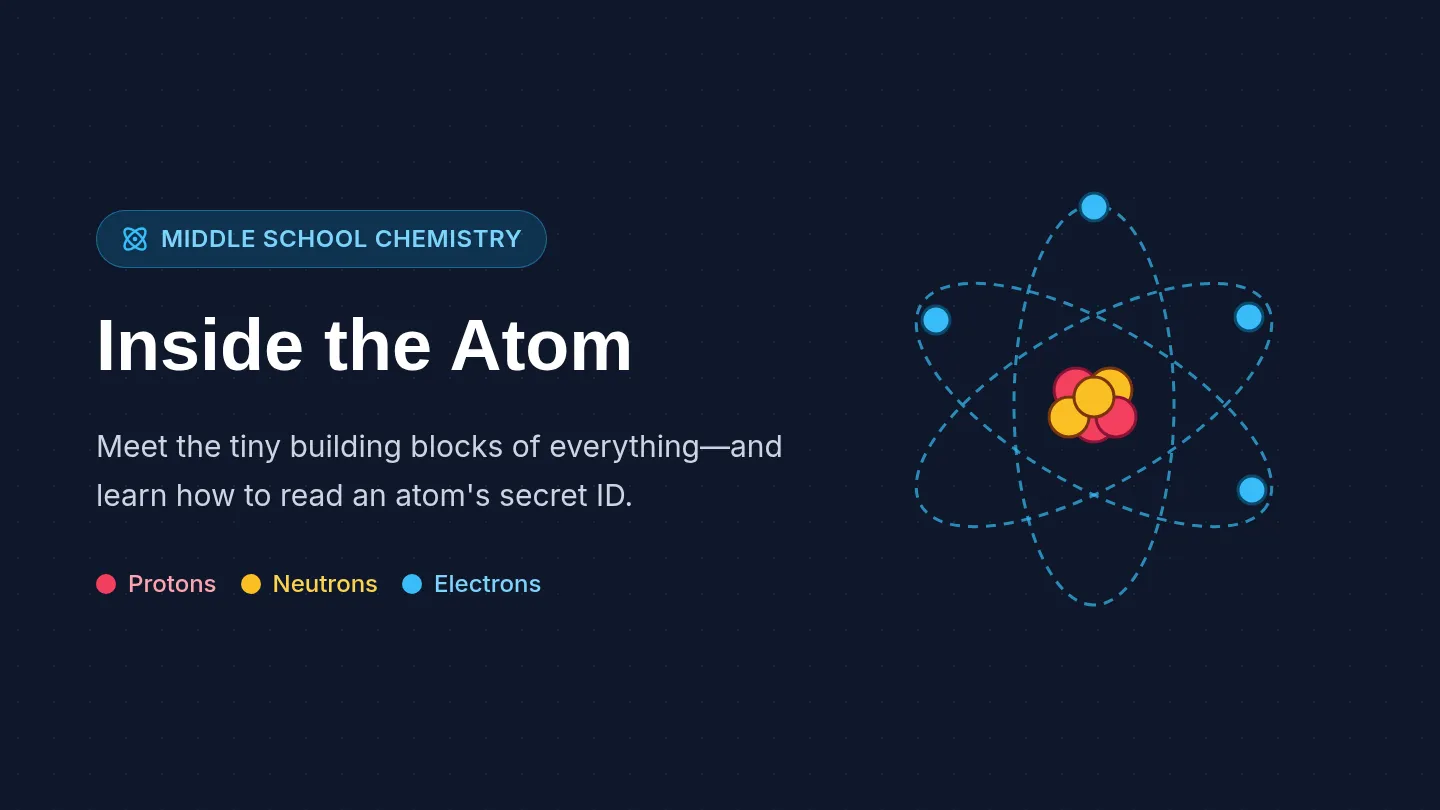
MIDDLE SCHOOL CHEMISTRY
+ CATION − ANION
Ion Charge Detectives
How atoms gain or lose electrons to become charged ions—and how the Periodic Table predicts every charge.
1
Cations vs. Anions
2
Electron Transfer
3
Periodic Patterns
Neutral Atoms vs. Ions
BIG IDEA
Neutral Atom Charge = 0
Has the exact same number of protons (+) and electrons (−).
11 p+
Protons
=
11 e−
Electrons
Charged Ion Charge ≠ 0
Forms when an atom gains or loses electrons so protons and electrons no longer match.
Rule: Protons never leave the nucleus! Only electrons move.
Charge Formula: Ion Charge = Protons (+) − Electrons (−)
Two Types of Ions
POSITIVE & NEGATIVE
Cation
- Loses one or more electrons
- More protons (+) than electrons (−)
- Usually metals (left side of table)
Memory Trick: Cations are paws-itive! 🐾
Anion
−
- Gains one or more electrons
- More electrons (−) than protons (+)
- Usually nonmetals (right side of table)
Memory Trick: A negative ion!
Think: Losing something negative (−) leaves you more positive (+)!
Forming a Cation: Sodium (Na)
LOSES 1 e−
Neutral Atom
Na 11 p+
e−
11 p+ & 11 e−
1 lonely outer electron
− 1 e−
Easier to lose 1 than gain 7!
Sodium Cation
Na+ 11 p+
11 p+ & 10 e−
Charge = +1 (Full outer shell!)
Math Check: 11 protons (+) − 10 electrons (−) = +1 charge → Written as Na+
Forming an Anion: Chlorine (Cl)
GAINS 1 e−
Neutral Atom
Cl 17 p+
7 outer e−
17 p+ & 17 e−
Needs 1 more for a full 8!
+ 1 e−
Easier to gain 1 than lose 7!
Chloride Anion
Cl− 17 p+
17 p+ & 18 e−
Charge = −1 (Full outer shell!)
Math Check: 17 protons (+) − 18 electrons (−) = −1 charge → Written as Cl−
Periodic Table Charge Patterns
GROUP SHORTCUT
Elements in the same column (group) have the same outer electrons—so they form the same ion charge!
Grp 1 +1 Li+, Na+ Lose 1
Grp 2 +2 Mg2+, Ca2+ Lose 2
Grp 13 +3 Al3+ Lose 3
Grp 14 ±4 C, Si Share
Grp 15 −3 N3−, P3− Gain 3
Grp 16 −2 O2−, S2− Gain 2
Grp 17 −1 F−, Cl− Gain 1
Grp 18 0 Ne, Ar Full!
Left Side (Metals): Lose electrons (+) Right Side (Nonmetals): Gain electrons (−) Group 18: Already stable!
Building Simple Ionic Formulas
TOTAL CHARGE = 0
Cations (+) and anions (−) attract! Combine them until the positive and negative charges cancel out.
Example 1: 1-to-1 Match
Na+
Cl−
(+1) + (−1) = 0
Formula: NaCl
Example 2: Need Two Anions
Mg2+
Cl−
Cl−
(+2) + (−1) + (−1) = 0
Formula: MgCl2
Tip: Subscripts (like the 2 in MgCl2) tell you how many of that ion you need!
Quick Check Challenge
TURN & TALK
1
Calcium (Ca) is in Group 2. Does it gain or lose electrons, and what is its ion charge?
2
Oxygen (O) has 8 protons and 10 electrons. Is it a cation or an anion? What is its symbol?
3
What neutral formula forms when Al3+ combines with Cl−?
Next up: Show what you know on the Ion Practice Worksheet!
Ion Practice Worksheet
Middle School Chemistry
Ion Practice Worksheet
Name: ________________________
Date: ____________
Cation (+) Loses electrons (e−)
Anion (−) Gains electrons (e−)
Charge = Protons (+) − Electrons (−)
Part 1: Protons, Electrons & Ion Type
Complete the table below. The first row is done as an example.
| Element |
Protons (+) |
Electrons (−) |
Ion Charge |
Ion Symbol |
Cation or Anion? |
| Lithium (Li) (Ex.) |
3 |
2 |
+1 |
Li+ |
Cation |
| 1. Sodium (Na) |
11 |
10 |
|
|
|
| 2. Oxygen (O) |
8 |
10 |
|
|
|
| 3. Magnesium (Mg) |
12 |
|
+2 |
|
|
| 4. Fluorine (F) |
9 |
|
−1 |
|
|
| 5. Aluminum (Al) |
13 |
10 |
|
|
|
Part 2: Explain Ion Formation
6. Why does losing an electron give an atom a positive (+) charge instead of a negative charge?
7. A neutral Chlorine atom has 17 protons and 17 electrons (7 in its outer shell). Explain how it becomes a Chloride ion (Cl−) instead of gaining 7 protons.
Page 1 of 2
Ion Practice Worksheet
Periodic Patterns & Formulas
Part 3: Periodic Table Charge Patterns
Use the group pattern chart below to predict the common ion charge and symbol for each element.
Group 1
+1
Group 2
+2
Group 13
+3
Group 15
−3
Group 16
−2
Group 17
−1
Group 18
0
8. Potassium (K)
Group 1
Ion Symbol:
9. Calcium (Ca)
Group 2
Ion Symbol:
10. Nitrogen (N)
Group 15
Ion Symbol:
11. Sulfur (S)
Group 16
Ion Symbol:
12. Bromine (Br)
Group 17
Ion Symbol:
13. Neon (Ne)
Group 18
Charge:
Part 4: Simple Ionic Formulas
Combine each cation and anion so the total charge equals 0. Show your charge balance or ion count, then write the final formula.
14. Potassium (K+) + Bromide (Br−)
Neutral Formula:
15. Calcium (Ca2+) + Oxide (O2−)
Neutral Formula:
16. Magnesium (Mg2+) + Fluoride (F−)
Neutral Formula:
17. Aluminum (Al3+) + Chloride (Cl−)
Neutral Formula:
Bonus Challenge
18. How many Al3+ ions and O2− ions are needed to make a neutral compound? Write the formula.
Page 2 of 2
Ion Practice Answer Key
Teacher Resource
Ion Practice Answer Key
Answer Key
Part 1: Protons, Electrons & Ion Type
| Element |
Protons (+) |
Electrons (−) |
Ion Charge |
Ion Symbol |
Cation or Anion? |
| 1. Sodium (Na) |
11 |
10 |
+1 |
Na+ |
Cation |
| 2. Oxygen (O) |
8 |
10 |
−2 |
O2− |
Anion |
| 3. Magnesium (Mg) |
12 |
10 |
+2 |
Mg2+ |
Cation |
| 4. Fluorine (F) |
9 |
10 |
−1 |
F− |
Anion |
| 5. Aluminum (Al) |
13 |
10 |
+3 |
Al3+ |
Cation |
Part 2: Explain Ion Formation (Sample Responses)
6. Electrons have a negative (−) charge. When an atom loses a negative electron, it now has more positive protons than negative electrons, leaving an overall positive (+) charge.
7. Protons are locked in the nucleus and cannot be gained or lost in chemical reactions. Instead, Chlorine gains 1 electron to complete its outer shell of 8, giving it 17 protons and 18 electrons (Cl−).
Part 3: Periodic Table Charge Patterns
8. Potassium (K): K+ (+1)
9. Calcium (Ca): Ca2+ (+2)
10. Nitrogen (N): N3− (−3)
11. Sulfur (S): S2− (−2)
12. Bromine (Br): Br− (−1)
13. Neon (Ne): 0 (no ion)
Part 4: Simple Ionic Formulas & Bonus
14. (+1) + (−1) = 0 → KBr
15. (+2) + (−2) = 0 → CaO
16. (+2) + 2(−1) = 0 → MgF2
17. (+3) + 3(−1) = 0 → AlCl3
18. Bonus Challenge: Two Al3+ ions (+6 total) + three O2− ions (−6 total) = 0 → Al2O3
Common Misconceptions to Watch For
- "Gaining makes it positive": Students often associate "gaining" with "+". Remind them that electrons are negative (−), so gaining negatives makes the charge go down.
- Changing protons: Reinforce that changing protons would change the element itself; only electrons transfer during ion formation.