Gas Detective Catch Up Slides
Lesson 5 Catch-Up Unit 7.1 • Bath Bomb Chemistry
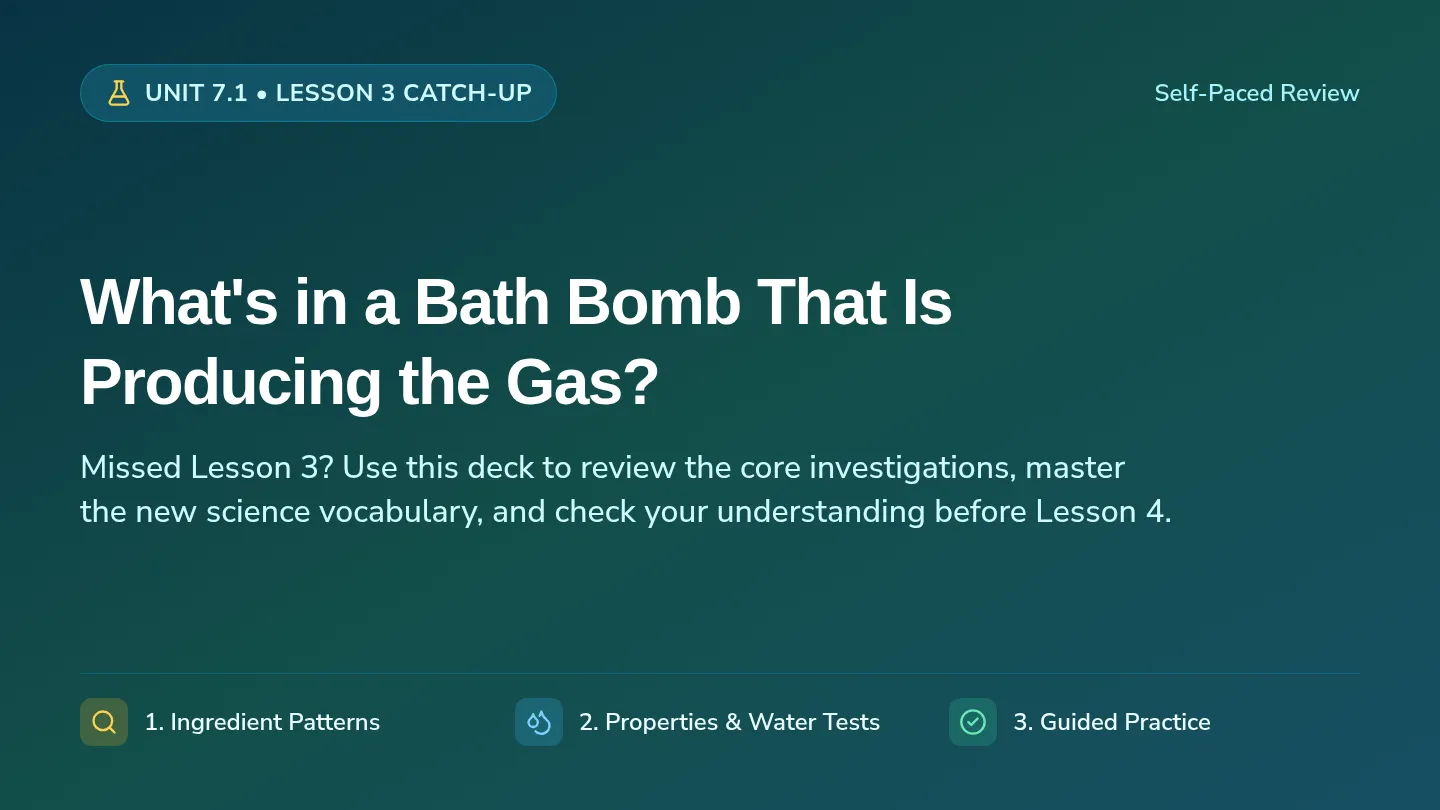
What Gas(es) Could Be Coming From the Bath Bomb?
Missed Lesson 5? This review walks you through our flammability and density investigations, key vocabulary, and guided practice so you are ready for Lesson 6.
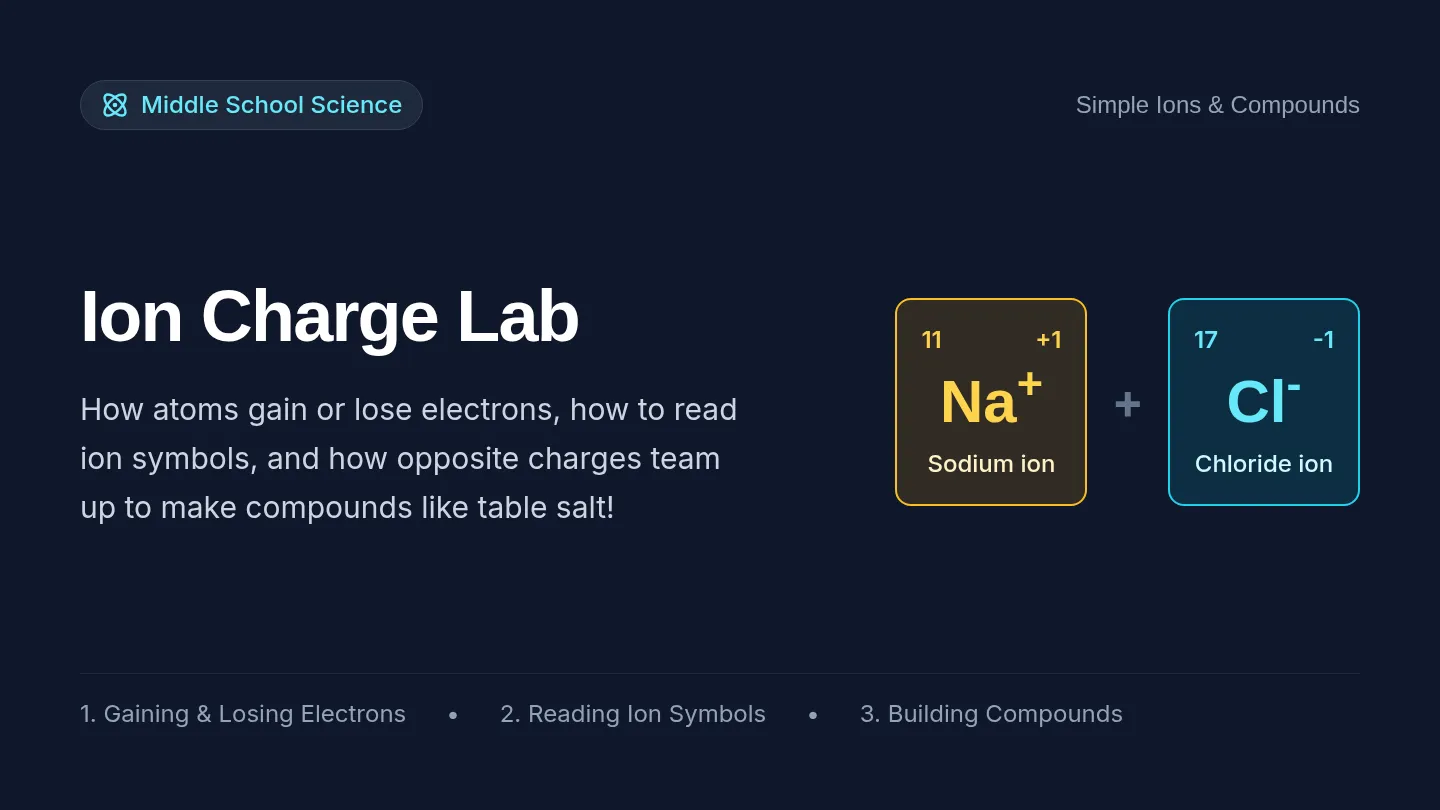
1. Flammability Tests
2. Density Investigations
3. Guided Practice & CER
Where We Left Off
Lesson 4 Recap
What We Already Know
- • Mixing baking soda, citric acid, and water produces gas bubbles.
- • The gas is a new substance—not one of the three starting substances.
- • Its matter came from the starting ingredients.
Today’s Big Question
Which specific gas (out of common gases in our air) is inside those bath bomb bubbles?
Since gases are invisible, we need measurable properties to tell them apart!
Goal: Narrow down 10 common gases to the most likely candidates using evidence.
Word Wall: Properties of Gases
Core Vocabulary
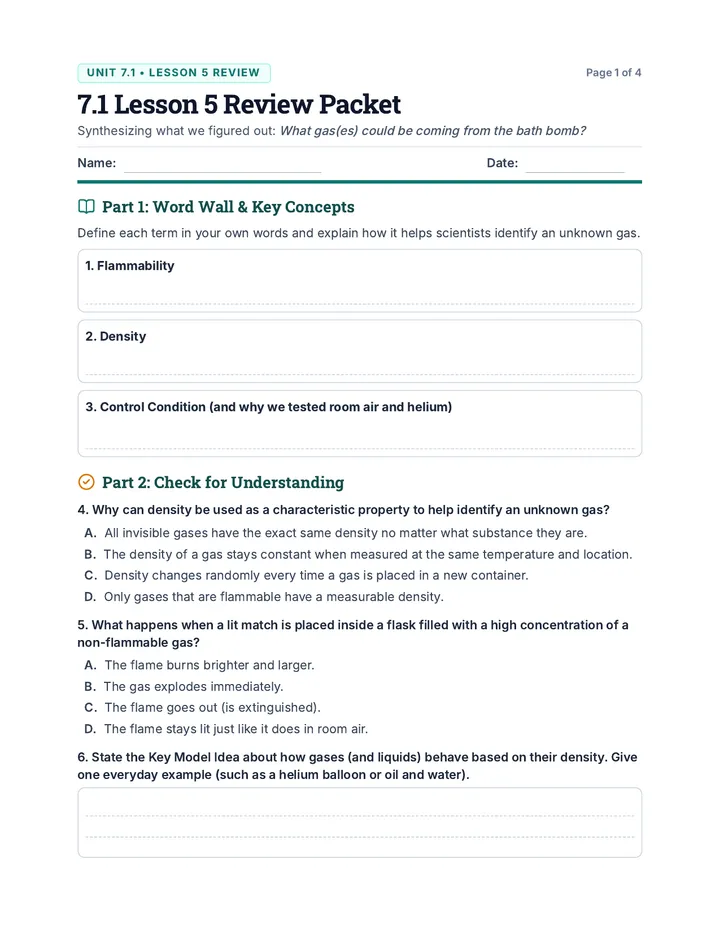
Flammability
How a substance interacts with fire.
Examples: Natural gas burns on a stove; helium does not burn and puts out a flame.
Density
How much matter there is in a certain space.
Examples: Helium is less dense than air, so balloons float upward.
Why not odor? Pure baking soda + citric acid had no smell, and natural gas only smells because an odor is added for safety!
Our 10 Candidate Gases
Data Reference
Scientists compare unknown gases to known data. Room air has a density of 1.160 – 1.161 g/L.
Flammable or Supports Fire (5)
- • Air (supports flame; 1.160–1.161 g/L)
- • Oxygen (helps things burn)
- • Hydrogen (explodes / flammable)
- • Methane (flammable)
- • Propane (flammable)
Non-Flammable Gases (5)
- • Helium (less dense than air)
- • Neon (less dense than air)
- • Nitrogen (more dense than air)
- • Argon (more dense than air)
- • Carbon Dioxide (more dense than air)
Pattern to notice: Every gas has its own combination of flammability and density!
Lab 1: Testing Flammability
Control Conditions
We used control conditions (known gases: room air and helium) to compare with our unknown bath bomb gas.
Control 1
Room Air
A lit match is slid into a flask of room air.
Match stays lit!
Control 2
Helium Gas
A lit match is slid into a flask of helium.
Flame goes out!
Unknown
Bath Bomb Gas
A lit match is slid into trapped bath bomb gas.
Flame goes out!
Key Science Idea: In high concentrations, gases that are non-flammable will extinguish a flame.
Eliminating Candidates: Step 1
10 → 5 Gases
Because the bath bomb gas extinguished the flame, we can cross off every gas that burns, explodes, or supports a flame.
Eliminated (5 Gases)
- • Air
- • Oxygen
- • Hydrogen
- • Methane
- • Propane
Still Possible (5 Gases)
- • Helium
- • Neon
- • Nitrogen
- • Argon
- • Carbon Dioxide
Next Step: How can we narrow these 5 non-flammable gases down even further? Let’s test density!
Guided Practice 1: Check Yourself
Pause & Think
1. Why did we test room air and helium before testing the bath bomb gas?
A. To make the lab take longer
B. As control conditions to compare results
C. To mix them with the bath bomb
D. Because room air is non-flammable
2. Which list shows ONLY gases that were eliminated by the flammability test?
A. Helium, Neon, Argon
B. Nitrogen, Carbon Dioxide, Air
C. Oxygen, Hydrogen, Methane
D. Neon, Propane, Nitrogen
Pick your answers, then move to the next slide to check!
Guided Practice 1: Answers
Self-Check
1. Answer: B — As control conditions to compare results
Comparing an unknown substance to known substances (room air and helium) increases reliability and helps us spot problems in our setup.
2. Answer: C — Oxygen, Hydrogen, Methane
Oxygen supports burning, and hydrogen and methane are flammable/explosive. Since the bath bomb gas put out the flame, it cannot be any of those!
Check: Ready to see how we test the density of an invisible gas? Let’s go!
Lab 2: Testing Density With Helium
Invisible Gas
Gases are invisible! So we used flammability as a detector to see whether helium floats upward or sinks downward.
Match BELOW Upside-Down Flask
We removed the stopper while holding the lit match underneath.
Result: Flame stayed lit! Helium did NOT sink out.
Match ABOVE Right-Side-Up Flask
We removed the stopper and held the lit match right above the opening.
Result: Flame went out! Helium floated UPWARD.
Key Model Idea: Less dense gases float upward in denser gases; more dense gases sink downward in less dense gases.
Guided Practice 2: Make Predictions
If–Then Reasoning
Before testing the bath bomb gas, complete these two predictions using room air’s density (1.160–1.161 g/L):
Prediction A: If the bath bomb gas puts out a flame above it, that means it is _____ dense than room air (1.160–1.161 g/L). I know this because _________________. This tells me the gas could be ___________.
Prediction B: If the bath bomb gas puts out a flame below it, that means it is _____ dense than room air (1.160–1.161 g/L). I know this because _________________. This tells me the gas could be ___________.
Check your answers on the next slide!
Guided Practice 2: Prediction Key
Self-Check
Prediction A (Flame Above Goes Out)
It is less dense than room air (1.160–1.161 g/L) because materials that are less dense float upward when surrounded by denser matter. The gas could be helium or neon.
Prediction B (Flame Below Goes Out)
It is more dense than room air (1.160–1.161 g/L) because materials that are more dense sink downward when surrounded by less dense matter. The gas could be nitrogen, argon, or carbon dioxide.
Now let’s see what actually happened when we tested the bath bomb gas!
Lab 3: Bath Bomb Gas Density Results
5 → 3 Gases
Test 1: Match 1" Above Bottle
We opened the bottle of bath bomb gas and held a lit match 1 inch above the top.
Result: Flame stayed lit! Gas did NOT float up.
Test 2: Pouring Gas Onto Candle
We tilted the bottle sideways above a lit candle (without spilling liquid!) to pour out the gas.
Result: Candle went out! Gas SANK downward.
Eliminated: Helium & Neon (less dense than air)
Remaining: Carbon Dioxide, Nitrogen, Argon
Guided Practice 3: Write Your Argument
CER Practice
Question: What gas(es) could be produced by a bath bomb?
1. Claim
State which 3 gases out of the 10 candidates could be coming from the bath bomb.
2. Evidence
Cite results from both tests (flame above/inside vs. candle below) and data from Some Common Gases.
3. Reasoning
Connect using Key Model Ideas about properties, non-flammable gases, and density (floating/sinking).
Draft your CER in your science notebook, then check the model argument on the final slide!
Model CER & What’s Next
Up to Speed!
Sample Evidence-Based Argument
Claim: The gas from the bath bomb could be carbon dioxide, nitrogen, or argon.
Evidence: When we tested the gas with a lit match, the flame went out. When we poured the gas onto a candle below it, the candle went out, while a match above stayed lit.
Reasoning: Substances have characteristic properties that help identify them. Non-flammable gases extinguish flames, eliminating air, oxygen, hydrogen, methane, and propane. Because denser gases sink in less dense air (1.160–1.161 g/L), the gas must be denser than air—eliminating helium and neon.
Next in Lesson 6: We’ll apply what we learned about properties to explain a new phenomenon—elephant’s toothpaste!