Cell Builders Reading Worksheet
Biology Lab Field Guide
Cell Builders: Macromolecules
Name: ________________________
Date: ________________________
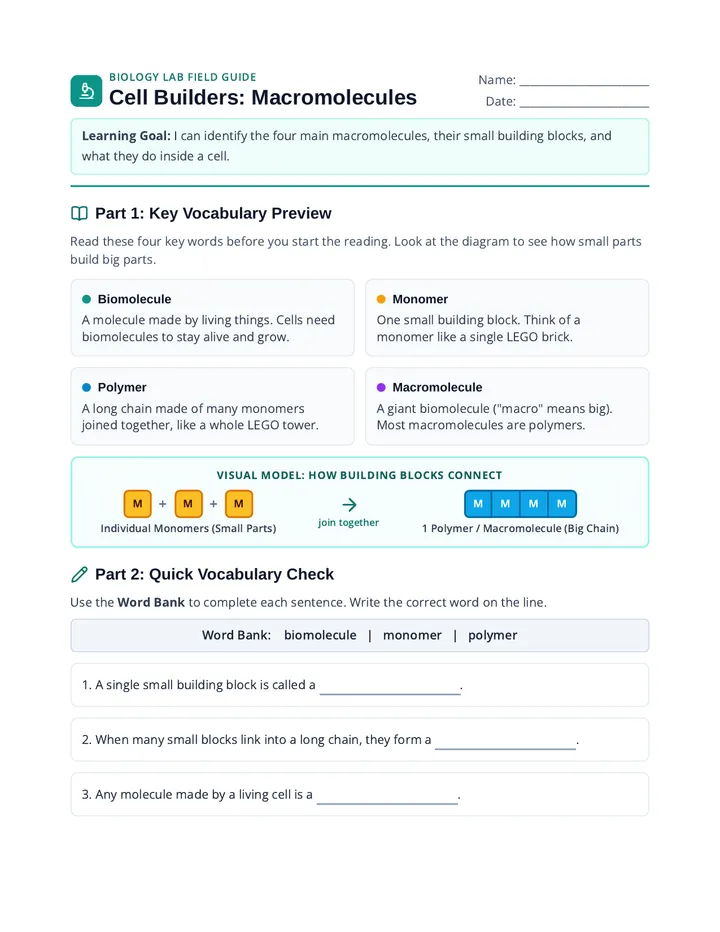
Learning Goal: I can identify the four main macromolecules, their small building blocks, and what they do inside a cell.
Part 1: Key Vocabulary Preview
Read these four key words before you start the reading. Look at the diagram to see how small parts build big parts.
Biomolecule
A molecule made by living things. Cells need biomolecules to stay alive and grow.
Monomer
One small building block. Think of a monomer like a single LEGO brick.
Polymer
A long chain made of many monomers joined together, like a whole LEGO tower.
Macromolecule
A giant biomolecule ("macro" means big). Most macromolecules are polymers.
Visual Model: How Building Blocks Connect
M
M
M
Individual Monomers (Small Parts)
join together
M
M
M
M
1 Polymer / Macromolecule (Big Chain)
Part 2: Quick Vocabulary Check
Use the Word Bank to complete each sentence. Write the correct word on the line.
Word Bank: biomolecule | monomer | polymer
1. A single small building block is called a .
2. When many small blocks link into a long chain, they form a .
3. Any molecule made by a living cell is a .
Part 3: Energy Builders (Carbohydrates & Lipids)
Reading Chunk 1
Carbohydrate
S
-
S
-
S
Monomer: Simple Sugar
(Glucose)
1. Carbohydrates: Quick Cell Fuel
Carbohydrates are the cell's main source of fast energy. When you eat bread, fruit, or pasta, your body breaks them down into small sugar rings.
The monomer (building block) of a carbohydrate is a simple sugar, such as glucose. Cells burn these sugars right away to power movement and growth.
Lipid
Building Blocks:
Glycerol + Fatty Acids
2. Lipids: Stored Energy & Cell Walls
Lipids are fats, oils, and waxes. They do not mix with water. Their building blocks are glycerol and fatty acids.
Lipids have two big jobs in the cell. First, they store long-term energy for later. Second, they build the cell membrane, which is the protective outer border of every cell.
Chunk 1 Check-In Questions
1. What is the building block (monomer) of a carbohydrate, and how do cells use it?
Sentence starter: The building block of a carbohydrate is ________, and cells use it to...
2. Name the two main jobs of lipids inside a cell.
Sentence starter: Two main jobs of lipids in a cell are...
Part 4: Cell Workers & Instructions (Proteins & Nucleic Acids)
Reading Chunk 2
Protein
Monomer:
Amino Acids
3. Proteins: The Workers of the Cell
Proteins do most of the daily work inside a cell. They are built from chains of 20 different monomers called amino acids.
Each protein folds into a special 3D shape. Some proteins build muscles and hair. Other proteins, called enzymes, speed up chemical reactions in the cell.
Nucleic Acid
Monomer:
Nucleotide
4. Nucleic Acids: The Cell's Instruction Book
Nucleic acids are the molecules that hold genetic information. DNA and RNA are the two types of nucleic acids.
Their monomer is called a nucleotide. Nucleic acids act like a recipe book—they store and pass on the instructions for how to build every protein in the cell.
Chunk 2 Check-In Questions
3. What are the building blocks of proteins, and why are proteins called "cell workers"?
Sentence starter: Proteins are built from ________, and they are called cell workers because...
4. What is the main job of nucleic acids like DNA in a cell?
Sentence starter: The main job of nucleic acids in a cell is to...
Part 5: Macromolecule Comparison Chart
Visual Summary
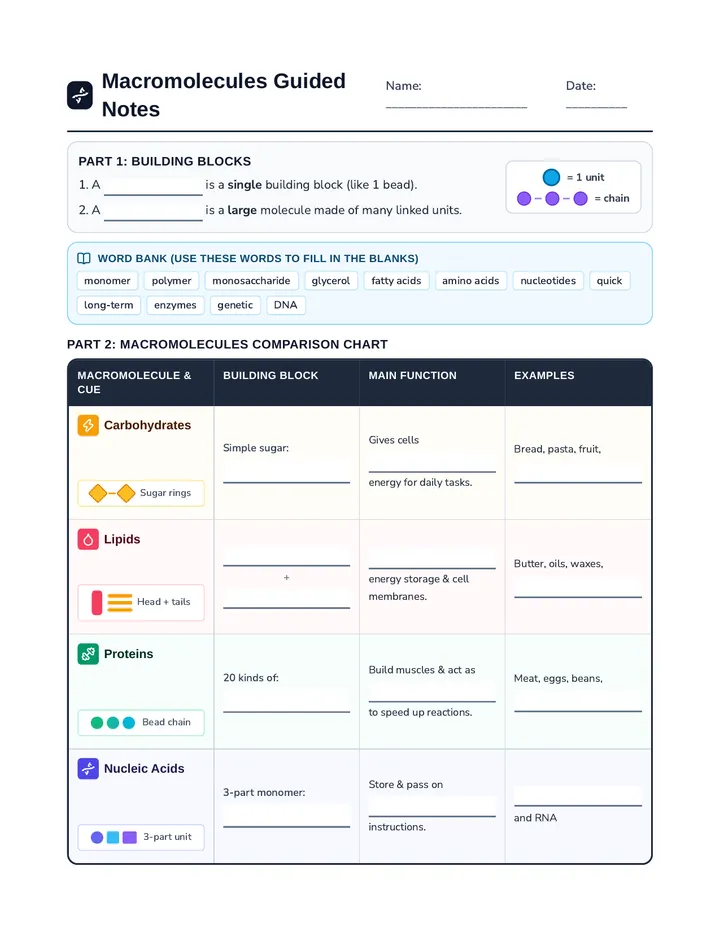
Use this chart to compare the four macromolecules, their building blocks, and their roles in the cell.
| Macromolecule |
Building Block (Monomer) |
Main Role in the Cell |
Examples |
|
|
|
|
| Carbohydrate |
|
|
|
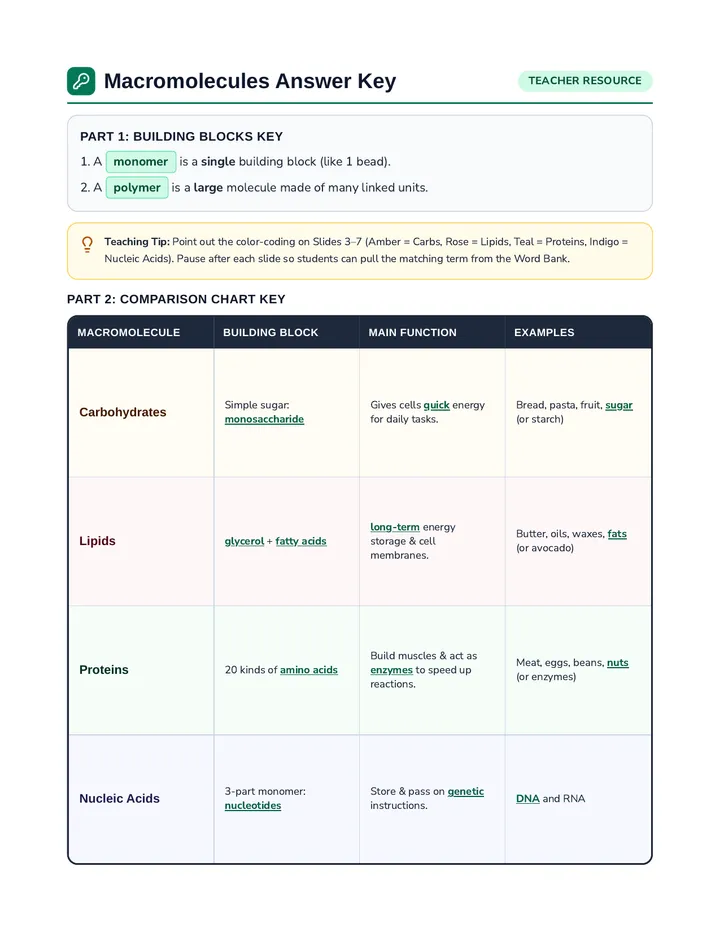
| Simple sugar (glucose) | Gives the cell quick energy | Bread, fruit, pasta, sugar |
|
Lipid
| Glycerol & fatty acids | Stores long-term energy & builds cell membranes | Oils, butter, waxes |
|
Protein
| Amino acids | Builds structures & speeds up reactions (enzymes) | Meat, beans, eggs, muscles |
|
Nucleic Acid
| Nucleotide | Stores & passes on genetic instructions | DNA, RNA |
Part 6: Wrap-Up Questions
1. Compare carbohydrates and lipids: How are their jobs in the cell different?
Sentence starter: Carbohydrates give the cell ________, while lipids...
2. Imagine a cell cannot make any proteins. Why would this be a problem for the cell?
Sentence starter: If a cell could not make proteins, it would have trouble because...
Cell Builders Answer Key
Teacher Resource
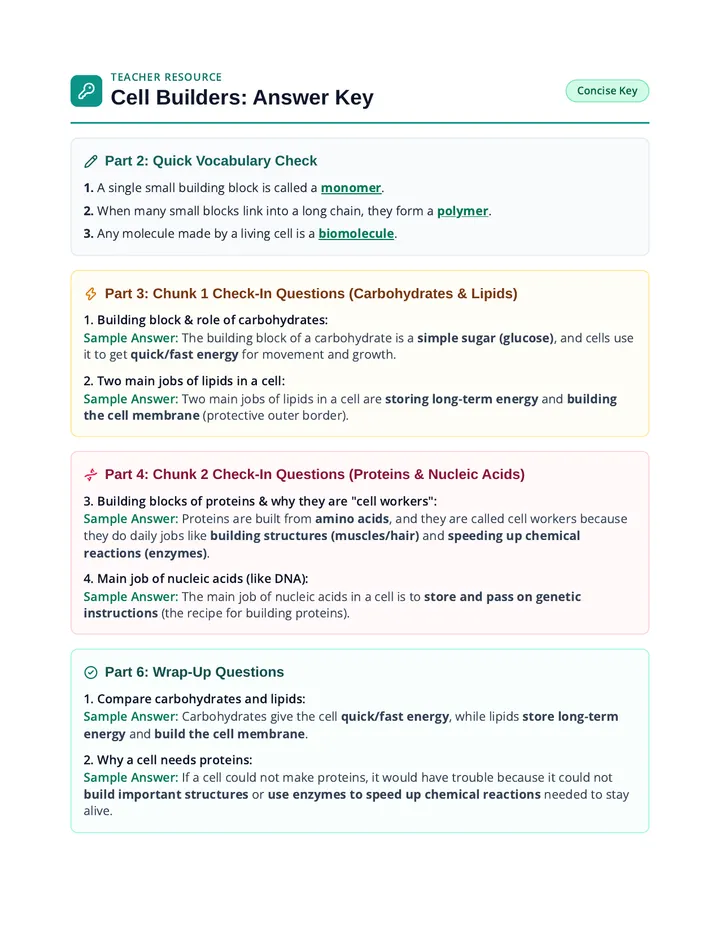
Cell Builders: Answer Key
Concise Key
Part 2: Quick Vocabulary Check
1. A single small building block is called a monomer.
2. When many small blocks link into a long chain, they form a polymer.
3. Any molecule made by a living cell is a biomolecule.
Part 3: Chunk 1 Check-In Questions (Carbohydrates & Lipids)
1. Building block & role of carbohydrates:
Sample Answer: The building block of a carbohydrate is a simple sugar (glucose), and cells use it to get quick/fast energy for movement and growth.
2. Two main jobs of lipids in a cell:
Sample Answer: Two main jobs of lipids in a cell are storing long-term energy and building the cell membrane (protective outer border).
Part 4: Chunk 2 Check-In Questions (Proteins & Nucleic Acids)
3. Building blocks of proteins & why they are "cell workers":
Sample Answer: Proteins are built from amino acids, and they are called cell workers because they do daily jobs like building structures (muscles/hair) and speeding up chemical reactions (enzymes).
4. Main job of nucleic acids (like DNA):
Sample Answer: The main job of nucleic acids in a cell is to store and pass on genetic instructions (the recipe for building proteins).
Part 6: Wrap-Up Questions
1. Compare carbohydrates and lipids:
Sample Answer: Carbohydrates give the cell quick/fast energy, while lipids store long-term energy and build the cell membrane.
2. Why a cell needs proteins:
Sample Answer: If a cell could not make proteins, it would have trouble because it could not build important structures or use enzymes to speed up chemical reactions needed to stay alive.