Falling Water Key Terms Guide
C.2 Structure & Properties of Matter · Lessons 2–3
Falling Water & Sparks: Key Terms Guide
Keep this guide open during class discussions, lab videos, and worksheet writing.

1 Spot a Pattern: Rain & lightning rise together
2 Test a Model: Water dropper makes sparks
3 Find the Forces: Pushes, pulls & energy
Lesson 2
From a Pattern to a Cause
Step 1
Pattern
Something we see again and again in data.
More rain shows up with more lightning.
Step 2
Correlation
Two things change together in data.
Rain and lightning rise together on the graph.
Step 3
Causation
One thing directly makes the other happen.
Does falling water make lightning? Test it!
Step 4
Mechanism
The step-by-step how and why it happens.
What we need to truly prove a cause.
Big Rule: Correlation is NOT causation. A graph shows two things change together, but proving a cause requires a mechanism and an experiment where we change one variable.
Words for Data & Evidence
Third factor
A hidden cause that makes two other things happen together.
Ex: Hot sun causes both ice cream sales and sunburns.
Variable
Anything that can change in an experiment.
Ex: Turning the falling water on or off.
Falling water
Our class phrase for rain, drops, or any water falling down.
Ex: Rain from a cloud; drips in the dropper.
Evidence
Data or observations that support a scientific claim.
Ex: "Sparks stopped when the water stopped."

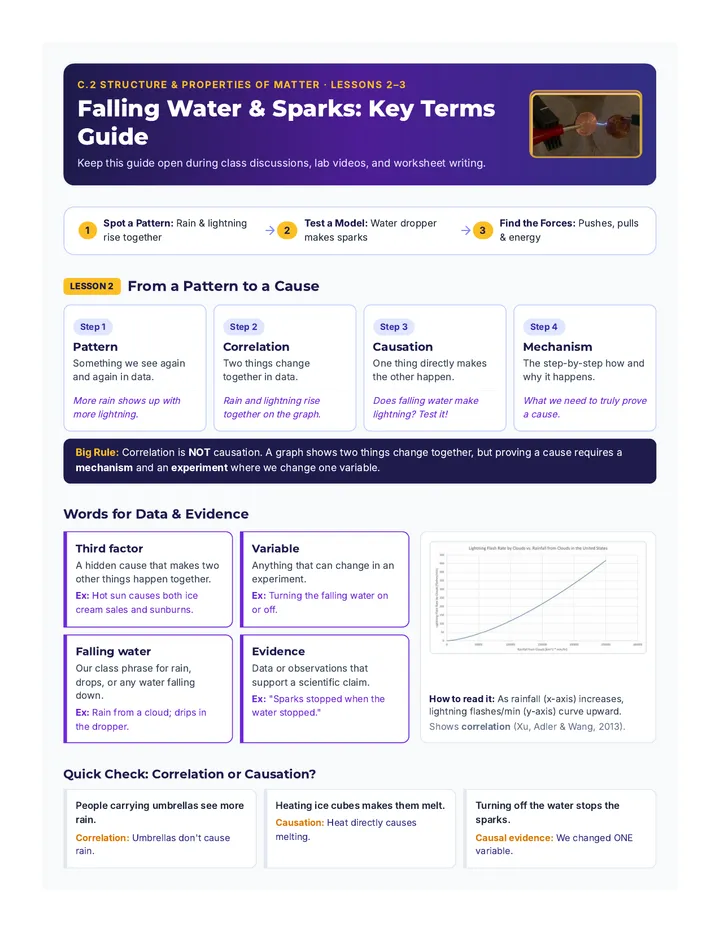
How to read it: As rainfall (x-axis) increases, lightning flashes/min (y-axis) curve upward.
Shows correlation (Xu, Adler & Wang, 2013).
Quick Check: Correlation or Causation?
People carrying umbrellas see more rain.
Correlation: Umbrellas don't cause rain.
Heating ice cubes makes them melt.
Causation: Heat directly causes melting.
Turning off the water stops the sparks.
Causal evidence: We changed ONE variable.
Lesson 2
Models: Studying Storms Safely at a Smaller Scale
Model
A drawing, object, or explanation showing how and why something happens.
Ex: Our class storm diagram.
Physical model
A real, smaller-scale object we can test and change to study something too big or dangerous.
Ex: The water dropper system.
Components & Scale
Components: parts of a system. Scale: size compared to the real thing.
Ex: Tiny penny spark vs. giant lightning.
Merits (Strengths)
What a model helps us explain or test. Ex: We can turn the water dropper on/off and test objects near it.
Limitations (Weaknesses)
What a model leaves out or cannot show. Ex: No real clouds, wires aren't in the sky, and particles are invisible.
Lesson 2 Lab
The Water Dropper System & Storm Analogy

Diagram: OpenSciEd Water Dropper Construction Reference
A Water tub: holds water (like a cloud)
G Pipettes: where water drips out
I Metal rings: drops fall through without touching
J Metal buckets: catch falling water (on plastic cups M)
K/L Crossed wires & Pennies: spark jumps the small gap
| Water Dropper |
Real Storm |
Analogy Limit |
| Water in tub |
Water in cloud |
Plastic tub ≠ air/vapor |
| Dripping water |
Falling rain |
Guided by rings |
| Two pennies |
Cloud & ground |
Connected by wires |
| Tiny spark |
Lightning bolt |
Tiny scale & energy |
What Happens in the System?
Electroscope
A jar with thin foil leaves that shows when charge is building up.
Look for: Leaves spread apart, then drop right at a spark.
Spark / Electric discharge
When built-up electric charge suddenly jumps across a gap.
Ex: Spark between pennies; lightning bolt.
Matter
Anything that has mass and takes up space; made of particles.
Ex: Falling water, air, metal rings & buckets.
Energy transfer
Energy moving from one object or place to another.
Ex: Spark transfers energy out as light & a snap.
Electroscope
Lesson 3
Building Our Force Words
Step 1
Force
A push or pull on an object. Ex: Foot pushes ball.
Step 2
Contact force
Push or pull by touching. Ex: Pushing a door open.
Step 3
Non-contact force
Push or pull without touching. Ex: Magnet & clip.
Step 4
Interaction
Two objects acting on each other. Ex: Bag & ring.
Attraction (Pull)
Objects move toward each other.
Ex: Plastic bag pulled toward metal ring.
Repulsion (Push)
Objects move away from each other.
Ex: Tinsel strands spreading apart.
Lesson 3 Lab
The Test Objects & Force Patterns

A · Light bulb
Glows near metal parts
B · Plastic bag
Pulled toward metal
C · Balloon
Pulled toward metal
D · Tinsel
Strands spread apart
Patterns we found: Forces act without touching, mostly near metal parts. They are stronger when closer and get weaker right after a spark (energy leaves as light & sound).
Matter–Energy–Forces
To explain lightning we need all three: what is there (matter), what moves (energy), and pushes/pulls (forces).
Static (static electricity)
When objects become charged and push or pull on each other. Ex: Doorknob shock; balloon on wall.
Zoom-in bubble
A part of a model showing what invisible particles might be doing.
Distance & Force Strength
Non-contact forces get stronger up close and weaker farther apart.
Our Matter–Energy–Forces Diagram
Use the Words: Evidence-Based Sentence Frames
Correlation vs. Cause: "The graph shows a correlation between ____ and ____, but to prove causation we need a ____."
Ex: "...between rainfall and lightning, but we need a mechanism."
Force & Distance: "The ____ showed attraction / repulsion because it moved ____, and the non-contact force got ____ when closer."
Ex: "The bag showed attraction... got stronger when closer."
Spark & Energy: "Right after a spark, energy transferred out as ____ and ____, so the force became ____."
Ex: "...as light and sound, so the force became weaker."
Model Limits: "A merit of the water dropper is ____, while a limitation is ____."
Ex: "...we can test it safely; a limit is we can't see particles."
Falling Water Sparks Slides

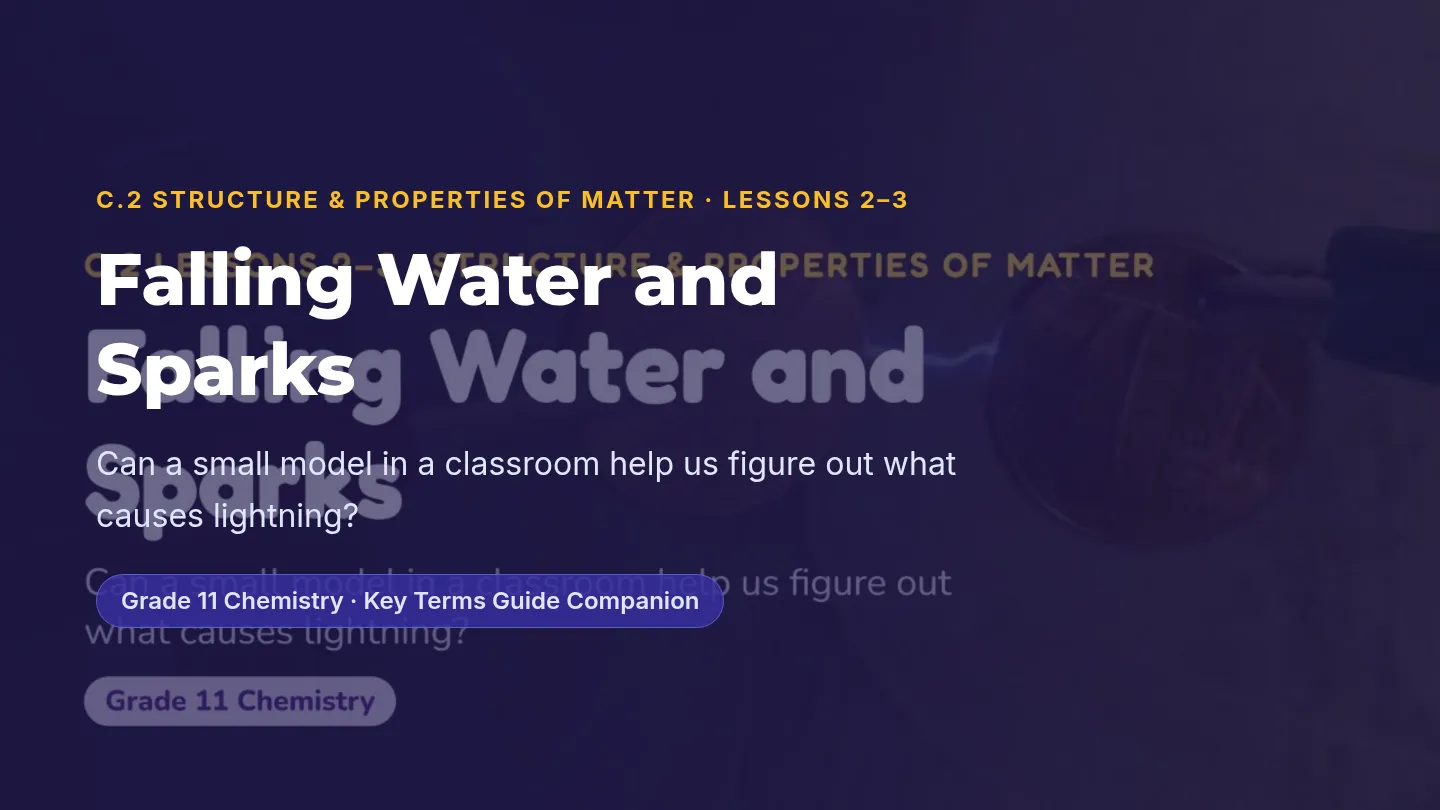
C.2 Structure & Properties of Matter · Lessons 2–3
Falling Water and Sparks
Can a small model in a classroom help us figure out what causes lightning?
Grade 11 Chemistry · Key Terms Guide Companion
Our Questions & Goals
What We Are Figuring Out
Unit Question: What causes lightning and why are some places safer than others when it strikes?
Lesson 2 · Goal 2.A
Use storm data and a physical model to decide if falling water and lightning have a correlation or a causal relationship.
Lesson 3 · Goal 3.A
Use the water dropper at a smaller scale to identify what causes attractions, repulsions, and energy transfer.
NGSS: HS-PS2-4, HS-PS3-5 · SEP 2 Developing & Using Models · CCC Cause & Effect, Scale
The Big Picture
How Our Investigation Unfolds
Stage 1 · Lesson 2A
Spot a Pattern
Read real U.S. storm data. Rain and lightning rise together—but does one cause the other?
Pattern → Correlation
Stage 2 · Lesson 2B
Test a Small Model
Watch the water dropper system. Can falling water alone create a real spark?
Physical Model → Causation
Stage 3 · Lesson 3
Find Hidden Forces
Hold test objects near the dropper to uncover non-contact forces and energy transfer.
Forces → Mechanism

Lesson 2 · Part 1
Is rain the cause?
Starter Question
When it storms, does the rain cause the lightning? Why do you think so?
Lesson 1 Recap
What Our Class Model Already Includes
We Agree
- • The ground and objects on it
- • Clouds (tiny water droplets)
- • Air between cloud and ground
- • Something moving between them
We're Still Unsure
- • Is falling water (rain) needed?
- • What exactly is moving?
- • What is lightning actually made of?
Lesson 2 · Storm Data
Do Rainier Clouds Make More Lightning?

X-axis: Rainfall from clouds
Y-axis: Lightning flashes per minute
Shape: Curves upward—more rain goes with more lightning!
Data: Xu, Adler & Wang (2013), J. Applied Meteorology & Climatology
Key Terms
From a Pattern to a Cause, Step by Step
Step 1
Pattern
Something we see again and again in data.
More rain shows up with more lightning.
Step 2
Correlation
Two things change together.
Rain and lightning rise together on the graph.
Step 3
Causation
One thing makes the other happen.
Does rain make lightning? Not proven yet!
Step 4
Mechanism
The step-by-step how and why.
What we need to prove a cause.
Watch Out for Third Factors
Correlation Is NOT Causation
Everyday Example: Ice cream sales and sunburns both go up in summer. Does eating ice cream cause sunburn?
Third Factor: A hidden cause! Hot, sunny weather causes both ice cream sales and sunburns.
For Lightning: Warm, humid, rising air makes storm clouds that produce both rain and lightning. We still need to test falling water!
Check Your Thinking
What Does the Graph Actually Prove?
A. They happen together, no connection.
B. Clouds make lightning because they make rain.
C. Clouds make rain because they make lightning.
D. Clouds make both because of a third factor.
E. We need more information!
How Scientists Prove a Cause
1. Spot a pattern / correlation in data.
2. Run an experiment: change ONE variable (like falling water) and keep everything else the same.
3. Find the step-by-step mechanism.
Why a Small Model?
Real Lightning Is Too Big & Dangerous to Test
Our Class Drawing: Merits
Easy to picture storm parts and zoom in on invisible particles—but we can't test or change a drawing.
Physical Model: Why It Helps
A real, smaller-scale system we can test and change safely—like engineers testing planes in wind tunnels.
Scale & Limits: A small model can show the same cause and effect, but we must always check what it leaves out.
Lesson 2 · Part 2 · Physical Model
Meet the Water Dropper System
Water drips from a plastic tub, through metal rings, into metal buckets. Wires connect the buckets to two pennies.
No battery. No wall plug. Just falling water!

Understanding the Model
How the Dropper Matches a Real Storm (and Its Limits)

| Water Dropper |
Real Storm |
Limit |
| Water in tub (A) |
Water in cloud |
Plastic tub ≠ vapor |
| Dripping water (G) |
Falling rain |
Guided by rings (I) |
| Two pennies (L) |
Cloud & ground |
Metal wires (K) |
| Tiny spark |
Lightning bolt |
Much smaller scale |
A Helper Tool
The Electroscope
A jar with thin foil leaves hanging on a wire. It detects when something invisible is building up in the system.
Watch closely: If the foil leaves spread apart, electric charge is building up. Watch what happens right at a spark!
Lesson 2 Lab · Watch & Record
Watch the Water, Foil Leaves, and Pennies
Embedded media
3 Notices
What happens to the water, foil leaves, and penny gap?
2 Wonders
What questions do you have about the spark?
Lesson 2 Conclusions
What Did the Water Dropper Show?
Matter
Water falls from the tub, through metal rings, into the buckets.
Energy Transfer
Moving water brings energy in; the spark transfers energy out as light and sound.
Electric Discharge
Built-up charge jumps the air gap—just like tiny lightning!
Causal Evidence: Water falls → sparks happen; water stops → sparks stop. Now we need the mechanism (Lesson 3)!
Lesson 3 · Part 1
What is the spark?
We bring 4 test objects near the water dropper to uncover hidden pushes, pulls, and energy transfers before a spark appears.
Lesson 3 Key Terms
Building Our Force Words
Step 1
Force
A push or pull on an object. Ex: Foot pushes ball.
Step 2
Contact
Push or pull by touching. Ex: Pushing a door.
Step 3
Non-contact
Push or pull without touching. Ex: Magnet & clip.
Step 4
Interaction
Two objects acting on each other.
Lesson 3 Stations
The 4 Test Objects
A · Light bulb
Does it light up?
B · Plastic bag
Does it move?
C · Balloon
Toward or away?
D · Tinsel
Do strands spread?
Lesson 3 Lab · Watch & Record
Stations A & B: Light Bulb and Plastic Bag
A · Light Bulb
Embedded media
Watch: Where does it glow? Is it brighter after waiting?
B · Plastic Bag
Embedded media
Watch: Does it move toward metal or plastic? What happens at a spark?
Lesson 3 Lab · Watch & Record
Stations C & D: Balloon and Tinsel
C · Balloon
Embedded media
Watch: What happens when held near metal parts or water?
D · Tinsel
Embedded media
Watch: Do strands spread apart? When do they fall back?
What the Tests Showed
Attraction, Repulsion & Force Patterns
Attraction (Pull)
Objects move toward each other. Ex: Plastic bag & balloon pulled toward metal parts.
Repulsion (Push)
Objects move away from each other. Ex: Tinsel strands spreading apart.
3 Big Patterns:
1. Forces act without touching, mostly near metal parts (not plastic).
2. Forces are stronger when closer and weaker farther apart.
3. Forces get weaker right after a spark (energy leaves as light & sound).
Updating Our Framework
Why We Need Matter, Energy, AND Forces
Matter: Tells us the parts (water, metal, air) but not why objects move.
Energy: Tells us the bulb lit and spark flashed, but not what pushed or pulled.
Forces: Explain the attractions and repulsions! Together, all three explain lightning.
Apply Your Thinking
Zoom-In Model & Everyday Static
Model One Interaction
1. Draw one test object and the metal part it moved toward or away from.
2. Add a zoom-in bubble: what might invisible particles be doing before and during a spark?
Everyday Static Electricity
- • Rubbing a balloon makes it stick to a wall
- • Shock from a doorknob after walking on carpet
- • Clothes from the dryer sticking & crackling
Is lightning giant static electricity?
Use Your Key Terms Guide
Write Evidence-Based Explanations
1. Correlation vs. Causation
"The graph shows a correlation between rainfall and lightning, and the water dropper gives causal evidence because sparks stop when water stops."
2. Model Merits & Limits
"A merit of the water dropper is we can test variables safely; a limitation is it uses wires and doesn't show particles."
3. Forces & Distance
"The plastic bag showed attraction toward the metal ring, and the non-contact force grew stronger when closer."
4. Spark & Energy Transfer
"Right after a spark, energy transferred out as light and sound, so the force became weaker."