Sugars and Fats Reading Sugars and Fats Reading
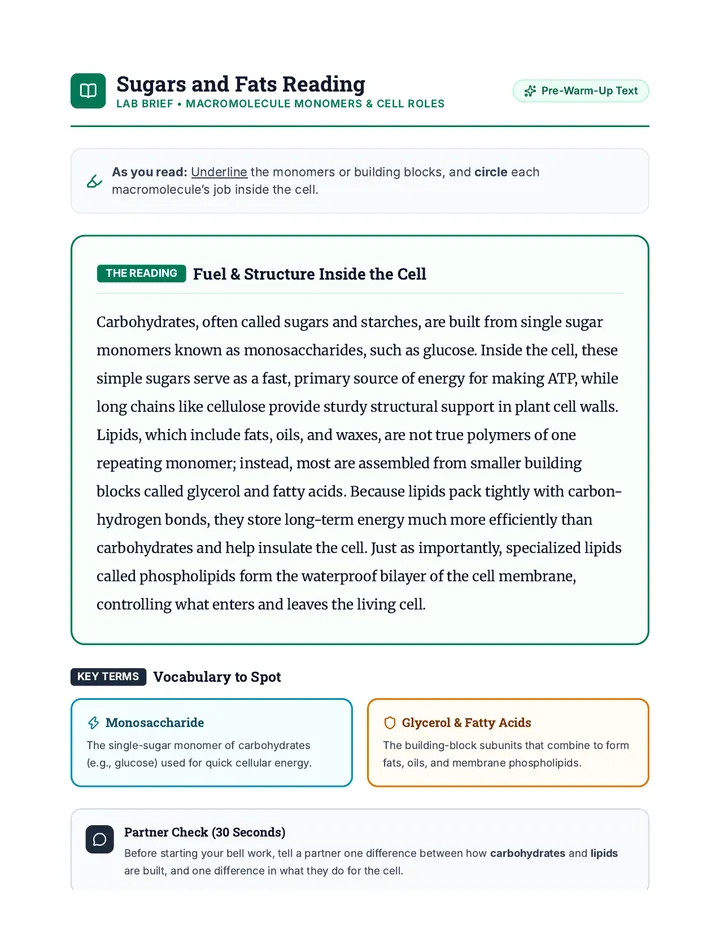
Lab Brief • Macromolecule Monomers & Cell Roles
Pre-Warm-Up Text
As you read: Underline the monomers or building blocks, and circle each macromolecule’s job inside the cell.
THE READING
Fuel & Structure Inside the Cell
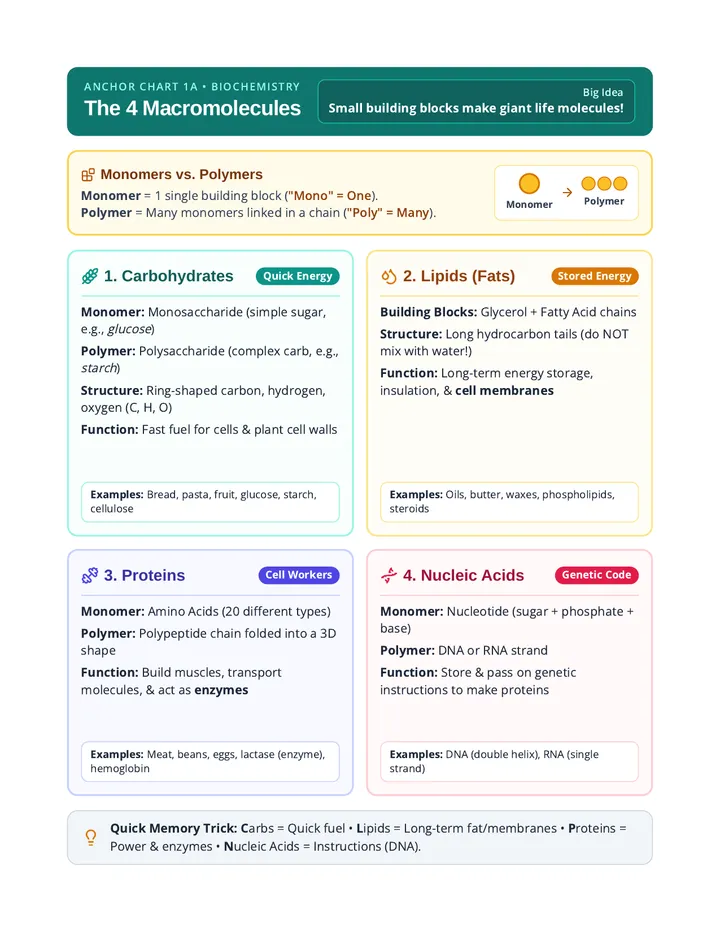
Carbohydrates, often called sugars and starches, are built from single sugar monomers known as monosaccharides, such as glucose. Inside the cell, these simple sugars serve as a fast, primary source of energy for making ATP, while long chains like cellulose provide sturdy structural support in plant cell walls. Lipids, which include fats, oils, and waxes, are not true polymers of one repeating monomer; instead, most are assembled from smaller building blocks called glycerol and fatty acids. Because lipids pack tightly with carbon-hydrogen bonds, they store long-term energy much more efficiently than carbohydrates and help insulate the cell. Just as importantly, specialized lipids called phospholipids form the waterproof bilayer of the cell membrane, controlling what enters and leaves the living cell.
KEY TERMS
Vocabulary to Spot
Monosaccharide
The single-sugar monomer of carbohydrates (e.g., glucose) used for quick cellular energy.
Glycerol & Fatty Acids
The building-block subunits that combine to form fats, oils, and membrane phospholipids.
Partner Check (30 Seconds)
Before starting your bell work, tell a partner one difference between how carbohydrates and lipids are built, and one difference in what they do for the cell.
Cell Fuel Bell Work Cell Fuel Bell Work
Macromolecules: Carbohydrates & Lipids
Warm-Up • 5–8 Min
Name:
Date:
PART 1
Monomers & Building Blocks
Identify the monomer (or building-block subunits) for each macromolecule, then give one common example.
Carbohydrates
C, H, O (1:2:1)
Monomer Name:
Example (Monomer or Polymer):
Lipids
C, H, O (mostly C-H)
Building Blocks (Subunits):
Example of a Lipid:
PART 2
Functions Within the Cell
Complete the table below by describing two key roles each macromolecule plays inside a living cell.
Macromolecule
Primary Energy Role
Structural / Other Role
Carbohydrates
Lipids
Cell Fuel Bell Work Page 2
PART 3
Quick Check
1. A plant cell builds cellulose for its cell wall by linking together many identical:
A. Amino acids
B. Monosaccharides
C. Fatty acids
D. Nucleotides
2. Which macromolecule forms the main waterproof bilayer of the cell membrane?
A. Carbohydrates
B. Nucleic acids
C. Lipids
D. Simple sugars
PART 4
60-Second Synthesis
Why does a cell need both carbohydrates and lipids instead of relying on just one? Explain in 2–3 sentences.
Sentence Starter: “A cell needs carbohydrates to ______________, whereas it needs lipids to ______________.”
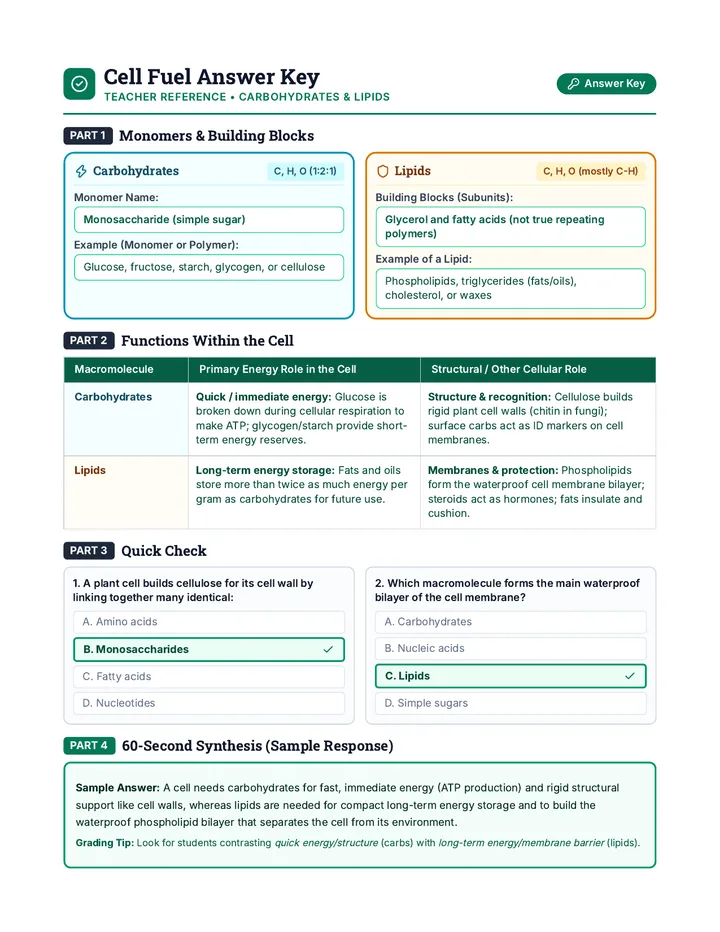
Cell Fuel Answer Key Cell Fuel Answer Key
Teacher Reference • Carbohydrates & Lipids
Answer Key
PART 1
Monomers & Building Blocks
Carbohydrates
C, H, O (1:2:1)
Monomer Name:
Monosaccharide (simple sugar)
Example (Monomer or Polymer):
Glucose, fructose, starch, glycogen, or cellulose
Lipids
C, H, O (mostly C-H)
Building Blocks (Subunits):
Glycerol and fatty acids (not true repeating polymers)
Example of a Lipid:
Phospholipids, triglycerides (fats/oils), cholesterol, or waxes
PART 2
Functions Within the Cell
Macromolecule
Primary Energy Role in the Cell
Structural / Other Cellular Role
Carbohydrates
Quick / immediate energy: Glucose is broken down during cellular respiration to make ATP; glycogen/starch provide short-term energy reserves.Structure & recognition: Cellulose builds rigid plant cell walls (chitin in fungi); surface carbs act as ID markers on cell membranes.
Lipids
Long-term energy storage: Fats and oils store more than twice as much energy per gram as carbohydrates for future use.Membranes & protection: Phospholipids form the waterproof cell membrane bilayer; steroids act as hormones; fats insulate and cushion.
PART 3
Quick Check
1. A plant cell builds cellulose for its cell wall by linking together many identical:
A. Amino acids
B. Monosaccharides
C. Fatty acids
D. Nucleotides
2. Which macromolecule forms the main waterproof bilayer of the cell membrane?
A. Carbohydrates
B. Nucleic acids
C. Lipids
D. Simple sugars
PART 4
60-Second Synthesis (Sample Response)
Sample Answer: A cell needs carbohydrates for fast, immediate energy (ATP production) and rigid structural support like cell walls, whereas lipids are needed for compact long-term energy storage and to build the waterproof phospholipid bilayer that separates the cell from its environment.
Grading Tip: Look for students contrasting quick energy/structure (carbs) with long-term energy/membrane barrier (lipids).