Macromolecule Builders Slides Biology Foundations
Macromolecules:
Building Blocks of Life
How four giant molecules give your body energy, structure, and genetic instructions.
Building Blocks Main Functions Real Examples
Big Idea
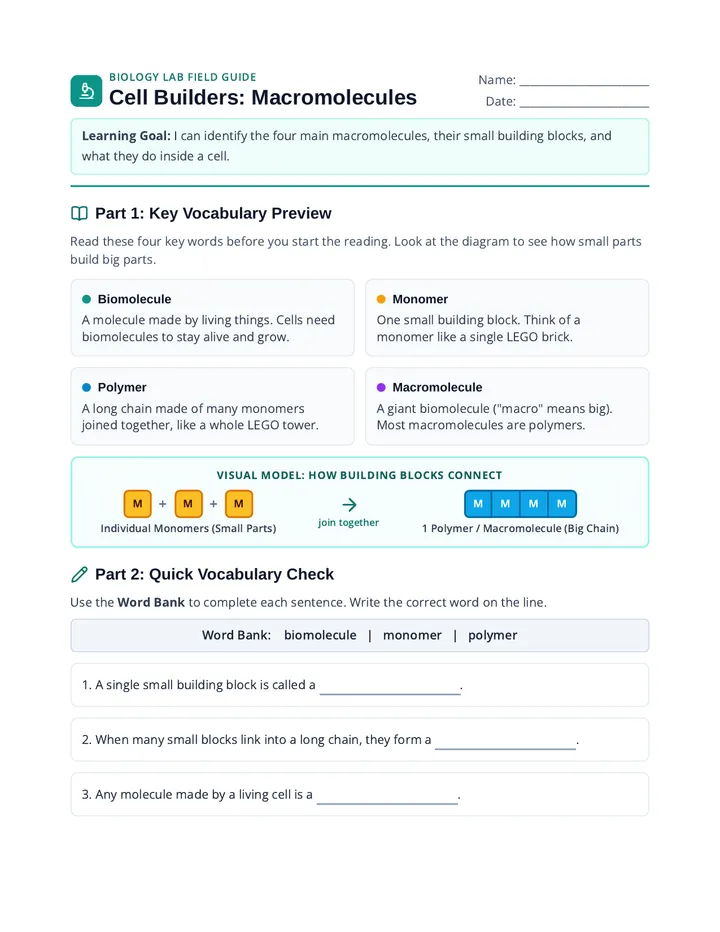
Monomers & Polymers
Monomer
Mono = 1
A single building block . Like one LEGO brick or one bead on a necklace.
1
Single Unit
Polymer
Poly = Many
A large molecule made by linking many monomers together in a chain.
Macro means giant — macromolecules are giant polymers inside living things!
Overview
The 4 Macromolecules
1. Carbohydrates
Quick energy for cells
2. Lipids
Long-term energy & membranes
3. Proteins
Body builders & cell helpers
4. Nucleic Acids
Store & share genetic code
Visual Cue: Watch the colors and icons — they match your guided notes chart!
Macromolecule #1
Carbohydrates
Quick Energy
Building Block (Monomer)
Monosaccharide (simple sugar, like glucose)
Main Function
Gives cells fast, ready-to-use energy . Plants also use them for structure.
Common Examples
Bread, pasta, rice, fruit, sugar, starch
Structure Diagram
S
1 Sugar Ring (Monomer)
Starch Chain (Polymer)
Macromolecule #2
Lipids
Stored Energy
Building Blocks
Glycerol + Fatty Acids (do not mix with water!)
Main Functions
Long-term energy storage , insulation, and building cell membranes .
Common Examples
Fats, oils, butter, avocado, waxes
Structure Diagram
Glycerol
Tail 1
Tail 2
Tail 3
Glycerol + 3 Fatty Acid Tails
Macromolecule #3
Proteins
Body Builders
Building Block (Monomer)
Amino Acids (20 different kinds!)
Main Functions
Build muscles, skin, and hair ; act as enzymes to speed up cell reactions.
Common Examples
Meat, eggs, beans, nuts, antibodies, enzymes
Structure Diagram
A
B
C
D
Amino Acid Chain
Folded 3D Protein
Macromolecule #4
Nucleic Acids
Genetic Code
Building Block (Monomer)
Nucleotides (made of a sugar, phosphate, and base)
Main Function
Store and pass on genetic instructions for how to build proteins.
Common Examples
DNA (double strand) and RNA (single strand)
Nucleotide Monomer
P
S
Base
DNA & RNA Strands
Summary
Macromolecules at a Glance
Macromolecule
Building Block
Main Function
Examples
Carbohydrates
Monosaccharide
Quick energy
Bread, fruit, sugar
Lipids
Glycerol + fatty acids
Stored energy, membranes
Oils, butter, wax
Proteins
Amino acids
Build tissue, enzymes
Meat, eggs, beans
Nucleic Acids
Nucleotides
Genetic instructions
DNA, RNA
Retrieval Practice
Which Macromolecule Is It?
1
A runner eats a banana 20 minutes before a race for fast energy .
2
Your cells use amino acids to repair muscle fibers after exercise.
3
A bear stores extra fat before winter for long-term energy and warmth .
Turn & Talk: Share your answer and explain why !
Knowledge Check
Quick Check Before You Go
Question 1
What is the building block of a protein ?
Write it on your chart!
Question 2
Which macromolecule carries DNA instructions?
Write it on your chart!
Question 3
How is a monomer different from a polymer ?
Write it on your chart!
Finish your Guided Notes Chart & complete the Knowledge Check on Page 2.
Macromolecule Guided Notes Chart Macromolecules Guided Notes
Name: _______________________ Date: __________
Part 1: Building Blocks
1. A is a single building block (like 1 bead).
2. A is a large molecule made of many linked units.
= 1 unit
= chain
Word Bank (Use these words to fill in the blanks)
monomer polymer monosaccharide glycerol fatty acids amino acids nucleotides quick long-term enzymes genetic DNA
Part 2: Macromolecules Comparison Chart
Macromolecule & Cue
Building Block
Main Function
Examples
Carbohydrates
Sugar rings
Simple sugar:
Gives cells
energy for daily tasks.
Bread, pasta, fruit,
Lipids
Head + tails
energy storage & cell membranes.
Butter, oils, waxes,
Proteins
Bead chain
20 kinds of:
Build muscles & act as
to speed up reactions.
Meat, eggs, beans,
Nucleic Acids
3-part unit
3-part monomer:
Store & pass on
instructions.
and RNA
Part 3: Knowledge Check
Try without looking back first!
Circle the Best Answer
1. Which macromolecule gives cells quick, fast energy?
A. Lipids
B. Carbohydrates
C. Proteins
D. Nucleic Acids
2. What are the building blocks (monomers) of proteins?
A. Monosaccharides
B. Nucleotides
C. Amino acids
D. Fatty acids
3. Which macromolecule stores genetic code (DNA & RNA)?
A. Nucleic Acids
B. Carbohydrates
C. Lipids
D. Proteins
4. Butter, olive oil, and waxes are all examples of:
A. Proteins
B. Nucleic Acids
C. Carbohydrates
D. Lipids
Short Answer: Explain It
5. In your own words, how is a monomer different from a polymer ?
6. A runner eats pasta the night before a race, and a bear stores fat before winter. Which macromolecule does each one use, and why?
7. Visual Check: Draw and label 1 monomer and 1 polymer using simple shapes below.
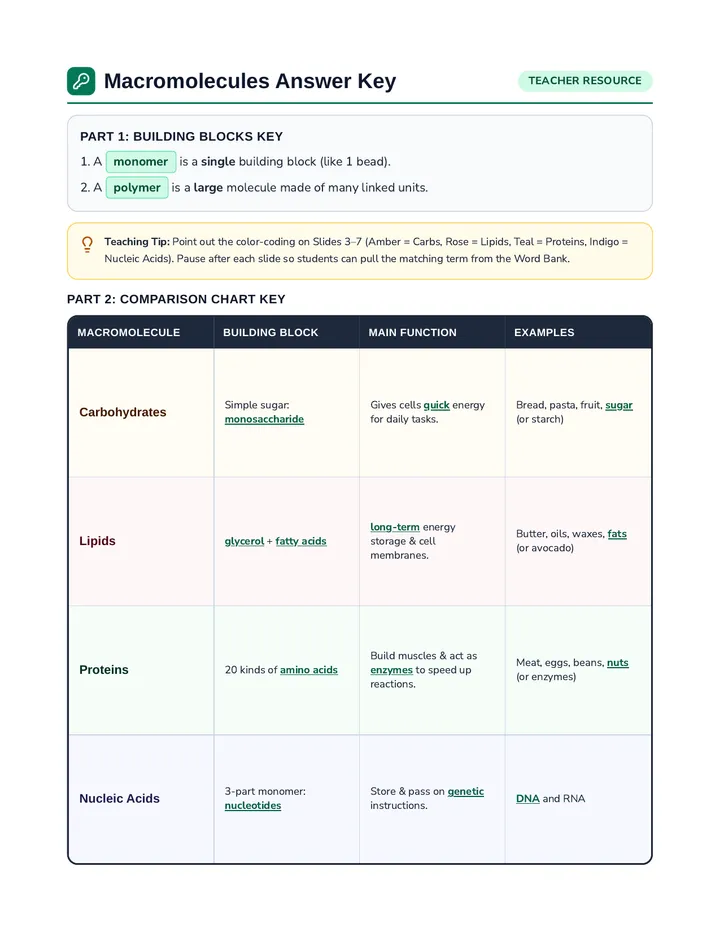
Macromolecule Answer Key Macromolecules Answer Key
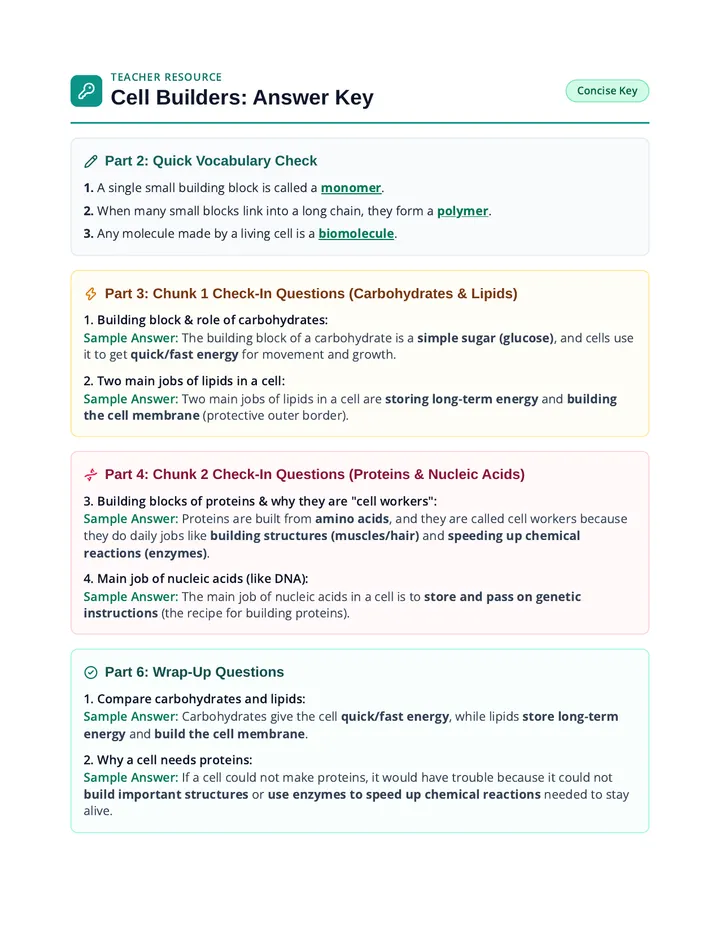
Teacher Resource
Part 1: Building Blocks Key
1. A monomer is a single building block (like 1 bead).
2. A polymer is a large molecule made of many linked units.
Teaching Tip: Point out the color-coding on Slides 3–7 (Amber = Carbs, Rose = Lipids, Teal = Proteins, Indigo = Nucleic Acids). Pause after each slide so students can pull the matching term from the Word Bank.
Part 2: Comparison Chart Key
Macromolecule
Building Block
Main Function
Examples
Carbohydrates
Simple sugar: monosaccharide
Gives cells quick energy for daily tasks.
Bread, pasta, fruit, sugar (or starch)
Lipids
glycerol + fatty acids
long-term energy storage & cell membranes.
Butter, oils, waxes, fats (or avocado)
Proteins
20 kinds of amino acids
Build muscles & act as enzymes to speed up reactions.
Meat, eggs, beans, nuts (or enzymes)
Nucleic Acids
3-part monomer: nucleotides
Store & pass on genetic instructions.
DNA and RNA
Part 3: Knowledge Check Key
Teacher Resource
Multiple Choice Answers
1. Quick, fast energy?
B. Carbohydrates
2. Building blocks of proteins?
C. Amino acids
3. Stores genetic code (DNA & RNA)?
A. Nucleic Acids
4. Butter, olive oil, and waxes?
D. Lipids
Sample Short-Answer Responses
5. How is a monomer different from a polymer?
Sample Answer: A monomer is a single building block (one unit), while a polymer is a large molecule made by linking many monomers together in a chain.
6. Runner (pasta) vs. Bear (fat) — which macromolecule and why?
Sample Answer: The runner uses carbohydrates (pasta) for quick energy during the race. The bear uses lipids (fat) for long-term energy storage and insulation during winter.
7. Visual Check Sample
Monomer (1 unit)
Polymer (Many linked units)
Aligned to Slides 1–10 of Macromolecule Builders Slides .