Crash Lab Station Cards STATION 1
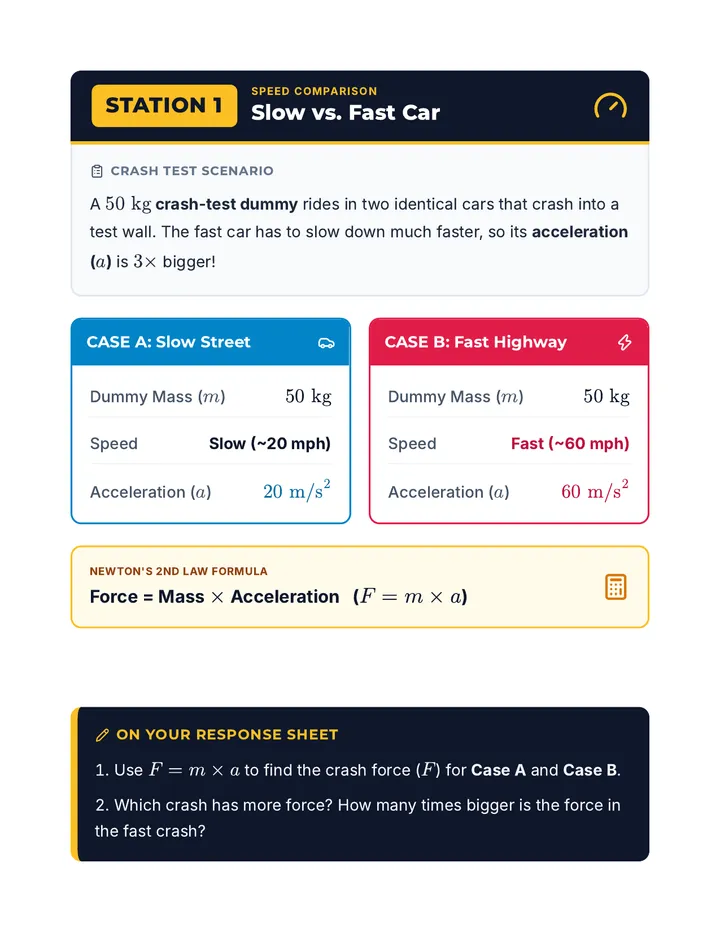
Speed Comparison
Slow vs. Fast Car
Crash Test Scenario
A \(50\text{ kg}\) crash-test dummy rides in two identical cars that crash into a test wall. The fast car has to slow down much faster, so its acceleration (\(a\)) is \(3\times\) bigger!
CASE A: Slow Street
Dummy Mass (\(m\)) \(50\text{ kg}\)
Speed Slow (~20 mph)
Acceleration (\(a\)) \(20\text{ m/s}^2\)
CASE B: Fast Highway
Dummy Mass (\(m\)) \(50\text{ kg}\)
Speed Fast (~60 mph)
Acceleration (\(a\)) \(60\text{ m/s}^2\)
Newton's 2nd Law Formula
Force = Mass \(\times\) Acceleration (\(F = m \times a\))
On Your Response Sheet
Use \(F = m \times a\) to find the crash force (\(F\)) for Case A and Case B .
Which crash has more force? How many times bigger is the force in the fast crash?
STATION 2
Seat Belts & Stopping Time
Seat Belt vs. No Seat Belt
Crash Test Scenario
A \(60\text{ kg}\) passenger is in a crash. By Newton's 1st Law (Inertia) , their body keeps moving forward. A seat belt stretches to give their body more time to stop , which makes the acceleration (\(a\)) much smaller!
CASE A: No Seat Belt
Passenger Mass (\(m\)) \(60\text{ kg}\)
What Happens Stops super fast
Acceleration (\(a\)) \(100\text{ m/s}^2\)
CASE B: Seat Belt On
Passenger Mass (\(m\)) \(60\text{ kg}\)
What Happens More time to stop
Acceleration (\(a\)) \(20\text{ m/s}^2\)
Newton's 2nd Law Formula
Force = Mass \(\times\) Acceleration (\(F = m \times a\))
On Your Response Sheet
Use \(F = m \times a\) to find the crash force (\(F\)) for Case A and Case B .
Why does giving your body more time to stop with a seat belt keep you safer?
STATION 3
Vehicle Mass
Small Car vs. Big Truck
Crash Test Scenario
A small car and a heavy truck are driving at the same speed and crash into a concrete wall. Both vehicles have the exact same stopping acceleration (\(50\text{ m/s}^2\)) , but the truck has twice as much mass!
CASE A: Small Car
Vehicle Mass (\(m\)) \(1,000\text{ kg}\)
Vehicle Size Lightweight
Acceleration (\(a\)) \(50\text{ m/s}^2\)
CASE B: Big Truck
Vehicle Mass (\(m\)) \(2,000\text{ kg}\)
Vehicle Size \(2\times\) Heavier
Acceleration (\(a\)) \(50\text{ m/s}^2\)
Newton's 2nd Law Formula
Force = Mass \(\times\) Acceleration (\(F = m \times a\))
On Your Response Sheet
Use \(F = m \times a\) to find the crash force (\(F\)) for Case A and Case B .
Why did the heavy truck hit with double the force? By Newton's 3rd Law , how hard does the wall push back on the truck?
STATION 4
Stopping Time & Cushioning
Airbag vs. Steering Wheel
Crash Test Scenario
A \(50\text{ kg}\) teen is in a front-end car crash. Without an airbag, they hit the hard steering wheel and stop instantly. With an airbag, the soft cushion gives them more time to slow down , making acceleration (\(a\)) much smaller!
CASE A: No Airbag
Teen Mass (\(m\)) \(50\text{ kg}\)
What Happens Hits hard wheel
Acceleration (\(a\)) \(200\text{ m/s}^2\)
CASE B: Airbag Opens
Teen Mass (\(m\)) \(50\text{ kg}\)
What Happens Soft cushion
Acceleration (\(a\)) \(40\text{ m/s}^2\)
Newton's 2nd Law Formula
Force = Mass \(\times\) Acceleration (\(F = m \times a\))
On Your Response Sheet
Use \(F = m \times a\) to find the crash force (\(F\)) for Case A and Case B .
How many Newtons of force did the airbag save? (Hint: subtract Case B from Case A!)
STATION 5
Mixed Scenario: Mass & Speed
Slow Bus vs. Fast Sports Car
Crash Test Scenario
Which one hits with more force: a huge school bus moving slowly or a light sports car speeding ? Calculate both forces to find out!
CASE A: School Bus
Vehicle Mass (\(m\)) \(10,000\text{ kg}\)
Speed Slow
Acceleration (\(a\)) \(10\text{ m/s}^2\)
CASE B: Sports Car
Vehicle Mass (\(m\)) \(1,000\text{ kg}\)
Speed Very Fast
Acceleration (\(a\)) \(80\text{ m/s}^2\)
Newton's 2nd Law Formula
Force = Mass \(\times\) Acceleration (\(F = m \times a\))
On Your Response Sheet
Use \(F = m \times a\) to find the crash force (\(F\)) for Case A and Case B .
Which vehicle had more force , and which had bigger acceleration ? Why are both dangerous?
STATION 6
Mixed Scenario: Inertia & 3rd Law
Loose Backpack
Crash Test Scenario
A \(5\text{ kg}\) backpack (~11 lbs) sits on the back seat. When the car crashes, inertia (Newton's 1st Law) keeps the backpack flying forward until it slams into the driver's seat! What if it was strapped in the trunk?
CASE A: Loose in Seat
Backpack Mass (\(m\)) \(5\text{ kg}\)
What Happens Hits headrest fast
Acceleration (\(a\)) \(200\text{ m/s}^2\)
CASE B: Strapped in Trunk
Backpack Mass (\(m\)) \(5\text{ kg}\)
What Happens Slows down w/ car
Acceleration (\(a\)) \(40\text{ m/s}^2\)
Newton's 2nd Law Formula
Force = Mass \(\times\) Acceleration (\(F = m \times a\))
On Your Response Sheet
Use \(F = m \times a\) to find the crash force (\(F\)) for Case A and Case B .
Why can even a small \(5\text{ kg}\) backpack hurt someone in a crash? (Use Newton's 1st Law and 3rd Law .)
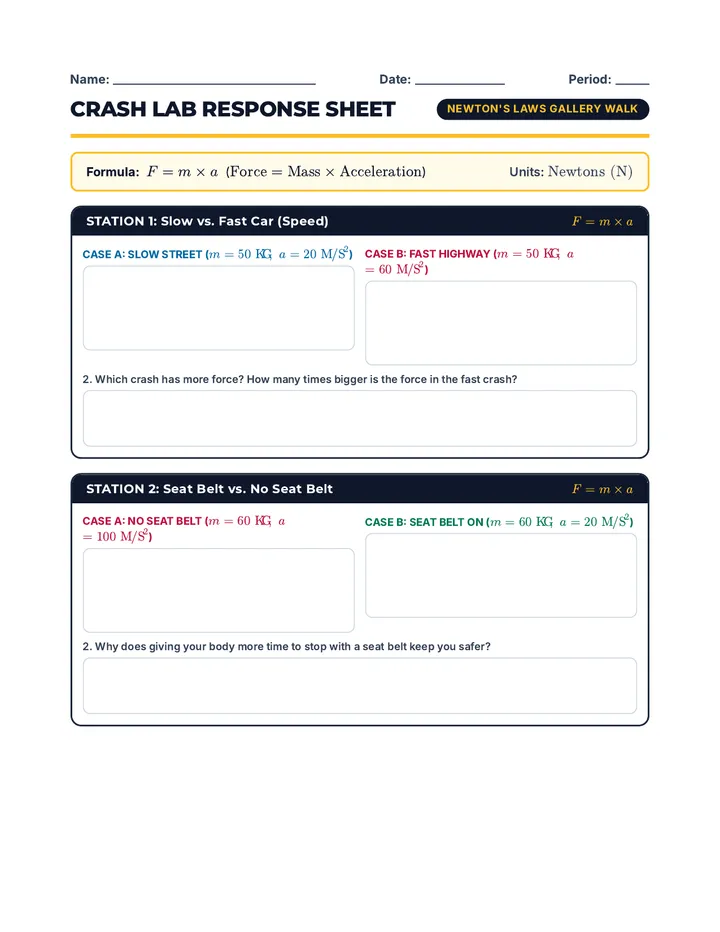
Crash Lab Response Sheet Name: ____________________________________ Date: ________________ Period: ______
CRASH LAB RESPONSE SHEET
Newton's Laws Gallery Walk
Formula: \(F = m \times a\) (\(\text{Force} = \text{Mass} \times \text{Acceleration}\)) Units: \(\text{Newtons (N)}\)
STATION 1: Slow vs. Fast Car (Speed)
\(F = m \times a\)
Case A: Slow Street (\(m = 50\text{ kg},\ a = 20\text{ m/s}^2\))
Case B: Fast Highway (\(m = 50\text{ kg},\ a = 60\text{ m/s}^2\))
2. Which crash has more force? How many times bigger is the force in the fast crash?
STATION 2: Seat Belt vs. No Seat Belt
\(F = m \times a\)
Case A: No Seat Belt (\(m = 60\text{ kg},\ a = 100\text{ m/s}^2\))
Case B: Seat Belt On (\(m = 60\text{ kg},\ a = 20\text{ m/s}^2\))
2. Why does giving your body more time to stop with a seat belt keep you safer?
Crash Lab Response Sheet — Page 2 Name: ___________________________
STATION 3: Small Car vs. Big Truck (Mass)
\(a = 50\text{ m/s}^2\)
Case A: Small Car (\(m = 1,000\text{ kg}\))
Case B: Big Truck (\(m = 2,000\text{ kg}\))
2. Why did the truck hit with double the force? By Newton's 3rd Law, how hard does the wall push back on the truck?
STATION 4: Airbag vs. Steering Wheel
\(m = 50\text{ kg}\)
Case A: No Airbag (\(a = 200\text{ m/s}^2\))
Case B: Airbag Opens (\(a = 40\text{ m/s}^2\))
2. How many Newtons of force did the airbag save? (Subtract Case B from Case A and show your work below.)
Crash Lab Response Sheet — Page 3 Name: ___________________________
STATION 5: Slow Bus vs. Fast Sports Car (Mixed)
\(F = m \times a\)
Case A: School Bus (\(10,000\text{ kg},\ 10\text{ m/s}^2\))
Case B: Sports Car (\(1,000\text{ kg},\ 80\text{ m/s}^2\))
2. Which vehicle had more force, and which had bigger acceleration? Why are both dangerous?
STATION 6: Loose Backpack (Inertia & 3rd Law)
\(m = 5\text{ kg}\)
Case A: Loose in Seat (\(a = 200\text{ m/s}^2\))
Case B: In Trunk (\(a = 40\text{ m/s}^2\))
2. Why can even a small \(5\text{ kg}\) backpack hurt someone in a crash? (Use Newton's 1st Law and 3rd Law.)
Crash Lab Response Sheet — Page 4 Name: ___________________________
CRASH LAB WRAP-UP
Use what you learned at the 6 stations to explain why car crashes are dangerous and how safety gear protects us.
Word Bank: inertia • mass • acceleration • stopping time • force • equal and opposite
1. Newton's 1st Law (Inertia): Why do passengers and loose backpacks keep moving forward when a car stops?
2. Newton's 2nd Law (\(F = m \times a\)): What are TWO things that make a car crash have a bigger force? (Hint: look at Stations 1 & 3.)
3. Newton's 3rd Law: When a big truck hits a wall with \(100,000\text{ N}\) of force, how much force does the wall push back on the truck?
4. Car Safety: How do seat belts and airbags lower the force on your body during a crash? Crash Lab Answer Key Teacher Guide & Answer Key
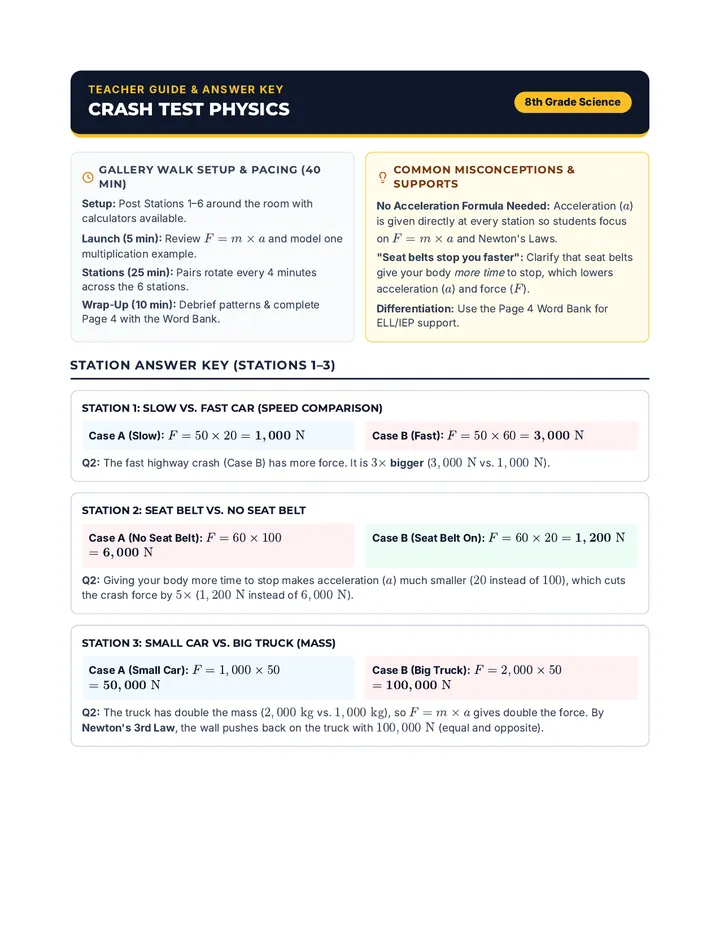
CRASH TEST PHYSICS
8th Grade Science
Gallery Walk Setup & Pacing (40 min)
Setup: Post Stations 1–6 around the room with calculators available.Launch (5 min): Review \(F = m \times a\) and model one multiplication example.Stations (25 min): Pairs rotate every 4 minutes across the 6 stations.Wrap-Up (10 min): Debrief patterns & complete Page 4 with the Word Bank.
Common Misconceptions & Supports
No Acceleration Formula Needed: Acceleration (\(a\)) is given directly at every station so students focus on \(F = m \times a\) and Newton's Laws."Seat belts stop you faster": Clarify that seat belts give your body more time to stop, which lowers acceleration (\(a\)) and force (\(F\)).Differentiation: Use the Page 4 Word Bank for ELL/IEP support.
Station Answer Key (Stations 1–3)
Station 1: Slow vs. Fast Car (Speed Comparison)
Case A (Slow): \(F = 50 \times 20 = \mathbf{1,000\text{ N}}\)
Case B (Fast): \(F = 50 \times 60 = \mathbf{3,000\text{ N}}\)
Q2: The fast highway crash (Case B) has more force. It is \(3\times\) bigger (\(3,000\text{ N}\) vs. \(1,000\text{ N}\)).
Station 2: Seat Belt vs. No Seat Belt
Case A (No Seat Belt): \(F = 60 \times 100 = \mathbf{6,000\text{ N}}\)
Case B (Seat Belt On): \(F = 60 \times 20 = \mathbf{1,200\text{ N}}\)
Q2: Giving your body more time to stop makes acceleration (\(a\)) much smaller (\(20\) instead of \(100\)), which cuts the crash force by \(5\times\) (\(1,200\text{ N}\) instead of \(6,000\text{ N}\)).
Station 3: Small Car vs. Big Truck (Mass)
Case A (Small Car): \(F = 1,000 \times 50 = \mathbf{50,000\text{ N}}\)
Case B (Big Truck): \(F = 2,000 \times 50 = \mathbf{100,000\text{ N}}\)
Q2: The truck has double the mass (\(2,000\text{ kg}\) vs. \(1,000\text{ kg}\)), so \(F = m \times a\) gives double the force. By Newton's 3rd Law , the wall pushes back on the truck with \(100,000\text{ N}\) (equal and opposite).
Station Answer Key (Stations 4–6)
Page 2
Station 4: Airbag vs. Steering Wheel
Case A (No Airbag): \(F = 50 \times 200 = \mathbf{10,000\text{ N}}\)
Case B (Airbag Opens): \(F = 50 \times 40 = \mathbf{2,000\text{ N}}\)
Q2: \(10,000\text{ N} - 2,000\text{ N} = \mathbf{8,000\text{ N}}\) of force saved by the airbag!
Station 5: Slow Bus vs. Fast Sports Car (Mixed)
Case A (School Bus): \(F = 10,000 \times 10 = \mathbf{100,000\text{ N}}\)
Case B (Sports Car): \(F = 1,000 \times 80 = \mathbf{80,000\text{ N}}\)
Q2: The school bus had more force (\(100,000\text{ N}\)) because of its huge mass. The sports car had bigger acceleration (\(80\text{ m/s}^2\)) because it was speeding. Both create huge forces that can cause serious damage.
Station 6: Loose Backpack (Inertia & 3rd Law)
Case A (Loose in Seat): \(F = 5 \times 200 = \mathbf{1,000\text{ N}}\)
Case B (Strapped in Trunk): \(F = 5 \times 40 = \mathbf{200\text{ N}}\)
Q2: By Newton's 1st Law (inertia) , the backpack keeps moving forward when the car stops. When it hits the seat/driver, it hits with \(1,000\text{ N}\) of force, and by Newton's 3rd Law , that same \(1,000\text{ N}\) force pushes on the person.
Crash Lab Wrap-Up — Sample Answers
1. Newton's 1st Law (Inertia): Objects in motion stay in motion unless a force stops them. Because of inertia , passengers and loose backpacks keep moving forward when the car suddenly stops.
2. Newton's 2nd Law (\(F = m \times a\)): Two things that make crash force bigger are larger mass (like the big truck in Station 3) and larger acceleration / faster speed (like the fast car in Station 1).
3. Newton's 3rd Law: The wall pushes back on the truck with \(100,000\text{ N}\) of force (equal and opposite ).
4. Car Safety: Seat belts and airbags give your body more stopping time to slow down. This lowers your acceleration , which lowers the force on your body.