Time Travelers Teacher Guide Archive No. CA-8-001
Time Travelers Toolkit
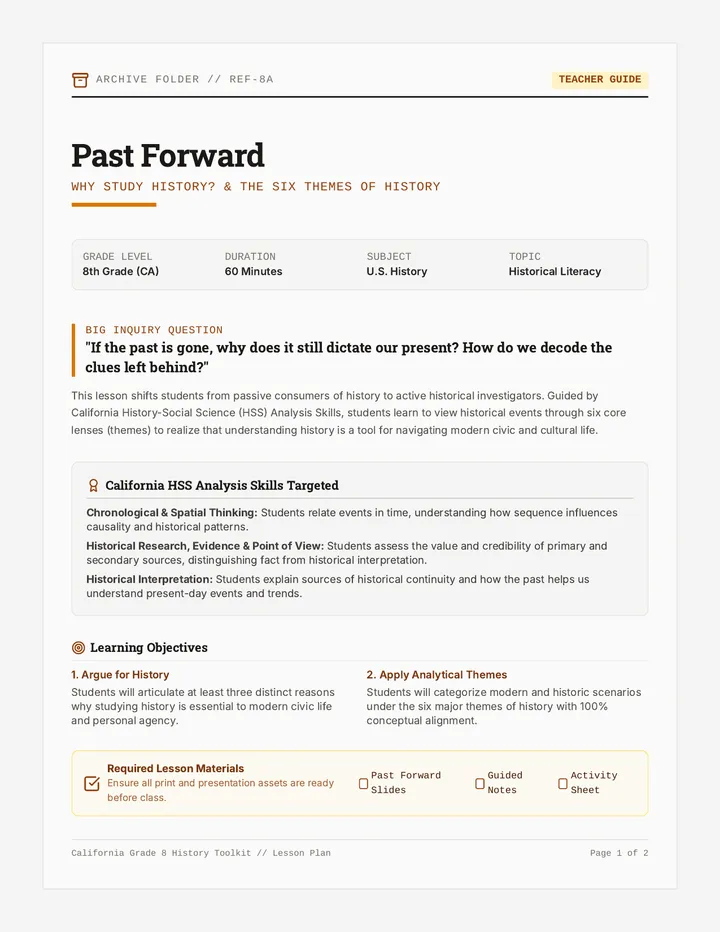
Introductory Unit: The Power of Historical Thinking
Teacher Guide
Grade Level 8th Grade (CA)
Duration 40 Minutes
Subject Focus US History
Key Skill Evidence Analysis
CA Content & Analysis Standards
Historical & Social Sciences Analysis Skills: Chronological & Spatial Thinking (1, 2); Historical Research, Evidence, & Point of View (1, 2, 4); Historical Interpretation (1, 2) — Students analyze why change happens, distinguish primary/secondary sources, and connect past patterns to current events.
Learning Objectives
Define history as an active investigation rather than memorization of facts.
Differentiate between primary and secondary sources with 100% accuracy.
Identify at least three distinct reasons why studying history helps navigate modern societal issues.
Instructional Pacing Blueprint
0-5 MIN
Hook: The Modern Detective
Students walk in to a slide displaying a mysterious modern phone artifact. Prompt: "If a future historian dug this up in 3026, what three things would it tell them about our daily lives?"
5-17 MIN
Direct Instruction: History Hacks (Slides 1-4)
Present slide deck. Introduce the 3 Pillars of History: Perspective, Patterns, and Power . Briefly distinguish primary and secondary sources. Keep pacing crisp and interactive.
17-32 MIN
Collaborative Work: History Case Files
Divide students into detective duos or trios. Distribute the Case Files. Students analyze modern issues (e.g., pandemics, fake news) and hunt for their historical roots using the provided cards.
32-40 MIN
Debrief & Synthesis (Exit Ticket)
Students fill out individual "Echoes of Yesterday" worksheets. Collect as they exit. Brief share-out: One historical pattern that exists today.
CALIFORNIA HISTORY LABS PAGE 1 OF 2 CONFIDENTIAL TEACHER NOTES
Teacher Dossier
Facilitation & Verification Keys
Confidential
Group Activity Facilitation (15 mins)
Group students into heterogenous pairs to support English Learners. Pass out the History Case Files Activity handout. Instruct students to examine each folder. Their goal is to match the modern "Symptom" with the historical "Diagnosis" to find how history repeats. Move around the room and challenge them: "Why do humans make the same mistakes twice? What is the missing variable?"
High-Impact Discussion Prompts
Q1: Can history predict the future?
Exemplar Answer: No, but it provides blueprints. Human nature doesn't change drastically, so how we react to crisis (fear, hope, division) repeats.
Q2: Who decides what history is saved?
Exemplar Answer: Historically, those in power. That's why historians must look for "lost voices" through primary sources to get a complete story.
Master Answer Key & Assessment Guide
Part A: Primary vs. Secondary Source Check
• Letter written by a Civil War soldier: Primary Source (direct participant evidence).
• Chapter in an 8th-grade US History textbook: Secondary Source (created after the fact).
• Photograph of a 1920s assembly line: Primary Source (visual record from that exact moment).
Part B: The Case File Synthesis Guide
For the Case File Analysis on the Worksheet, students should correctly link their chosen file. For instance, linking the Fake News File to the Yellow Journalism of the 1890s. Acceptable claims must assert: (1) what the pattern is, (2) how the past events can serve as an instructional warning for how we handle information today.
California Classroom Differentiation
Support (EL/IEP) Provide visual cards, sentence stems for writing, and assign key vocabulary (primary source, bias) in advance.
Bridge (Strategic) Focus student peer-pairings on discussing the prompt before committing ink to the paper worksheet.
Extend (Advanced) Have students write a 30-word "Time Traveler Warning" to modern leaders about one historical pitfall.
CALIFORNIA HISTORY LABS PAGE 2 OF 2 CONFIDENTIAL TEACHER NOTES
History Hacks Slides UNIT 1 // TOOLKIT SESSION 1.1
Time Travelers Toolkit
Welcome to your history lab. Today, we decode why examining the past is the ultimate hack for predicting the future.
HISTORICAL DETECTIVE ACADEMY
SLIDE 01
The 3 Pillars of History
Why Study the Past?
Perspective
Understanding *why* people made decisions in their own time, without judging them by our modern values.
Patterns
Noticing loops in human behavior. Crisis, innovation, and conflict follow predictable blueprints.
Power
Analyzing who wrote the story, whose voices were left out, and how that shapes our world today.
Time Travelers Toolkit // Slides SLIDE 02
The Detective's Evidence
Types of Sources
1
Primary Sources
Firsthand accounts of an event.
Examples: Letters, diaries, photographs, artifacts, video recordings.
Tip: These are the "eyewitnesses" of history.
2
Secondary Sources
Analyses created after the fact.
Examples: Textbooks, biography books, encyclopedia entries, historical documentaries.
Tip: Created by someone who wasn't there but studied the primary data.
Time Travelers Toolkit // Slides SLIDE 03
⚡ Mission Briefing: Case Files
Collaborative Work
Your Objective in Pairs:
Examine the "Symptom" (a modern-day crisis or event) in your Case Files.
Match it to its historical "Diagnosis" (a past event that followed a similar pattern).
Synthesize: What lesson does the past event teach us about the present-day symptom?
Historian's Warning
Beware of presentism —don't judge the decisions of historical actors using today's modern knowledge. Look at the context!
Time Travelers Toolkit // Slides SLIDE 04
Case Study: The Echo Effect
History Repeats
The Past: 1890s Yellow Journalism
Sensational Headlines
Sensationalist newspapers published unverified rumors about the Spanish-American War to sell copies, driving panic and war fever across the country.
The Present: Modern Social Media Algorithms
Echoes of Yesterday Worksheet CASE LOG NO. G8-001
Echoes of Yesterday
History Detective Field Notes & Exit Ticket
Class Record
Detective Name:
Date Logged:
Class Period:
Part 1: Sifting the Evidence
Classify each artifact as either a Primary Source (P) or a Secondary Source (S) . Check the correct folder below.
Artifact A: Letter from a Union Soldier (1863) Written on the battlegrounds of Gettysburg detailing daily meals and letters from home.
Primary (P) Secondary (S)
Artifact B: Chapter in an 8th-Grade US History Textbook Written in 2024 by a modern historian analyzing the factors that led to the American Revolution.
Primary (P) Secondary (S)
Artifact C: Photograph of a 1920s Factory Assembly Line An original film negative captured in Detroit, showing workers putting together Model T cars.
Primary (P) Secondary (S)
Part 2: Cold Case Connection
Select one Case File from today's group activity (e.g., Fake News File, Pandemic File, or Climate File).
Selected Case File:
Modern Symptom observed:
Analysis & Connection (Explain the pattern and why the historical "diagnosis" repeats today):
Part 3: The Time Traveler's Warning
Based on your historical connection above, write a brief, powerful message to modern leaders or citizens warning them about how to avoid repeating past mistakes.
CALIFORNIA HISTORY LABS TURN IN LOG AT DISMISSAL FORM CA-8-A
History Case Files Activity CLASSIFIED // FOR STUDENT COLLABORATION
Historical Investigation Folders
Analyze the modern symptoms, evaluate the past diagnosis, and discover the pattern.
Active Case Files
Case #101: Epidemic
The Epidemic Echo
Modern Symptom
The global panic, lockdowns, public mask mandates, economic disruptions, and vaccine skepticism witnessed during the recent COVID-19 pandemic.
Past Diagnosis
1918 Spanish Flu (California)
San Francisco faced fierce anti-mask leagues, closed all public schools, and struggled with business closures during the worst waves of the flu.
Clue: How did society's response to fear change (or stay the same) over 100 years?
Case #102: Info War
The Information War
Modern Symptom
Viral deepfakes, manipulated algorithm-driven feeds, and "fake news" designed to spark public anger, bias, and deep social polarization online.
Past Diagnosis
Yellow Journalism of the 1890s
William Randolph Hearst used highly exaggerated, unverified headlines about Spanish cruelty in Cuba to spark a war and sell millions of print newspapers.
Clue: What is the constant motivation behind spreading false information?
Case #103: Climate
The Climate Migration
Modern Symptom
Extreme droughts, agricultural water loss, and fires in California forcing farmers and rural workers to relocate or abandon dry properties.
Past Diagnosis
The Dust Bowl of the 1930s
Extreme drought coupled with poor agricultural practices ruined Midwest farmlands, prompting over 300,000 "Okies" to migrate to California's Central Valley.
Clue: How do environmental shifts trigger social and political changes?
Case #104: Security
The Security Debate
Modern Symptom
Facial recognition scanning, social media data sweeps, NSA surveillance, and security tracking that spark deep civil liberty debates today.
Past Diagnosis
The Alien and Sedition Acts (1798)
Fearing war with France, President John Adams signed acts criminalizing false or malicious speech against the government, claiming it secured national safety.
Clue: In times of crisis, does security matter more than individual freedom?
CALIFORNIA HISTORY LABS COLLABORATIVE HANDOUT // PAIR WORK FORM CA-8-B