Past Forward Lesson Plan Archive Folder // Ref-8A
TEACHER GUIDE
Past Forward
Why Study History? & The Six Themes of History
Grade Level 8th Grade (CA)
Duration 60 Minutes
Subject U.S. History
Topic Historical Literacy
Big Inquiry Question
"If the past is gone, why does it still dictate our present? How do we decode the clues left behind?"
This lesson shifts students from passive consumers of history to active historical investigators. Guided by California History-Social Science (HSS) Analysis Skills, students learn to view historical events through six core lenses (themes) to realize that understanding history is a tool for navigating modern civic and cultural life.
California HSS Analysis Skills Targeted
Chronological & Spatial Thinking: Students relate events in time, understanding how sequence influences causality and historical patterns.Historical Research, Evidence & Point of View: Students assess the value and credibility of primary and secondary sources, distinguishing fact from historical interpretation.Historical Interpretation: Students explain sources of historical continuity and how the past helps us understand present-day events and trends.
Learning Objectives
1. Argue for History
Students will articulate at least three distinct reasons why studying history is essential to modern civic life and personal agency.
2. Apply Analytical Themes
Students will categorize modern and historic scenarios under the six major themes of history with 100% conceptual alignment.
Required Lesson Materials
Ensure all print and presentation assets are ready before class.
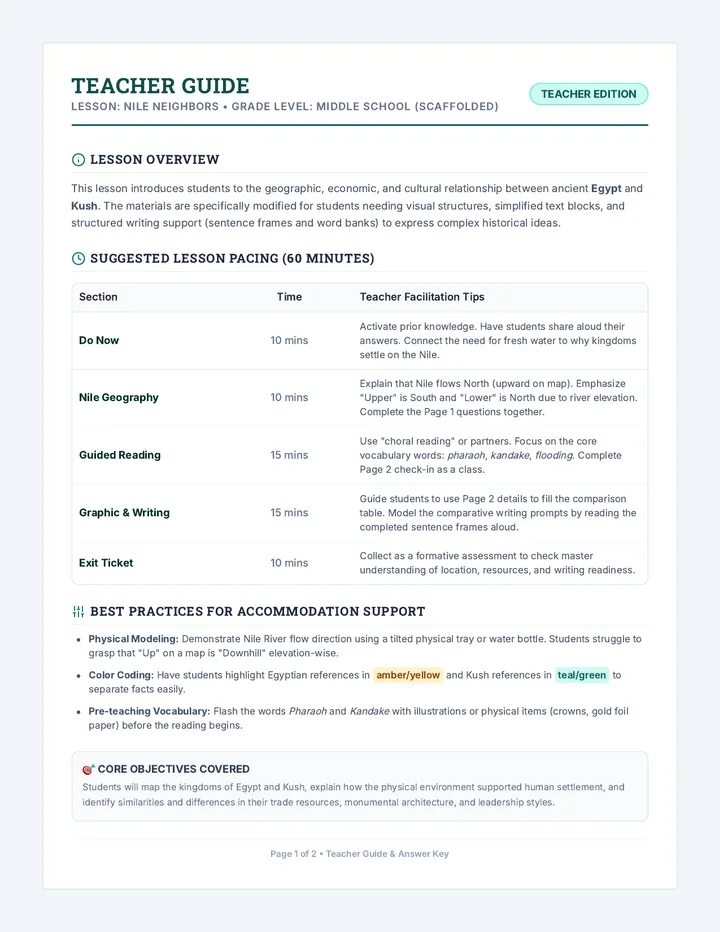
Past Forward Slides
Guided Notes
Activity Sheet
California Grade 8 History Toolkit // Lesson Plan Page 1 of 2
Archive Folder // Ref-8A
TEACHER GUIDE
Step-by-Step Pacing & Delivery Guide
Instructional Sequence (60 Minutes)
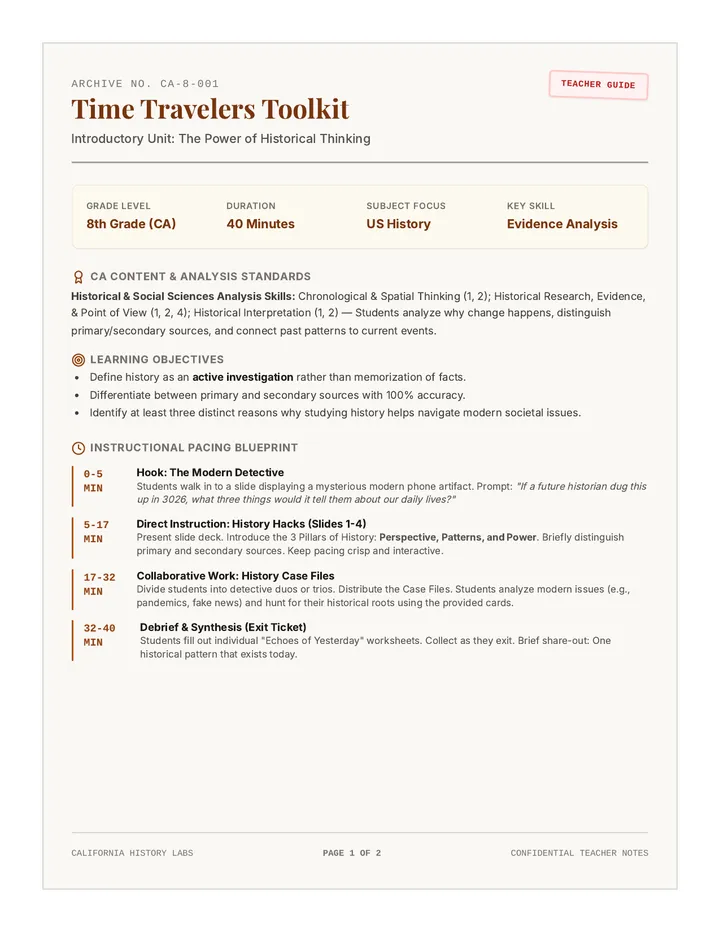
00-10 MIN
The Modern Time Capsule Dilemma
Present the scenario: "An catastrophic electromagnetic pulse wipes out the entire internet. Everything you posted or stored is gone. How will future archeologists reconstruct who you were?" Discuss why physical evidence, personal context, and bias shape historical records.
10-25 MIN
The 6 Lenses of History (Using Guided Notes)
Deliver instruction via Past Forward Slides . Guide students through filling out their Guided Notes . Define key terms: Primary Source, Secondary Source, Historical Bias . Introduce the six key themes of historical analysis: Power, Culture, Change, Geography, Economics, and Perspective.
25-35 MIN
The Smartphone Artifact Analysis
Project an image of a shattered smartphone. Model how to analyze this object as a historical artifact. Demonstrate how a modern device touches all six historical themes (e.g., Geography : mined minerals from Congo; Power : state surveillance and communication; Culture : social media shifts).
35-50 MIN
History Detective Investigation (Activity Sheet)
Distribute the Activity Sheet . Students evaluate three diverse historical scenarios (including California history connections, like the gold rush or migration) and apply the correct analytical themes. They construct an evidence-backed argument to solve historical "crimes."
50-60 MIN
Reflective Exit Ticket & Debrief
Have students write their final reflections on the Activity Sheet. Prompt: How does looking at history prevent society from repeating past failures? Collect sheets for formative assessment.
Probing Questions for Classroom Discussion
On Evidence & Bias:
"If two people see the exact same protest but write opposite articles about it, who is telling the 'real' history?"
On Change & Continuity:
"What is one thing about daily life that has not changed at all in 500 years? Why did that endure?"
Scaffolding & Differentiation Strategies
For Struggling Writers / ELs:
Provide a visual card deck representing the 6 themes. Allow students to use single-sentence evidence frames rather than full paragraphs on the Activity Sheet.
For Advanced Historians:
Challenge students to research a seventh theme (e.g., Technological Innovation or Environmental Determinism) and defend its inclusion in the analytical model.
California Grade 8 History Toolkit // Lesson Plan Page 2 of 2
Past Forward Guided Notes Student Casefile // Detective Training
Past Forward: Guided Notes
Investigator ID Class Block
Score / 10
Name:
Date:
Period:
Part 1: The Investigator's Purpose — Why History?
History isn't just about memorizing dead people's birthdays. It is the ultimate detective story of human choices. Fill in the critical vocabulary gaps as your guide reveals them:
1. The Mirror Rule: History holds up a mirror to the present, allowing us to understand our modern and culture by examining where they originated.
2. The GPS Rule: Studying history prevents us from repeating the same , guiding us toward better choices in our future.
3. The Empathy Lens: Reading the records of diverse past lives helps us build for cultures and viewpoints different from our own.
Part 2: The Six Lenses (Themes) of Historical Analysis — Group A
Historians use specific investigative lenses to break down complex events. Complete the definitions and write down a Modern-Day Connection for each:
Power &
Focus Question Who is in ? How do leaders maintain control, make laws, or face protests from the people?
Your Modern-Day Connection:
Culture &
Focus Question How do communities express identity through religion, art, family structures, language, and social ?
Your Modern-Day Connection:
Economics &
Focus Question How do people buy, sell, or trade goods? How does wealth, poverty, or the drive for valuable shape societies?
Your Modern-Day Connection:
California Grade 8 History Toolkit // Past Forward Page 1 of 2
Casefile Folder // Ref-8A
STUDENT HANDOUT
Part 2 (Cont.): The Lenses of Historical Analysis — Group B
Geography &
Focus Question How does landscape, climate, or borders affect where humans settle? How do humans alter the natural ?
Your Modern-Day Connection:
Change &
Focus Question What massive shifts alter life dramatically (Change), and what fundamental systems remain (Continuity)?
Your Modern-Day Connection:
Perspective &
Focus Question Whose voice is sharing the narrative? What underlying values, self-interests, or systemic are present?
Your Modern-Day Connection:
Part 3: Sifting the Evidence — Source Analysis
Past Forward Activity Sheet Investigator Field Kit // Scenario Test
Past Forward: Case Files
Case ID #CA-801
Status ACTIVE
Name:
Date:
Period:
The Detective's Mission
You are a historical detective. For each case, read the evidence dossier, select the most relevant Themes of History , and write your investigative briefing using specific facts from the text.
CASE FILE #1: The Golden Paradox (California, 1849)
Code: GP-49
"Over 300,000 people rushed to California after gold was discovered. Instant cities emerged. While some miners struck it rich, merchants became the true millionaires. Indigenous tribes were forced off ancestral lands, and ecosystems were destroyed by hydraulic mining."
1. Select the TWO historical lenses that best explain this case:
Power
Culture
Change
Geography
Economics
Perspective
2. Investigative Briefing (Justify your choices with text evidence):
CASE FILE #2: The Iron Road (North America, 1869)
Code: IR-69
"The Transcontinental Railroad connected East and West. Immigrant laborers, especially from China and Ireland, worked in grueling conditions. It shrank cross-country travel from six months to six days, accelerating trade, but fractured Native American hunting grounds."
1. Select the TWO historical lenses that best explain this case:
Power
Culture
Change
Geography
Economics
Perspective
2. Investigative Briefing (Justify your choices with text evidence):
California Grade 8 History Toolkit // Past Forward Activity Page 1 of 2
Casefile Folder // Ref-8A
STUDENT HANDOUT
CASE FILE #3: The Dig in Silicon Valley (Year 3026)
Code: SV-30
"Historians in 3026 dig beneath the ruins of modern San Jose, California. They find three preserved artifacts: a plastic wireless earbud case, a physical student diary from 2026, and a hard drive containing compiled code from a social media server."
1. Select the TWO historical lenses that best explain this case:
Power
Culture
Change
Geography
Economics
Perspective
2. Investigative Briefing (Identify a primary source and detect potential bias in these artifacts):
The Final Case Briefing: Why History Matters
Based on today's case files, write a cohesive paragraph answering:
Past Forward Slides Ref-8A // Detective Training
Past Forward
Why Study History? & The Six Analytical Lenses
California Grade 8 History Toolkit
Slide 1 of 7
The Digital Blackout Dilemma
THE HOOK
Imagine an electromagnetic pulse instantly wipes out the entire internet .
"Everything you have ever posted, texted, or searched is permanently gone."
The Detective Challenge
How would future historical investigators piece together who you actually were? What physical artifacts did you leave behind?
Unit 1: Historical Literacy Slide 2 of 7
The Science of Human Choices
DEFINITION
The Mirror Rule
We study the past to understand our modern identities, cultures, and structures.
The GPS Rule
We trace ancient failures and successes to make informed, ethical civic decisions today.
The Empathy Lens
We step inside different eras and cultures to construct a more complex human view.
Unit 1: Historical Literacy Slide 3 of 7
The 6 Analytical Lenses
METHODOLOGY
Power
Laws, governance, rebellions, and systemic control.
Culture
Identity, values, art, beliefs, and societal norms.
Economics
Trade, resource allocation, money, and labor structures.
Geography
Climate, terrain, water access, borders, and settlements.
Change
Disruptive shifts vs. long-term historical continuities.
Perspective
Point of view, selective narratives, and systemic bias.
Unit 1: Historical Literacy Slide 4 of 7
Primary vs. Secondary Evidence
EVIDENCE
Primary Source
An eyewitness artifact or document generated during the event .
Examples: Diaries, raw photos, objects, treaties, legal records.
Secondary Source
An interpretation or summary made after the event by non-witnesses.
Examples: Textbooks, research biographies, history documentaries.
Unit 1: Historical Literacy Slide 5 of 7
Spotting Historical Bias
THE DETECTIVE'S FILTER
Every Record Has a Goal
Historical accounts are rarely perfectly neutral. They are filtered through human motives.