Tea Party Showdown Worksheet
Historical Inquiry Archive
TEA PARTY SHOWDOWN
Comparative Case Study: Boston (1773) vs. Edenton (1774)
Student File
Doc ID: REV-773774
Student Name:
Date:
Class Period:
Historical Context
In 1773, Britain’s Parliament passed the Tea Act, granting a monopoly to the British East India Company and reinforcing the tax on tea. In response, American colonists revolted. While the dramatic, male-led destruction of property in Boston is famous, another remarkable protest occurred ten months later in Edenton, North Carolina. Led by Penelope Barker, fifty-one women met publicly to sign a petition boycotting British tea and manufactured goods. Today, you will analyze how gender, methods, justifications, and British reactions differed between these two iconic acts of rebellion.
Doc A Protest Resolutions & Public Declarations
Source 1: The Boston Tea Party Resolutions
Adopted at Old South Meeting House, Nov 29, 1773
"Resolved, That this meeting do utterly oppose the landing of the tea... and that the same shall be sent back from whence it came, at all events. That it is the determination of this body, that the disposal of their own property is the inherent right of freeborn subjects; and that any tax on tea... is a direct violation of their most sacred liberties."
Source 2: The Edenton Women's Resolves
Signed by 51 women in Edenton, NC, Oct 25, 1774
"As we cannot be indifferent on any occasion that appears nearly to affect the peace and happiness of our country... it is a duty which we owe, not only to our near and dear connections... but to ourselves... to do everything as far as lies in our power, to testify our sincere adherence to each and all resolves... we will not conform to that pernicious Custom of Drinking Tea."
Document Set A Analysis Questions
1. According to Source 1, what constitutional grievance did the Boston patriots use to justify their resistance?
2. According to Source 2, who do the Edenton women claim to owe a duty to? Why was a public political declaration signed exclusively by women revolutionary in 1774?
Page 1 of 4 • Tea Party Showdown Inquiry Pack
Historical Inquiry Archive
DOCUMENT SET B: VISUAL PROPAGANDA
Doc ID: REV-773774-B
Visual media was a powerful weapon during the American Revolution. Below are two highly influential London engravings published in British magazines, mocking or criticizing the colonial protests. Study their details closely.
PRINT ARCHIVE PUBLISHED LONDON, 1774
Cartoon 1: "The Bostonians in Distress"
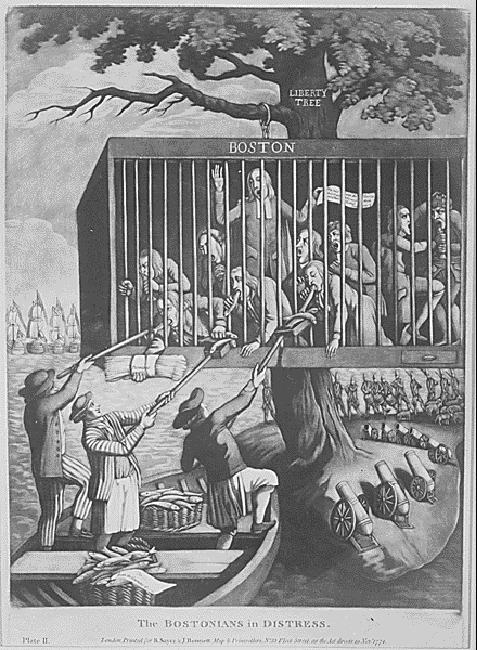
Key Elements: Boston patriots trapped inside a cage hanging from the "Liberty Tree." British military blocks the harbor. Sympathetic colonists feed them codfish on long poles, representing the blockades of the Coercive Acts.
PRINT ARCHIVE PUBLISHED LONDON, 1775
Cartoon 2: "A Society of Patriotic Ladies"
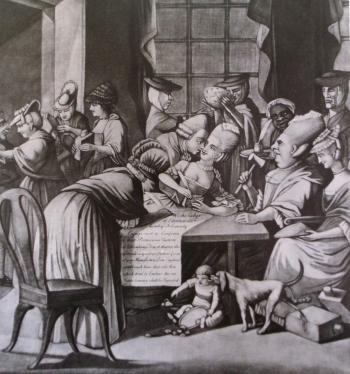
Key Elements: British caricature mocking the Edenton signatories. Women with exaggerated facial features sign a petition. In the chaos, a child is neglected on the floor and a dog urinated on a tea chest, criticizing women's political action.
Document Set B Analysis Questions
1. Based on Cartoon 1, what was the British reaction to Boston’s violent resistance? How did the British government attempt to punish and isolate the town?
2. In Cartoon 2, why did the London artist focus on neglected children and chaotic domestic life? What did this reveal about British anxieties regarding women entering politics?
Page 2 of 4 • Tea Party Showdown Inquiry Pack
Historical Inquiry Archive
DOCUMENT SET C & D: CORRESPONDENCE & REACTION
Doc ID: REV-773774-C
Doc C Firsthand Opinions & Personal Correspondence
Source 1: John Adams' Diary Entry
Boston, December 17, 1773
"This is the most magnificent Movement of all. There is a Dignity, a Majesty, a Sublimity, in this last Effort of the Patriots, that I greatly admire. The People should never rise, without doing something to be remembered—something notable and striking. This Destruction of the Tea is so bold, so daring, so firm, intrepid & inflexible, and it must have so important Consequences... that I can't but consider it as an Epocha in History."
Source 2: Arthur Iredell's Satirical Letter
Sent from London to his brother James in NC, Jan 31, 1775
"Is there a Female Congress at Edenton? I have read their Association, and they have write a solemn agreement... Pray, are the Ladies also Colonels, or do they act in the civil line? ... If they are Colonels, we are in a bad way... for if they attack us, they will command our submission and we shall find it useless to resist. Indeed, the signers of this Association have made a great deal of noise here."
Doc D Colonial Newspaper Coverage
Source 3: The Boston Gazette
December 20, 1773
"On Thursday last... a number of brave & resolute men, determined to do all in their power to save their country from impending ruin, went on board the ships, and in about three hours, broke open three hundred and forty-two chests of tea, and discharged their contents into the sea... without the least damage done to the ships or any other property."
Source 4: The Virginia Gazette
November 3, 1774
"The Association entered into by the ladies of Edenton... reflects the highest honor on them. When the fair sex, who have so much influence over our conduct, take so noble and patriotic a part in the defense of our liberties, what man can be so base as to remain neutral? It is a noble example that must animate the most cold and indifferent."
Document Set C & D Analysis Questions
1. Contrast John Adams's tone in Source 1 with Arthur Iredell's tone in Source 2. What does Iredell's satirical reference to "Ladies also Colonels" suggest about the way British men viewed colonial women's political organizing?
2. How do Source 3 and Source 4 try to persuade their readers? Compare how each newspaper portrays the protestors to make their actions seem noble and justified.
Page 3 of 4 • Tea Party Showdown Inquiry Pack
Historical Inquiry Archive
SYNTHESIS & COMPARATIVE MATRIX
Doc ID: REV-773774-D
Part 1: Comparative Matrix
Using evidence from the primary sources on pages 1–3, complete the matrix below comparing the two historic protests.
Analysis Lens
Boston Tea Party (1773)
Edenton Tea Party (1774)
Gender & Society Who participated? What was their social role?
Protest Methods What physical actions did they take?
British Reactions How did Parliament & British media respond?
Goals & Justification What arguments or legal claims did they make?
Part 2: Synthesis Writing Prompt
Which of these two colonial protests was a more radical challenge to the traditional political and social order of the 18th century? Support your argument with at least two specific pieces of evidence from the documents.
Page 4 of 4 • Tea Party Showdown Inquiry Pack
Tea Party Showdown Teacher Guide
Teacher Resource Dossier
TEA PARTY SHOWDOWN
Instructional Guide, Facilitation Tips & Answer Key
Teacher Key
Doc ID: KEY-773774
Lesson Specs
- Grade: 8th (U.S. History)
- Pacing: 45-60 Minutes
- Format: Individual/Pairs DBQ
- Topic: Protest & Gender
Historical Context Note for Educators
Students often learn about the Revolution as a male-dominated, violent series of skirmishes. Comparing Boston's property damage to Edenton's civic boycotted petition reveals how women utilized alternative, economic, and highly subversive methods to participate in the political sphere despite having no legal vote or office.
Pacing & Facilitation Blueprint
Hook (10m)
Discuss what "political power" meant in 1774 for non-voters.
Inquiry (20m)
Students analyze Documents A–D in pairs or independently.
Matrix (15m)
Synthesize comparison of the two events using the table.
Debrief (10m)
Facilitate a class debate on which was more "radical."
Part 1 Exemplar Answers & Reading Comprehension Keys
Doc A Protest Resolutions
Q1 (Boston Grievance): Exemplar Answer: The Boston resolutions claim that the disposal of their own property is the "inherent right of freeborn subjects." They argue that taxing tea without their consent is a direct violation of their sacred liberties. This is the argument of "no taxation without representation."
Q2 (Edenton Duty & Female Agency): Exemplar Answer: The Edenton women claim they owe a duty to their country, their families ("near and dear connections"), and "themselves." This public declaration was revolutionary because, in 1774, political action and petitioning were strictly considered male activities. Women were expected to stay in the private domestic sphere; signing a political manifesto publicly challenged that limit.
Doc B Visual Propaganda
Q1 (Cartoon 1 - Boston Punishment): Exemplar Answer: The British government reacted with anger and economic blockade, cutting off Boston's trade through the Coercive (Intolerable) Acts. This is represented visually by the Bostonians trapped in a cage suspended from the Liberty Tree, starving and reliant on codfish handed to them on poles.
Q2 (Cartoon 2 - Edenton Mockery): Exemplar Answer: The British artist focused on a neglected baby and domestic chaos to argue that when women step out of their domestic duties to participate in politics, society falls into chaos. They wanted to mock the women as unfeminine, neglectful, and ridiculous for attempting to act as political leaders.