Sphere Systems Slideshow Sphere Systems
Exploring the Interactions of the Geosphere, Hydrosphere, Atmosphere, and Biosphere
Geo
Hydro
Atmo
Bio
What is a System?
Definition
A system is a group of parts that work together as a whole.
Earth as a System
Earth is a complex system of four major "spheres." These spheres are constantly moving and changing each other.
Energy and matter flow between these spheres in cycles.
The Geosphere
The Geosphere consists of all the solid rock, minerals, and landforms on Earth.
Rocks and sand
Mountains and valleys
Volcanoes
The interior layers (Crust, Mantle, Core)
"Geo" comes from the Greek word for "Earth" or "Ground."
Solid Foundations
The Hydrosphere
Water World
The Hydrosphere includes all the water on Earth's surface, underground, and in the air.
Oceans (97% of Earth's water)
Rivers and Lakes
Glaciers and Ice Caps
Groundwater
"Hydro" comes from the Greek word for "Water."
The Atmosphere
The Atmosphere is the thin layer of gases that surround Earth.
Nitrogen (78%)
Oxygen (21%)
Carbon Dioxide and Water Vapor
Protects us from UV rays
"Atmo" comes from the Greek word for "Vapor" or "Air."
Air Envelope
The Biosphere
Living Planet
The Biosphere contains all living organisms on Earth.
Plants and Animals
Bacteria and Fungi
Humans!
Extends from deep oceans to high mountains
"Bio" comes from the Greek word for "Life."
Sphere Interactions: Plants
Biosphere
Atmosphere
Plants (Biosphere ) take in Carbon Dioxide from the Atmosphere and release Oxygen back into it.
Sphere Interactions: Rain & Soil
Hydrosphere
Geosphere
Rain (Hydrosphere ) falls on mountains, causing rocks to erode and break down into soil (Geosphere ).
Quick Challenge
"A bird builds a nest in a tree using mud and twigs."
Which spheres are interacting here? Discuss with your neighbor!
The Answer
Biosphere
The Bird, the Tree, and the Twigs.
Geosphere
The Mud (soil and minerals).
Hydrosphere
The Water that mixed the mud.
Everything is connected!
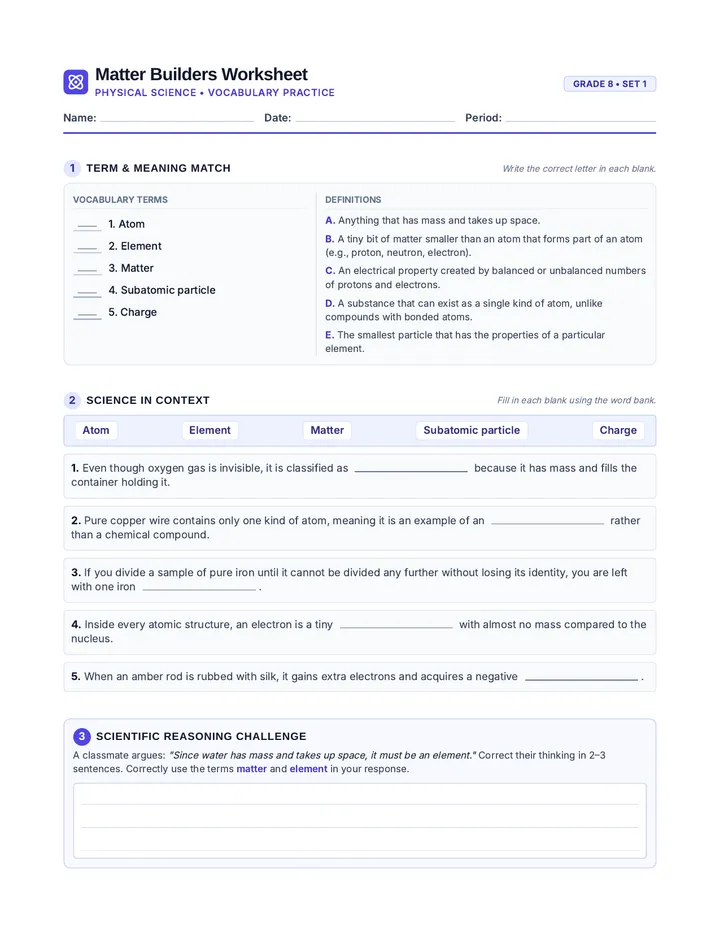
Sphere Scouts Guided Notes Sphere Scouts
Guided Discovery Notes
Name:
Date:
What is a System?
A system is a group of _________________ that work together as a _________________.
Earth is a system made of _________________ major spheres that constantly _________________ with each other.
The Four Spheres of Earth
Sphere Root Meaning Examples & Contents Geosphere Geo = _________ Hydrosphere Hydro = ________ Atmosphere Atmo = _________ Biosphere Bio = _________
Sphere Interactions
1. Evaporation
Water turns into vapor in the air.
Spheres: _______________________ & _______________________
2. Hurricane Erosion
Strong winds and heavy rain wash away a sandy beach.
Spheres: ____________________, ____________________, & ____________________
3. Drinking Water
A deer drinks from a cold forest stream.
Spheres: _______________________ & _______________________
Field Sketch
Draw a scene from outside. Label one part for each of the four spheres.
Mini Sphere Lab Activity Mini Sphere Lab
Modeling Earth's Systems
Group:
HANDS-ON MODELING
The Mission
Your team will build a "Sphere in a Jar" model to observe how the four spheres of Earth interact in a closed system. Can you identify all four spheres in your miniature world?
Materials List
Clear plastic jar/container with lid
Small pebbles or gravel (2 cups)
Potting soil (3 cups)
Small plant or moss (or seeds)
Water (approx. 1/2 cup)
Plastic wrap (if no lid)
Procedure
Layer gravel at the bottom for drainage.
Add potting soil on top of the gravel.
Carefully plant your moss or small plant.
Pour water over the soil until moist.
Seal the container tightly with the lid.
Place the container in a sunny spot.
Lab Analysis
1. Identify the Spheres: Which part of your model represents each sphere?
Geosphere:
Hydrosphere:
Atmosphere:
Biosphere:
2. Prediction: How will the spheres interact inside your jar?
Interaction between Hydrosphere & Atmosphere (Look at the lid):
Interaction between Biosphere & Geosphere (Look at the roots):
3. Big Picture: Why is it important that all four spheres work together?
Sphere Master Teacher Guide Sphere Master
Teacher Guide & Answer Key
TEACHER RESOURCE
Lesson Overview
This lesson establishes foundational knowledge of Earth's four major systems (ESS.5.1.1). Students move from identification to interaction analysis (ESS.5.1.2), building a miniature biosphere to observe cycles in action and analyzing real-world systems through text and field observations.
Key Vocabulary
System: Interacting parts forming a whole.Erosion: Water/Air wearing down land (Hydro/Atmo → Geo).Transpiration: Plants releasing water vapor (Bio → Atmo).
Common Misconceptions
Atmosphere = empty space (it is actually a complex mix of gases).
Biosphere = only animals (forgetting plants, fungi, and bacteria).
Worksheet & Reading Keys
Guided Notes Key
System: Parts... Whole.Spheres: Four... Interact.Table: Geo (Earth/Ground), Hydro (Water), Atmo (Air/Vapor), Bio (Life).Interactions: 1. Hydro/Atmo. 2. Atmo/Hydro/Geo. 3. Bio/Hydro.
Reading Passage Key
1. Identification: Geo (Volcano), Hydro (Rain), Atmo (Clouds), Bio (Ferns).2. Interaction: Rain (Hydro) erodes rocks into soil (Geo), helping plants (Bio) grow.3. Inference: Short volcano = less rain. This leads to a drier island.4. Visual: Simple diagram showing interaction (e.g., rain falling on ground).
Sphere Check Quiz Key
Part 1: Matching
1. C (Geosphere)2. A (Hydrosphere)3. D (Atmosphere)4. B (Biosphere)
Part 2: Multiple Choice
Part 3: Interactions
1. Geosphere & Atmosphere2. Hydrosphere & Geosphere
Bonus: Transpiration helps the Biosphere (removes waste/cools plant) and the Atmosphere (adds moisture for rain/humidity).
Sphere Stories Reading Passage Sphere Stories
Reading & Analysis
Name:
Date:
The Island Engine
Geosphere
Hydrosphere
Atmosphere
Biosphere
In the middle of the Pacific Ocean sits a high, volcanic island. This island is a perfect example of how Earth’s four "spheres" work together like a complex engine. It begins with the geosphere —the giant, dormant volcano that forms the solid foundation of the island. Its jagged peaks reach high into the sky, creating a barrier for passing clouds.
As warm air from the atmosphere hits these cold mountain slopes, the moisture in the air cools and turns into heavy rain. This rain—part of the hydrosphere —pours down the mountainsides. Over thousands of years, the water has carved deep canyons into the volcanic rock, breaking it down into rich, fertile soil.
This soil provides the perfect home for the biosphere . Massive ferns and towering palm trees drink the rainwater and stretch their roots deep into the ground for support. In return, these plants release oxygen and water vapor back into the atmosphere, keeping the air fresh and humid. Brightly colored birds eat the island’s fruit and spread seeds across the land, ensuring the cycle continues. On this tiny island, not a single part of the system works alone.
Comprehension & Analysis
1. Identification: Name one specific item from the passage for each sphere.
Geosphere Item
Hydrosphere Item
Atmosphere Item
Biosphere Item
2. Describe how the interaction between the Hydrosphere and Geosphere creates a benefit for the Biosphere.
3. Inference: If the volcano were much shorter and did not reach the clouds, how would the island's plant life change? Why?
4. Visual Summary: Draw a simple diagram of "The Island Engine" below. Use arrows to show one interaction between two spheres.
Sphere Systems Quiz Sphere Check
Systems Assessment
Name:
Date:
Part 1: Vocabulary & Roots
1. Geosphere
2. Hydrosphere
3. Atmosphere
4. Biosphere
A. Includes all water on Earth.
B. Includes all living things.
C. Includes the solid rock and land.
D. Includes the mixture of gases in air.
Part 2: Multiple Choice
5. Which root word means "vapor" or "air"?
Geo
Atmo
Bio
Hydro
6. A group of parts that work together as a whole is called a...
Fragment
Pattern
System
Cycle
Part 3: Interaction Analysis
Situation 1: A volcano erupts, sending hot ash and gases into the sky.
Identify the two spheres interacting here:
Sphere A
Sphere B
Situation 2: Waves crash against a rocky shore, breaking chunks of stone off.
Identify the two spheres interacting here:
Sphere A
Sphere B
Bonus Question:
Plants release water vapor through a process called transpiration. How does this interaction help both the biosphere and the atmosphere ?