Starlight Secrets Slides
STEMscopedia Article Review • NGSS 5-ESS1-1
Observing the Stars
Classroom Review & Discussion Slides
Review key concepts, analyze stellar distance data, and prepare your scientific argument—without giving away the answers!
5th Grade Science • Active Discussion Deck
Student Inquiry Mode: No Answers Shown
01
Article Reflection: The Sky Mystery
STEMscopedia Page 1
From the Reading
"Think about the night sky. What can you see? There are probably billions and billions of stars in the universe. Looking at the stars in the night sky, sometimes it is difficult to tell which ones are closer to Earth and which ones are farther away..."
"Sometimes it is easy to forget the closest star to Earth, because it is only visible during the day—the Sun."
Source: Observing the Stars (STEMscopedia)
What Do You Think?
Prompt 1:
Why does the Sun look so radically different from every other star in the sky?
Prompt 2:
Is the Sun so much bigger, or so much brighter, or is something else happening?
Turn and talk with your shoulder partner before continuing!
Class Challenge: Keep your hypotheses in mind as we review the article data!
02
Size & Distance: Solar Radius
STEMscopedia Pages 1-2
Understanding the Radius
The article defines radius as the distance from the center of a sphere to its surface.
1 Solar Radius = Radius of the Sun
Used as the standard unit to compare star sizes.
Article Check Question:
If a star measures 0.75 solar radius, how large is it compared to our Sun?
VY Canis Majoris
Scale Check
The Sun
1
solar radius
VY Canis Majoris
> 1,800
solar radii
Class Discussion Question:
If VY Canis Majoris is over 1,800 times larger than the Sun, why does our Sun appear so gigantic, while VY Canis Majoris is invisible without a telescope?
What factor accounts for this dramatic difference in appearance?
STEMscopedia Key Concept: The Sun is actually a medium-sized star!
What explains what we see? →
03
Cosmic Measuring Tape: The Light-Year
STEMscopedia Page 2
What is a Light-Year?
Because stars are so far apart, scientists need a special unit of distance to measure them.
Definition from Text:
The distance that light travels through space in one Earth year.
1 Light-Year equals:
~ 5,878,499,810,000 miles
(About 9.5 Trillion Kilometers)
Think About the Scale
Question from Text:
Why is it easier for astronomers to measure in light-years rather than miles or kilometers?
Rule of Distance:
What does the text state happens to a star's size and brightness as its distance grows?
Cite evidence directly from Page 2 of your reading!
Remember: A light-year measures DISTANCE, not time!
04
Comparing Distance & Radius Data
STEMscopedia Page 3 Table
Table 1: The Sun vs. VY Canis Majoris
| Measurement | The Sun | VY Canis Majoris |
|---|
| Distance to Earth | 149,600,000 km | |
| (0.1496 billion km) | ~ 4,900 light-years | |
| (46,550,000 billion km) | | |
| Solar Radius | 1 solar radius | > 1,800 solar radii |
Compare the numbers: 0.1496 billion km vs 46,550,000 billion km!
Analyze the Data
Question A:
Which star is physically bigger in reality, and by how much?
Question B:
Why does the Sun appear blinding and massive in our sky while VY Canis Majoris cannot even be seen by eye?
Use the relative distances from the table to explain!
Article Evidence: A much smaller star that is extremely close can look millions of times brighter than a gargantuan star that is light-years away!
05
What Do You Think? Star Distances
STEMscopedia Pages 3-4
Table 2: Four Night Stars
| Star | Distance in Light-Years |
|---|
| Sirius | 8.6 |
| Alpha Centauri | 4.3 |
| Betelgeuse | 650 |
| Achernar | 69 |
Examine each distance carefully. Which is closest? Which is farthest?
Article Questions for You
Article Question 1:
Which star would you expect to be the dimmest star seen from Earth? Why?
Article Question 2:
Rank the four stars in order from nearest to farthest from Earth.
Prepare your answers to record on your worksheet!
Data Strategy: Look at the distance column to predict apparent brightness!
Next: The Brightness Puzzle →
06
The Brightness Puzzle: Sirius vs Alpha Centauri
STEMscopedia Page 4
The Article's Big Question
"Sirius is the brightest star seen from Earth even though Alpha Centauri is closer to Earth. Why do you think this is?"
Alpha Centauri: 4.3 light-years
Sirius: 8.6 light-years (twice as far!)
If distance was the ONLY factor, Alpha Centauri should look brighter!
Detective Clues to Consider
Clue 1: Two Types of Brightness
What is the difference between how bright a star looks from Earth vs how much light it actually produces?
Clue 2: Star Power
Can one star give off significantly more light energy than another star?
Synthesize both clues to write your explanation on the worksheet!
Apparent brightness depends on distance AND actual brightness!
★
Constructing Your Scientific Argument (CER)
NGSS 5-ESS1-1
C
Claim
Your Question to Answer:
Why does the Sun appear so much brighter and larger than all other stars in the sky?
Write a clear, direct 1-sentence scientific claim on your worksheet.
E
Evidence
Facts to Include:
- • Distance to the Sun vs. distance to night stars (light-years).
- • Solar radius of the Sun vs. VY Canis Majoris.
Include specific numbers and units from the reading!
R
Reasoning
Scientific Principles:
Explain why light behaves the way it does over distance, connecting your evidence back to your claim.
Use the flashlight model to explain light spreading out!
Turn to Part 4 & 5 on your Starlight Detective Worksheet to complete your analysis!
Ready to Write
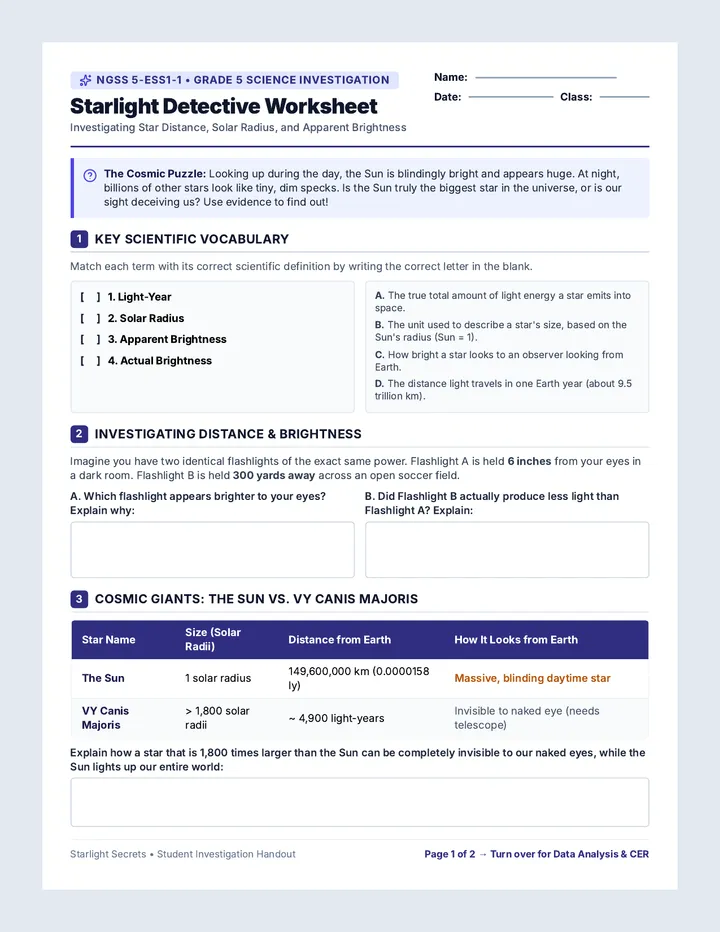
Starlight Detective Worksheet
NGSS 5-ESS1-1 • Grade 5 Science Investigation
Starlight Detective Worksheet
Investigating Star Distance, Solar Radius, and Apparent Brightness
Name:
Date: Class:
The Cosmic Puzzle: Looking up during the day, the Sun is blindingly bright and appears huge. At night, billions of other stars look like tiny, dim specks. Is the Sun truly the biggest star in the universe, or is our sight deceiving us? Use evidence to find out!
1
Key Scientific Vocabulary
Match each term with its correct scientific definition by writing the correct letter in the blank.
[ ] 1. Light-Year
[ ] 2. Solar Radius
[ ] 3. Apparent Brightness
[ ] 4. Actual Brightness
A. The true total amount of light energy a star emits into space.
B. The unit used to describe a star's size, based on the Sun's radius (Sun = 1).
C. How bright a star looks to an observer looking from Earth.
D. The distance light travels in one Earth year (about 9.5 trillion km).
2
Investigating Distance & Brightness
Imagine you have two identical flashlights of the exact same power. Flashlight A is held 6 inches from your eyes in a dark room. Flashlight B is held 300 yards away across an open soccer field.
A. Which flashlight appears brighter to your eyes? Explain why:
B. Did Flashlight B actually produce less light than Flashlight A? Explain:
3
Cosmic Giants: The Sun vs. VY Canis Majoris
| Star Name | Size (Solar Radii) | Distance from Earth | How It Looks from Earth |
|---|
| The Sun | 1 solar radius | 149,600,000 km (0.0000158 ly) | Massive, blinding daytime star |
| VY Canis Majoris | > 1,800 solar radii | ~ 4,900 light-years | Invisible to naked eye (needs telescope) |
Explain how a star that is 1,800 times larger than the Sun can be completely invisible to our naked eyes, while the Sun lights up our entire world:
Starlight Secrets • Student Investigation Handout Page 1 of 2 → Turn over for Data Analysis & CER
NGSS 5-ESS1-1 Evidence Analysis