Wild Homes Slides
Ecology Expedition
GRADE 3–5 SCIENCE
Wild Homes & Wonder
Discover Earth's biomes, unique physical features, and the survival superpowers organisms use every day.
Climate & Space
Living conditions
Organisms
Plants and animals
Adaptations
Physical & behavioral
Foundations
What Makes a Habitat?
Food
Nutrients and energy for growth, movement, and staying healthy.
Water
Clean moisture to drink, absorb, or swim in for life processes.
Shelter
Protection from extreme weather, predators, and raising young.
Space
Enough territory to roam, hunt, establish nests, and avoid conflict.
Key Idea: If any single need is missing, an organism must move, adapt, or it will not survive.
Habitat Profile 01
Tropical Rainforest
Warm & Extremely Wet
Environment Features
- • Over 80–400 inches of rainfall every single year.
- • Warm temperatures year-round (around 70–85°F).
- • Distinct layers: emergent, canopy, understory, forest floor.
- • Home to more than 50% of all Earth’s land species!
Adaptation Spotlight
Poison Dart Frog
Warning Coloration: Bright neon skin warns predators that touching or eating it is toxic.
Drip-Tip Leaves
Water Runoff: Waxy pointed tips shed heavy rainwater fast so fungus cannot grow.
Challenge Question: Why do so many rainforest creatures live up high in the canopy? Sunlight & Food!
Habitat Profile 02
Arid Desert
Arid & Temperature Extremes
Environment Features
- • Less than 10 inches of total precipitation annually.
- • Intense daytime heat followed by rapid freezing nights.
- • Dry, sandy, or rocky soil with rapid moisture evaporation.
- • Organisms must conserve every single drop of water.
Adaptation Spotlight
Fennec Fox
Oversized Ears: Massive blood-rich ears radiate body heat away to stay cool in scorching sand.
Saguaro Cactus
Spines & Pleats: Accordion pleats expand to store water; sharp needles prevent animals from drinking it.
Did You Know? Many desert animals are nocturnal to avoid the baking sun. Behavioral Adaptation!
Habitat Profile 03
Arctic Tundra
Freezing & Treeless
Environment Features
- • Sub-zero temperatures for most of the entire year.
- • Permafrost: subsoil layer remains permanently frozen.
- • Severe howling winds prevent tall trees from growing.
- • Very short summer growing season (50–60 days).
Adaptation Spotlight
Polar Bear
Insulation: 4 inches of blubber, dense underfur, and black skin underneath to absorb heat.
Arctic Willow & Moss
Low Profile: Grows carpet-flat to the ground to hide from biting, ice-laden winds.
Color Shifting: Arctic foxes turn white in winter and brown in summer! Seasonal Camouflage
Habitat Profile 04
Ocean & Coral Reefs
Saltwater & Vast Depths
Environment Features
- • Covers over 71% of our entire planet’s surface.
- • Saline (saltwater) with variable pressure and light zones.
- • Reefs provide nurseries for 25% of all marine life.
- • Sunlit surface down to completely black abyss.
Adaptation Spotlight
Gills & Streamlined Body
Aquatic Respiration: Extracts dissolved oxygen from water; torpedo shapes reduce drag.
Bioluminescent Anglerfish
Deep Sea Glow: Produces light from a glowing lure to attract prey in pitch-black depths.
Teamwork: Clownfish and Sea Anemones share shelter and food safety. Mutualism
Scientific Concept
Two Ways to Survive
Physical (Structural)
What an organism HAS
Body parts, shapes, and internal systems that develop over generations.
Webbed feet for fast swimming
Sharp talons or beaks for tearing meat
Hollow bones in birds for light flight
Behavioral
What an organism DOES
Actions, habits, and instincts creatures perform to survive conditions.
Birds migrating south for the winter
Bears hibernating to save energy
Wolves hunting together in coordinated packs
Quick Class Vote: A chameleon changing its skin color to hide is...
Both Physical & Behavioral!
Classroom Mission
Habitat Designer Challenge
Investigation Activity
1
Choose a Habitat
Select one extreme biome (deep trench, windswept tundra, or arid dunes).
2
Invent an Organism
Give your creature 2 physical adaptations and 1 survival behavior.
3
Prove Survival
Explain exactly how it finds food, water, and shelter in that specific environment.
Ready for pair discussion, science notebooks, or poster drawing.
Wild Homes Expedition Complete
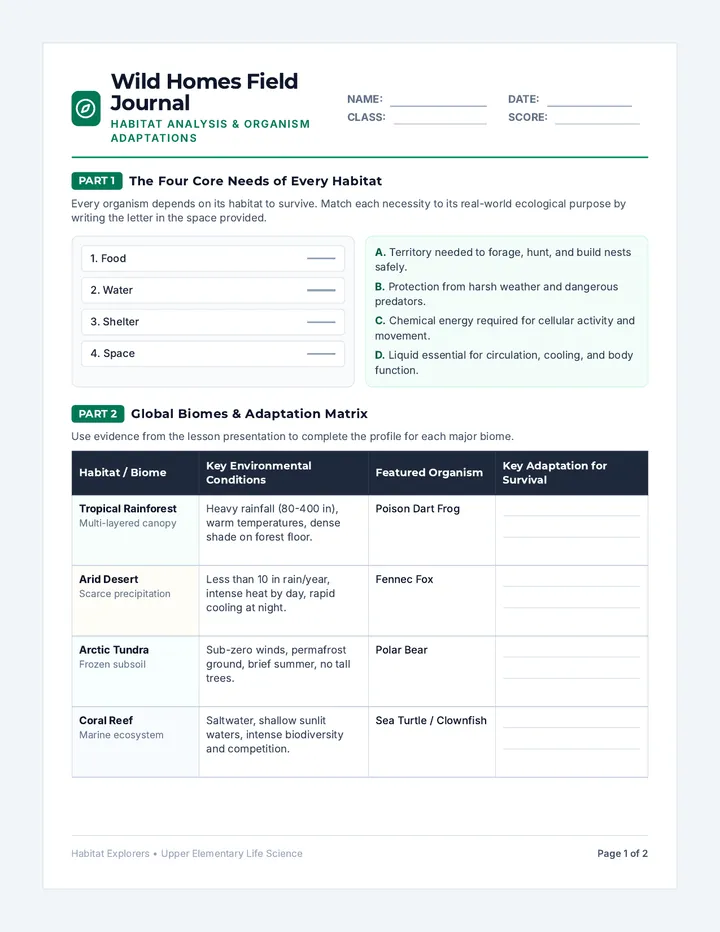
Wild Homes Worksheet
Wild Homes Field Journal
Habitat Analysis & Organism Adaptations
Name:
Date:
Class:
Score:
PART 1
The Four Core Needs of Every Habitat
Every organism depends on its habitat to survive. Match each necessity to its real-world ecological purpose by writing the letter in the space provided.
1. Food
2. Water
3. Shelter
4. Space
A. Territory needed to forage, hunt, and build nests safely.
B. Protection from harsh weather and dangerous predators.
C. Chemical energy required for cellular activity and movement.
D. Liquid essential for circulation, cooling, and body function.
PART 2
Global Biomes & Adaptation Matrix
Use evidence from the lesson presentation to complete the profile for each major biome.
| Habitat / Biome | Key Environmental Conditions | Featured Organism | Key Adaptation for Survival |
|---|
| Tropical Rainforest Multi-layered canopy | Heavy rainfall (80-400 in), warm temperatures, dense shade on forest floor. | Poison Dart Frog | |
| | | |
| Arid Desert Scarce precipitation | Less than 10 in rain/year, intense heat by day, rapid cooling at night. | Fennec Fox | |
|
| Arctic Tundra Frozen subsoil | Sub-zero winds, permafrost ground, brief summer, no tall trees. | Polar Bear |
|
| Coral Reef Marine ecosystem | Saltwater, shallow sunlit waters, intense biodiversity and competition. | Sea Turtle / Clownfish |
|
Habitat Explorers • Upper Elementary Life Science Page 1 of 2
Field Journal (Continued)
HABITAT & ADAPTATION LAB
PART 3
Classify the Adaptation
Write P for a Physical (Structural) Adaptation (body part/feature) or B for a Behavioral Adaptation (action/instinct).
1. A rattlesnake basking on warm rocks to regulate heat.
2. A saguaro cactus storing water in expandable pleats.
3. Canadian geese flying south in a 'V' formation in fall.
4. An Arctic fox growing thick, insulating white winter fur.
5. A brown bear sleeping in a den through freezing winter.
Habitat Check Exit Ticket
Habitat Check • Exit Ticket
Life Science Assessment
Name:
Date:
1 Name the 4 core survival necessities every habitat must provide:
2 Identify adaptation type: Write P (Physical) or B (Behavioral):
Polar bear’s 4-inch layer of insulating blubber
Kangaroo rat hiding underground during the day
3 A desert cactus is moved to a damp tropical rainforest. Explain why it might struggle:
How confident are you with today's topic?
1. Need help 2. Getting it 3. Mastered
CUT ALONG DASHED LINE
Habitat Check • Exit Ticket
Life Science Assessment
Name:
Date:
1 Name the 4 core survival necessities every habitat must provide:
2 Identify adaptation type: Write P (Physical) or B (Behavioral):
Polar bear’s 4-inch layer of insulating blubber
Kangaroo rat hiding underground during the day
3 A desert cactus is moved to a damp tropical rainforest. Explain why it might struggle:
How confident are you with today's topic?
1. Need help 2. Getting it 3. Mastered