Rebellion Road Slides Revolutionary Road
The Path to American Independence
A Guide for Young Patriots & Future Historians
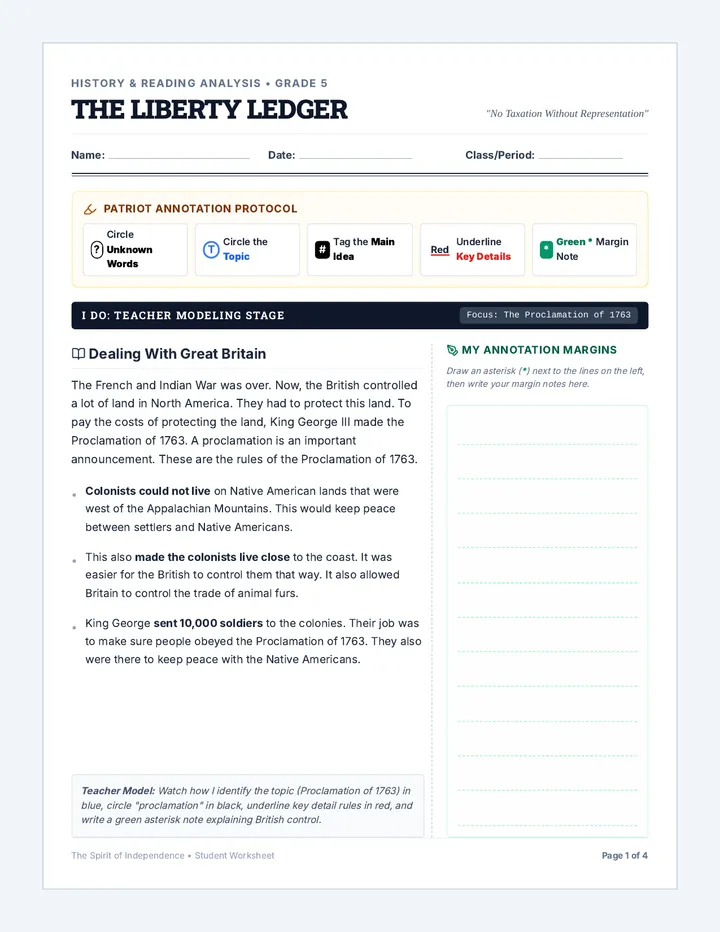
The French and Indian War
Before the Revolution, Britain and France fought for control of North America (1754–1763).
The Result:
Britain won the war and more land!
But... the war was VERY expensive.
King George III needed money to pay back his debts.
Debt = The spark that started the fire.
The Ocean Divide
"British Subjects"
England called the colonists subjects, promising them the same rights as people in London. But unlike them, colonists could not vote for Parliament.
The Money Trail
Tax money didn't build colonial schools or roads. It went across the ocean to England to fill the King's treasury.
The 3,000 Mile Gap
13 Colonies
The Atlantic Ocean
London
"How can a King who is so far away know what we need?"
The Early Taxes (1764-1765)
The Sugar Act
Taxed sugar and molasses. Colonists felt it was unfair to be forced to pay without a vote.
The Stamp Act
Taxed almost all paper. Imagine paying a tax every time you used a sheet of paper at school!
"NO TAXATION WITHOUT REPRESENTATION!"
The Quartering Act (1765)
A Constant Threat
The King ordered colonists to provide housing and food for British soldiers. This wasn't just about sharing a room—it was about power.
Having armed guards in your home and on your streets made colonists feel threatened, watched, and violated.
Armed Guards Everywhere:
No privacy in your own home
Soldiers patrolling your streets
Feeling like a prisoner in your town
Paying to feed the guards who watch you
The Townshend Acts (1767)
After the Stamp Act failed, Britain tried taxing imported goods that the colonists couldn't easily make themselves.
Glass
Paint
Paper
Tea
The colonists responded by boycotting (refusing to buy) these goods. Tension was reaching a boiling point.
The Redcoats Arrive (1768)
To stop the protests and boycotts, Britain sent thousands of soldiers to Boston.
Seeing "Redcoats" on every street corner made the people of Boston feel like they were in a prison.
TENSION: CRITICAL
The Boston Massacre (1770)
March 5, 1770
A crowd of colonists began throwing snowballs and insults at British soldiers. In the chaos, the soldiers opened fire. Five colonists were killed.
The Propaganda:
Paul Revere made a famous engraving showing the British as monsters, making many colonists even angrier.
Crispus Attucks:
Known as the first person to die for the cause of American liberty.
The Sons of Liberty
Secret Society
This group organized protests and resisted British laws.
Famous Members:
• Samuel Adams
• John Hancock
• Paul Revere
• Benedict Arnold
Protest Tactics
They used "Liberty Trees" for meetings and sometimes used harsh methods like "tar and feathering."
Communication
They helped spread news between colonies so everyone knew what the British were doing.
The Tea Act (1773)
Britain gave the East India Company a monopoly on tea. This meant colonists could only buy tea from this one company.
"Even if the tea is cheaper, we still didn't agree to the tax! It's the principle that matters!"
The Turning Point (1773)
Property Destruction
Patriots dumped 342 chests of tea into the harbor. This was the first time they destroyed British property as a group.
The Message to the King
King George III realized the colonists were not going to back down. He saw that the rebellion was growing out of control.
King George's Reaction:
"The colonies must either submit or triumph." He sent even more soldiers to force the colonists into control.
Property destruction turned a protest into a REVOLUTION.
The Intolerable Acts (1774)
King George was furious. He passed the "Coercive Acts" to punish Boston, but the colonists called them Intolerable.
Blockade of Boston Harbor:
The port was closed! No ships could enter or leave until the tea was paid for. People began to starve.
Other Punishments:
Town meetings were banned.
A stronger Quartering Act was passed.
British officials accused of crimes would be tried in England.
First Continental Congress
In September 1774, leaders from 12 of the 13 colonies met in Philadelphia to discuss how to respond to the Intolerable Acts.
What they decided:
To boycott all British goods.
To tell each colony to start forming its own militia (citizen army).
To meet again in May 1775 if things didn't get better.
Philadelphia
The Birthplace of Liberty
The Midnight Ride (1775)
April 18, 1775: British troops marched toward Concord to seize colonial weapons and arrest patriot leaders.
Paul Revere and William Dawes rode through the night to warn the Minutemen that the British were coming.
"One if by land, two if by sea."
The signal in the Old North Church
The Shot Heard 'Round the World
Lexington
A small group of Minutemen met the British. A shot was fired—no one knows by whom—and the fighting began. 8 colonists died.
Concord
The British reached Concord but found no weapons. On their march back to Boston, hundreds of Minutemen attacked from behind trees and walls.
The American Revolution had officially begun.
Common Sense (1776)
Thomas Paine wrote a simple pamphlet that changed everything.
He argued that it was "common sense" that a small island (Britain) shouldn't rule a whole continent (America).
COMMON SENSE
Addressed to the inhabitants of America
"A government of our own is our natural right..."
"The sun never shined on a cause of greater worth."
The Purpose of Government
The document explained that government exists to protect the people and their natural rights.
The People's Right:
"Whenever any form of government becomes destructive... it is the Right of the People to alter or to abolish it, and to institute new Government."
If a government fails to work for the people, the people can start a new one.
This idea gave Patriots the courage to keep fighting for their total freedom!
The Road Was Long...
1
French War
2
Subjects/Taxes
3
Tea Party
4
Lex/Concord
5
Liberty!
Would you have been a Patriot or a Loyalist?
Think about the choices the colonists had to make.
Road Rebellion Timeline Worksheet Road to Rebellion Timeline
Order the events and describe why they mattered.
Name: __________________________
Date: ___________________________
Mission: Use the Word Bank at the end of this packet to fill in the timeline in chronological order. For each event, write a short explanation of its significance in the space provided.
1
Year
Event Name
Significance / Historical Impact:
2
Year
Event Name
Significance / Historical Impact:
3
Year
Event Name
Significance / Historical Impact:
4
Year
Event Name
Significance / Historical Impact:
5
Year
Event Name
Significance / Historical Impact:
6
Year
Event Name
Significance / Historical Impact:
7
Year
Event Name
Significance / Historical Impact:
8
Year
Event Name
Significance / Historical Impact:
9
Year
Event Name
Significance / Historical Impact:
10
Year
Event Name
Significance / Historical Impact:
11
Year
Event Name
Significance / Historical Impact:
12
Year
Event Name
Significance / Historical Impact:
13
Year
Event Name
Significance / Historical Impact:
14
Year
Event Name
Significance / Historical Impact:
15
Year
Event Name
Significance / Historical Impact:
Patriot Word Bank
• French & Indian War
• Sugar Act
• Stamp Act
• Quartering Act
• Townshend Acts
• Sons of Liberty
• Boston Massacre
• Tea Act
• Boston Tea Party
• Intolerable Acts
• Continental Congress
• Paul Revere's Ride
• Lexington & Concord
• Common Sense
Patriot Knowledge Quiz Patriot Knowledge Check
American Revolution Unit Assessment
Name: __________________________ Date: ___________________________
Section I: Escalating Tensions
1. How did high taxes directly hurt the daily lives (welfare) of colonial families?
Families had less money left over to buy necessary things like food and clothing.
It made it impossible for kids to go to the park on weekends.
2. Why did the King pass a law banning town meetings in Boston?
To silence the colonists and stop them from planning how to rebel.
Because the town halls were being painted and weren't safe to enter.
3. Look at the map. Why was this 3,000-mile ocean distance a problem for the colonists?
It made it hard for the King to understand what the colonists really needed.
It made it very easy for the King to visit the colonies every single month.
Colonies
3,000 MILES
London
Atlantic Ocean
4. According to the Declaration of Independence, what is the main "job" of a government?
To protect and work for the people it rules.
To make the King as rich and powerful as possible.
5. How did the Boston Tea Party change King George III's view of the rebellion?
He realized they would not back down and were willing to destroy property.
He decided the colonies were too messy and gave them their freedom immediately.
Section II: Revolutionary Vocabulary
Match the word to its correct definition by writing the letter on the line.
Boycott
A. A formal complaint against something or someone.
Intimidate
B. To frighten someone into doing what you want.
Blockade
C. Closing a port so ships cannot enter or leave.
Patriot
D. A person who supported the fight for independence.
Section III: The Turning Point
6. Explain how the closing of Boston Harbor (the blockade) hurt the safety and health of people living there. Be specific about what they needed.
7. How did the King use the Quartering Act to "intimidate" or scare the colonists into obeying him?
Rebel Teacher Guide Instructional Blueprint
Teacher Resource
Unit Overview
A decade of escalating tension (1763–1776) where the Revolution was a gradual breakdown caused by debt, lack of representation, and military threat. Focus on the impact on daily life (welfare) and the silencing of colonial voices.
Essential Questions
• What makes a law "fair"?
• How did loss of freedom hurt daily life?
Facilitation Guide
Status & Welfare
British Subjects & Map (Slide 3): Discuss distance. Ask: "If you have a problem, do you want a principal from 3,000 miles away to decide the rules?" Highlight that taxes went to England's treasury, not colonial projects.
Colonies
London
Atlantic Ocean
Welfare Impact (Slide 4): Discuss the "Dinner Table" effect. Ask: "If the King takes the money your parents needed for food or warm coats, how does your day change?"
Escalation
Quartering Act & Intimidation: Use the "Bully" analogy. Armed guards were sent not to protect, but to intimidate and force obedience through show of military strength.
Silencing Voices & Harbor Blockade: Banning town meetings was a way to silence the people. Closing the harbor caused a Starvation period in Boston where no flour, salt, or milk could reach the city. Once property was destroyed, King George sent even more troops to gain control.
Independence
Declaration & Purpose: Gov't exists ONLY to serve and protect. If it fails, the people have a "given right" to overthrow it. This legal argument gave Patriots the courage to fight on.
Simulation: "The Candy King"
Give every student 10 small treats.
Announce "The Desk Tax": Anyone at a desk owes 2 treats.
Announce "The Sneaker Tax": Anyone with sneakers owes 1 treat.
The Intimidation: Pick 2 "guards" to stand with arms crossed while you collect the tax.
The Silence: Tell the class, "No talking! You cannot meet to discuss this. Anyone who speaks loses a treat."
Discussion: How did it feel to be intimidated and silenced?
Rebel Answer Key Patriot Answer Key
Confidential Teacher Document
OFFICIAL RECORD
Quiz: Patriot Knowledge Check
Section I: Multiple Choice
1. Correct: Less money for food and clothing.
2. Correct: To silence them and stop planning.
3. Correct: Hard for King to understand needs.
4. Correct: To protect and work for the people.
Section II: Vocabulary
B — Boycott (Refuse to buy)
A — Intimidate (Frighten)
C — Blockade (Closing port)
D — Patriot (Fought for independence)
Section III: Short Answer Samples
5. Blockade Impact: Closing the harbor was like cutting off the grocery store. Ships couldn't bring in food like flour, salt, or milk. Many people in Boston went hungry because their welfare depended on the trade that came through the water.
6. Intimidation: By putting armed soldiers inside private homes, the King showed the colonists that he was willing to use military force in their personal lives. It made them feel watched and threatened, proving the King wanted to scare them into obeying his unfair laws.
Rebellion Road Slides Kid Friendly The Great American Breakup
How the 13 Colonies Said "Goodbye" to the King
The Empty Piggy Bank
Britain fought a HUGE war to protect the colonies. They won!
The Problem:
Wars are expensive! King George III had zero money left. He needed a way to get rich again—fast!
King George is Broke
Patriot Anger Meter
1/10 - Curious
The 3,000 Mile Gap
"British Subjects"
England called the colonies family. But unlike people in London, colonists had NO vote on the rules.
"How can a King who is so far away know what we need?"
Colonies
Ocean
London
Distance = Disconnect!
Patriot Anger Meter
2/10 - Annoyed
The Early Taxes
The King taxed Sugar and Paper.
Hurting the People
When the King took more money, families had less money for food and clothes. Life in the colonies was getting harder and harder for kids and parents.
Tax money went straight to London, never helping the colonies.
"NO TAXATION WITHOUT REPRESENTATION!"
Patriot Anger Meter
4/10 - Grumpy
The Quartering Act
The King's Command
The King ordered the colonists to give Housing and Food to thousands of British soldiers.
"It wasn't a request—it was a LAW. If a soldier knocked on your door, you HAD to let him in."
Your bed is now HIS bed.
Your dinner is now HIS dinner.
Patriot Anger Meter
7/10 - Angry!
Intimidation & Force
Force to Obey
The King used ARMY FORCE to scare the colonists into doing what he wanted.
"The King wasn't protecting the people; he was using armed guards to intimidate them. It's like having a bully watching you everywhere you go."
Taking Freedom:
No privacy!
Guards on your street!
Feeling unsafe!
Patriot Anger Meter
8/10 - Threatened
The Big Boycott
The King tried to tax everything: paint, paper, and glass.
Tea
Paint
Paper
Glass
"We won't buy it! We will make our own or do without!"
(This is called a Boycott!)
Patriot Anger Meter