A comprehensive 7th-grade Texas History lesson introducing the Mexican War of Independence (1810–1821), its ideological and social roots, clashing perspectives, and its profound impact on Texas.
Weakened by internal quarrels, the rebels were unprepared for Spain's iron-fisted counterattack.
Takeaway: Texas was not an isolated spectator; it was on the bleeding front lines of independence.
The Battle of Medina: August 18, 1813
Deadliest Day in Texas History
The Ambush
Spanish General Joaquín de Arredondo baited the rebel army into a dense oak forest south of San Antonio, trapping them in suffocating summer heat.
~1,300 Rebels Killed
The Purge of Béxar
Arredondo occupied San Antonio (Béxar). He executed over 300 townspeople, imprisoned women in "La Quinta," and burned ranches to the ground.
Population Cut in Half
A Devastated Land
Texas was completely crippled. With ranches burned and Tejano families fleeing to Louisiana, the frontier lay vacant and defenseless.
Sets Stage for 1821
Fact: A young Spanish lieutenant serving under Arredondo watched these brutal tactics: Antonio López de Santa Anna.
1821: Independence Won & A New Era
The Birth of Mexican Texas
August 1821: Treaty of Córdoba
After 11 agonizing years of war, Spain surrendered. Mexico became a sovereign nation, ending 300 years of Spanish colonial dominance.
Texas was no longer a Spanish province—it was now a vast northern borderland of the Republic of Mexico.
The Texas Dilemma
Because of the war and the Battle of Medina, Texas was nearly empty (fewer than 3,000 Tejanos). Mexican officials desperately needed settlers to build a buffer against Comanche raids.
The Solution:
Honor Moses and Stephen F. Austin’s empresario grant to bring 300 Anglo-American families to Texas!
Up Next: Rebel Crossfire Activity • Pick Your Perspective 1821 → Empresario Era
___ 3. Priest whose midnight bell call (Grito) sparked the 1810 revolution.
___ 4. 1821 agreement in which Spain officially recognized Mexican independence.
___ 5. Joint rebel expedition that captured San Antonio under the Green Flag.
___ 6. Land agent authorized by Mexico to bring Anglo settlers to Texas.
A. Father Miguel Hidalgo B. Casta System C. Battle of Medina D. Gutierrez-Magee Expedition E. Treaty of Córdoba F. Empresario
Part 5: Historical Cause & Effect Chain
Summarize how one event triggered the next in Texas history by completing the missing boxes:
1. The Spark (1810)
Father Hidalgo issues the Grito de Dolores demanding equality and an end to Spanish tyranny.
↓ leads to
2. War in Texas (1813)
What happened at the Battle of Medina?
↓ leads to
3. The Aftermath
Texas is severely depopulated; ranches are ruined; fewer than 3,000 Tejanos remain to face Comanche raids.
↓ leads to
4. New Strategy (1821)
How did Mexico solve the empty frontier?
✓ Outcome
Part 6: Big Picture Synthesis (TEKS 7.2D • 7.2F)
Why did Mexico’s victory over Spain in 1821 make Anglo-American colonization (Stephen F. Austin’s contract) possible? Explain two specific reasons connecting the war’s devastation to Austin's arrival.
Unit 4: Mexican Independence • Student Handout Page 2 of 2
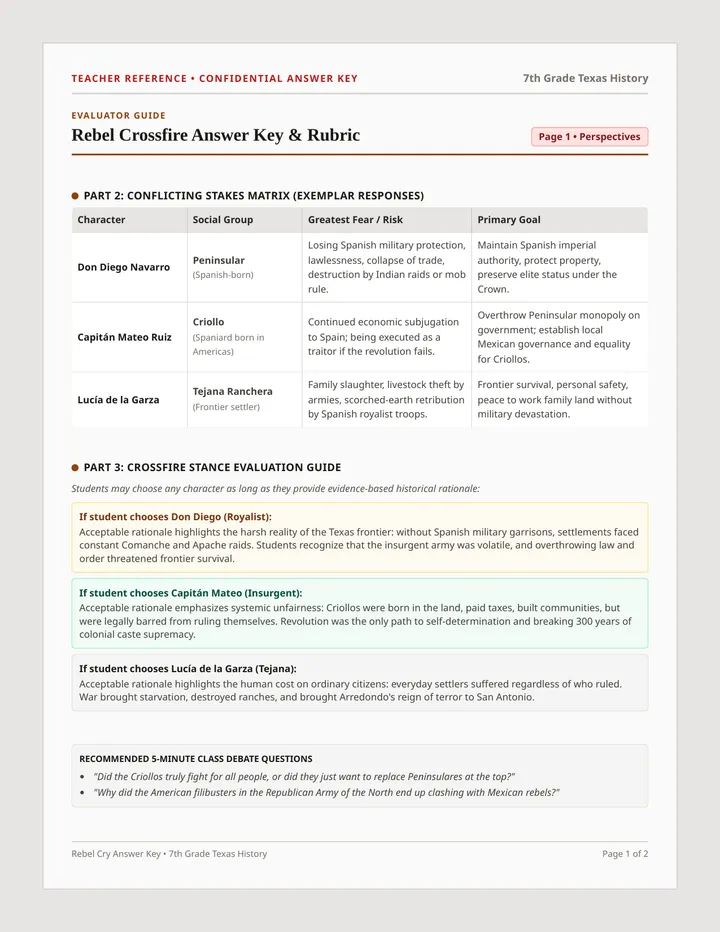
Recommended 5-Minute Class Debate Questions
"Did the Criollos truly fight for all people, or did they just want to replace Peninsulares at the top?"
"Why did the American filibusters in the Republican Army of the North end up clashing with Mexican rebels?"
Rebel Cry Answer Key • 7th Grade Texas History Page 1 of 2
Teacher Reference • Confidential Answer Key Page 2 of 2
Parts 4, 5 & 6
Concept Solutions & Scoring Rubric
TEKS 7.2D & 7.2F
Part 4: Concept Matching Key
1. C • Battle of Medina (1813)
2. B • Casta System
3. A • Father Miguel Hidalgo
4. E • Treaty of Córdoba (1821)
5. D • Gutierrez-Magee Expedition
6. F • Empresario
Part 5: Cause & Effect Chain (Exemplar Student Fill-ins)
Box 2: War in Texas (Battle of Medina)
The Gutierrez-Magee Expedition captures San Antonio, but Royalist General Joaquín de Arredondo ambushes and massacres ~1,300 rebels at the Battle of Medina, then violently purges Béxar.
Box 4: New Strategy (1821 Solution)
With Texas nearly depopulated and Spanish garrisons gone, the newly independent Mexican government confirms Moses & Stephen F. Austin’s empresario grant to populate Texas with Anglo settlers.
Part 6: Big Picture Synthesis (Exemplar & 4-Point Rubric)
Model Student Response (Full Credit):
"The 11-year War of Independence left Texas ruined and depopulated, especially after the bloody Battle of Medina in 1813 where Spanish forces killed over 1,000 men and drove Tejano families away. When Mexico won independence in 1821, Texas had fewer than 3,000 Mexican settlers, making the region defenseless against hostile Comanche raids and vulnerable to American takeover. Because Mexican citizens did not want to move to the dangerous frontier, the Mexican government was forced to recruit Anglo-American settlers through Stephen F. Austin's empresario contract to build farms, defend the border, and pay taxes."
Score
Performance Criteria
4 (Mastery)
Explains 2 clear causes linking war's devastation (e.g. Battle of Medina depopulation, Indian raids, lack of soldiers) to the decision to invite Austin's colonists.
3 (Proficient)
Identifies the connection between Mexican independence and Austin, but only fully develops one concrete reason (e.g., mentions population loss but omits defense/Indian threat).
2 (Developing)
States that Mexico became independent and Austin brought families, but fails to explain why Mexico needed Anglo settlers (lacks cause-and-effect link).
1 (Beginning)
Inaccurate historical facts; confuses Mexican independence with the Texas Revolution of 1836 or Cinco de Mayo.
Watch Out For This Misconception:
Students often write: "Austin asked Mexico for land because they were friends." Remind students that Moses Austin originally received permission from the Spanish governor (Martínez) in early 1821, but after Mexico won independence later that year, Stephen F. Austin had to travel all the way to Mexico City to re-negotiate the contract with the new Mexican government!
Rebel Cry Answer Key • 7th Grade Texas History Page 2 of 2