Seven Principles Guide
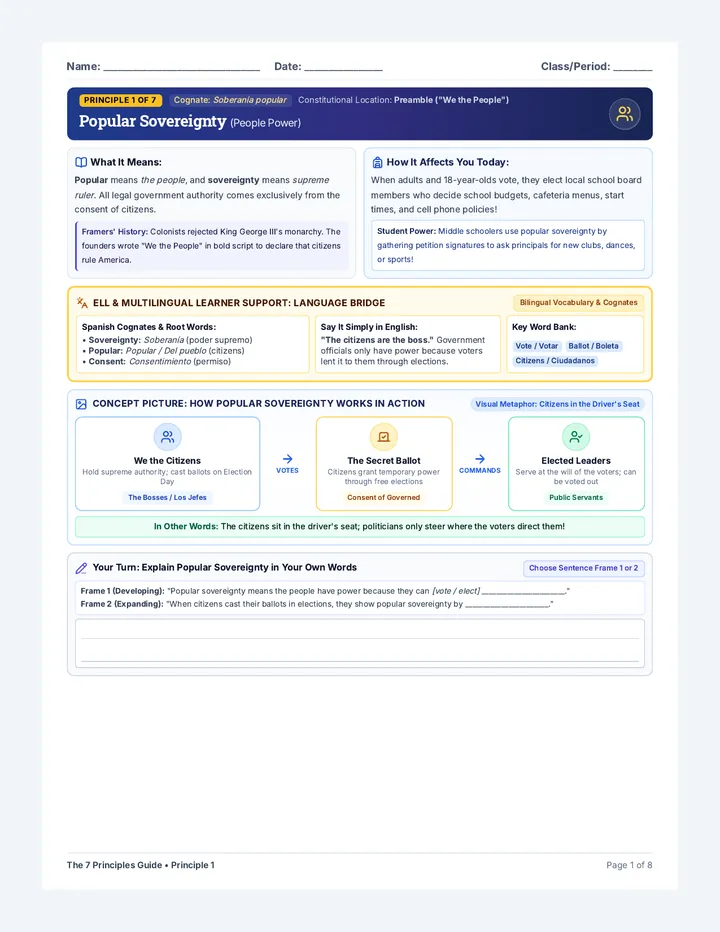
Name: ________________________________ Date: ________________
Class/Period: ________
Principle 1 of 7 Cognate: Soberanía popular Constitutional Location: Preamble ("We the People")
Popular Sovereignty (People Power)
What It Means:
Popular means the people, and sovereignty means supreme ruler. All legal government authority comes exclusively from the consent of citizens.
Framers' History: Colonists rejected King George III's monarchy. The founders wrote "We the People" in bold script to declare that citizens rule America.
How It Affects You Today:
When adults and 18-year-olds vote, they elect local school board members who decide school budgets, cafeteria menus, start times, and cell phone policies!
Student Power: Middle schoolers use popular sovereignty by gathering petition signatures to ask principals for new clubs, dances, or sports!
ELL & Multilingual Learner Support: Language Bridge Bilingual Vocabulary & Cognates
Spanish Cognates & Root Words:
• Sovereignty: Soberanía (poder supremo)
• Popular: Popular / Del pueblo (citizens)
• Consent: Consentimiento (permiso)
Say It Simply in English:
"The citizens are the boss." Government officials only have power because voters lent it to them through elections.
Key Word Bank:
Vote / Votar Ballot / Boleta Citizens / Ciudadanos
Concept Picture: How Popular Sovereignty Works in Action Visual Metaphor: Citizens in the Driver's Seat
We the Citizens Hold supreme authority; cast ballots on Election Day
The Bosses / Los Jefes
Votes
The Secret Ballot Citizens grant temporary power through free elections
Consent of Governed
Commands
Elected Leaders Serve at the will of the voters; can be voted out
Public Servants
In Other Words: The citizens sit in the driver's seat; politicians only steer where the voters direct them!
Your Turn: Explain Popular Sovereignty in Your Own Words Choose Sentence Frame 1 or 2
Frame 1 (Developing): "Popular sovereignty means the people have power because they can [vote / elect] _______________________."
Frame 2 (Expanding): "When citizens cast their ballots in elections, they show popular sovereignty by _______________________."
The 7 Principles Guide • Principle 1 Page 1 of 8
Name: ________________________________ Date: ________________
Class/Period: ________
Principle 2 of 7 Cognate: Gobierno limitado Constitutional Location: Article I, Section 9
Limited Government (The Rule of Law)
What It Means:
The government does not have total power. It can only do what the written Constitution explicitly permits. Under the Rule of Law, no leader is above the legal system.
Framers' History: From Magna Carta (1215) to 1787, Americans knew rulers abuse power. Article I, Section 9 bans unlawful imprisonment without trial (habeas corpus).
How It Affects You Today:
School leaders cannot create arbitrary punishments on the spot. Under *New Jersey v. T.L.O.*, principals cannot search your private backpack or locker without reasonable cause!
Equal Rules: School handbook rules apply to administrators and teachers too—nobody gets a free pass to ignore the law!
ELL & Multilingual Learner Support: Language Bridge Bilingual Vocabulary & Cognates
Spanish Cognates & Root Words:
• Limited: Limitado (tiene barreras/límites)
• Constitution: Constitución (ley suprema)
• Rule of Law: Estado de derecho (nadie está por encima)
Say It Simply in English:
"The government has rules it cannot break." Leaders must obey the Constitution just like everyday citizens.
Key Word Bank:
Limit / Límite Law / Ley Rules / Reglas
Concept Picture: The Legal Fence Around Government Power Visual Metaphor: Boundaries & Limits
Inside Legal Fence (Permitted) Strictly Allowed by Constitution:
- Building public roads & schools
- Collecting taxes passed by Congress
- Investigating crimes with warrants
U.S. Constitution Fence
Rule of Law
Outside Fence (Forbidden) Illegal Government Actions:
- Jailing critics without a trial
- Searching homes without warrants
- Leaders acting above the law
In Other Words: Just like a fence keeps a pet from wandering into the road, the Constitution keeps politicians from trespassing on our freedoms!
Your Turn: Explain Limited Government in Your Own Words Choose Sentence Frame 1 or 2
Frame 1 (Developing): "Limited government protects citizens because leaders must obey the [laws / rules] and cannot _______________________."
Frame 2 (Expanding): "Just like a fence sets boundaries, the Constitution limits government power by _______________________."
The 7 Principles Guide • Principle 2 Page 2 of 8
Name: ________________________________ Date: ________________
Class/Period: ________
Principle 3 of 7 Cognate: Separación de poderes Constitutional Location: Articles I, II, & III
Separation of Powers (Three Distinct Branches)
What It Means:
Government duties are divided across three independent branches: Legislative (makes laws), Executive (enforces laws), and Judicial (interprets laws).
Framers' History: James Madison followed philosopher Montesquieu, who proved that putting all power into one leader's hands always leads to dictatorship.
How It Affects You Today:
Congress passes laws funding school lunch programs; the Executive Department of Education distributes funds; and federal courts ensure students with disabilities get equal support!
Specialized Jobs: Just like a school has teachers (teach), a principal (leads), and counselors (advise), the government divides responsibilities!
ELL & Multilingual Learner Support: Language Bridge Bilingual Vocabulary & Cognates
Spanish Cognates & Root Words:
• Legislative: Legislativo (crea leyes)
• Executive: Ejecutivo (aplica leyes)
• Judicial: Judicial (juzga / interpreta leyes)
Say It Simply in English:
"Three separate jobs for three separate teams." One team writes laws, one team carries them out, and one team judges them.
Key Word Bank:
Branches / Ramas Congress / Congreso Court / Tribunal
Concept Picture: The Three Pillars Holding Up Democracy Visual Metaphor: Architecture of Power
1. Legislative Branch Article I • Congress
• JOB: MAKES laws • Body: Senate & House • Tools: Votes, Budgets
2. Executive Branch Article II • President
• JOB: ENFORCES laws • Body: President & Cabinet • Tools: Agencies, Police
3. Judicial Branch Article III • Courts
• JOB: INTERPRETS laws • Body: Supreme Court • Tools: Trials, Judicial Review
In Other Words: Never rest all weight on one pillar; dividing power across three pillars keeps democracy upright and stable!
Your Turn: Explain Separation of Powers in Your Own Words Choose Sentence Frame 1 or 2
Frame 1 (Developing): "Power is divided into three branches because if one leader had all the power, they could become a [dictator / king] and _______________________."
Frame 2 (Expanding): "Separating power into Legislative, Executive, and Judicial branches protects citizens because _______________________."
The 7 Principles Guide • Principle 3 Page 3 of 8
Name: ________________________________ Date: ________________
Class/Period: ________
Principle 4 of 7 Cognate: Frenos y contrapesos Constitutional Location: Articles I, II, & III System
Checks and Balances (Stopping Abuse)
What It Means:
Each branch has legal powers to check (block or limit) the actions of the other two branches so no branch overpowers the government.
Framers' History: James Madison wrote in Federalist No. 51: "Ambition must counteract ambition." Dividing power wasn't enough; branches needed constitutional shields to defend against overreach.
How It Affects You Today:
If a state legislature passes a law banning student speech or certain books, federal judges can act as a check and declare the law unconstitutional!
Mutual Restraint: If a president signs an executive order affecting schools, Congress and courts check and review its legality.
ELL & Multilingual Learner Support: Language Bridge Bilingual Vocabulary & Cognates
Spanish Cognates & Root Words:
• Checks: Frenos / Controles (detener o bloquear)
• Balances: Contrapesos (mantener equilibrio)
• Veto: Vetar (rechazar una ley)
Say It Simply in English:
"Each branch can hit the brakes on the others." No branch can bully the others because all three hold referee whistles.
Key Word Bank:
Block / Bloquear Override / Anular Balance / Equilibrio
Concept Picture: The Watchdog Triangle in Action Visual Metaphor: Mutual Referee System
Checks on Congress
• Presidential Veto: President rejects an unfair bill from Congress.
• Judicial Review: Courts strike down unconstitutional laws.
Blocks Bad Laws
Checks on President
• 2/3 Override: Congress overrides presidential vetoes.
• Senate Confirmation: Senate rejects unsuitable nominees.
Stops Executive Abuse
Checks on Courts
• Nominations: President names judges; Senate confirms.
• Amendments: Congress and states can amend Constitution.
Prevents Court Bias
In Other Words: Every branch holds a referee whistle; if one commits a foul, the others blow the whistle to keep things fair!
Your Turn: Explain Checks and Balances in Your Own Words Choose Sentence Frame 1 or 2
Frame 1 (Developing): "Checks and balances works like a referee because one branch can [block / stop] another branch when they _______________________."
Frame 2 (Expanding): "An example of checks and balances is when the President vetoes a bill passed by Congress, because _______________________."
The 7 Principles Guide • Principle 4 Page 4 of 8
Name: ________________________________ Date: ________________
Class/Period: ________
Principle 5 of 7 Cognate: Federalismo Constitutional Location: 10th Amendment & Article IV
Federalism (Division Between National & State)
What It Means:
Political power is distributed between two distinct levels: the single National Government in Washington, D.C. and the 50 State Governments.
Framers' History: Under the Articles of Confederation, states acted like 13 separate rival countries. Federalism united them while reserving local powers for states in the 10th Amendment.
How It Affects You Today:
Washington, D.C. does not decide your school calendar, high school graduation credits, or the age you can get a driving permit (age 14–16 depending on state)—your State Government does!
Laboratories of Democracy: States can test different ideas (like school start times) without forcing changes on all 50 states at once.
ELL & Multilingual Learner Support: Language Bridge Bilingual Vocabulary & Cognates
Spanish Cognates & Root Words:
• Federalism: Federalismo (unión de estados)
• National: Nacional (todo el país / D.C.)
• State: Estatal (los 50 estados individuales)
Say It Simply in English:
"A two-layer cake of power." The national government handles big country stuff; your state government handles local community rules.
Key Word Bank:
National / Central State / Estado Share / Compartir
Concept Picture: The Division of Powers (Venn Spheres) Visual Metaphor: Two-Layer Cake
National (Delegated) Washington, D.C.
- Print & coin currency
- Declare war & military
- Treaties with nations
- Interstate commerce
Whole Country
Shared (Concurrent) Both Working Together
- Collect taxes
- Build roads & bridges
- Operate court systems
- Enforce legal codes
Partnership
State (Reserved) 10th Am. • 50 States
- Run public schools
- Issue driver licenses
- Conduct state elections
- Local speed limits
Local Control
In Other Words: Think of a two-story home: the national government maintains the roof and foundation, but each state decorates and arranges its own bedroom!
Your Turn: Explain Federalism in Your Own Words Choose Sentence Frame 1 or 2
Frame 1 (Developing): "Federalism is like a two-layer cake because national power is for [money / military] while my state controls _______________________."
Frame 2 (Expanding): "Power is divided between Washington, D.C. and the 50 states so that local communities can _______________________."
The 7 Principles Guide • Principle 5 Page 5 of 8
Name: ________________________________ Date: ________________
Class/Period: ________
Principle 6 of 7 Cognate: Republicanismo Constitutional Location: Article IV, Section 4 (Guarantee Clause)
Republicanism (Representative Democracy)
What It Means:
Citizens elect representatives (Senators and House members) to go to the Capitol and debate, pass laws, and govern on their behalf.
Framers' History: Ancient Athens had direct democracy where all citizens voted on every rule. The founders modeled America after Rome's republic, guaranteeing a representative government.
How It Affects You Today:
Your student council is republicanism in action! You vote for class officers who meet with the principal to speak up for dances, spirit weeks, and field trips.
Direct Contact: Your family can email your Congressperson to fix crosswalks, traffic, or park funding near your home.
ELL & Multilingual Learner Support: Language Bridge Bilingual Vocabulary & Cognates
Spanish Cognates & Root Words:
• Representative: Representante (habla por ti)
• Republic: República (gobierno de ciudadanos)
• Elect: Elegir / Votar (escoger líderes)
Say It Simply in English:
"We vote for lawmakers to speak for us." Instead of millions of people voting on every single law, we hire representatives.
Key Word Bank:
Voice / Voz Delegate / Delegar District / Distrito
Concept Picture: Electing Our Voice in Washington, D.C. Visual Metaphor: The Voice Megaphone
750,000 Citizens Everyday people living in one congressional district
Diverse Concerns
Vote
1 Representative Hired by the community to carry their voice
Our Voice
Debate
U.S. Capitol Floor Lawmakers study complex bills and pass laws
Federal Laws Passed
In Other Words: Just like a soccer team elects a captain to speak to the referee, citizens elect lawmakers to speak for them in government!
Your Turn: Explain Republicanism in Your Own Words Choose Sentence Frame 1 or 2
Frame 1 (Developing): "Republicanism means we vote for [representatives / leaders] who go to Washington to _______________________."
Frame 2 (Expanding): "Instead of having every single person vote on thousands of laws, republicanism allows citizens to _______________________."
The 7 Principles Guide • Principle 6 Page 6 of 8
Name: ________________________________ Date: ________________
Class/Period: ________
Principle 7 of 7 Cognate: Derechos individuales Constitutional Location: The Bill of Rights (Amendments 1–10)
Individual Rights (Personal Liberties Shield)
What It Means:
Personal freedoms and human liberties are legally shielded from government interference. The government cannot strip you of these rights without fair legal due process.
Framers' History: Anti-Federalists like Patrick Henry refused to ratify the Constitution unless an explicit Bill of Rights was added (ratified 1791) protecting free speech, faith, and jury trials.
How It Affects You Today:
In *Tinker v. Des Moines* (1969), the Supreme Court ruled students don't shed their free speech rights at the school door! You can express peaceful beliefs and write for school papers.
Personal Shield: You have the freedom to pray privately, read diverse books, and speak your mind peacefully without fear.
ELL & Multilingual Learner Support: Language Bridge Bilingual Vocabulary & Cognates
Spanish Cognates & Root Words:
• Individual: Individual (cada persona)
• Rights: Derechos (libertades garantizadas)
• Due Process: Debido proceso legal (juicio justo)
Say It Simply in English:
"A personal armor shield for your freedoms." The government cannot silence your voice or search your home without legal proof.
Key Word Bank:
Liberty / Libertad Speech / Expresión Trial / Juicio
Concept Picture: The Protective Shield of the Bill of Rights Visual Metaphor: Personal Armor
1st Amendment Speech & Faith
Share peaceful opinions, dissent, and worship freely without state control.
Voice Protected
1st Amendment Press & Protest
Reporters publish truthful news; citizens gather in peaceful protest.
Truth Protected
4th Amendment Search & Seizure
Police cannot search your backpack or phone without a signed judge warrant.
Privacy Protected
5th & 6th Am. Fair Legal Trial
Right to a public trial, a jury of peers, and an attorney defense.
Justice Protected
In Other Words: Even if 99% of people vote against your peaceful belief, the Bill of Rights shields you; fundamental rights are never up for a popularity contest!
Your Turn: Explain Individual Rights in Your Own Words Choose Sentence Frame 1 or 2
Frame 1 (Developing): "Individual rights protect my personal freedoms such as [free speech / religion] so that leaders cannot _______________________."
Frame 2 (Expanding): "The Bill of Rights acts like a personal shield for every citizen because _______________________."
The 7 Principles Guide • Principle 7 Page 7 of 8
Student: ________________________________ Date: ____________
SCORE: _____ / 10
Principles in Action: Comprehension Questionnaire
Show what you know! Match real-world scenarios and explain key ideas.
Principle Word Bank & Bilingual Clues (Match Letters A–G): Spanish cognates in parentheses
A. Popular Sovereignty (Soberanía popular: people rule) B. Limited Government (Gobierno limitado: rule of law) C. Separation of Powers (Separación de poderes: 3 branches) D. Checks and Balances (Frenos y contrapesos: veto/stop) E. Federalism (Federalismo: national + state) F. Republicanism (Republicanismo: vote for reps) G. Individual Rights (Derechos individuales: Bill of Rights shield)
Part 1: Real-Life & Student Scenario Match
Write the correct letter (A–G) in each square.
1. The President vetoes a bill passed by Congress, but Congress votes with a 2/3 supermajority to override the veto.
2. Middle school students elect class officers to speak for their grade, just as citizens elect members of Congress.
3. Your state government decides the driving permit age and school test dates, while Washington, D.C. coins money.
4. A school principal cannot arbitrarily search a student's personal backpack without reasonable cause under the law.
5. On Election Day, citizens vote out an unpopular official, demonstrating that the people are the ultimate bosses.
6. Congress writes a national education law, the Department of Education enforces it, and federal judges interpret it.
7. A student wears a symbolic armband in peaceful protest and is protected by the First Amendment (*Tinker v. Des Moines*).
Part 2: Visual Concept Connection (Short Response)
Use the scaffolded frame below.
8. Choose one visual picture from this guide (The Drivers, The Fence, The Three Pillars, The Referee Triangle, The Two-Layer Cake, or The Shield). How does that picture explain the principle?
Sentence starter prompt: "The picture of ___________________ helped me understand ___________________ because it shows that ___________________________________________."
Self-Reflection: How confident do you feel explaining all 7 principles?
🟢 Mastered all 7 🟡 Need quick review 🔴 Need teacher support
The 7 Principles Guide • Questionnaire Page 8 of 8