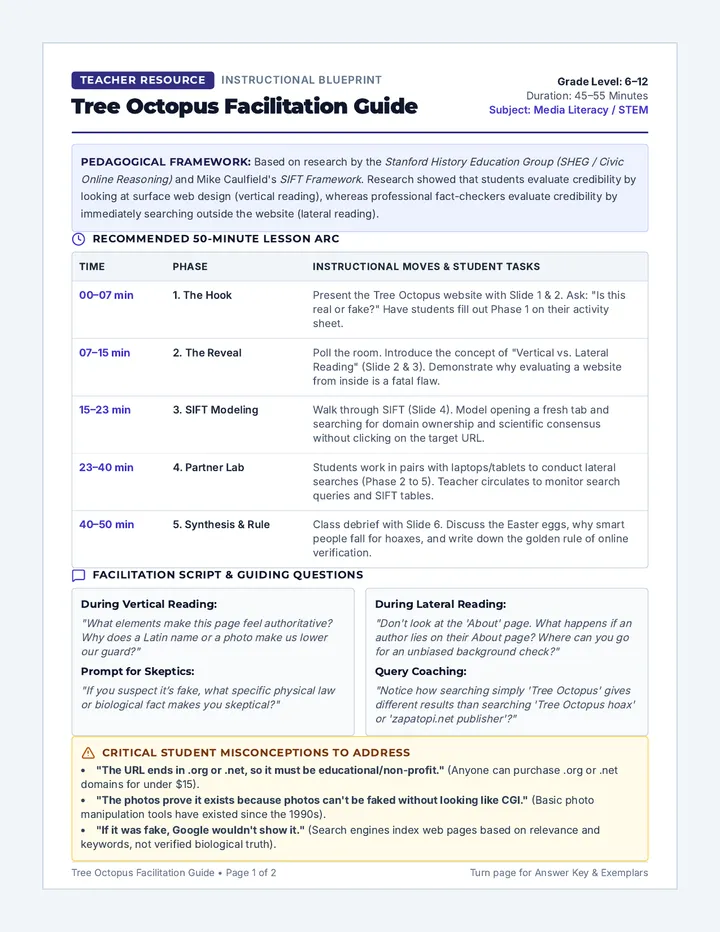
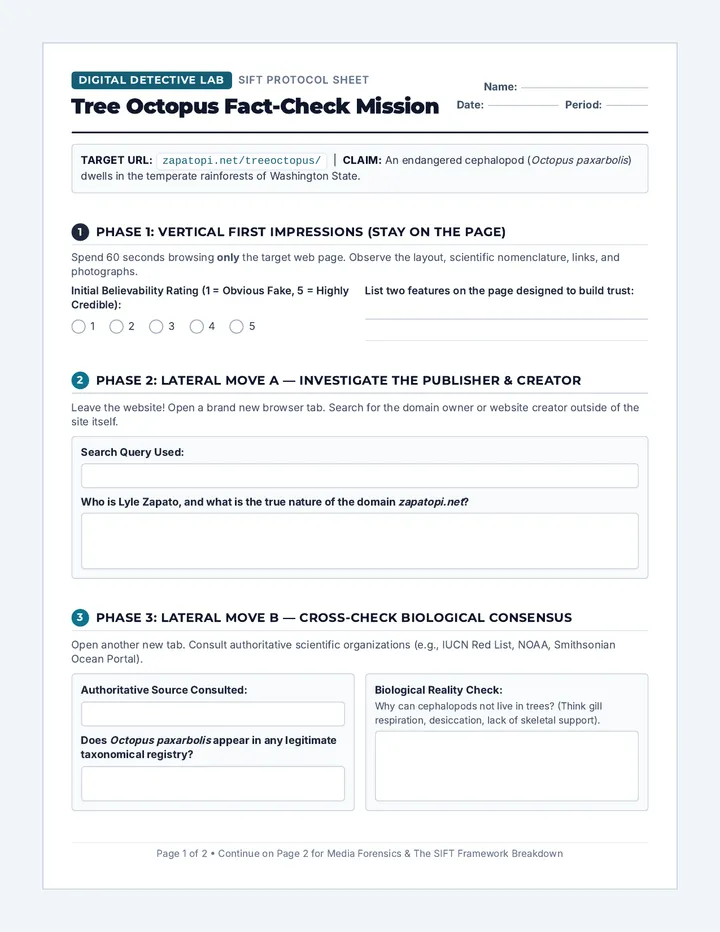
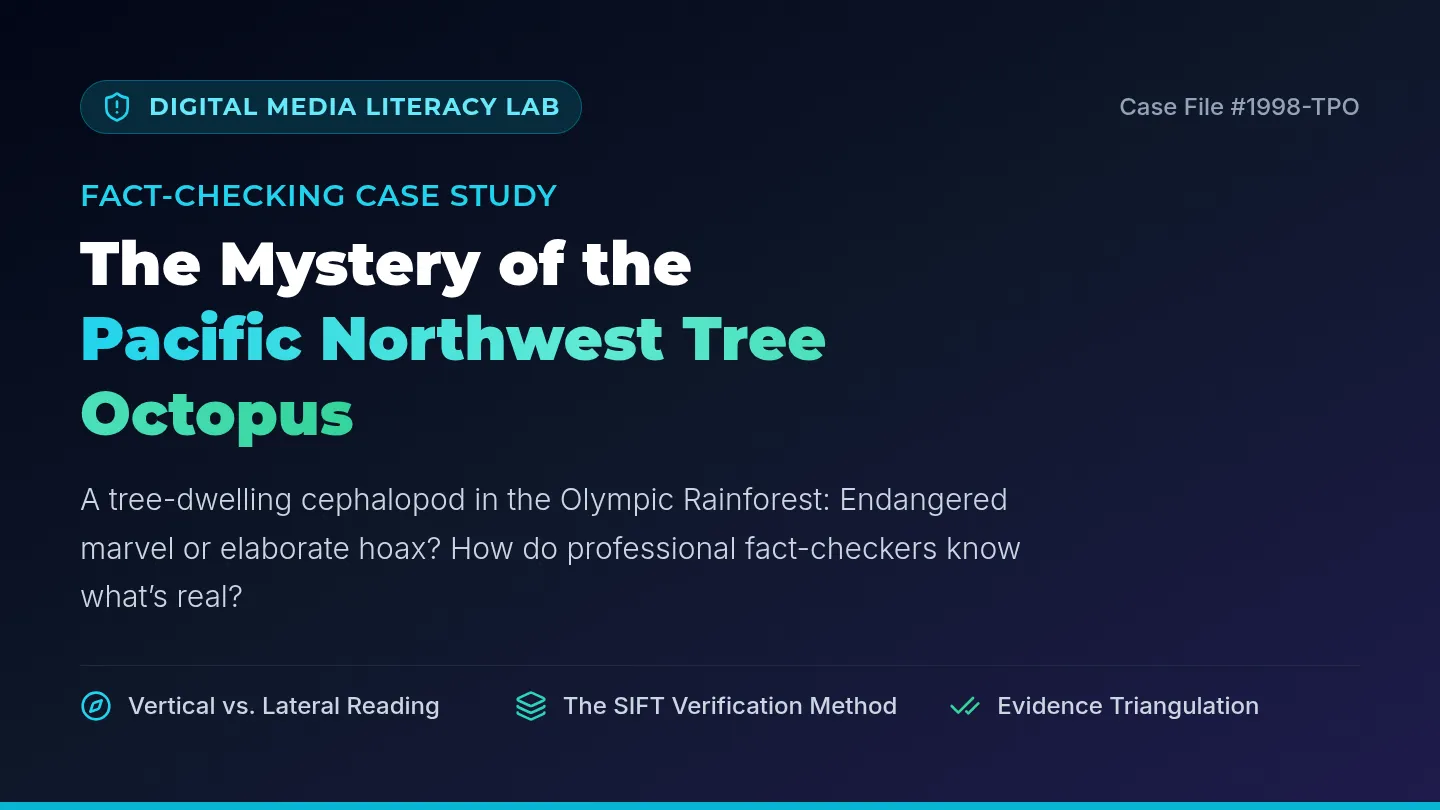
A hands-on digital media literacy lesson teaching students the essential skill of lateral reading using the famous Pacific Northwest Tree Octopus hoax. Students learn to step outside unfamiliar web pages to evaluate source credibility, cross-reference scientific claims, and spot digital misinformation.
The Stanford Study showed that over 80% of middle and high school students believed this website was real. Why was it so effective, and what is your personal rule for evaluating websites going forward?
Investigation Complete • Digital Media Literacy Lab Verification Status: [ COMPLETE ]
"The photos prove it exists because photos can't be faked without looking like CGI." (Basic photo manipulation tools have existed since the 1990s).
"If it was fake, Google wouldn't show it." (Search engines index web pages based on relevance and keywords, not verified biological truth).
Tree Octopus Facilitation Guide • Page 1 of 2 Turn page for Answer Key & Exemplars
Answer Key Tree Octopus Fact Check Activity — Exemplar Key
Phase 1 Surface Features: Latin taxonomy (Octopus paxarbolis), detailed habitat descriptions, links to legitimate environmental organizations (Greenpeace, WWF), copyrighted footer, structured navigation bar.
Phase 2 Search Queries:"Lyle Zapato", zapatopi.net hoax, or zapatopi wikipedia.
Phase 2 Findings: Lyle Zapato is an American humorist and web satirist who created the website in 1998 as an early internet hoax. The site also features humorous parodies like Mind-Control Tin Foil Helmets (AFDB) and Bigfoot conspiracy theories. Zapato is not a biologist.
Phase 3 Exemplar (Biological Consensus) Phase 3
Sources Consulted: IUCN Red List of Threatened Species, NOAA Fisheries, Smithsonian National Museum of Natural History, World Register of Marine Species (WoRMS).
Taxonomical Registry:Octopus paxarbolis does not appear in any peer-reviewed biological database.
Biological Reality: Octopuses are cephalopod mollusks that extract dissolved oxygen through gills (ctenidia). Gills collapse and desiccate rapidly outside of water, leading to suffocation. Additionally, cephalopods lack a rigid skeletal structure; on land, gravity collapses their mantle and organs.
Image Forensics: The images are low-resolution photos of rubber toy octopuses or real marine octopuses digitally superimposed onto branches using early digital editing software (uneven lighting, pixelated borders, unnatural tentacle posture on bark).
Satirical Easter Eggs (Any two):
Sasquatch listed as the primary natural predator of the tree octopus.
Harvesting tree octopuses to produce decorative ornamental "tentacle hats."
Instructions to support the octopus by putting water dishes in backyard trees.
Links to the "People's Republic of Rockall" and mind-control helmet technology.
Phase 5 Exemplar (The SIFT Table)
[S] STOP Notice extraordinary claim: an aquatic animal living in trees should trigger skepticism.
[I] INVESTIGATE Look up Lyle Zapato on external sites; discover he is a satirist and humor writer.
[F] FIND COVERAGE Consult Snopes, Wikipedia, or news articles confirming the site is a famous internet hoax.
[T] TRACE CLAIMS Trace photo origins back to 1998 Photoshop experiments and rubber toy models.
Real-World Transfer & Extension Activities:
The Golden Takeaway:"Credibility is judged by consensus outside the webpage, never by aesthetics inside the webpage."
Next Practice Challenges: Challenge students to investigate "Dihydrogen Monoxide Research Division" (dhmo.org) or "Buy Dehydrated Water Online" using their new lateral reading protocol.
Tree Octopus Facilitation Guide • Page 2 of 2 Civic Online Reasoning Standards Aligned
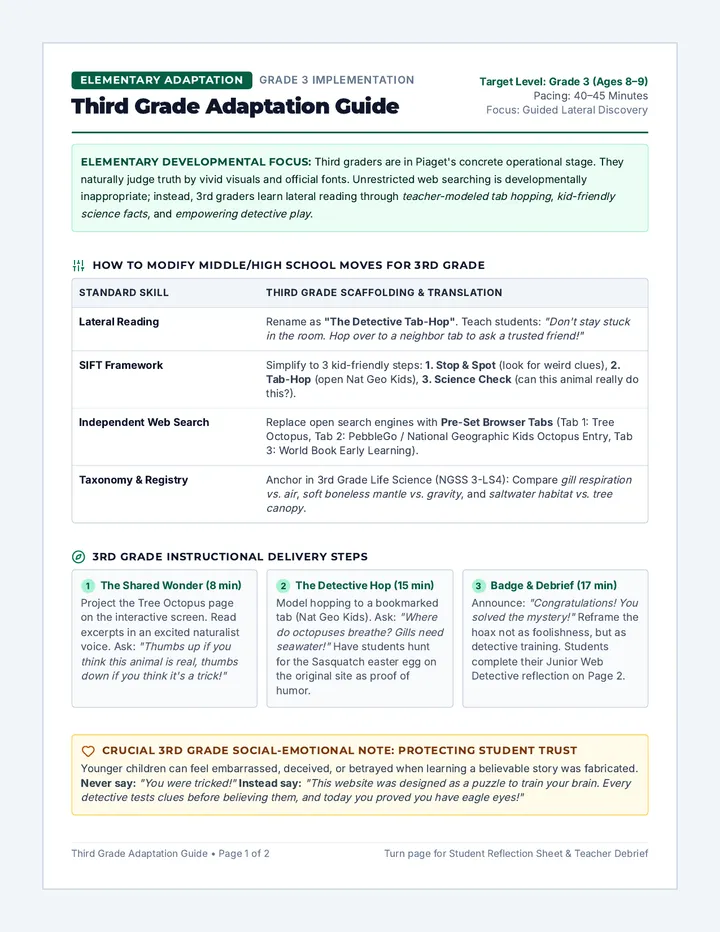
Never say:
"You were tricked!"
Instead say:
"This website was designed as a puzzle to train your brain. Every detective tests clues before believing them, and today you proved you have eagle eyes!"
Third Grade Adaptation Guide • Page 1 of 2 Turn page for Student Reflection Sheet & Teacher Debrief
Junior Web Detective Reflection
My Investigation of the Pacific Northwest Tree Octopus
Name:
Date:
1. When our class first looked at the pictures and the website, what did you think?
2. What was the #1 science clue that helped you realize octopuses cannot live in trees?
3. My Detective Promise for the Internet:
Before I believe a wild animal story or strange picture online, I will:
How confident are you at tab-hopping to check facts?
🌱 Still Learning
🔍 Good Detective
⭐ Master Detective
Circle your detective level!
T
Teacher Post-Lesson Reflection Protocol
Use these reflective questions during your post-lesson review to assess student media literacy growth and inform future digital research lessons:
1. Visual Vulnerability
What percentage of students relied purely on the photos to validate the claim? Did students notice unnatural photo lighting or pixel edges without prompting?
2. The "Tab-Hop" Habit
When prompted to verify, did students immediately look for another tab/book, or did they scroll further down the original page? How readily did they grasp looking sideways?
3. Transfer of Skepticism
In subsequent science or reading units, do students ask: "Can we check another source?" Look for unprompted lateral inquiry during library and computer lab periods.
Key Takeaway for Elementary Educators: Digital literacy at age 8 is not about cynical disbelief; it is about cultivating healthy curiosity and knowing where to verify.
Third Grade Adaptation Guide • Page 2 of 2 Elementary Civic Online Reasoning Integration