Cocoa Craze Slides
Culinary Literacy Lab
Procedural Reading
Mastering Procedural Texts
The Science of
Chocolate Recipes
Unlock culinary instructions by mastering imperative verbs, precision measurements, and sequencing signals.
3 Key Recipe Parts
Action Verbs in Action
Sequencing Clues
Recipe Architecture
Part 1: The Structure
The 3 Essential Recipe Building Blocks
Every successful recipe is organized into three distinct, non-negotiable sections:
Block 1
Header & Yield
States prep time, cook time, temperature, and total servings (yield).
Answers: "How much & how long?"
Crucial
Block 2
Ingredients List
Lists exact quantities and prep states (e.g., "sifted cocoa").
Answers: "What do I need?"
Block 3
Numbered Method
Sequential instructions ordered chronologically step-by-step.
Answers: "How do I make it?"
Pro Chef Rule: Always read through all 3 sections before touching any ingredient!
Culinary Vocabulary
Part 2: Command Words
Imperative Verbs: The "Bossy" Words
Recipes use imperative verbs (commands) at the start of each step. Each verb requires a specific technique:
WHISK
(verb)
Beat rapidly with a wire whisk or fork to incorporate air and eliminate lumps.
Example: "Whisk the dry cocoa, flour, and sugar."
FOLD
(verb)
Gently turn ingredients over using a spatula to blend without deflating air.
Example: "Gently fold in the chocolate chips."
MELT
(verb)
Apply gentle heat to turn solid butter or chocolate into a smooth liquid.
Example: "Melt the dark chocolate over low heat."
SIFT
(verb)
Pass dry powder through a mesh strainer to separate clumps and aerate.
Example: "Sift cocoa powder to remove dense clumps."
Notice: Imperative verbs never start with "You should" or "Please". Direct command = Clear instruction
Order Matters
Part 3: Chronology
Sequence Signal Words Guide Your Path
In baking chemistry, order is everything. Transition words signal exact timing and priority:
1
FIRST
Prep stations, preheat oven, and measure dry ingredients.
2
NEXT
Blend wet ingredients into a smooth, liquid base.
3
MEANWHILE
Melt chocolate or line pans while batter rests.
4
THEN
Combine both mixtures and pour into baking dish.
5
FINALLY
Cool completely, slice into portions, and serve.
What happens if steps are reversed? Adding hot liquid onto unmixed baking powder can cause the cake to sink in the center!
Featured Walkthrough
Prep: 3 min Cook: 70 sec Yield: 1 mug
Quick Single-Serve
Molten Lava Mug Cake
Notice how the ingredients list specifies exact units of measurement (tablespoons) and physical properties (melted, unsweetened).
Abbreviations: tbsp = tablespoon, tsp = teaspoon
Ingredients & Equipment Checklist
3 tbsp all-purpose flour
2 tbsp granulated sugar
1 tbsp unsweetened cocoa
1/4 tsp baking powder
3 tbsp whole milk
1 tbsp melted butter
1 tbsp mini chocolate chips
1 microwave-safe mug (12 oz)
Question: What would happen if you used a 6 oz mug instead of a 12 oz mug? Batter would overflow!
Method Analysis
Following the Steps
Analyzing the 4 Preparation Steps
1
First, whisk the flour, sugar, cocoa powder, and baking powder together inside the ceramic mug until uniform.
Action: Whisk dry
2
Next, pour in the milk and melted butter. Stir with a small fork until no dry pockets remain.
Action: Pour & stir
3
Then, drop the chocolate chips directly into the center of the batter without stirring.
Action: Drop center
4
Finally, microwave on high for 70 seconds. Rest for 2 minutes before enjoying.
Action: Heat & rest
Look closely at Step 3: Why should you not stir the chips in? To create the molten center!
Classroom Check
Chef's Inspection
Chef's Spot-the-Detail Challenge
Test your recipe reading comprehension with these three quick questions:
Q1
Ingredient Detail
What specific condition must the butter be in before adding it to the mug?
Clue: Check Step 2 & ingredients list!
Q2
Sequence Impact
Why must you whisk dry ingredients before adding the milk and butter?
Clue: Think about powder lumps!
Q3
Patience & Safety
What does the final step instruct you to do for 2 minutes after microwaving?
Clue: Temperature safety & texture!
Next Up: Independent Recipe Reading Worksheet!
Grab your pencils & recipe detective hats
Cocoa Recipe Worksheet
Student Name:
Date:
Period:
Score: / 25
Reading Procedural Texts: The Midnight Brownie
Read the recipe carefully, paying close attention to measurements, action verbs, and sequence words.
Page 1 of 2
Featured Recipe
Midnight Fudgy Cocoa Brownie Bites
Yield: 16 squares Prep: 15 min Bake: 22 min @ 350°F
Ingredients List
- • 1/2 cup unsalted butter
- • 2 large eggs (room temp)
- • 6 oz bittersweet chocolate
- • 1 tsp vanilla extract
- • 3/4 cup granulated sugar
- • 1/3 cup all-purpose flour
- • 1/4 cup unsweetened cocoa
- • 1/4 tsp fine sea salt
Kitchen Equipment
- • 8×8-inch metal baking pan
- • Parchment paper (2-in overhang)
- • Heatproof bowl & saucepan
- • Wire whisk & rubber spatula
Method & Preparation Steps
Step 1: Preheat oven to 350°F (175°C). Line an 8×8 metal pan with parchment paper, leaving a 2-inch overhang on opposite sides.
Step 2: Combine butter and chopped chocolate in heatproof bowl over simmering water. Melt gently, stirring until glossy. Cool for 5 minutes.
Step 3: In a separate bowl, whisk eggs, sugar, and vanilla vigorously for 2 full minutes until pale, thick, and frothy.
Step 4: Pour cooled chocolate mixture into egg mixture in a steady stream. Whisk slowly until completely incorporated.
Step 5: Sift flour, cocoa, and salt directly over wet batter. Using a spatula, gently fold until dry streaks disappear. Do not overmix!
Step 6: Spread batter into prepared pan. Bake for 20–22 minutes until a toothpick inserted in center comes out with moist crumbs. Cool before slicing.
A Part 1: Culinary Action Verbs Matching
Match each term to its exact definition (4 pts)
1. Fold (Step 5)
2. Sift (Step 5)
3. Simmer (Step 2)
4. Incorporate (Step 4)
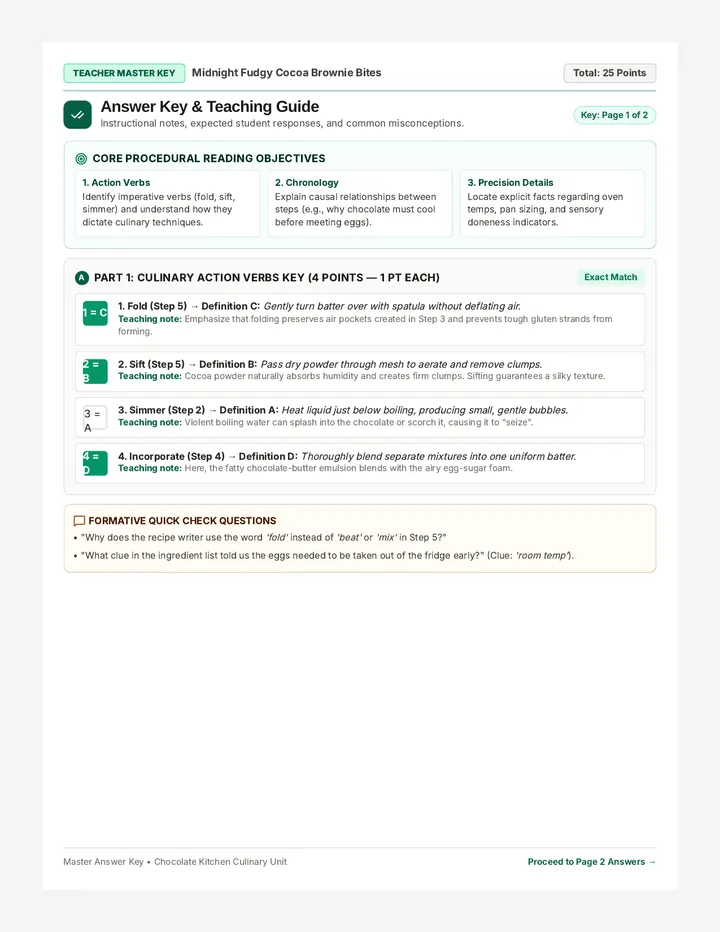
Cocoa Recipe Answer Key
Teacher Master Key Midnight Fudgy Cocoa Brownie Bites
Total: 25 Points
Answer Key & Teaching Guide
Instructional notes, expected student responses, and common misconceptions.
Key: Page 1 of 2
Core Procedural Reading Objectives
1. Action Verbs Identify imperative verbs (fold, sift, simmer) and understand how they dictate culinary techniques.
2. Chronology Explain causal relationships between steps (e.g., why chocolate must cool before meeting eggs).
3. Precision Details Locate explicit facts regarding oven temps, pan sizing, and sensory doneness indicators.
A Part 1: Culinary Action Verbs Key (4 Points — 1 pt each)
Exact Match
1 = C
1. Fold (Step 5) → Definition C: Gently turn batter over with spatula without deflating air.
Teaching note: Emphasize that folding preserves air pockets created in Step 3 and prevents tough gluten strands from forming.
2 = B
2. Sift (Step 5) → Definition B: Pass dry powder through mesh to aerate and remove clumps.
Teaching note: Cocoa powder naturally absorbs humidity and creates firm clumps. Sifting guarantees a silky texture.
3 = A
3. Simmer (Step 2) → Definition A: Heat liquid just below boiling, producing small, gentle bubbles.
Teaching note: Violent boiling water can splash into the chocolate or scorch it, causing it to "seize".
4 = D
4. Incorporate (Step 4) → Definition D: Thoroughly blend separate mixtures into one uniform batter.
Teaching note: Here, the fatty chocolate-butter emulsion blends with the airy egg-sugar foam.
Formative Quick Check Questions
- • "Why does the recipe writer use the word 'fold' instead of 'beat' or 'mix' in Step 5?"
- • "What clue in the ingredient list told us the eggs needed to be taken out of the fridge early?" (Clue: 'room temp').
Master Answer Key • Chocolate Kitchen Culinary Unit Proceed to Page 2 Answers →
Teacher Master Key Sections B, C, and D Solutions
Key: Page 2 of 2
B Part 2: Chronological Sequence Solutions (5 pts order + 2 pts analysis)
Exact Order
Order: 4 Sift dry ingredients