Northeastern Tribes Worksheet
Social Studies • 5th Grade
Northeastern Tribes
Studies Weekly: Northeast Woodlands Tribes (Iroquois & Wampanoag)
Name:
Date:
Directions: Read Article 2 of your Week 6 Studies Weekly on Northeast Tribes. Use what you learned about the Iroquois (Haudenosaunee) and Wampanoag to fill out this graphic organizer. Be descriptive and write in complete sentences!
1. Tribal Homeland
Where did the Northeast Woodlands tribes (like the Iroquois and Wampanoag) live?
2. The Environment
What was the physical land like in this region, and how did they adapt to it?
3. Traditional Housing
What types of houses did they build? Mention longhouses and wigwams!
4. Community & Daily Life
What was daily life like for men, women, and children within their clans?
Northeast Woodlands Research Guide
Page 1 of 2
Social Studies • 5th Grade
Northeastern Tribes
Graphic Organizer (Continued)
5. Growing the Three Sisters
What foods did they grow? Describe the planting relationship of the 3 main crops.
6. Diet & Sustenance
What did they eat in addition to crops? How did they hunt, fish, or forage?
7. Resource Mastery
How did they use natural resources (trees, stone, birch bark, waterways, animals) to build tools, canoes, clothing, or wampum?
Think Like a Historian (Synthesis)
How did the natural environment of the Northeast Woodlands directly shape the everyday lifestyle and survival strategies of the Haudenosaunee and Wampanoag?
Northeast Woodlands Research Guide
Page 2 of 2
Northeastern Tribes Answer Key
Teacher Resource • Answer Key
Northeastern Tribes
Studies Weekly: Northeast Woodlands Tribes (Iroquois & Wampanoag)
TEACHER REFERENCE Grade 5 Social Studies
Grading Note: The sample responses provided below in blue ink style represent high-scoring student answers. Student responses may vary but should capture these core historical facts.
1. Tribal Homeland
Where did the Northeast Woodlands tribes (like the Iroquois and Wampanoag) live?
They lived in the northeastern region of North America.
This territory stretched from the Atlantic Ocean coast inland toward the Great Lakes, covering areas of modern-day New York, Pennsylvania, and New England.
2. The Environment
What was the physical land like in this region, and how did they adapt to it?
The landscape featured thick deciduous and evergreen forests, rolling hills, rivers, streams, and lakes.
They adapted by using wood/bark for shelter, navigating rivers with lightweight canoes, and clearing forest patches to farm.
3. Traditional Housing
What types of houses did they build? Mention longhouses and wigwams!
Iroquois: Built large, bark-covered wooden longhouses for up to 20 related families.
Wampanoag: Built smaller, dome-shaped wigwams from bent saplings covered with bark or woven mats, perfect for single families.
4. Community & Daily Life
What was daily life like for men, women, and children within their clans?
Communities were organized around clans. Iroquois society was matrilineal: Clan Mothers held immense power, choosing tribal chiefs.
Women managed agriculture and the village. Men hunted, fished, and protected communities. Children helped and learned from Elders.
Northeast Woodlands Reference Guide (Teacher Edition)
Page 1 of 2
Teacher Resource • Answer Key
Northeastern Tribes
Graphic Organizer Answer Key
5. Growing the Three Sisters
What foods did they grow? Describe the planting relationship of the 3 main crops.
They grew corn, beans, and squash (the "Three Sisters").
They planted them together: tall cornstalks supported climbing beans; beans enriched the soil with nitrogen; and large squash leaves shaded weeds and kept soil moist.
6. Diet & Sustenance
What did they eat in addition to crops? How did they hunt, fish, or forage?
They hunted forest animals (deer, bear, wild turkey) using bows/arrows.
They caught fish in lakes and streams with spears, nets, and traps. They gathered berries, walnuts, maple sap (for syrup), and edible roots from the forests.
7. Resource Mastery
How did they use natural resources (trees, stone, birch bark, waterways, animals) to build tools, canoes, clothing, or wampum?
Wood/bark made homes and lightweight, sturdy birch-bark canoes. Animal hides were cured for moccasins and warm clothing. Stone, wood, and deer antlers became farming tools, axes, and arrowheads.
Clam shells were carefully carved into purple and white wampum beads for records and treaties.
Think Like a Historian (Synthesis)
How did the natural environment of the Northeast Woodlands directly shape the everyday lifestyle and survival strategies of the Haudenosaunee and Wampanoag?
The environment defined their entire existence. Dense forests provided wood and bark for longhouses, wigwams, and canoes, which made deep-water travel possible.
Rich soil and rainfall allowed successful companion farming (Three Sisters), ensuring stable communities, while rivers and wild animals provided fish, game, and raw materials for essential tools.
Northeast Woodlands Reference Guide (Teacher Edition)
Page 2 of 2
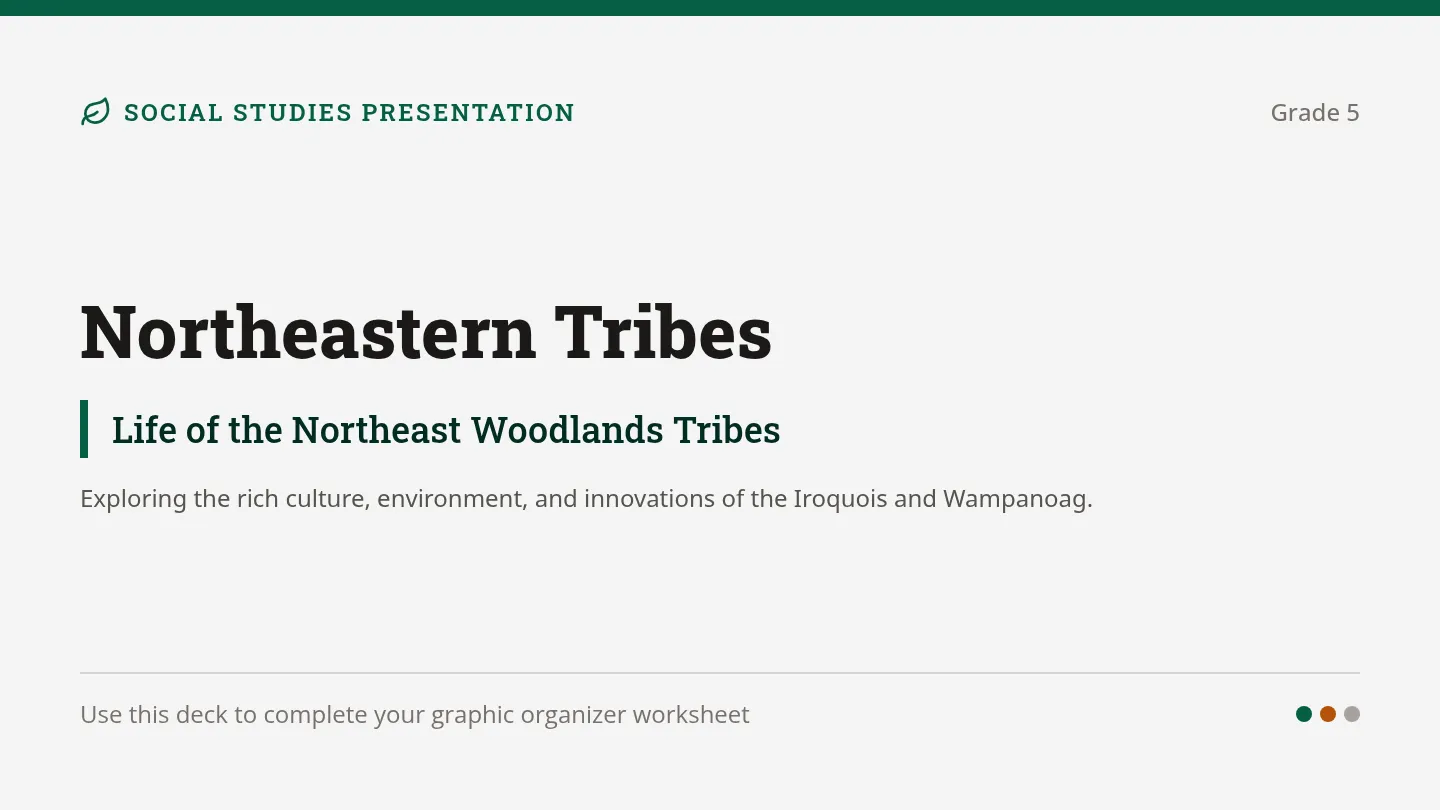
Northeastern Tribes Slides
Social Studies Presentation
Grade 5
Northeastern Tribes
Life of the Northeast Woodlands Tribes
Exploring the rich culture, environment, and innovations of the Iroquois and Wampanoag.
Use this deck to complete your graphic organizer worksheet
Homeland & Landscape
Geography
Where Did They Live?
- The Region: Northeast North America (Atlantic coast to the Great Lakes).
- Modern States: New York, Pennsylvania, and New England.
- The Environment: Dense deciduous and evergreen forests, rolling hills, rivers, and lakes.
Adapting to the Forest
The thick forests provided endless wood and bark for homes and tools, while rivers were natural highways for travel, trade, and fishing.
Northeast Woodlands Tribes Slide 2
Traditional Housing
Shelter
The Iroquois Longhouse
Large, permanent wooden-frame structures covered with thick sheets of bark. Up to 100 feet long!
🏡 Housed up to 20 related families.
The Wampanoag Wigwam
Smaller, dome-shaped houses. Built from flexible saplings bent into frames and covered with bark or woven grass mats.
⛺ Designed for single-family living.
Northeast Woodlands Tribes Slide 3
Growing the Three Sisters
Agriculture
🌽
Corn (The Support)
Grew tall and strong, acting as a natural trellis or pole for the bean vines to climb toward the sunlight.
🌱
Beans (The Nourisher)
Climbed up the cornstalks and absorbed nitrogen from the air, sending it into the soil to feed the other plants.
🎃
Squash (The Protector)
Sprawled across the ground. Its huge leaves shaded the soil, stopping weeds and trapping moisture in the earth.
Northeast Woodlands Tribes Slide 4
Diet & Resource Mastery
Survival
What Else Did They Eat & Use?
- Hunting: Bows and arrows were used to hunt deer, black bear, rabbit, and wild turkey.
- Fishing: Catching fish and gathering clams/shellfish from lakes, coastal waters, and streams.
- Foraging: Gathering forest berries, walnuts, maple sap (for syrup), and wild greens.
Material Magic