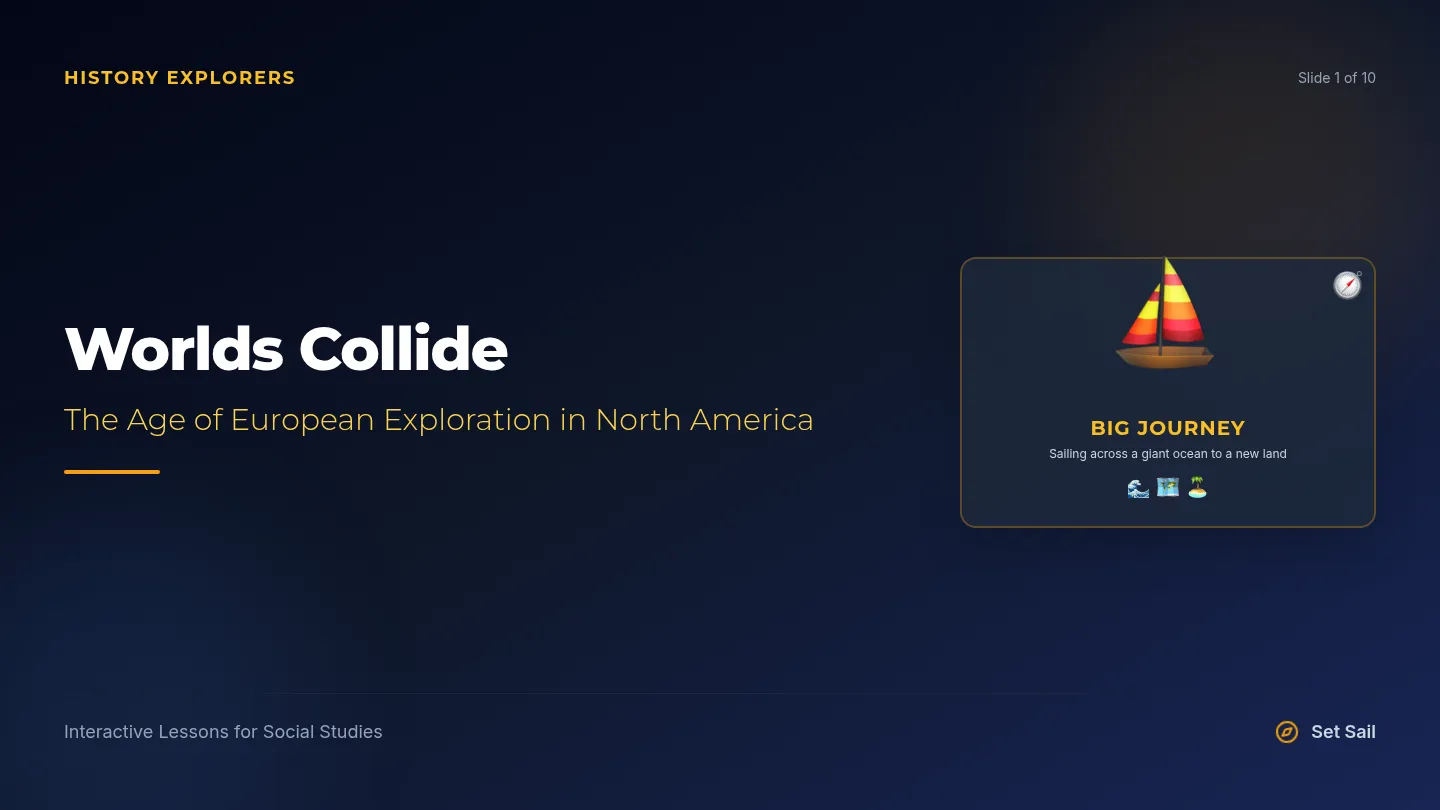
Colliding Worlds Slides
History Inquiry
Grade 5 • Chapter 3
Cultural & Biological Encounters
Colliding Worlds
The complex, life-changing impacts of European exploration and colonization on Native American societies.
How did the meeting of two worlds reshape human history?
Begin Presentation
Inquiry Framework
Slide 2 / 10
The Big Question
"When two cultures meet with completely different ways of life, technologies, and environments, what happens next?"
Turn & Talk: What do you already know about how Native Americans lived before Europeans arrived?
Key Vocabulary
Columbian Exchange
The transfer of plants, animals, culture, and diseases between the Old and New Worlds.
Alliance
An agreement or partnership between two groups to work together, especially in trade or war.
Assimilation
The process where one culture is forced or chooses to adopt the customs and beliefs of another.
Every encounter brings both opportunities and conflicts.
COLLIDING WORLDS
The Columbian Exchange
Slide 3 / 10
The Food and Animal Swap
For thousands of years, ecosystems developed in complete isolation. Exploration linked them overnight.
Europe & Asia → Americas
Items brought by European explorers and settlers:
🐎 Horses
🐂 Cattle & Pigs
🌾 Wheat & Rice
🍌 Bananas
Impact: Horses transformed Native societies on the Great Plains, dramatically changing hunting and travel.
Americas → Europe & Asia
Native agricultural masterworks shipped east:
🌽 Corn (Maize)
🥔 Potatoes
🍅 Tomatoes
🍫 Cacao (Chocolate)
Impact: Native American crops like potatoes and corn ignited a massive population boom across Europe and Asia.
How did these new resources change everyday life for both groups?
BIOLOGICAL TRANSFER
The Biological Impact
Slide 4 / 10
The Unintended Tragedy
The Silent Invaders: Microbes and Devastation
The most destructive passenger on European ships wasn't weapons or soldiers—it was germs. Because Native Americans had never been exposed to European diseases, they had no natural immunity.
Devastating Loss of Life:
Historians estimate that up to 90% of the indigenous population in some areas was wiped out by diseases like smallpox, measles, and influenza within a century.
Why was it so destructive?
- Lack of Immunity: No historic exposure to urban European pathogens.
- Social Chaos: Whole communities became sick at once, leaving no one to farm, hunt, or care for the ill.
- Loss of Leadership: Chiefs, elders, healers, and oral historians passed away, disrupting political systems.
Reflect: How might losing 90% of its citizens change a community's ability to protect its land?
PATHOGEN PATHWAYS
Displacement & Power
Slide 5 / 10
Land Loss, Labor, and Cultural Assimilation
European ideas about land ownership and social structures differed sharply from indigenous views.
Land Displacement
Native Americans viewed land as a shared resource to be cared for collectively. Europeans believed in individual ownership, boundaries, and fences.
Native groups were steadily pushed off ancestral hunting grounds to make way for farming colonies.
Forced Labor Systems
In South and Central America, and later parts of North America, European conquerors created systems like the Encomienda, forcing Native people to work in dangerous silver mines and sugar plantations.
Harsh, enslaving conditions devastated local environments and communities.
Cultural Pressure
European monarchs and missionaries believed it was their duty to "civilize" Native Americans. This meant replacing traditional religions with Christianity, forbidding indigenous ceremonies, and reshaping native lifestyles.
Many Native communities resisted, keeping their languages and customs alive in secret.
How did contrasting views of "ownership" lead to deep-seated conflicts?
CONQUEST AND RESISTANCE
Trade networks
Slide 6 / 10
Trade, Technology & Alliances
The interaction was not just conflict—it was also highly cooperative. Both European merchants and Native nations found ways to benefit from one another through complex trade and strategic defense agreements.
"Both sides adapted to survive. Native Americans quickly mastered European goods, while Europeans depended entirely on Native guidance to traverse the continent."
🦫
The Fur Trade
European traders (especially the French) partnered with Native hunters like the Huron and Algonquin. Beaver pelts were shipped to Europe to make fashionable hats, making trade highly lucrative.
🪓
New Technology
Native Americans traded furs for revolutionary tools: iron axes, brass cooking kettles, woven wool blankets, and firearms (muskets). These replaced traditional bone, stone, and clay tools.
🤝
Political & Military Alliances
Powerful alliances formed, such as the French with the Huron, and the Dutch/English with the Haudenosaunee (Iroquois) Confederacy. Native nations used these alliances to gain advantages over rival tribes, while European powers used them to secure land boundaries.
Turn & Talk: How did trading for iron tools change a Native craftsperson's daily workload?
INTERDEPENDENT ALLIANCES
Primary Source Analysis
Slide 7 / 10
Voices from the Past
A Haudenosaunee Chief Reflects on Trade
“
"Before you came, we had only stone axes and clay pots, which broke easily. Now, we hunt beaver, sell them to you, and buy guns, steel traps, and brass kettles. But we also see our people dying from diseases we never knew, and we wonder if this trade is a blessing or a curse."
— Adapted from historical council notes, circa 1700
Guided Analysis
- Perspective: Who is speaking in this quote, and what is their role?
- Double Impact: Identify one positive development and one negative consequence mentioned in the passage.
- The Dilemma: Why does the speaker call the exchange both "a blessing or a curse"?
How do we weigh the benefits of new technology against devastating losses?
CRITICAL LITERACY
Student Activity
Slide 8 / 10
Organizer Preparation
Your Turn: Mapping the Impacts
It's time to organize what you've learned on your physical Colliding Worlds Organizer. Grouping details helps historians spot trends.
Get Ready to Write:
Ensure you have a pencil and your two-sided worksheet ready as we review the categories together.
Worksheet Roadmap:
1
The Biological Swap (The Columbian Exchange)
List 3 positive resources and the deadly diseases transferred.
2
Culture & Land Loss
Note how land was displaced and why cultural assimilation was forced.
3
Trade & Alliances
Highlight how beaver pelt trading and steel weapon exchange created alliances.
Synthesizing multiple perspectives is key to historical empathy.
ORGANIZING EVIDENCE
Formative Review
Slide 9 / 10
Quick Quiz Showdown
Let's test our historical detective skills together!
1
Which item originally came from the Americas to Europe?
A) Horses
B) Wheat
C) Potatoes
D) Smallpox
2
Why did European diseases decimate Native populations?
A) No clean water
B) No natural immunity
C) Lack of doctors
D) Warmer climates
3
Which animal changed hunting on the Great Plains?
A) Horse
B) Pig
C) Sheep
D) Cow
4
What fur was highly valued in trade alliances?
A) Deer
B) Squirrel
C) Beaver
D) Bear
Tip: Think about how materials, diseases, and alliances interacted with each other.
CONCEPTUAL CHECK
Reflection
Slide 10 / 10
History's Complex Mirror
The history of exploration isn't a simple tale of "heroes and villains" or "winners and losers." It is a web of deep cultural adjustments, life-altering agreements, and horrific tragedies.
As students of history, your job is to examine multiple perspectives to construct a balanced understanding.
Exit Ticket Prompt
On your organizer worksheet, complete the final section with your written paragraph:
"Summarize the dual legacy of the Columbian Exchange. How did it both save and destroy lives at the exact same time?"
Be sure to use at least two specific pieces of evidence from today's slides or quotes.
Thank you for participating with focus and historical curiosity!
END OF LESSON
Colliding Worlds Organizer
5th Grade Social Studies Inquiry
Colliding Worlds Organizer
UNIT 3: ENCOUNTERS
Student Note-Taking Guide
NAME:
DATE:
CLASS PERIOD:
1. The Biological Swap (The Columbian Exchange)
Based on the slide presentation, list the critical biological resources that crossed oceans and summarize their impact.
Europe/Asia → Americas
List 3 crops, livestock, or materials:
How did horses change native life?
Americas → Europe/Asia
List 3 indigenous crops exported east:
Why did European populations spike?
The Silent Invaders (Disease and Population Devastation)
Why did European diseases have such an immediate, tragic impact on Native American societies? Highlight at least two distinct reasons discussed in class (immunity, labor, or social disruption).
2. Territorial & Cultural Displacement
Explain how differences in values led to territorial loss, forced labor, and assimilation efforts.
Contrasting Views on Land
Native American Viewpoint:
European Colonist Viewpoint:
Assimilation and Forced Labor
Describe the purpose of European missionaries or the Encomienda:
How did Native groups resist cultural erosion?
COLLIDING WORLDS STUDENT ORGANIZER PAGE 1 OF 2
Part II: Cooperation & Critical Analysis
Student Worksheet • Page 2
3. Trade Networks & Strategic Alliances
Cooperation was critical for both survival and control. Record key dimensions of interactions.
🦫 The Fur Trade
Who traded what with whom? What was the primary motivation?
🪓 New Technologies
Name 3 items traded to Native groups and how they modified daily tasks:
🤝 Strategic Alliances
Why did European powers and Native nations build alliances?
4. Primary Source Inquiry
Source: Adapted from a Haudenosaunee (Iroquois) Council Record (circa 1700)
"Before you came, we had only stone axes and clay pots, which broke easily. Now, we hunt beaver, sell them to you, and buy guns, steel traps, and brass kettles. But we also see our people dying from diseases we never knew, and we wonder if this trade is a blessing or a curse."
Question A (Dual Impact): What are the specific positive assets and negative consequences mentioned by the Chief?
Question B (The Dilemma): Explain in your own words why this trade represents a "blessing or a curse."
5. Synthesis Exit Ticket Reflection