A high school sociology and literature unit exploring the concept of family through historical shifts, sociological critiques of structural norms, and modern interpersonal networks. Features three leveled reading passages and a comprehensive teacher guide.
Who is excluded when a society defines only the "nuclear family" as normal or natural? Jot down your initial thoughts in the margins.
High School Sociology Curriculum • Unit 3: Kinship Page 1 of 2
Assessment & Synthesis
The Nuclear Myth • Comprehension
Reading Level 2: Standard
A Theoretical Analysis
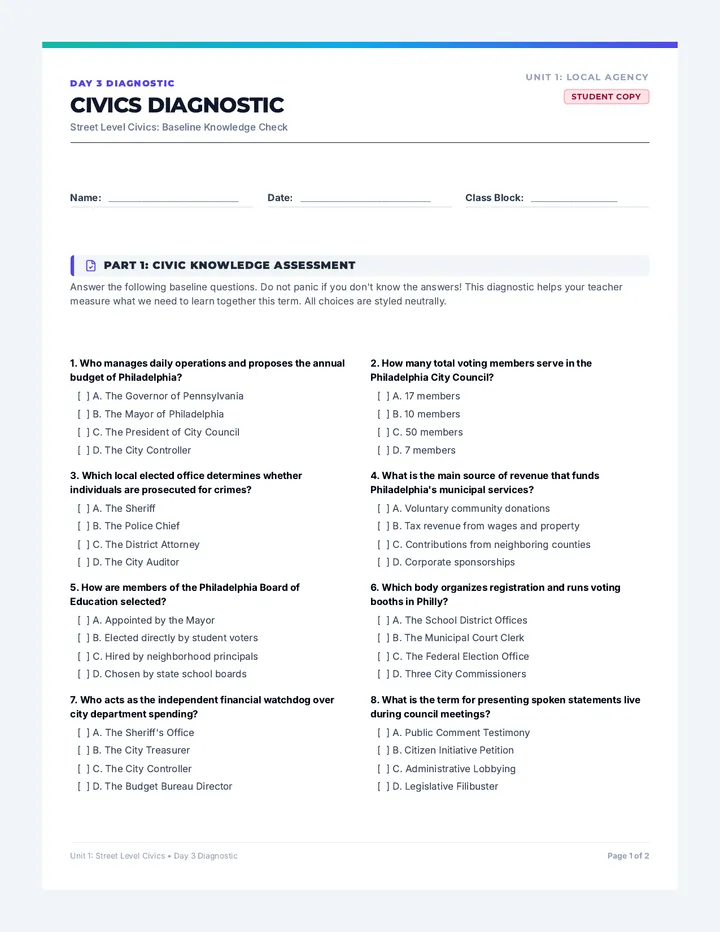
1. Why do sociologists refer to the mid-century suburban nuclear family as an "anomaly" rather than a timeless norm?
A It was only practiced by ancient agrarian groups.
B It relied on highly unusual post-war economic prosperity.
C It completely rejected the concept of marriage.
D It was legally mandated by international trade treaties.
2. Which sociological perspective argues that the traditional division of labor within the nuclear family reproduces systemic gender inequality?
A Structural Functionalism
B Sociobiology
C Conflict Theory
D Rational Choice Theory
B Critical Synthesis & Essay Questions
3. Contrast how a Structural Functionalist and a Conflict Theorist would evaluate a household where one partner does all domestic chores while the other earns the salary.
4. Why does the author argue that the mid-century nuclear model was largely exclusive to white middle-class families? What strategies did other groups use?
High School Sociology Curriculum • Unit 3: Kinship Page 2 of 2
Reciprocal Mutuality: A relationship structure where support, respect, and emotional care are actively exchanged and balanced between equal participants.
Theoretical Nexus
How might a conflict theorist view a legal system that only recognizes biological relationships for medical and heritage decisions?
High School Sociology Curriculum • Unit 3: Kinship Page 1 of 2
Assessment & Synthesis
Beyond Blood • Comprehension
Reading Level 3: Advanced
A Conceptual Analysis
1. According to the passage, how does the structure of "social capital" differ between traditional biological families and voluntaristic families?
A Traditional models pass capital vertically, while voluntaristic models distribute it horizontally.
B Traditional models completely lack capital, while voluntaristic models rely purely on government aid.
C Traditional families rely on horizontal contracts, while chosen families reject emotional ties.
D Voluntaristic models operate strictly through monetary, commercial banking exchanges.
2. Historically, why did marginalized communities like LGBTQ+ and immigrant networks initially pioneer chosen families?
A They wanted to create commercial companies and pool stock market profits.
B They were mimicking upper-class corporate boards and hierarchical structures.
C As a survival mechanism to provide emotional and economic safety nets when excluded by biological families.
D To legally dissolve traditional definitions of tax-free geographic zones.
B Advanced Sociological Synthesis
3. The author states that voluntaristic kinship relies on "reciprocal mutuality rather than genealogical duty." Analyze this distinction. How does an obligation to a chosen family differ from an obligation to a biological family?
4. Identify a conflict between modern structural institutions (e.g., hospital visitation policies, taxation, inheritance laws) and the functional reality of chosen families. Suggest a potential policy solution.
High School Sociology Curriculum • Unit 3: Kinship Page 2 of 2
Passages 1, 2, and 3
Passage 1: Shifting Hearth Key (Introductory)
Multiple Choice: 1. B • 2. C
Q3 (Haven Concept): High-scoring answers will note that "haven in a heartless world" describes the home as an emotional sanctuary, a moral refuge, and a place of absolute safety designed to offer emotional escape from the highly competitive and stressful public sphere of wage labor.
Q4 (Child Value): Students must explain that on farm households, children were vital "economic assets" providing critical crop labor. When machines took over, labor moved to factories, converting children into "priceless emotional assets" valued for affection rather than direct income.
Passage 2: Nuclear Myth Key (Standard)
Multiple Choice: 1. B • 2. C
Q3 (Theoretical Contrast): A Structural Functionalist sees the breadwinner/homemaker division as a positive, balanced system that ensures stability, reduces conflict, and smoothly socializes kids. A Conflict Theorist sees it as a site of patriarchal exploitation that makes women financially dependent and confines them to unpaid, unseen domestic labor.
Q4 (Exclusivity & Adaptations): The mid-century nuclear model required immense post-war wealth, leaving out working-class, immigrant, and minority families. To survive, these excluded groups historically relied on robust, cooperative extended kinship networks to share child care, income, and shelter.
Passage 3: Beyond Blood Key (Advanced)
Multiple Choice: 1. A • 2. C
Q3 (Obligation vs Mutuality): Biological families operate on vertical "genealogical duty" or obligation based on birthright and social expectation. Chosen families operate on "reciprocal mutuality"—an ongoing horizontal exchange where emotional commitment and practical care must be actively co-negotiated, and mutual support is balanced among equals.
Q4 (Structural Inequities): Modern legal, medical, and banking codes deny chosen families standard rights (e.g., intensive care unit visitation, tax exemptions, estate inheritance without a will). Solutions include expanding the legal definition of "next of kin," implementing voluntaristic healthcare proxies, or reforming domestic partnership laws to accommodate broader cooperative arrangements.
High School Sociology Curriculum • Educator Guide Page 2 of 2