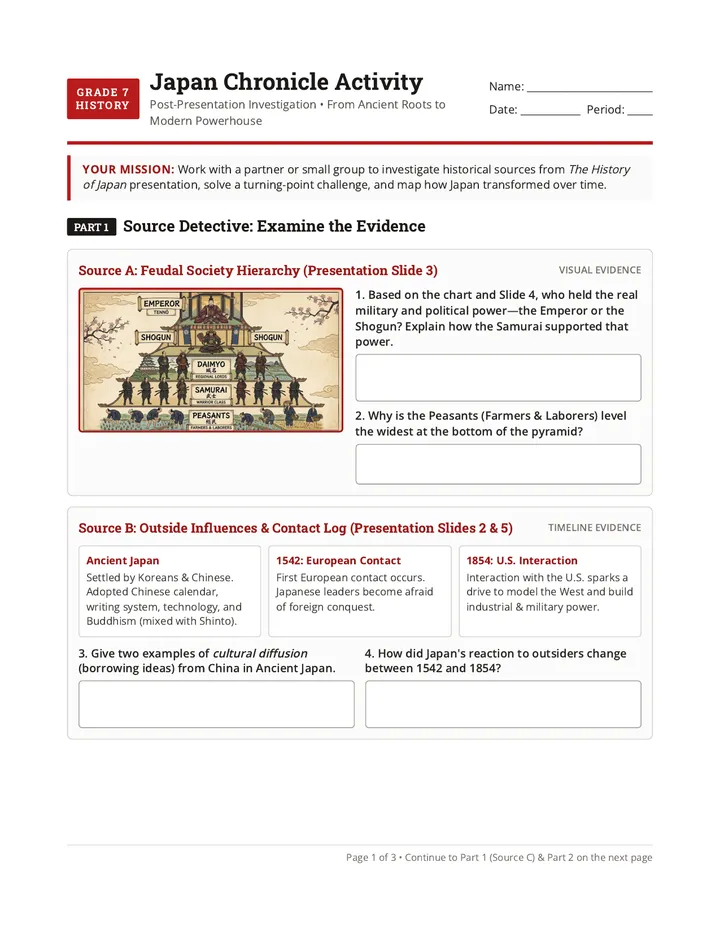
Japan Chronicle Activity
Grade 7
History
Japan Chronicle Activity
Post-Presentation Investigation • From Ancient Roots to Modern Powerhouse
Name: _________________________
Date: ____________ Period: _____
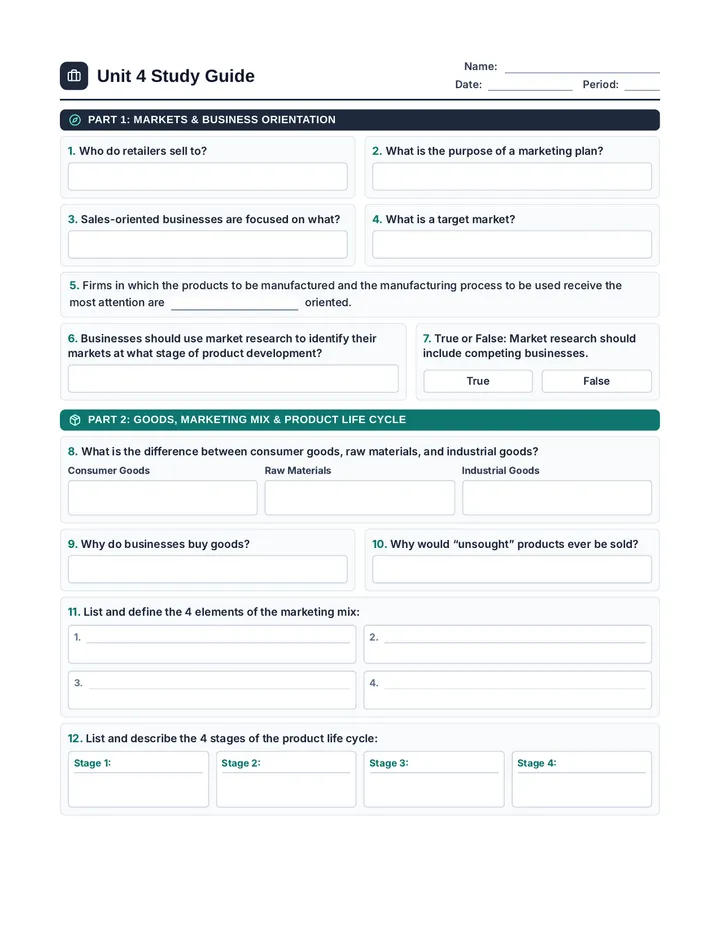
Your Mission: Work with a partner or small group to investigate historical sources from The History of Japan presentation, solve a turning-point challenge, and map how Japan transformed over time.
Part 1
Source Detective: Examine the Evidence
Source A: Feudal Society Hierarchy (Presentation Slide 3)
Visual Evidence

1. Based on the chart and Slide 4, who held the real military and political power—the Emperor or the Shogun? Explain how the Samurai supported that power.
2. Why is the Peasants (Farmers & Laborers) level the widest at the bottom of the pyramid?
Source B: Outside Influences & Contact Log (Presentation Slides 2 & 5)
Timeline Evidence
Ancient Japan
Settled by Koreans & Chinese. Adopted Chinese calendar, writing system, technology, and Buddhism (mixed with Shinto).
1542: European Contact
First European contact occurs. Japanese leaders become afraid of foreign conquest.
1854: U.S. Interaction
Interaction with the U.S. sparks a drive to model the West and build industrial & military power.
3. Give two examples of cultural diffusion (borrowing ideas) from China in Ancient Japan.
4. How did Japan's reaction to outsiders change between 1542 and 1854?
Page 1 of 3 • Continue to Part 1 (Source C) & Part 2 on the next page
Source C: Empire of Japan, 1942 (Presentation Slides 6 & 7)
Map Evidence

Context from Slides 6–7: During WWII, Japan joined the Axis Powers, faced frozen funds and cut-off oil supplies, attacked Pearl Harbor to control the Pacific, and was defeated in 1945 after Hiroshima and Nagasaki.
5. What does the red area on the 1942 map show about Japan's goals during World War II?
6. Why did cutting off oil and freezing money push Japan toward attacking Pearl Harbor?
Part 2
The Crossroads Challenge: Solve a Historical Dilemma
Directions: With your group, choose ONE scenario below (or complete the one assigned by your teacher). Discuss your strategy, then write your group's solution in the blank workspace.
Option A: The 1854 Advisor Dilemma
It is 1854. U.S. ships have arrived, and Japan remembers its 1542 fear of foreign conquest. As advisors to Japan's leaders, how should Japan protect its independence while catching up with Western nations?
Option B: The 1945 Rebuilding Dilemma
It is 1945. Japan's empire has fallen after Hiroshima and Nagasaki. As post-war planners, how should Japan rebuild its government, economy, and global reputation without military conquest?
Chosen Scenario (circle one): Option A (1854) / Option B (1945) Group Members: _______________________
1. Our Main Goal (What problem are we trying to solve?):
2. Our 2-Step Action Plan (Use ideas from the presentation—e.g., industry, democracy, capitalism, technology):
3. Risk Check (What could go wrong if Japan takes this path?):
Page 2 of 3 • Continue to Part 3 (Show Your Learning) on the next page
Part 3
Show Your Learning: Turning Points Organizer
Complete the chronicle below to show how Japan changed across four major eras from the presentation. Write your answers in the blank boxes.
Historical Era
Key Features (What happened?)
Turning Point (Why did it matter?)
1. Ancient Japan
Korean & Chinese settlers; Buddhism + Shinto
2. Samurai Era
Shogun, Daimyo, Samurai & Peasants
3. Rise & WWII
1854 Western model; 1942 Empire; 1945 defeat
4. Modern Japan
Democracy, capitalism, electronics & tech
Exit Reflection: The Big Picture
Individual Check
1. Which turning point in Japan's history do you think caused the biggest change for everyday people? Support your claim with at least one detail from the presentation.
2. Two facts I remember clearly from today:
3. One question I still have about Japan:
Page 3 of 3 • Great work! Be ready to share one insight with the class.
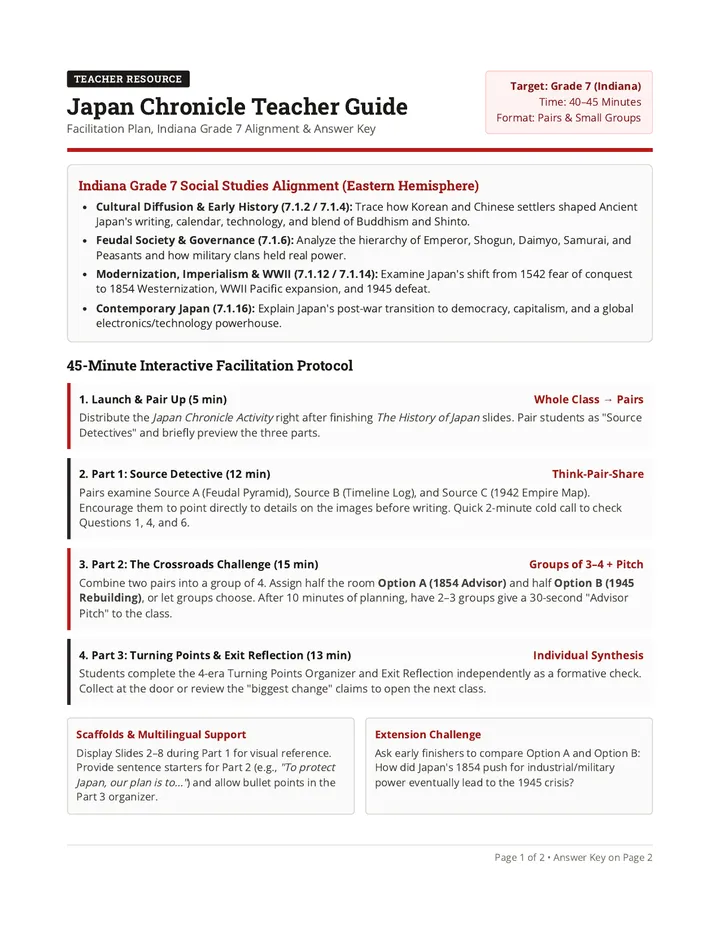
Japan Chronicle Teacher Guide
Teacher Resource
Japan Chronicle Teacher Guide
Facilitation Plan, Indiana Grade 7 Alignment & Answer Key
Target: Grade 7 (Indiana)
Time: 40–45 Minutes
Format: Pairs & Small Groups
Indiana Grade 7 Social Studies Alignment (Eastern Hemisphere)
- Cultural Diffusion & Early History (7.1.2 / 7.1.4): Trace how Korean and Chinese settlers shaped Ancient Japan's writing, calendar, technology, and blend of Buddhism and Shinto.
- Feudal Society & Governance (7.1.6): Analyze the hierarchy of Emperor, Shogun, Daimyo, Samurai, and Peasants and how military clans held real power.
- Modernization, Imperialism & WWII (7.1.12 / 7.1.14): Examine Japan's shift from 1542 fear of conquest to 1854 Westernization, WWII Pacific expansion, and 1945 defeat.
- Contemporary Japan (7.1.16): Explain Japan's post-war transition to democracy, capitalism, and a global electronics/technology powerhouse.
45-Minute Interactive Facilitation Protocol
1. Launch & Pair Up (5 min) Whole Class → Pairs
Distribute the Japan Chronicle Activity right after finishing The History of Japan slides. Pair students as "Source Detectives" and briefly preview the three parts.
2. Part 1: Source Detective (12 min) Think-Pair-Share
Pairs examine Source A (Feudal Pyramid), Source B (Timeline Log), and Source C (1942 Empire Map). Encourage them to point directly to details on the images before writing. Quick 2-minute cold call to check Questions 1, 4, and 6.
3. Part 2: The Crossroads Challenge (15 min) Groups of 3–4 + Pitch
Combine two pairs into a group of 4. Assign half the room Option A (1854 Advisor) and half Option B (1945 Rebuilding), or let groups choose. After 10 minutes of planning, have 2–3 groups give a 30-second "Advisor Pitch" to the class.
4. Part 3: Turning Points & Exit Reflection (13 min) Individual Synthesis
Students complete the 4-era Turning Points Organizer and Exit Reflection independently as a formative check. Collect at the door or review the "biggest change" claims to open the next class.
Scaffolds & Multilingual Support
Display Slides 2–8 during Part 1 for visual reference. Provide sentence starters for Part 2 (e.g., "To protect Japan, our plan is to...") and allow bullet points in the Part 3 organizer.
Extension Challenge
Ask early finishers to compare Option A and Option B: How did Japan's 1854 push for industrial/military power eventually lead to the 1945 crisis?
Page 1 of 2 • Answer Key on Page 2
Answer Key & Sample Student Responses
Japan Chronicle Activity
Part 1: Source Detective (Questions 1–6)
1. Emperor vs. Shogun & Samurai: The Shogun (and military clans) held the real political and military power, even though the Emperor was at the top. Landowning Samurai warriors supported the Shogun and enforced order for regional lords (Daimyo).
2. Peasants at the bottom: Peasants (farmers and laborers) made up the largest part of the population and produced the food/labor that supported all the upper classes.
3. Cultural diffusion from China: Any two of: Chinese calendar, system of writing, technology, or Buddhism (which mixed with Shinto).
4. Change from 1542 to 1854: In 1542, Japan feared foreign conquest after European contact. By 1854 (after U.S. interaction), Japan decided to model the West and build its own industrial and military power.
5. 1942 Map goals: The large red area across East Asia and the Pacific shows Japan's goal of building an empire and controlling more of the Pacific.
6. Oil & Pearl Harbor: Having its money frozen and oil cut off threatened Japan's military and empire, pushing Japan to attack Pearl Harbor to seize control of Pacific resources.
Part 2: The Crossroads Challenge (Sample Solutions)
Option A: 1854 Advisor Dilemma
Goal: Stay independent and avoid being conquered by Western powers.
Action Plan: (1) Study Western technology and factories to industrialize; (2) Modernize the military so Japan can defend itself.
Risk: Focusing too heavily on military power could lead to aggressive expansion later.
Option B: 1945 Rebuilding Dilemma
Goal: Recover from WWII defeat and rebuild a peaceful, strong nation.
Action Plan: (1) Shift government toward democracy and a capitalist economy; (2) Invest in electronics and technology rather than war.
Risk: Rapid economic change can be hard on workers and requires strong trade partners.
Part 3: Turning Points Organizer & Exit Reflection
| Era |
Key Features (Sample) |
Why It Mattered (Sample) |
| 1. Ancient Japan |
Settled by Koreans/Chinese; adopted writing, calendar, tech, Buddhism + Shinto. |
Created Japan's early culture by blending outside ideas with local traditions. |
| 2. Samurai Era |
Military clans, Shogun, Daimyo, and Samurai warriors ruled over peasants. |
Locked in a strict social hierarchy led by warriors rather than the Emperor. |
| 3. Rise & WWII |
Modeled the West after 1854; built an empire; attacked Pearl Harbor; defeated in 1945. |
Turned Japan into an industrial power, but empire-building ended in devastation. |
| 4. Modern Japan |
Shifted to democracy, capitalism, and electronics/technology. |
Rebuilt Japan into a peaceful global economic and tech powerhouse. |
Exit Reflection Q1: Accept any well-reasoned claim supported by presentation evidence (e.g., 1854 modernization changed daily life through industry, OR 1945/Modern Japan gave citizens democracy and a tech-based economy).
Page 2 of 2 • Japan Chronicle Teacher Guide