Market Mastery Answer Key
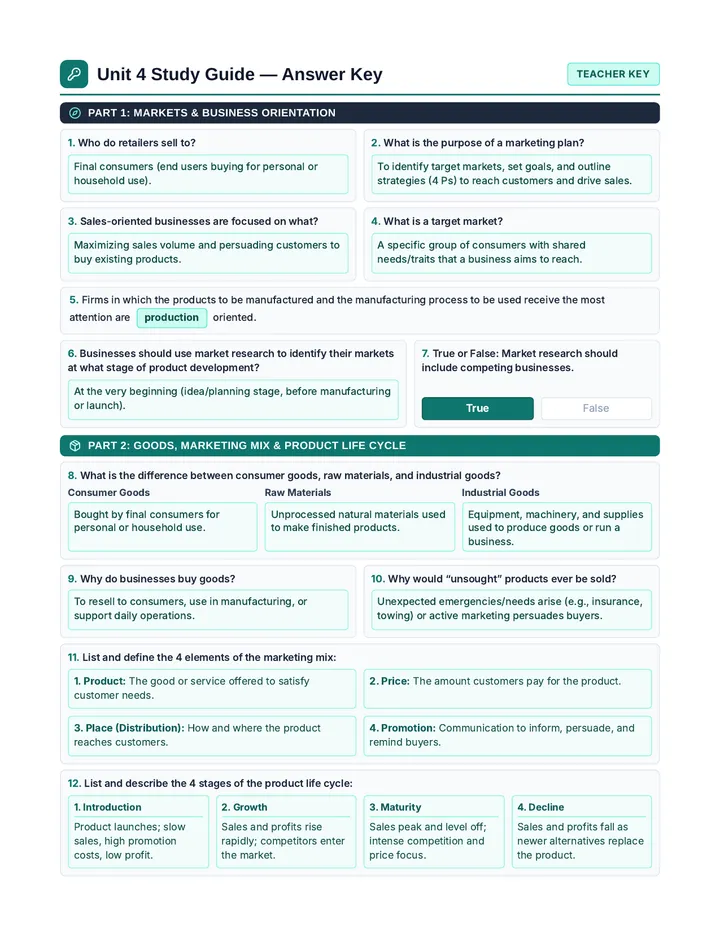
Unit 4 Study Guide — Answer Key
Teacher Key
Part 1: Markets & Business Orientation
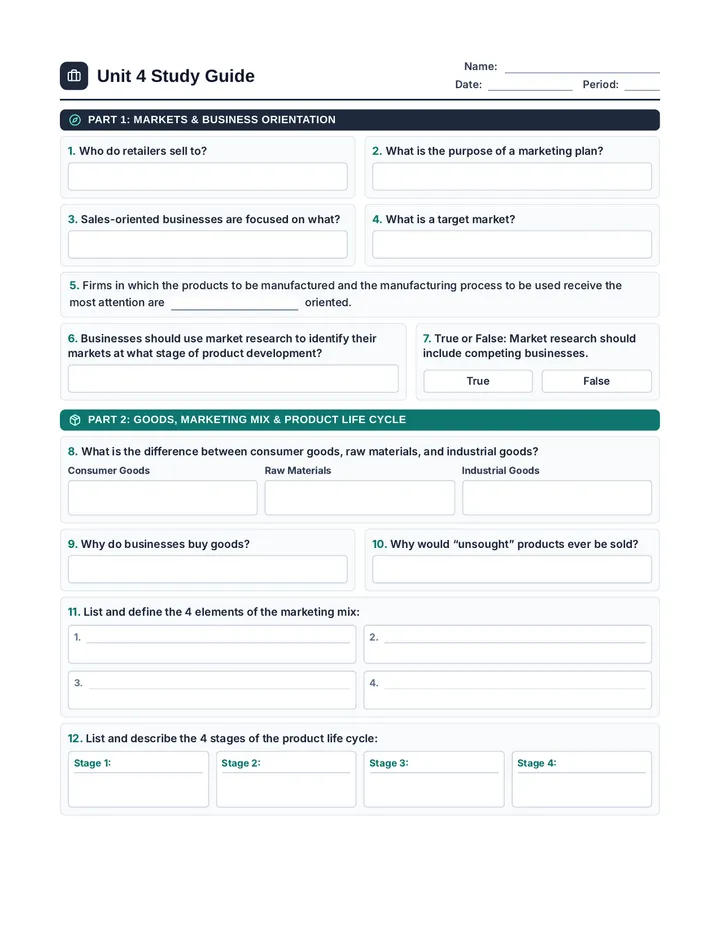
- Who do retailers sell to?
Final consumers (end users buying for personal or household use).
- What is the purpose of a marketing plan?
To identify target markets, set goals, and outline strategies (4 Ps) to reach customers and drive sales.
- Sales-oriented businesses are focused on what?
Maximizing sales volume and persuading customers to buy existing products.
- What is a target market?
A specific group of consumers with shared needs/traits that a business aims to reach.
-
Firms in which the products to be manufactured and the manufacturing process to be used receive the most attention are production oriented.
-
Businesses should use market research to identify their markets at what stage of product development?
At the very beginning (idea/planning stage, before manufacturing or launch).
- True or False: Market research should include competing businesses.
True
False
Part 2: Goods, Marketing Mix & Product Life Cycle
- What is the difference between consumer goods, raw materials, and industrial goods?
Consumer Goods
Bought by final consumers for personal or household use.
Raw Materials
Unprocessed natural materials used to make finished products.
Industrial Goods
Equipment, machinery, and supplies used to produce goods or run a business.
- Why do businesses buy goods?
To resell to consumers, use in manufacturing, or support daily operations.
- Why would “unsought” products ever be sold?
Unexpected emergencies/needs arise (e.g., insurance, towing) or active marketing persuades buyers.
- List and define the 4 elements of the marketing mix:
1. Product: The good or service offered to satisfy customer needs.
2. Price: The amount customers pay for the product.
3. Place (Distribution): How and where the product reaches customers.
4. Promotion: Communication to inform, persuade, and remind buyers.
- List and describe the 4 stages of the product life cycle:
1. Introduction
Product launches; slow sales, high promotion costs, low profit.
2. Growth
Sales and profits rise rapidly; competitors enter the market.
3. Maturity
Sales peak and level off; intense competition and price focus.
4. Decline
Sales and profits fall as newer alternatives replace the product.
Unit 4 Study Guide — Answer Key Teacher Key
Part 3: Buying Behavior & Sales
- Describe how a new task purchase, modified rebuy, and straight rebuy differ from each other.
New Task Purchase
Buying a product for the first time; requires full research and evaluation.
Modified Rebuy
Reordering with changes to specs, price, terms, or suppliers.
Straight Rebuy
Routine, automatic reorder of the exact same item from the same supplier.
- How do buyers choose what to buy?
By evaluating needs and comparing quality, price, features, brand, and total value.
- Define customer objections.
Concerns, doubts, or reasons a customer gives for hesitating or refusing to buy.
Part 4: Pricing, Discounts & Payment Terms
- How do list price, discounts, and selling price relate to each other?
Discounts are subtracted from the original list price to determine the final selling price (List Price − Discounts = Selling Price).
-
When payments are said to be “net 30 or n/60,” it means that payment is due in full in 30 or 60 days.
-
A cash discount is given for early (prompt) payment.
-
Calculate the payment terms if a bill reads: 3/10, n/60. Customers can receive a 3% discount if they pay in 10 days, or they can pay the full bill amount within 60 days.
-
What is the purpose of a trade discount?
A price reduction from manufacturers/wholesalers to retailers so resellers can cover costs and earn a profit margin.
Part 5: Costs, Markup & Retail Profit
-
What are three ways that retail businesses can improve their costs and profits?
-
Negotiate lower supplier costs / buy in bulk.
-
Cut operating expenses (waste, energy, staffing).
-
Increase sales volume, optimize markup, or reduce shrinkage.
-
How are the cost of goods sold different from operating expenses?
Cost of Goods Sold (COGS)
Direct cost of purchasing or making the products sold (inventory/materials).
Operating Expenses
Ongoing overhead costs required to run the business (rent, wages, utilities).
-
Markup is the amount added to a product to determine list/selling price.
-
What are common operating expenses?
Rent/lease, employee salaries/wages, utilities, insurance, advertising, and supplies.