Dynasty Storytellers Activity
Ancient China • Introductory Activity
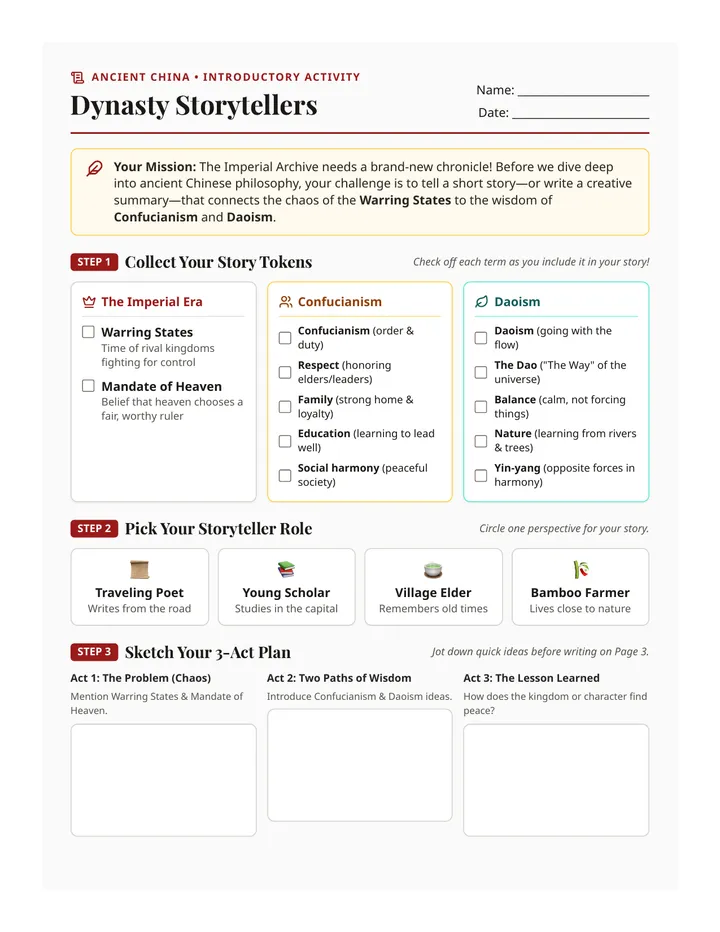
Dynasty Storytellers
Name: ________________________
Date: _________________________
Your Mission: The Imperial Archive needs a brand-new chronicle! Before we dive deep into ancient Chinese philosophy, your challenge is to tell a short story—or write a creative summary—that connects the chaos of the Warring States to the wisdom of Confucianism and Daoism.
STEP 1 Collect Your Story Tokens
Check off each term as you include it in your story!
The Imperial Era
Confucianism
- Confucianism (order & duty)
- Respect (honoring elders/leaders)
- Family (strong home & loyalty)
- Education (learning to lead well)
- Social harmony (peaceful society)
Daoism
- Daoism (going with the flow)
- The Dao ("The Way" of the universe)
- Balance (calm, not forcing things)
- Nature (learning from rivers & trees)
- Yin-yang (opposite forces in harmony)
STEP 2 Pick Your Storyteller Role
Circle one perspective for your story.
📜
Traveling Poet
Writes from the road
📚
Young Scholar
Studies in the capital
🍵
Village Elder
Remembers old times
🎋
Bamboo Farmer
Lives close to nature
STEP 3 Sketch Your 3-Act Plan
Jot down quick ideas before writing on Page 3.
Act 1: The Problem (Chaos)
Mention Warring States & Mandate of Heaven.
Act 2: Two Paths of Wisdom
Introduce Confucianism & Daoism ideas.
Act 3: The Lesson Learned
How does the kingdom or character find peace?
MODEL Sample Scroll: "The River and the Palace"
Role: Traveling Poet • 12/12 Tokens Used
The River and the Palace
Example Story
For years, I walked the dusty roads between rival kingdoms during the Warring States period. Villages were tired of endless battles, and farmers whispered that the cruel lords had lost the Mandate of Heaven. Everyone wondered: how could a broken land ever find peace again?
In the capital city, I met a teacher of Confucianism. He told me that peace begins inside the home. When children show respect to their parents and every family honors its duties, kindness spreads outward. He believed that education would train wise leaders who could build lasting social harmony across the empire.
Yet outside the city walls, an old fisher showed me the quiet wisdom of Daoism. Pointing to the rushing stream, she explained that the Dao is like water—soft, yet strong enough to shape stone without fighting. By watching nature, she found inner balance. Just like yin-yang, light and shadow, action and stillness, both philosophies taught me that a peaceful world needs both dutiful hearts and calm minds.
Spot How the Story Works
Answer these 3 quick questions before writing your own!
1. In the sample story, why did people think the lords lost the Mandate of Heaven?
2. According to the teacher of Confucianism, what helps create social harmony?
3. How does the fisher use nature to explain the Dao and balance?
Storyteller Tip: Notice how the sample story uses 3 short paragraphs—one for the problem (Act 1), one for Confucianism, and one for Daoism! Try a similar structure on Page 3.
STEP 4 The Imperial Scroll: Tell Your Story
Goal: Use at least 10 of the 12 Story Tokens!
Write your story or historical summary below. Underline or highlight each Story Token when you use it!
Story Title:
STEP 5 Town Square Share (Partner Check)
Tokens Used: _____ / 12
Trade scrolls with a partner! Write one thing you liked or learned from their story:
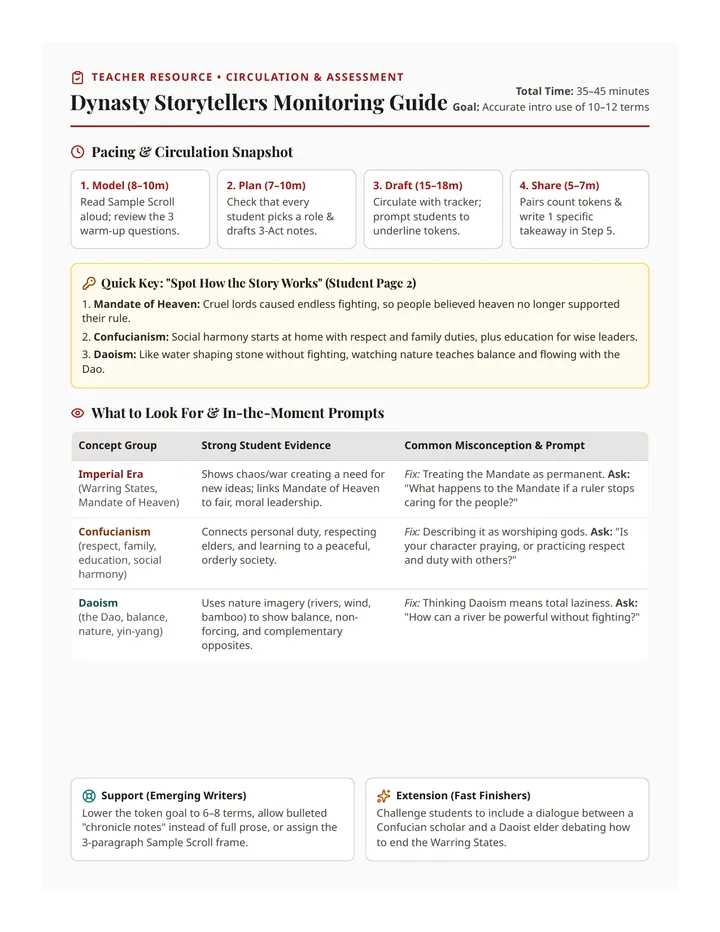
Dynasty Storytellers Monitoring Guide
Teacher Resource • Circulation & Assessment
Dynasty Storytellers Monitoring Guide
Total Time: 35–45 minutes
Goal: Accurate intro use of 10–12 terms
Pacing & Circulation Snapshot
1. Model (8–10m)
Read Sample Scroll aloud; review the 3 warm-up questions.
2. Plan (7–10m)
Check that every student picks a role & drafts 3-Act notes.
3. Draft (15–18m)
Circulate with tracker; prompt students to underline tokens.
4. Share (5–7m)
Pairs count tokens & write 1 specific takeaway in Step 5.
Quick Key: "Spot How the Story Works" (Student Page 2)
- Mandate of Heaven: Cruel lords caused endless fighting, so people believed heaven no longer supported their rule.
- Confucianism: Social harmony starts at home with respect and family duties, plus education for wise leaders.
- Daoism: Like water shaping stone without fighting, watching nature teaches balance and flowing with the Dao.
What to Look For & In-the-Moment Prompts
| Concept Group |
Strong Student Evidence |
Common Misconception & Prompt |
| Imperial Era |
|
|
| (Warring States, Mandate of Heaven) |
Shows chaos/war creating a need for new ideas; links Mandate of Heaven to fair, moral leadership. |
Fix: Treating the Mandate as permanent. Ask: "What happens to the Mandate if a ruler stops caring for the people?" |
| Confucianism |
|
|
| (respect, family, education, social harmony) |
Connects personal duty, respecting elders, and learning to a peaceful, orderly society. |
Fix: Describing it as worshiping gods. Ask: "Is your character praying, or practicing respect and duty with others?" |
| Daoism |
|
|
| (the Dao, balance, nature, yin-yang) |
Uses nature imagery (rivers, wind, bamboo) to show balance, non-forcing, and complementary opposites. |
Fix: Thinking Daoism means total laziness. Ask: "How can a river be powerful without fighting?" |
Support (Emerging Writers)
Lower the token goal to 6–8 terms, allow bulleted "chronicle notes" instead of full prose, or assign the 3-paragraph Sample Scroll frame.
Extension (Fast Finishers)
Challenge students to include a dialogue between a Confucian scholar and a Daoist elder debating how to end the Warring States.
Classroom Circulation Tracker
Class / Period: ______________ Date: ______________
Use ✓ (accurate in context), ~ (mentioned, needs clearer meaning), or – (missing/needs prompt) as you circulate.
| Student / Pair | 3-Act Plan | Era Terms
(Warring / Mandate) | Confucianism
(4 concepts) | Daoism
(4 concepts) | Coaching Notes / Next Step |
| --- | --- | --- | --- | --- | --- |
| | | | | | |
| | | | | | |
| | | | | | |
| | | | | | |
| | | | | | |
| | | | | | |
| | | | | | |
| | | | | | |
| | | | | | |
| | | | | | |
| | | | | | |
| | | | | | |
| | | | | | |
| | | | | | |
| | | | | | |
| | | | | | |
Whole-Class Debrief & Next-Lesson Adjustments