Invention Ripples Worksheet
Reading Comprehension & History of Technology 55-Minute Lesson
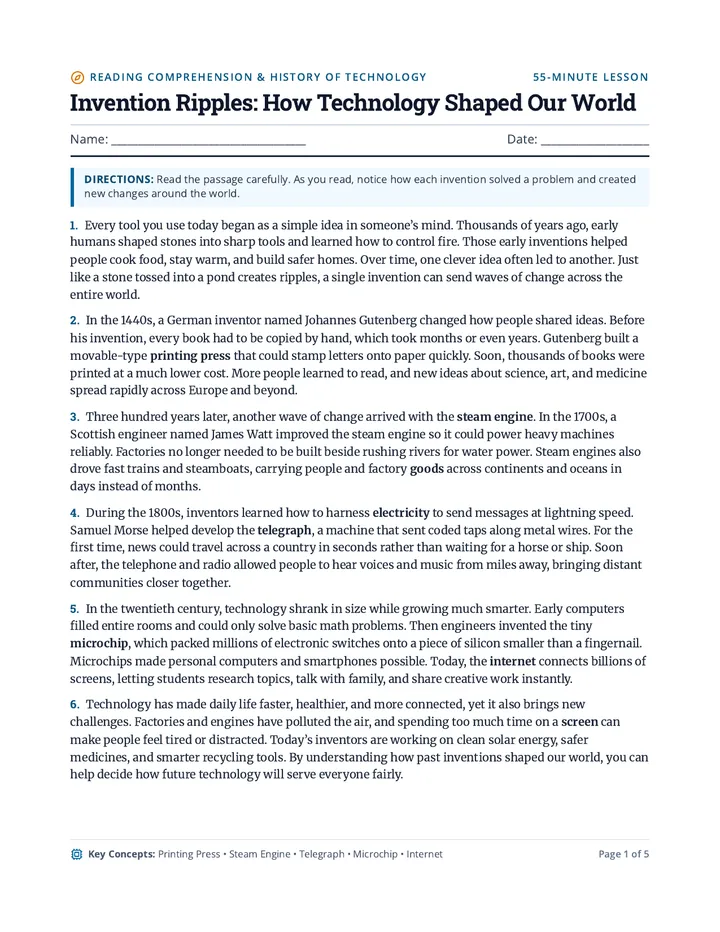
Invention Ripples: How Technology Shaped Our World
Name: ____________________________________
Date: ____________________
Directions: Read the passage carefully. As you read, notice how each invention solved a problem and created new changes around the world.
-
Every tool you use today began as a simple idea in someone’s mind. Thousands of years ago, early humans shaped stones into sharp tools and learned how to control fire. Those early inventions helped people cook food, stay warm, and build safer homes. Over time, one clever idea often led to another. Just like a stone tossed into a pond creates ripples, a single invention can send waves of change across the entire world.
-
In the 1440s, a German inventor named Johannes Gutenberg changed how people shared ideas. Before his invention, every book had to be copied by hand, which took months or even years. Gutenberg built a movable-type printing press that could stamp letters onto paper quickly. Soon, thousands of books were printed at a much lower cost. More people learned to read, and new ideas about science, art, and medicine spread rapidly across Europe and beyond.
-
Three hundred years later, another wave of change arrived with the steam engine. In the 1700s, a Scottish engineer named James Watt improved the steam engine so it could power heavy machines reliably. Factories no longer needed to be built beside rushing rivers for water power. Steam engines also drove fast trains and steamboats, carrying people and factory goods across continents and oceans in days instead of months.
-
During the 1800s, inventors learned how to harness electricity to send messages at lightning speed. Samuel Morse helped develop the telegraph, a machine that sent coded taps along metal wires. For the first time, news could travel across a country in seconds rather than waiting for a horse or ship. Soon after, the telephone and radio allowed people to hear voices and music from miles away, bringing distant communities closer together.
-
In the twentieth century, technology shrank in size while growing much smarter. Early computers filled entire rooms and could only solve basic math problems. Then engineers invented the tiny microchip, which packed millions of electronic switches onto a piece of silicon smaller than a fingernail. Microchips made personal computers and smartphones possible. Today, the internet connects billions of screens, letting students research topics, talk with family, and share creative work instantly.
-
Technology has made daily life faster, healthier, and more connected, yet it also brings new challenges. Factories and engines have polluted the air, and spending too much time on a screen can make people feel tired or distracted. Today’s inventors are working on clean solar energy, safer medicines, and smarter recycling tools. By understanding how past inventions shaped our world, you can help decide how future technology will serve everyone fairly.
Key Concepts: Printing Press • Steam Engine • Telegraph • Microchip • Internet
Page 1 of 5
Part 1: Multiple Choice (10 Questions)
Circle the best answer for each question.
1. Why does the author compare an invention to a stone tossed into a pond?
A. Both are made out of heavy rock.
B. One invention can create wide waves of change.
C. Most inventions sink and are forgotten.
D. Early humans only invented tools near water.
2. What problem did Johannes Gutenberg’s printing press solve in the 1440s?
A. Paper was too thin to hold ink.
B. Trains could not carry heavy books.
C. Copying books by hand took too much time.
D. People did not want to read about science.
3. What happened after books became cheaper to print?
A. Fewer people learned how to read.
B. Ideas about science and medicine spread faster.
C. Libraries closed across Europe.
D. Writers stopped making new stories.
4. How did James Watt’s improved steam engine change where factories could be built?
A. Factories had to be built on mountain tops.
B. Factories could only operate during winter.
C. Factories no longer needed to sit beside rivers.
D. Factories were moved onto steamboats.
5. According to Paragraph 3, how did steam-powered trains and boats affect travel?
A. Trips that took months now took only days.
B. People stopped traveling across oceans.
C. Goods became too expensive to ship.
D. Travel became slower but much quieter.
6. How did Samuel Morse’s telegraph send messages?
A. By printing newspapers on fast trains
B. By sending coded taps along metal wires
C. By carrying letters on steamboats
D. By beaming pictures to smartphones
7. Which invention came AFTER the telegraph to let people hear voices from far away?
A. The printing press
B. The stone tool
C. The telephone
D. The steam engine
8. What did the invention of the microchip make possible?
A. Computers that filled entire rooms
B. Personal computers and smartphones
C. Steam engines powered by wood
D. Books copied carefully by hand
9. Which of the following is mentioned as a challenge caused by modern technology?
A. People have too few books to read.
B. Air pollution and too much screen time.
C. Microchips are too large to fit in phones.
D. Messages take weeks to cross a country.
10. What is the main idea of the entire passage?
A. Only twentieth-century inventions mattered.
B. Inventors always agree on how to use tools.
C. Inventions build on one another and reshape daily life.
D. Technology has only caused problems for the Earth.
Invention Ripples Worksheet Page 2 of 5
Part 2: True or False (10 Questions)
Circle True or False for each statement.
1. Early humans used stone tools and fire to cook food and stay warm. True / False
2. Johannes Gutenberg invented the steam engine in the 1440s. True / False
3. Before the printing press, copying a single book by hand could take months or years. True / False
4. James Watt improved the steam engine in the 1700s. True / False
5. Steamboats and trains made shipping goods slower than before. True / False
6. Samuel Morse’s telegraph used electricity to send coded messages. True / False
7. The earliest computers were small enough to fit inside a backpack. True / False
8. A microchip is smaller than a fingernail yet holds millions of switches. True / False
9. The internet connects billions of people for learning and communication. True / False
10. Modern inventors are no longer trying to solve environmental problems. True / False
Part 3: Fill in the Blanks (5 Questions)
Use the Word Bank below to complete each sentence.
Word Bank
microchip electricity printing press internet steam engine
1. Johannes Gutenberg’s _________________________ made it possible to produce thousands of books quickly and cheaply.
2. Factories could be built away from rivers once the _________________________ began powering machines.
3. In the 1800s, inventors used _________________________ to send telegraph messages across wires in seconds.
4. Engineers shrank giant computers into personal devices by inventing the tiny _________________________.
5. Today, the _________________________ links billions of screens so people can share work and ideas worldwide.
Invention Ripples Worksheet Page 3 of 5
Part 4: Invention Word Search
Find and circle all 10 words hidden across (→) or down (↓).
Words to Find (10)
☐ ELECTRIC
☐ INTERNET
☐ ENGINE
☐ INVENTOR
☐ FACTORY
☐ MICROCHIP
☐ FUTURE
☐ PRINTING
☐ STEAM
☐ TELEGRAPH
Part 5: Innovation Crossword
Use clues from the passage to fill in the grid.
Across
1. Gutenberg’s invention that stamped letters onto paper (8)
4. Glass display on a computer or smartphone (6)
7. Machine that sent coded messages along wires (9)
Down
1. Gutenberg’s printing _____ (5)
2. Global network connecting billions of screens (8)
3. Items made in factories and shipped by train or boat (5)
5. Machine powered by steam to run factories and trains (6)
6. Energy that runs machines, lights, and cities (5)
Invention Ripples Worksheet Page 4 of 5
Part 6: Open Response (2 Questions)
Write complete sentences using details from the passage.
1. Choose one invention from the passage (the printing press, the steam engine, the telegraph, or the microchip). Explain how it changed people’s daily lives and why it was important for future inventions.
2. The author says technology brings both benefits and challenges. Describe one benefit and one challenge of modern technology, and suggest one way people can use technology responsibly.
Invention Ripples Worksheet Page 5 of 5