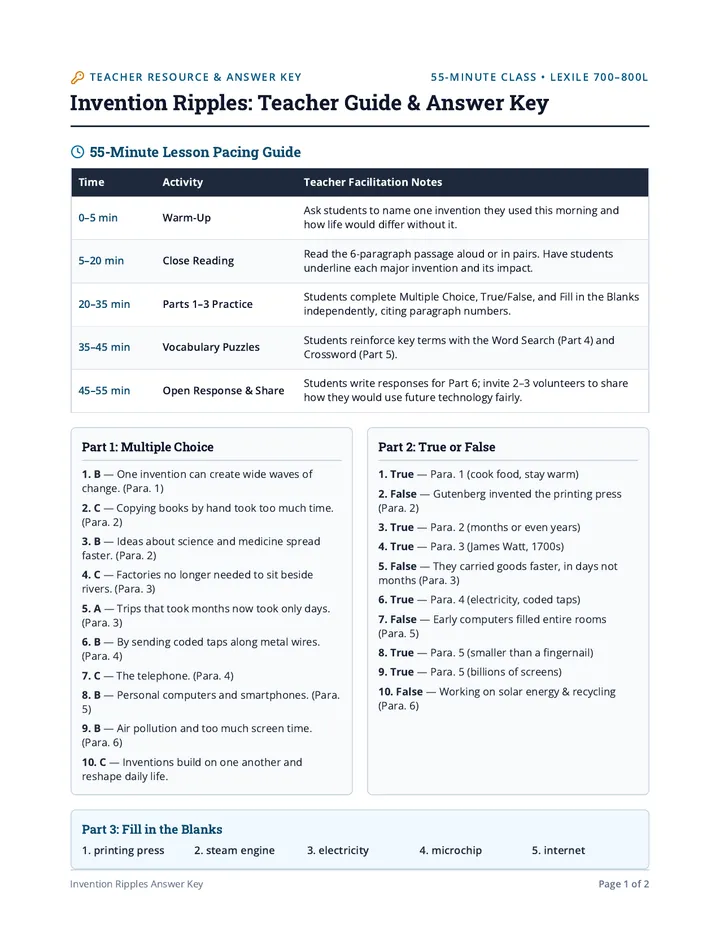
Business Law Answer KeyTeacher Reference • Chapters 8–12 Business Law Answer Key Student Activity Workbook Pages 73–119 Chapter 8: Personal Property Workbook pp. 73–79 Section 8.1 Types of Property — Monitoring Comprehension (p. 73) Answers will vary. Accept thoughtful student responses aligned with the text. Main ideas: Personal property is anything that can be owned other than real property, including tangible items and intangible rights such as intellectual property (copyrights, patents, and trademarks). Vocabulary: Students should list unfamiliar terms (e.g., intellectual property, copyright, patent, trademark, tangible) and write accurate dictionary definitions. Comparison to Ch. 7: Both property laws and consumer laws are designed to protect individuals' rights and ensure fair treatment in ownership and transactions. Prediction for 8.2 (Bailments): Relates to temporarily transferring or lending personal property to someone else with the expectation that it will be returned. Section 8.2 Note Taking (p. 75) Sample completed notes: Cues: Bailor & bailee; Types of bailments; Standards of care. Notes: Mutual benefit = ordinary care; Gratuitous (sole benefit of bailor) = slight care; Gratuitous (sole benefit of bailee) = great care; Special bailment = bailee liable for damage (common carriers, hotels). Section 8.2 Topic Web (p. 77) Sample outer-oval bailments (answers vary): Dry cleaning clothes (mutual benefit) Paid valet parking (mutual benefit) Neighbor watching pet for free (gratuitous — bailor) Borrowing a friend's calculator (gratuitous — bailee) Shipping via delivery carrier (special bailment) Chapter 8 Content Vocabulary — Fill in the Blanks (p. 79) mutual benefit bailment bailment copyright carrier Personal property common carrier gratuitous bailment special bailment (by word-bank elimination)* patent trademark Intellectual property *Teacher Note: Legally, a bailment for the sole benefit of the bailee is also a gratuitous bailment; in this workbook's word bank, special bailment is the remaining match for #10. Chapter 9: Renting or Owning a Home Workbook pp. 83–89 Section 9.1 Rental Agreements — Critical Thinking (p. 83) Answers will vary. Look for clear reasoning supported by evidence. Security deposit: Yes, fair to both—protects the landlord against damage or unpaid rent, and the tenant receives it back if the unit is left in good condition. Written lease: Establishes clear terms (rent, duration, rules, responsibilities), prevents misunderstandings, and provides legal proof in disputes. Excessive damage clause: Fair for tenants to pay for excessive damage they cause beyond normal wear and tear, provided the landlord handles normal upkeep. Repair and deduct: Fair when a landlord fails to fix habitability issues after proper notice, ensuring tenants have safe living conditions. Section 9.2 Buying a Home — Note Taking (p. 85) Forms of co-ownership: Tenancy in common, joint tenancy, tenancy by the entirety, community property. Types of deeds & limits: General warranty, special warranty, bargain and sale, quitclaim deeds. Limits: zoning, easements, liens, eminent domain. Section 9.2 Buying a Home — True/False & Corrections (p. 87) T — Ownership of real property can be lost by adverse possession. F — An easement is an irrevocable right to the limited use of another's land. (A lien is a legal claim against property as security for a debt.) F — A quitclaim deed provides the grantee with no protection against a faulty title. (A general warranty deed provides the greatest protection.) T — Eminent domain is the right of the government to take private land for a public purpose. F — A lien is a legal claim against another person's property as security for a debt or loan. (A license is temporary, revocable permission to use land.) Chapter 9 Content Vocabulary — Word Unscramble & Sample Sentences (p. 89) 1. nioticve → eviction 6. ensceil → license 2. ttseea → estate 7. nlei → lien 3. eedd → deed 8. teninme namido → eminent domain 4. eslea → lease 9. nanytec → tenancy 5. ublsaese → sublease 10. erla ypporrte → real property Sample Sentences (for items 2–7; sentences will vary): 2. Estate: She inherited a large estate in real property. 3. Deed: The seller signed the deed to transfer ownership. 4. Lease: We signed a one-year apartment lease. 5. Sublease: With permission, he arranged a summer sublease. 6. License: A concert ticket grants a license to enter the venue. 7. Lien: The contractor placed a lien on the unpaid home. Chapter 10: Banking and Negotiable Instruments Workbook pp. 93–99 Section 10.1 Using Negotiable Instruments — Listening Skills (p. 93) Anticipating: Prepares your brain to receive new information and keeps you actively engaged. Keep in mind: The five W questions—who, what, where, when, and why. Relating to life: Helps you better understand and remember what you are hearing. Before, during, after: Before: skim material. During: take notes, restate ideas, ask the 5 Ws. After: rewrite and study notes. Advice (varies): Active listening improves comprehension, retention, and the quality of study notes. Section 10.2 Banking Basics — Note Taking (p. 95) Sample Notes: Checking Accounts create a contractual relationship; bank honors valid checks with sufficient funds; customer must keep accurate records and report errors/forgeries promptly. Electronic Banking uses EFT (ATMs, debit cards, direct deposit, online transfers) instead of paper checks. Section 10.2 Banking Basics — Improving Learning Skills (p. 97) Personal skill (varies): Student identifies a skill and how they learned it (reading, watching, listening, practicing). Knowing how you learn: Lets you apply your most effective study strategies to new material. Summarizing: Forces you to identify main ideas in your own words, boosting comprehension and memory. Asking questions: Keeps focus sharp, checks understanding, and highlights gaps to review. Multiple sources: Provides varied explanations. Examples: textbook, class notes, dictionary, reputable websites, study group. Multiple methods: Stimulates more areas of the brain at once (e.g., reading aloud combines visual and auditory learning). Chapter 10 Content Vocabulary — Quick Reference for Student Sentences (p. 99) Students choose 10 terms and write original sentences demonstrating meaning. Verify accuracy against these definitions: payee: party to whom an instrument is payable drawer: person who orders payment on a draft/check draft: unconditional written order to pay money drawee: party ordered to pay (usually a bank) negotiable instrument: transferable written promise/order to pay negotiation: transfer of instrument making transferee a holder note: written promise to pay a specified sum electronic fund transfer: computerized transfer of funds maker: person who executes a promissory note indorsement: signature on back to transfer rights holder: person in possession of an instrument payable to them holder in due course: good-faith holder for value without notice assignment: transfer of contract rights to another forgery: unauthorized signing of another's name to defraud Chapter 11: Credit and Debt Workbook pp. 103–109 Section 11.1 Understanding Credit — Revising Notes (p. 103) Sample Plan (answers vary): Students should describe a concrete routine incorporating strategies from the box—such as recopying class notes neatly after school, color-coding main ideas vs. vocabulary definitions, creating a graphic organizer, and making flash cards for key terms. Section 11.2 Credit and You — Note Taking (p. 105) Buying a Vehicle: Know exact price, amount borrowed, finance charge, APR, and total sales price before signing. Using Credit Cards: Convenient borrowing, but carries high interest rates and late-payment fees if not paid in full. Student Loans: Federal loans are need-based with lower rates; repayment typically begins after graduation or leaving school. Debt Warning Signs: Making only minimum payments, using credit for everyday necessities, maxing out credit limits. Section 11.2 Credit and You — Creating Study Aids (p. 107) Answers will vary. Sample student-created test questions & answers: What five figures should you know before financing a car? (Price, amount borrowed, finance charge, APR, total sales price.) What are two drawbacks of carrying a credit card balance? (High interest rates and potential late-payment fees.) Who provides need-based student loans? (The federal government.) List two warning signs of debt problems. (Paying only the minimum due; using credit to pay for basic necessities.) Chapter 11 Content Vocabulary — Fill in the Blanks (p. 109) Credit Default debtor security interest Interest Collateral secured loan finance charge creditor annual percentage rate Chapter 12: Credit Protection and Bankruptcy Workbook pp. 113–119 Section 12.1 Credit Protection Laws — Identifying the Main Idea (p. 113) Paragraph 1: Under the Equal Credit Opportunity Act (ECOA), if you are denied credit (for low income, large debts, or poor payment history), you have the right to know why, get a free credit report, and dispute inaccurate information. Paragraph 2: Both federal and state governments regulate the credit industry to protect consumers (via state usury laws and federal credit protection acts). (Topic sentence is the first sentence.) Section 12.2 Bankruptcy Laws — Note Taking (p. 115) Two types of bankruptcy: Voluntary (initiated by debtor) and involuntary (initiated by creditors). Four bankruptcy proceedings: Chapter 7 (liquidation), Chapter 11 (business reorganization), Chapter 12 (family farmers/fishers), Chapter 13 (individual repayment plan). Restoring credit: Stays on credit report up to 10 years; rebuild via budgeting, secured cards, and on-time payments. Section 12.2 Bankruptcy Laws — Multiple Choice (p. 117) 1. b. debtor 4. a. ten years. 2. c. a petition for bankruptcy is filed. 5. b. allows businesses to reorganize... 3. d. individual debtors to discharge all debts... 6. c. individuals. Chapter 12 Content Vocabulary — Quick Reference for Student Sentences (p. 119) Students choose 10 terms and write original sentences demonstrating meaning. Verify accuracy against these definitions: bankruptcy: legal process freeing debtors from overwhelming debt Chapter 11: business debt reorganization while operating voluntary bankruptcy: proceeding filed by the debtor Chapter 12: debt adjustment for family farmers/fishers involuntary bankruptcy: proceeding filed by creditors Chapter 13: individual debt repayment plan (3–5 years) Chapter 7: liquidation of nonexempt assets for fresh start repossession: taking back collateral after loan default garnishment: court-ordered withholding of wages for debt usury law: state law capping maximum interest rates Fair Credit Reporting Act: right to see/dispute credit reports Equal Credit Opportunity Act: bans credit discrimination Consumer Credit Protection Act: requires clear cost disclosures Fair Credit Billing Act: process to dispute billing errors Fair Debt Collection Practices Act: prohibits abusive or deceptive debt collection practices
Turkey Day Trials SlidesBusiness Law • Thanksgiving Special Turkey Day Trials Five holiday legal disputes. One courtroom. Can your team apply the law before dinner is served? Bailments • Contracts • Banking • Leases • Credit Law Your Role in Court Today 1. Read the Facts Review each holiday dispute in your Case Packet with your partner or small group. 2. Spot the Law Identify the legal principle at stake (standard of care, offer, forgery, deposit, or FCBA). 3. Rule & Defend Decide who wins and write a clear 2–3 sentence legal ruling before we debate! Case 1 • Chapter 8: Bailments The Burnt Bird Bailment Aunt Linda drops off her prized $120 heritage turkey at Cousin Greg's house so he can store it in his extra fridge overnight as a free favor. Greg forgets to shut the fridge door all the way, and the turkey spoils by morning. What type of bailment is this, and is Greg legally liable for the spoiled turkey? Case 2 • Contract Formation The Black Friday Doorbuster MegaMart prints a flyer: "$50 65-Inch Smart TVs — First 10 Customers Only!" Maya camps out overnight, is #4 in line, and hands over $50 cash. The manager refuses, saying, "We changed our mind—they're $300 now." Was this ad a binding offer or just an invitation to negotiate? Does Maya get the TV for $50? Case 3 • Chapter 10: Banking & Checks The Bounced Pie Check Uncle Bob keeps his checkbook locked in his glovebox. A thief breaks into his car, steals a blank check, forges Bob's signature, and cashes it at Bob's bank for $450. Bob spots the error on his statement and reports it immediately. Who bears the $450 loss—Uncle Bob or the bank? Why? Case 4 • Chapter 9: Leases & Property The Gravy-Stained Sofa Devon hosts Friendsgiving in his rented, furnished apartment. A guest trips and spills cranberry sauce and turkey gravy all over the landlord's cream-colored sofa, leaving permanent stains. Devon moves out and demands his full security deposit back. Can the landlord legally deduct the sofa repair or replacement cost from Devon's security deposit? Case 5 • Chapters 11 & 12: Credit Protection The Holiday Credit Crunch Jordan opens their November credit card statement and sees a $350 charge for a luxury Thanksgiving centerpiece they never ordered. Jordan notifies the credit card company in writing 20 days after the statement was sent. Which federal law protects Jordan, and must Jordan pay the $350 while the bank investigates? Court Adjourned! Time to share your rulings. Which case had the toughest legal gray area—and what is one legal tip you'll remember this holiday weekend? Happy Thanksgiving! Complete your Bonus Contract Challenge before turning in your packet.
Turkey Day Trials Case PacketName: ______________________________ Date: ________________ Class: ____________ Business Law • Thanksgiving Case Packet Turkey Day Trials: You Be the Judge Directions: Read each Thanksgiving legal dispute below. In the ruling box, state who wins, identify the legal principle or law that applies, and explain your reasoning in 2–3 sentences. Case 1: The Burnt Bird Bailment Ch. 8 • Bailments Aunt Linda drops off her prized $120 heritage turkey at Cousin Greg's house so he can store it in his extra refrigerator overnight as a free favor. Greg forgets to shut the fridge door all the way, and the turkey spoils by morning. What type of bailment is this, and is Greg legally liable? Your Ruling & Legal Reasoning: Case 2: The Black Friday Doorbuster Contracts • Offers MegaMart prints a flyer: "$50 65-Inch Smart TVs — First 10 Customers Only!" Maya camps out overnight, is #4 in line, and hands over $50 cash. The manager refuses, saying, "We changed our mind—they're $300 now." Was this ad a binding offer, and does Maya get the TV for $50? Your Ruling & Legal Reasoning: Case 3: The Bounced Pie Check Ch. 10 • Banking Uncle Bob keeps his checkbook locked in his glovebox. A thief breaks into his car, steals a blank check, forges Bob's signature, and cashes it at Bob's bank for $450. Bob spots the error on his statement and reports it immediately. Who bears the $450 loss—Uncle Bob or the bank? Your Ruling & Legal Reasoning: Turkey Day Trials (Continued) Cases 4–5 & Bonus Challenge Case 4: The Gravy-Stained Sofa Ch. 9 • Leases Devon hosts Friendsgiving in his rented, furnished apartment. A guest trips and spills cranberry sauce and turkey gravy all over the landlord's cream-colored sofa, leaving permanent stains. Devon moves out and demands his full security deposit back. Can the landlord legally deduct the repair or replacement cost? Your Ruling & Legal Reasoning: Case 5: The Holiday Credit Crunch Ch. 11–12 • Credit Law Jordan opens their November credit card statement and sees a $350 charge for a luxury Thanksgiving centerpiece they never ordered. Jordan notifies the credit card company in writing 20 days after the statement was sent. Which federal law protects Jordan, and must Jordan pay the $350 while the bank investigates? Your Ruling & Legal Reasoning: Bonus Challenge: The Thanksgiving Table Contract Quick Draft Draft a short, legally binding agreement between two family members trading Thanksgiving chores (e.g., cooking vs. doing all the dishes). Make sure your contract includes offer, acceptance, and consideration!
Turkey Day Trials Teacher GuideBusiness Law • Single-Period Lesson Plan Turkey Day Trials Teacher Guide 50 Minutes Ch. 8–12 Review 50-Minute Pacing Guide 0–5 min: Hook & Roles (Slides 1–2). Pair students or form 3–4 person "law firms." 5–25 min: Case Deliberation. Firms analyze Cases 1–5 in the Case Packet (4 min/case). 25–42 min: Courtroom Debate (Slides 3–7). Poll the room on each case, then reveal the legal rule. 42–50 min: Adjourn & Bonus Contract (Slide 8). Complete the Thanksgiving Table Contract. Differentiation Support: Let students use Chapters 8–12 notes or assign 3 of 5 cases. Extension: Have fast finishers write a dissenting opinion for Case 2. Case Rulings & Legal Reasoning (Answer Key) Case 1 — The Burnt Bird Bailment (Ch. 8): Greg wins (not liable) — unless gross negligence is shown. This is a gratuitous bailment for the sole benefit of the bailor (Aunt Linda), so Greg only owes slight care. Accidentally leaving the door slightly ajar is usually ordinary negligence, not gross negligence—though students can debate whether spoiling raw meat crosses into gross negligence! Case 2 — The Black Friday Doorbuster (Contracts): Maya wins ($50 TV). Normally, advertisements are invitations to negotiate, not offers. However, when an ad is clear, definite, and explicit and leaves nothing open to negotiation—like "First 10 Customers Only" (a classic Lefkowitz v. Great Minneapolis Surplus Store rule)—it becomes a binding unilateral offer that Maya accepted by being #4 in line. Case 3 — The Bounced Pie Check (Ch. 10): Uncle Bob wins (bank bears the $450 loss). Under the UCC, a bank is strictly liable for paying a check with a forged drawer's signature, provided the customer exercised ordinary care (locking the checkbook in the glovebox) and reported the forgery promptly upon receiving the statement. Case 4 — The Gravy-Stained Sofa (Ch. 9): Landlord wins (can deduct from deposit). A tenant is responsible for damage caused by themselves or their guests that goes beyond normal wear and tear. Permanent gravy and cranberry stains on a furnished sofa count as excessive damage, so the landlord may deduct reasonable cleaning or replacement costs. Case 5 — The Holiday Credit Crunch (Ch. 11–12): Jordan wins (protected by the Fair Credit Billing Act). Under the FCBA, consumers have 60 days from the statement date to dispute billing errors in writing. Because Jordan wrote within 20 days, they do not have to pay the disputed $350 (or interest on it) while the issuer investigates. Bonus Contract Check: Verify each student draft has (1) a clear offer ("I will roast the turkey..."), (2) acceptance ("I agree"), and (3) consideration (something of value exchanged by both sides, e.g., cooking in exchange for dishwashing).
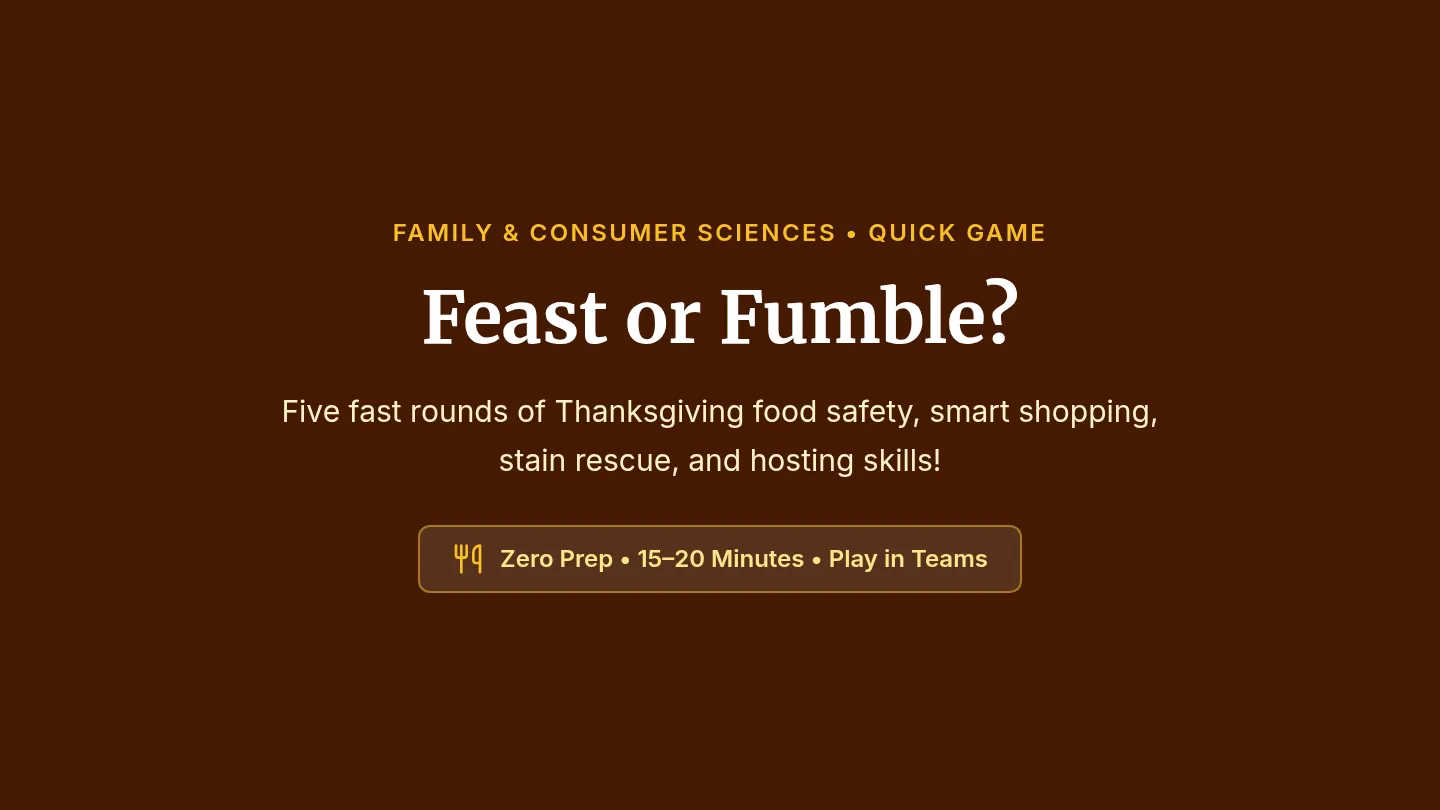
Feast or Fumble SlidesFamily & Consumer Sciences • Quick Game Feast or Fumble? Five fast rounds of Thanksgiving food safety, smart shopping, stain rescue, and hosting skills! Zero Prep • 15–20 Minutes • Play in Teams How to Play 1. Team Up Form teams of 2–4. Grab one scrap sheet of paper or a mini whiteboard per team. 2. Huddle (30s) Read each Thanksgiving scenario and lock in A, B, C, or D before the timer ends. 3. Score Points 1 point per right answer—plus a 2-point Tie-Breaker at the end! Round 1 • Food Safety The Great Turkey Thaw You have a 16-pound frozen turkey. Which method is the safest way to thaw it, and what internal temperature must it reach when cooked? A. On the kitchen counter overnight; cook to 145°F B. In the fridge (about 4 days); cook to 165°F C. In a sink of hot water for 2 hours; cook to 155°F D. In the garage; cook until juices run clear (140°F) Round 2 • Smart Shopping Mashed Potato Math At the grocery store, you need 10 pounds of potatoes. Which option gives you the lowest unit price (cost per pound)? A. Two 5-lb bags at $4.00 each B. One 10-lb bag for $6.50 C. Loose potatoes at $0.89 per pound D. Five 2-lb bags at $1.50 each Round 3 • Textile Care Cranberry Sauce Crisis! Someone spills bright red cranberry sauce on a white cotton tablecloth. What is your best first move? A. Scrub hard with hot water and dish soap B. Toss it straight into a hot dryer to set it C. Blot gently, then flush from the back with cold water D. Rub salt into the stain and iron it dry Round 4 • Hosting & Etiquette Set the Table Right You're in charge of setting a classic Thanksgiving place setting. Where do the fork, knife, and spoon go? A. Fork on the right; knife and spoon on the left B. Fork on the left; knife (blade in) and spoon on the right C. All three utensils stacked above the plate D. Knife on the left; fork and spoon on the right Round 5 • Personal Finance The Black Friday Trap You see a jacket marked "50% OFF — $60!" that you didn't plan to buy. Which budgeting rule keeps you out of debt? A. Buy it on a credit card because you're saving $60 B. It's a "want" not in your budget—skip it and save $60 C. Use Buy Now, Pay Later so it feels free today D. Empty your emergency fund since sales don't last Answer Key & Tie-Breaker 1. B — Fridge thaw (24 hrs per 4–5 lbs) & 165°F 2. B — 10-lb bag for $6.50 ($0.65/lb) 3. C — Blot & flush from back with cold water 4. B — Fork left; knife (blade in) & spoon right 5. B — Unplanned 50%-off "wants" still cost $60! Tie-Breaker (2 pts): How long can cooked Thanksgiving leftovers safely sit at room temperature before going into the fridge? (Answer: 2 hours!)
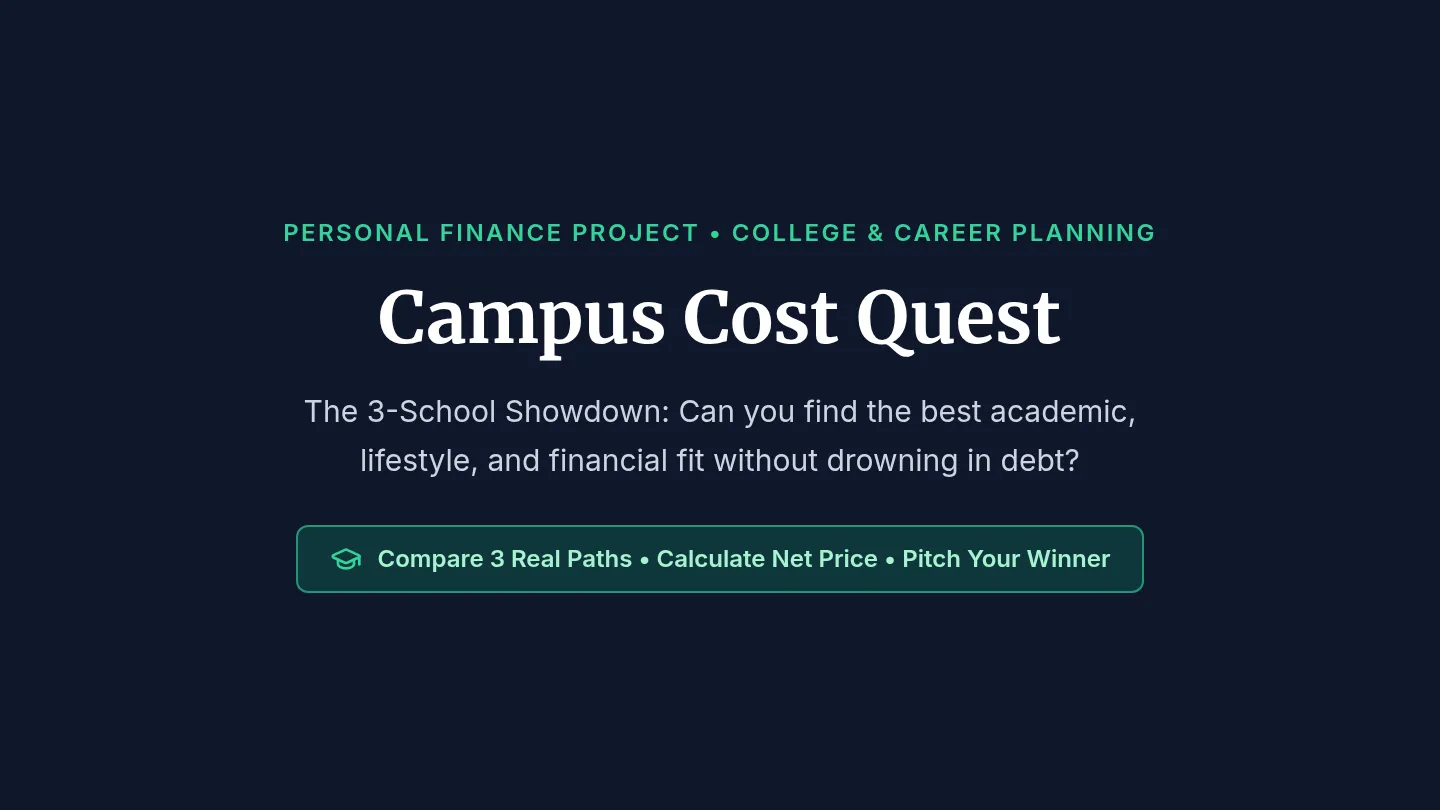
Campus Cost Quest SlidesPersonal Finance Project • College & Career Planning Campus Cost Quest The 3-School Showdown: Can you find the best academic, lifestyle, and financial fit without drowning in debt? Compare 3 Real Paths • Calculate Net Price • Pitch Your Winner Your Mission: Compare 3 Paths Path A: 2-Year / Trade A local community college, technical institute, or 2+2 transfer pathway. Path B: In-State Public A 4-year public university in your home state with resident tuition rates. Path C: Out-of-State / Private A dream out-of-state university or private college to test merit aid vs. cost. Key Concept #1 Sticker Price vs. Net Price Sticker Price (Cost of Attendance) The full published price: tuition + fees + room & board + books + travel. Almost nobody pays this exact number! Net Price (What You Actually Pay) Sticker Price minus grants and scholarships (free money you don't pay back). Always use a school's Net Price Calculator! Key Concept #2 The Student Loan Reality Check Quick Loan Math: Every $10,000 you borrow costs about $110/month for 10 years after graduation. The 10% Rule of Thumb: Keep your estimated monthly loan payment under 10% of your expected starting monthly pay—and total debt below your first-year salary. Cost Matters—But So Does Fit! Academic Fit: Does it offer your major, internships, and strong 4-year graduation rates? Location & Size: Close to home or far away? Big lecture halls or small classes? Career Outcomes: What do graduates actually earn in your target field? Hidden Costs: Parking, flights home, lab fees, and off-campus rent. Pitch Your Best-Fit Winner Once your 3-School Showdown packet is complete, prepare a 2-minute pitch explaining which school won—and prove it with your net price, loan math, and fit score! Tools: College Scorecard • BigFuture • School Net Price Calculators • BLS.gov
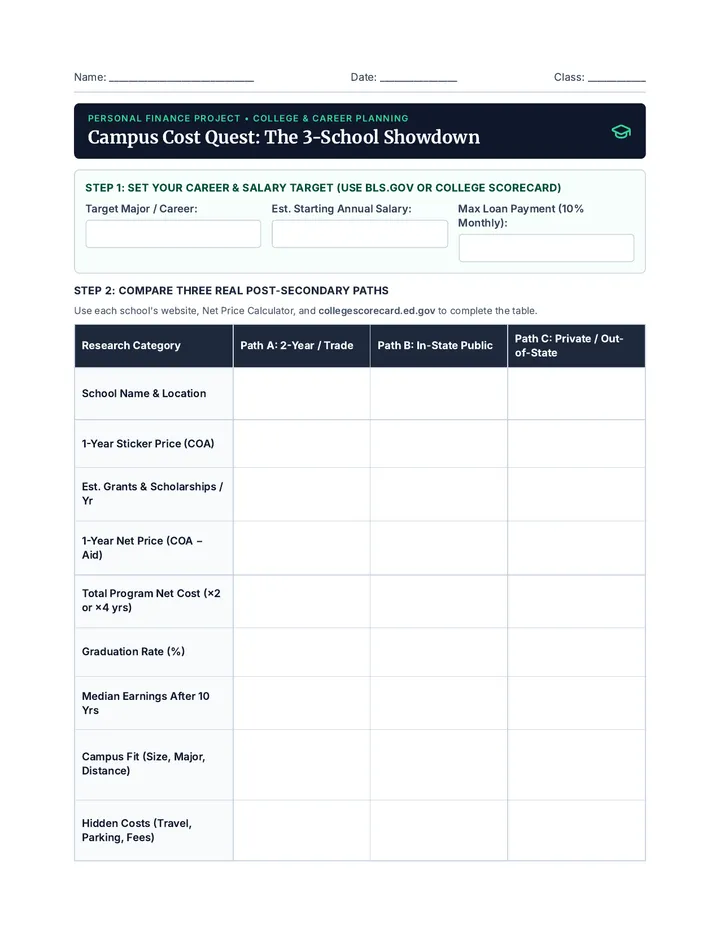
Campus Cost Quest Project GuideName: ______________________________ Date: ________________ Class: ____________ Personal Finance Project • College & Career Planning Campus Cost Quest: The 3-School Showdown Step 1: Set Your Career & Salary Target (Use BLS.gov or College Scorecard) Target Major / Career: Est. Starting Annual Salary: Max Loan Payment (10% Monthly): Step 2: Compare Three Real Post-Secondary Paths Use each school's website, Net Price Calculator, and collegescorecard.ed.gov to complete the table. Research Category Path A: 2-Year / Trade Path B: In-State Public Path C: Private / Out-of-State School Name & Location 1-Year Sticker Price (COA) Est. Grants & Scholarships / Yr 1-Year Net Price (COA − Aid) Total Program Net Cost (×2 or ×4 yrs) Graduation Rate (%) Median Earnings After 10 Yrs Campus Fit (Size, Major, Distance) Hidden Costs (Travel, Parking, Fees) Campus Cost Quest (Continued) Loan Math & Final Best-Fit Pitch Step 3: Student Loan Reality Check Assume you pay 25% of your Total Program Net Cost with savings/part-time work and borrow the remaining 75%. Use the rule of thumb: $110/month for every $10,000 borrowed. Loan Calculation Path A Path B Path C Est. Total Borrowed (75% of Net Cost) Est. Monthly Payment (÷ 10,000 × $110) Passes 10% Salary Rule? (Yes / No) Step 4: Best-Fit Scorecard (Rate 1–5, where 5 = Best) Fit Criterion Path A Path B Path C Affordability & Low Debt Risk Academic Program & Graduation Rate Campus Environment, Size & Location TOTAL FIT SCORE (out of 15) Step 5: Final Verdict & 2-Minute Pitch Notes Which school won your 3-School Showdown? Support your choice with 2 financial facts (net price, monthly loan payment, or ROI) and 2 personal/academic fit reasons.
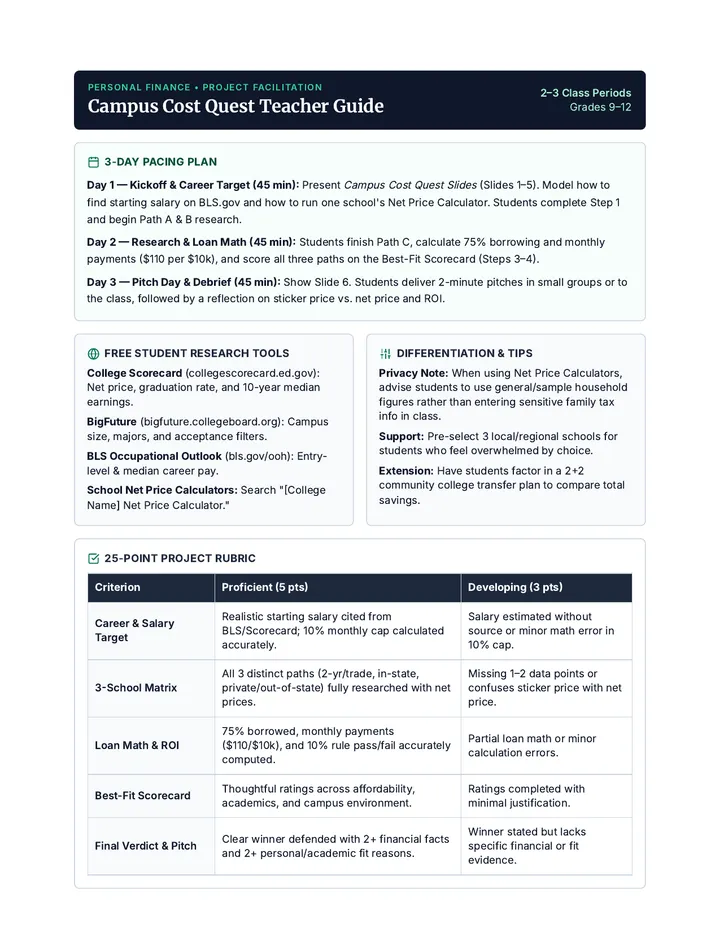
Campus Cost Quest Teacher GuidePersonal Finance • Project Facilitation Campus Cost Quest Teacher Guide 2–3 Class Periods Grades 9–12 3-Day Pacing Plan Day 1 — Kickoff & Career Target (45 min): Present Campus Cost Quest Slides (Slides 1–5). Model how to find starting salary on BLS.gov and how to run one school's Net Price Calculator. Students complete Step 1 and begin Path A & B research. Day 2 — Research & Loan Math (45 min): Students finish Path C, calculate 75% borrowing and monthly payments ($110 per $10k), and score all three paths on the Best-Fit Scorecard (Steps 3–4). Day 3 — Pitch Day & Debrief (45 min): Show Slide 6. Students deliver 2-minute pitches in small groups or to the class, followed by a reflection on sticker price vs. net price and ROI. Free Student Research Tools College Scorecard (collegescorecard.ed.gov): Net price, graduation rate, and 10-year median earnings. BigFuture (bigfuture.collegeboard.org): Campus size, majors, and acceptance filters. BLS Occupational Outlook (bls.gov/ooh): Entry-level & median career pay. School Net Price Calculators: Search "[College Name] Net Price Calculator." Differentiation & Tips Privacy Note: When using Net Price Calculators, advise students to use general/sample household figures rather than entering sensitive family tax info in class. Support: Pre-select 3 local/regional schools for students who feel overwhelmed by choice. Extension: Have students factor in a 2+2 community college transfer plan to compare total savings. 25-Point Project Rubric Criterion Proficient (5 pts) Developing (3 pts) Career & Salary Target Realistic starting salary cited from BLS/Scorecard; 10% monthly cap calculated accurately. Salary estimated without source or minor math error in 10% cap. 3-School Matrix All 3 distinct paths (2-yr/trade, in-state, private/out-of-state) fully researched with net prices. Missing 1–2 data points or confuses sticker price with net price. Loan Math & ROI 75% borrowed, monthly payments ($110/$10k), and 10% rule pass/fail accurately computed. Partial loan math or minor calculation errors. Best-Fit Scorecard Thoughtful ratings across affordability, academics, and campus environment. Ratings completed with minimal justification. Final Verdict & Pitch Clear winner defended with 2+ financial facts and 2+ personal/academic fit reasons. Winner stated but lacks specific financial or fit evidence.