Colonies to Sparks Slides 4th Grade History Bridge
From Colonies to Sparks
How 13 small settlements grew into a new nation ready for the American Revolution
1607: Jamestown → 1765: Stamp Act → 1775: Revolution
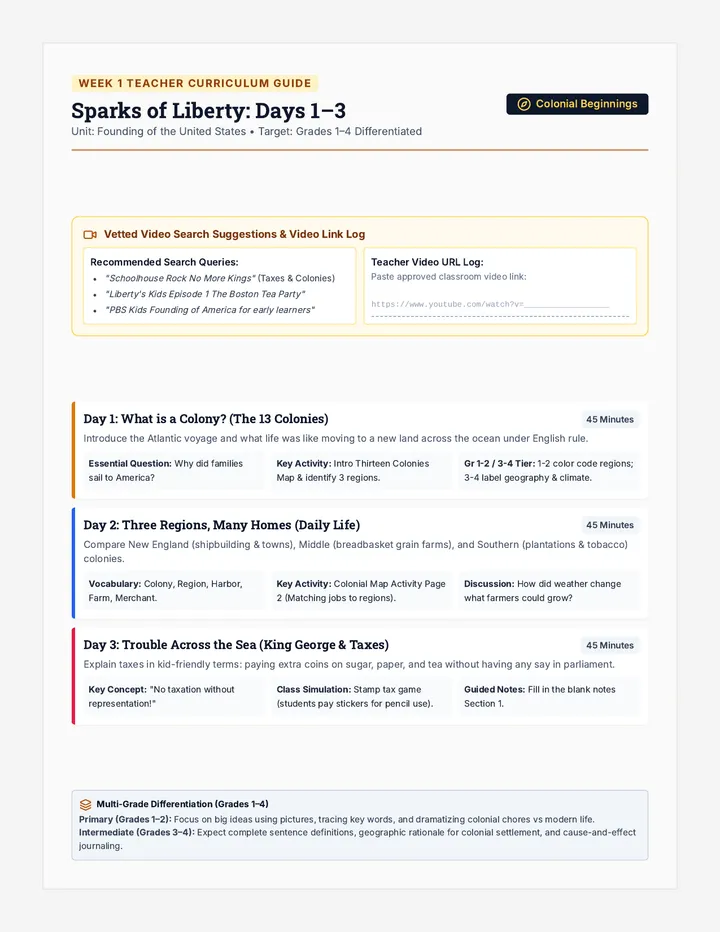
Step 1: Settlement (1607–1732)
Building the 13 Colonies
Settlers sailed from Britain to North America starting with Jamestown (1607) and Plymouth (1620) , forming three regions:
New England
Rocky soil and cold winters led colonists to fishing, whaling, and shipbuilding.
Middle
Rich soil and busy ports made this the “Breadbasket” of grain and trade.
Southern
Warm weather supported large farms growing tobacco, rice, and indigo.
Step 2: Self-Government
3,000 Miles Apart
For over 150 years , the Atlantic Ocean separated the colonies from King George III in Britain.
Because Britain was so far away, colonists got used to running their own towns and making their own local laws.
Town Meetings
Neighbors gathered to vote on schools, roads, and local leaders.
Colonial Pride
Colonists felt proud of building their own communities.
Step 3: New Taxes (1765)
“No Taxation Without Representation!”
After fighting an expensive war, Britain owed a lot of money. King George III and Parliament passed new taxes on the colonies—like the Stamp Act on paper goods.
The problem? Colonists had zero representatives in Britain’s government to vote on those taxes!
Key Idea:
Paying taxes felt unfair without a voice or vote.
Step 4: Rising Tension (1770–1774)
From Protests to Sparks
Boycotts
Colonists refused to buy British goods like cloth and tea to show their anger.
Boston Tea Party (1773)
Colonists dumped 342 chests of British tea into Boston Harbor to protest the Tea Act.
Britain sent more soldiers to Boston—and the 13 Colonies stood on the edge of war.
Next Unit: The American Revolution!
Quick Turn & Talk (1 Minute)
If you were a 4th grader in Boston in 1774, what would make you angriest about King George’s rules—and why?
Next: Complete your 2-minute Timeline Bridge Activity!
Colonies to Sparks Teacher Guide Teacher Pacing & Facilitation Guide
Colonies to Sparks
Grade 4 Social Studies
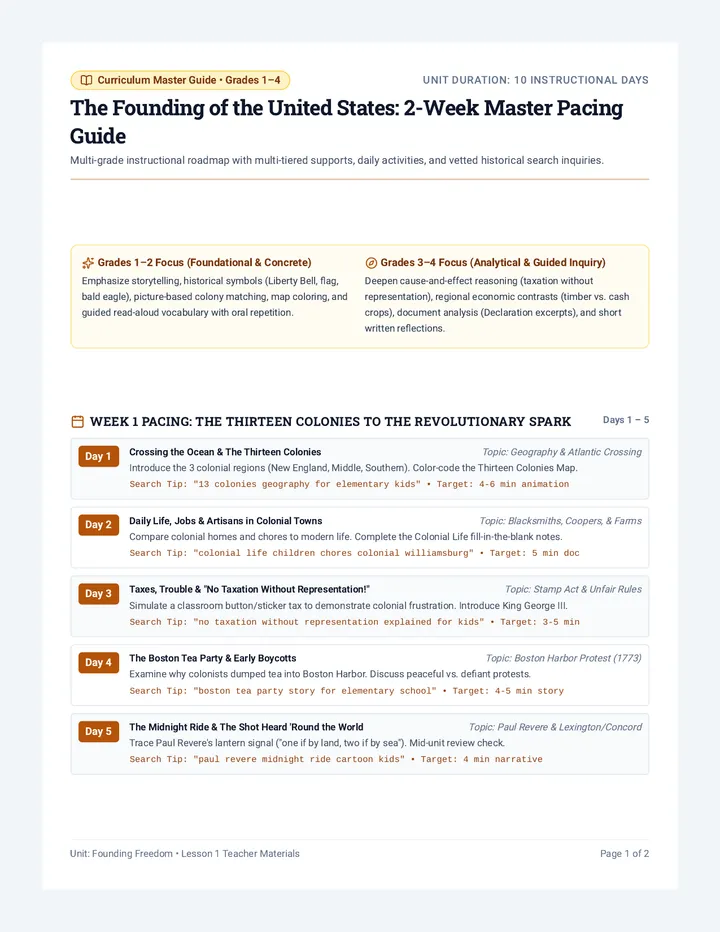
10-Minute Bridge Lesson
Lesson Objective: Students trace how the 13 Colonies grew from early settlements into self-governing communities, and explain how British taxes without representation sparked protests leading to the American Revolution.
10-Minute Pacing Plan
0:00 – 2:00 • Settlement Recap (Slides 1–2) 2 min
Activate prior knowledge: ask students to name Jamestown (1607) or Plymouth (1620). Briefly contrast the 3 regions (New England fishing/ships, Middle grain, Southern cash crops).
2:00 – 4:30 • Growing Apart (Slide 3) 2.5 min
Emphasize the 3,000-mile ocean gap. Over 150 years, colonists ran town meetings and local laws. Ask: “How would you feel if a principal far away suddenly changed your classroom rules?”
4:30 – 7:30 • Taxes & Sparks (Slides 4–5) 3 min
Explain Britain’s war debt, the Stamp Act, and the slogan “No taxation without representation!” Connect to boycotts and the 1773 Boston Tea Party. Video Tip: If adding a 2-minute YouTube clip, show it here and trim Turn & Talk to 30 seconds.
7:30 – 10:00 • Bridge Activity & Launch (Slide 6) 2.5 min
Run the 1-minute Turn & Talk, then have students complete the Timeline Bridge Activity to bridge into tomorrow’s American Revolution unit.
Key Vocabulary
Colony: A settlement ruled by a distant country.Representation: Having a voice or vote in government.Boycott: Refusing to buy goods as a protest.
Quick Supports
ELL / Visual: Act out “dumping tea” and point to Atlantic Ocean distance on a map.Extension: Ask early finishers to predict Britain’s next move after the Tea Party.
Timeline Bridge Activity — Answer Key
Part 1 Order: 1. Jamestown & Plymouth settled → 2. Colonists hold town meetings → 3. King George passes the Stamp Act → 4. Boston Tea Party protests taxes. | Part 2 Quick-Write: Look for mention of unfair taxes, no voice/vote (representation), or wanting to keep self-government.
Timeline Bridge Activity Name: ____________________________________
Date: ____________________
4th Grade History • 2-Minute Check
Timeline Bridge Activity
Part 1: Put History in Order
Write the numbers 1, 2, 3, and 4 in the blank boxes to show the order these events happened (1 = earliest, 4 = latest).
King George III and Parliament pass the Stamp Act , taxing colonial paper goods.
Settlers arrive in North America and build Jamestown and Plymouth .
Colonists dump 342 chests of British tea into the harbor during the Boston Tea Party .
Living 3,000 miles from Britain, colonists hold town meetings and make local laws.
Part 2: Quick Check
What did colonists mean by “No taxation without representation”?
A. Colonists wanted to move back to Britain to pay lower taxes.
B. Colonists thought it was unfair to pay taxes when they had no voice or vote in Britain’s government.
C. Colonists wanted to tax British ships that sailed to New England.
D. Colonists refused to grow crops in the Southern colonies.
Part 3: Ready for Revolution
In 1–2 sentences, explain why many colonists were ready to break away from Britain by 1775.