Lenny.com
Explore
Create
ActivitiesNewMathEnglish Language ArtsScience & EngineeringSocial StudiesGlobal LanguagesHealth & Physical EducationSpecial EducationCounseling & Life SkillsArts & CreativityESL
Lenny.com
Lenny.com
Explore
Create
ActivitiesNewMathEnglish Language ArtsScience & EngineeringSocial StudiesGlobal LanguagesHealth & Physical EducationSpecial EducationCounseling & Life SkillsArts & CreativityESL
Lenny.com
Lenny.com

Solutions

Lenny for EducatorsLenny for SchoolsLenny for Districts

Product

ExploreSign inCreateSupportAbout

Resources

Getting startedMTSS Acceleration Program

© 2026 Lenny Learning Inc.

TermsPrivacyAccessibility
LinkedInInstagramX
Lenny
Science & EngineeringLife ScienceLiving ThingsAnimalsPlantsBody SystemsTraitsAdaptationsCellsEcosystemsHeredityGenes to TraitsCell DivisionPhysicsComparing MaterialsShapes and PropertiesMagnetsMagnetismLightSoundLight and SoundMatterStates of MatterChanges of StateMixturesPhysical and Chemical ChangeHeating and CoolingHeat and Thermal EnergyEnergyForce and MotionElectrical CircuitsAtoms and MoleculesPeriodic TableMotion in One DimensionMotion in Two DimensionsScalars and VectorsForces and Laws of MotionCircular Motion and GravityMomentum and ImpulseWork, Energy, and PowerWavesElectromagnetic WavesGeometric OpticsElectricity and MagnetismSimple Harmonic MotionThermodynamicsNuclear PhysicsEarth Science & AstronomyWeatherWater CycleRocks and MineralsFossilsEarth's FeaturesEarth's ResourcesEarth's StructureWeather and ClimateEarth EventsFossils and Geologic TimePlate TectonicsHuman ImpactsAstronomyChemistryUnits and MeasurementAtomic StructurePeriodic TrendsChemical BondingNomenclatureMolecular StructureIntermolecular ForcesThe MoleStoichiometryProperties of GasesSolutionsChemical ReactionsBalancing EquationsEnergy ChangesRates of ReactionsEquilibriumAcids and BasesQuantum ModelBiologyClassificationCell StructureThe Chemistry of LifeBiomoleculesCellular TransportCell EnergyCell Growth and DivisionDNAProtein SynthesisMeiosis and Sexual ReproductionPatterns of InheritanceMulticellular OrganismsEvolutionEcologyBiodiversityComputer ScienceAlgorithms and Computational ThinkingProgramming LanguagesComputing SystemsNetworks and InternetData AnalysisCybersecurityAI and Machine LearningSoftware Design and DevelopmentBlockchainEngineering & AIDesigning ExperimentsEngineering PracticesDesign ThinkingEngineering Design ProcessMechanical EngineeringElectrical EngineeringMaterials and StructuresCAD and 3D DesignRoboticsArtificial Intelligence BasicsVibe CodingMachine LearningAI Ethics and SocietySystems ThinkingEntrepreneurship & InnovationEntrepreneurial MindsetBusiness Idea DevelopmentBusiness Plan BasicsMarketing & Customer DiscoveryFinancial Management for Startups

Carbon Trackers

An introductory Day 1 biology lesson investigating how plants acquire carbon from atmospheric carbon dioxide and return it through combustion, tracking atoms to demonstrate the conservation of matter across Earth systems (BI-LS2-5 and BI-LS2-4).

LPLeShonda Price

Carbon Trackers

An introductory Day 1 biology lesson investigating how plants acquire carbon from atmospheric carbon dioxide and return it through combustion, tracking atoms to demonstrate the conservation of matter across Earth systems (BI-LS2-5 and BI-LS2-4).

LPLeShonda Price
10.0 kg oak log
0.1 kg

4. Did the remaining 9.9 kg of matter get destroyed or converted into pure heat? Based on your knowledge of matter, what actually happened to those carbon atoms?

4

Part 4: The Atom-Counting Balance Sheet (BI-LS2-4)

Conservation of Matter

When wood fuel (represented here by glucose monomer \(\text{C}_6\text{H}_{12}\text{O}_6\)) burns in atmospheric oxygen (\(\text{O}_2\)), it undergoes complete combustion:

\[ \text{C}_6\text{H}_{12}\text{O}_6 \;(\text{wood fuel}) \;+\; 6\text{O}_2 \;(\text{air}) \;\longrightarrow\; 6\text{CO}_2 \;(\text{smoke/gas}) \;+\; 6\text{H}_2\text{O} \;(\text{vapor}) \]

Count the total number of each type of atom before the fire (Reactants) and after the fire (Products) to prove whether matter is conserved.

| Element / Atom | Reactant Side Atoms
(\(\text{C}_6\text{H}_{12}\text{O}_6 + 6\text{O}_2\)) | Product Side Atoms
(\(6\text{CO}_2 + 6\text{H}_2\text{O}\)) | Net Change
(Reactants − Products) | | --- | --- | --- | --- | | Carbon (\(\text{C}\)) | | | | | Hydrogen (\(\text{H}\)) | | | | | Oxygen (\(\text{O}\)) | | | | | TOTAL ATOMS | | | |

5

Part 5: Earth System Model Synthesis (BI-LS2-5)

5. Use your findings from today to explain how carbon cycles between the Atmosphere and Biosphere. Include the roles of both photosynthesis and combustion, and explicitly state what happens to the atoms during both events.

Page 2 of 2 • Carbon Trackers Student Investigation

Combustion Solutions, Atom Inventory & Evaluation Rubric

Complete answer keys for Parts 3, 4, and 5 with standard-aligned scoring criteria.

3 Part 3: Burning the Timber (Exemplar)

3 Points

4. Where did the missing 9.9 kg of matter go? Did it turn into pure energy?

Exemplar: Matter was not destroyed or converted into pure energy. In accordance with the Law of Conservation of Mass, the 9.9 kg of solid wood reacted with atmospheric \(\text{O}_2\) to form invisible gases—primarily carbon dioxide (\(\text{CO}_2\)) and water vapor (\(\text{H}_2\text{O}\))—that escaped into the atmosphere with smoke and hot air. The 0.1 kg ash left behind consists solely of non-flammable mineral nutrients (like potassium, calcium, magnesium) the tree took up from soil.

4 Part 4: Completed Atom-Counting Table (BI-LS2-4)

4 Points

| Element / Atom | Reactants
(\(\text{C}_6\text{H}_{12}\text{O}_6 + 6\text{O}_2\)) | Products
(\(6\text{CO}_2 + 6\text{H}_2\text{O}\)) | Net Change & Status | | --- | --- | --- | --- | | Carbon (\(\text{C}\)) | 6 (1 × 6) | 6 (6 × 1) | 0 (Conserved) | | Hydrogen (\(\text{H}\)) | 12 (1 × 12) | 12 (6 × 2) | 0 (Conserved) | | Oxygen (\(\text{O}\)) | 18 (6 + [6 × 2]) | 18 ([6 × 2] + 6) | 0 (Conserved) | | TOTAL ATOMS | 36 | 36 | 0 Net Change |

Conclusion: Exactly 36 atoms enter the combustion reaction and 36 atoms emerge; matter is 100% conserved.

5 Part 5: Synthesis Model & Rubric (BI-LS2-5)

3 Points

Exemplar Model Explanation:

"Carbon flows in a continuous cycle between the atmosphere and biosphere. During photosynthesis, trees absorb atmospheric \(\text{CO}_2\) gas through leaf stomata, fixing the carbon atoms into solid glucose and wood fibers (biosphere). When that wood is burned as fuel during combustion, the carbon atoms react with \(\text{O}_2\) and return right back into the atmosphere as \(\text{CO}_2\) gas. Throughout this entire cycle, no atoms are ever created or destroyed; they only change chemical bonds and physical states."

Level 4: AdvancedLevel 3: ProficientLevel 2: DevelopingLevel 1: Novice
Thoroughly explains bidirectional carbon flow between Atmosphere & Biosphere; correctly explains atom conservation and identifies \(\text{CO}_2\) in air and combustion gas.Identifies that carbon comes from atmospheric \(\text{CO}_2\) and returns via burning; correctly counts atoms in combustion table with zero errors.Understands trees take carbon from air, but struggles to explain where combustion products go or has minor calculation errors in atom table.Maintains misconception that tree mass comes from soil or that burning destroys matter; atom table incomplete.

Page 2 of 2 • Teacher Answer Key: Carbon Trackers

How do microscopic sugar molecules build thousands of pounds of rock-hard timber?

Molecular Hierarchy: Gas ⟶ Glucose ⟶ Cellulose Wood 50% Carbon by Dry Weight

1. Glucose Sugar (C₆H₁₂O₆) C₆ Ring Link 2. Cellulose Chain (Polymer) Tens of thousands of linked C-atoms Build 3. Solid Wood Trunk Rigid Biosphere Fiber

Summary: Wood is literally crystallized atmospheric carbon bonded by solar energy. Atmosphere ⟶ Biosphere


The Reversal • Fire & Smoke 05 / 07

Where Does Mass Go When Wood Burns?

You place a 10.0 kg oak log on a campfire. By morning, only 0.1 kg of ash remains.

Combustion Infographic 9.9 kg CO₂ Gas + H₂O Vapor Escapes Back into Atmosphere! 10.0 kg Wood Fuel 0.1 kg Ash

Did the Wood Turn into Pure Energy?

NO! Chemical bonds release thermal energy (heat/light), but physical atoms can never be destroyed!

The Mass Returned to the Sky

The 9.9 kg reacted with atmospheric \(\text{O}_2\) and dissolved right back into the air as invisible \(\text{CO}_2\) gas and steam.

The Great Return: Combustion reverses photosynthesis! Biosphere ⟶ Atmosphere


BI-LS2-4 • Conservation of Matter 06 / 07

The Unbroken Atom Ledger

Combustion reaction: \(\text{C}_6\text{H}_{12}\text{O}_6 \;(\text{wood}) + 6\text{O}_2 \;(\text{air}) \longrightarrow 6\text{CO}_2 \;(\text{gas}) + 6\text{H}_2\text{O} \;(\text{vapor})\)

Atom TypeReactants (Before Fire)Products (After Fire)Net Change
Carbon (\(\text{C}\))6 atoms6 atoms0 (Conserved)
Hydrogen (\(\text{H}\))12 atoms12 atoms0 (Conserved)
Oxygen (\(\text{O}\))18 atoms18 atoms0 (Conserved)
TOTAL ATOMS36 Atoms36 Atoms0 Atoms Lost

Law of Conservation: Not a single atom ceased to exist. They simply traded bonds. 100% Mass Conserved


BI-LS2-5 • The Earth Systems Model 07 / 07

The Bidirectional Carbon Cycle

Connecting the Atmosphere and Biosphere across Earth systems.

ATMOSPHERE CO₂ Gas Invisible Reservoir PHOTOSYNTHESIS (Fixes Gas into Wood) BIOSPHERE Wood Cellulose Living Organic Matter COMBUSTION / FIRE (Releases Wood back to Gas)

Day 2 Preview: How living organisms return carbon without fire (Cellular Respiration). Earth System Model Active

You might also like

Helix Studio Slides

Candy Code Sequence

A multi-day competency-based biology sequence exploring DNA architecture, complementary base pairing, and semi-conservative replication through tactile candy modeling and evidence-based assessment.

TM

Teri Minami

6
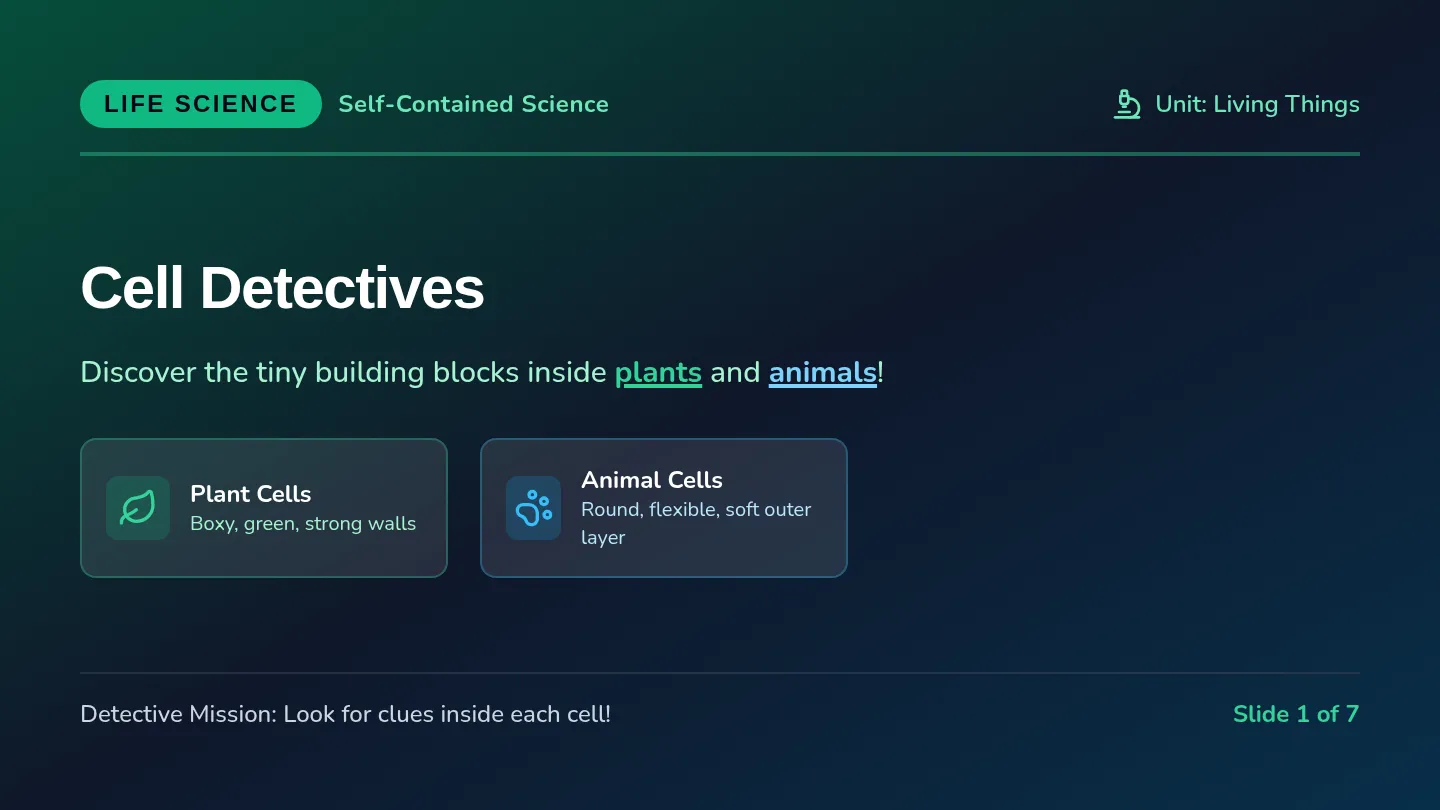
Cell Detectives Slides

Cell Detectives

A foundational life science lesson introducing plant and animal cells for self-contained classrooms, featuring high-contrast visual diagrams, simple analogies, and hands-on matching.

CF

Carissa Fenner

4
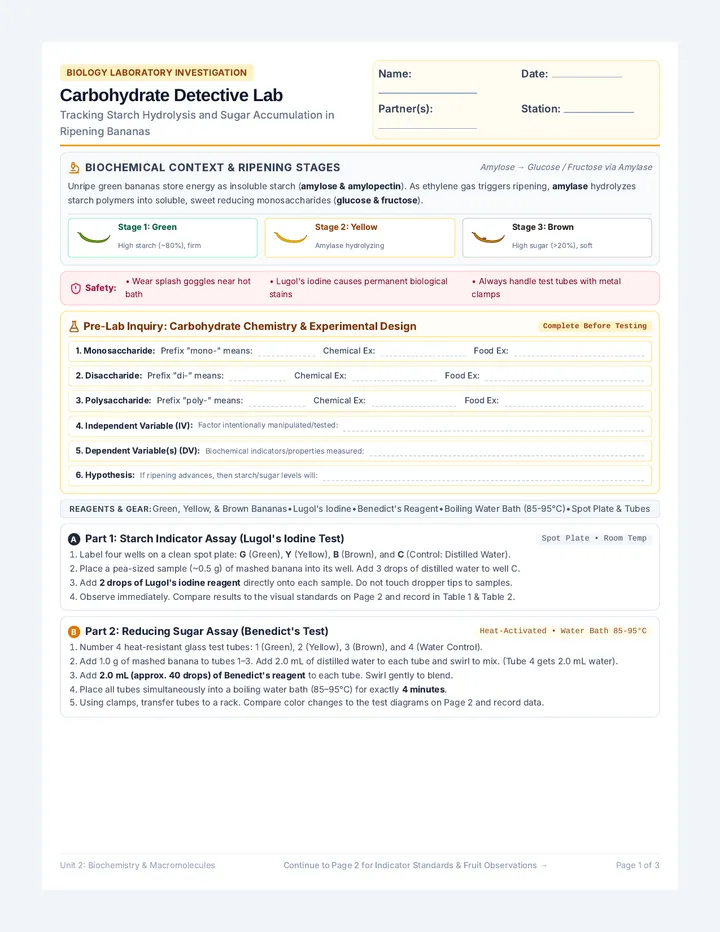
Banana Ripening Lab Worksheet

Banana Ripening Lab Worksheet

A comprehensive three-page student laboratory investigation worksheet examining carbohydrate changes across banana ripening stages, updated with 12px font sizing for enhanced legibility across instructional text, headers, and metadata, complete with visual indicator standards, photographic observation tables, and a NYS Regents biology item cluster with quantitative data and a student bar graphing grid.

S

stewart

Pesky Biters Slides

Bug Busters

A two-part fifth-grade science sequence investigating how insects can be annoying nuisances, bite and sting, and damage crops and homes. Specially scaffolded with high-visual supports, decodable text chunks, and guided practice for lower-literacy learners.

Lenny Avatar
Lenny
11
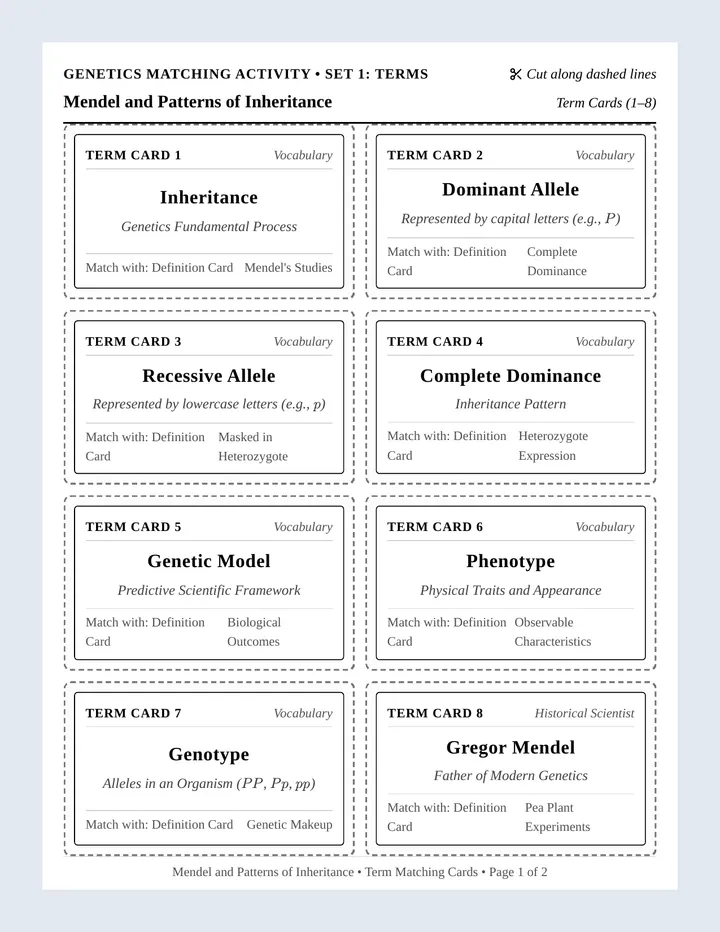
Mendel Inheritance Matching Cards

Mendel Inheritance

An introductory genetics lesson exploring Gregor Mendel's foundational pea plant experiments, inheritance patterns, allele types, genotype versus phenotype, and complete dominance.

MB

Marsha Bolden

4
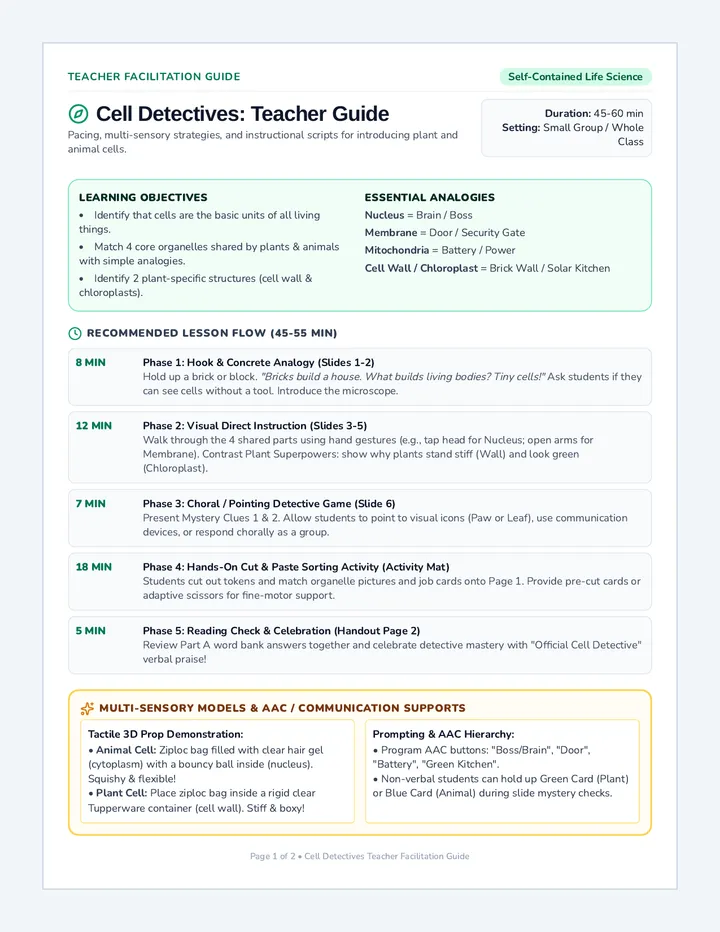
Cell Detectives Teacher Guide

Cell Detectives Teacher Guide

A 2-page instructional guide for teachers containing lesson pacing, multi-sensory accommodations, communication support cues, full answer keys, and tiered rubrics.

CF

Carissa Fenner

Helix Studio Slides

Candy Code Sequence

A multi-day competency-based biology sequence exploring DNA architecture, complementary base pairing, and semi-conservative replication through tactile candy modeling and evidence-based assessment.

TM

Teri Minami

4
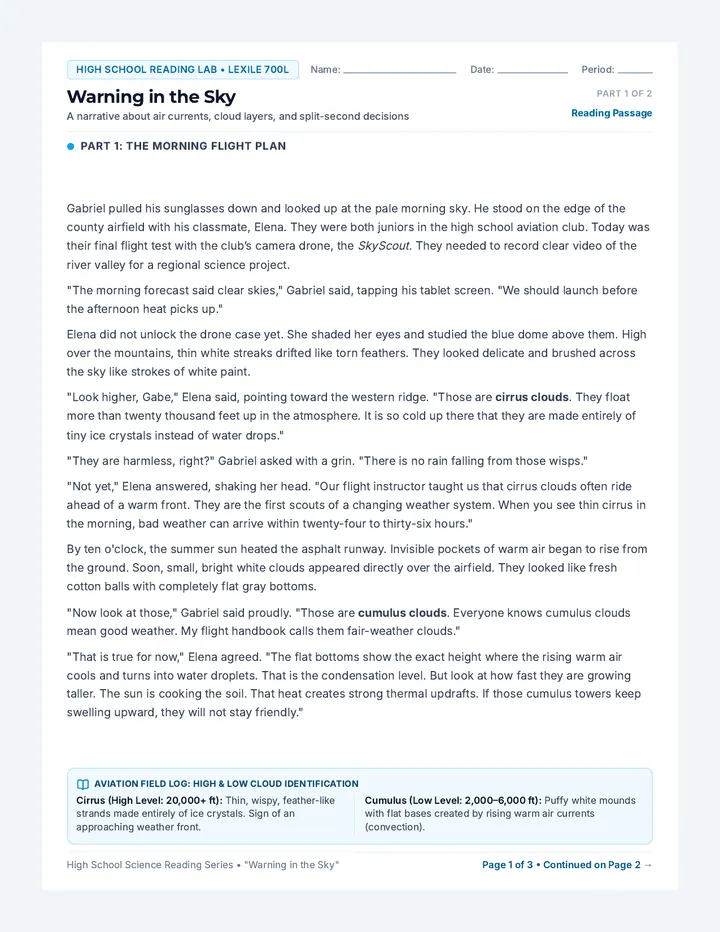
Warning Sky Cloud Passage

Cloud Watchers

An instructional reading and earth science lesson exploring cloud classification and atmospheric conditions through high-interest narrative text tailored for high school readers.

EB

Emily Bear

2
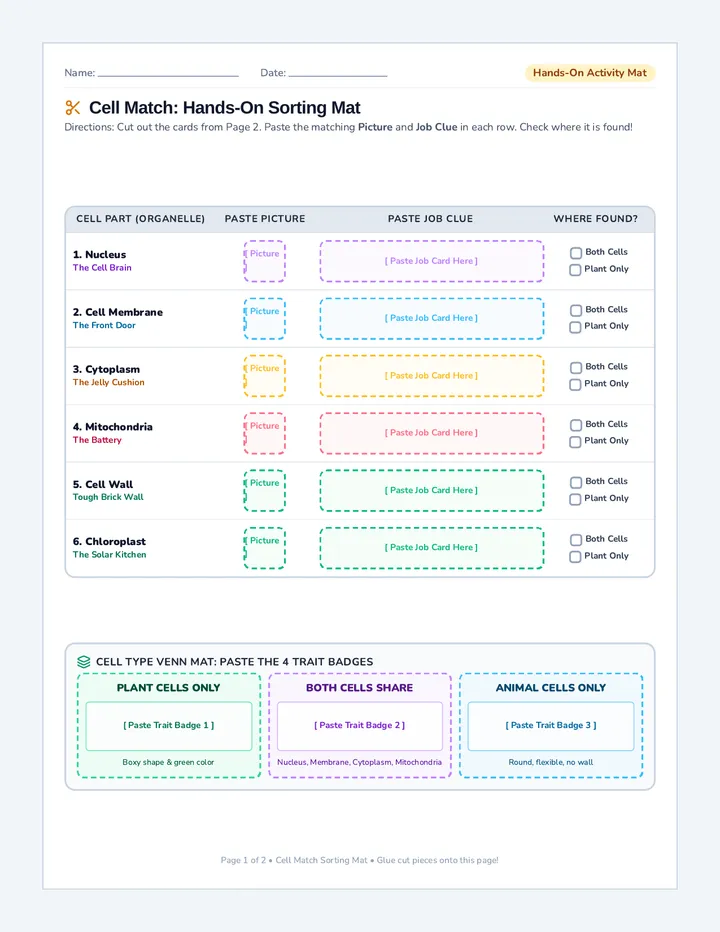
Cell Match Sorting Activity

Cell Match Sorting Activity

A 2-page hands-on cut-and-paste sorting activity featuring a structured matching mat on Page 1 and tactile cut-out tokens (pictures, names, and job analogies) on Page 2 for self-contained learners.

CF

Carissa Fenner

Habitability Blueprint Slides

Life Beyond Limits

A one-week interdisciplinary astrobiology sequence investigating Earth's habitability, extreme biological adaptations across eleven Earth species, and the plausibility of life on other celestial bodies.

M

Megan.Tanner

7
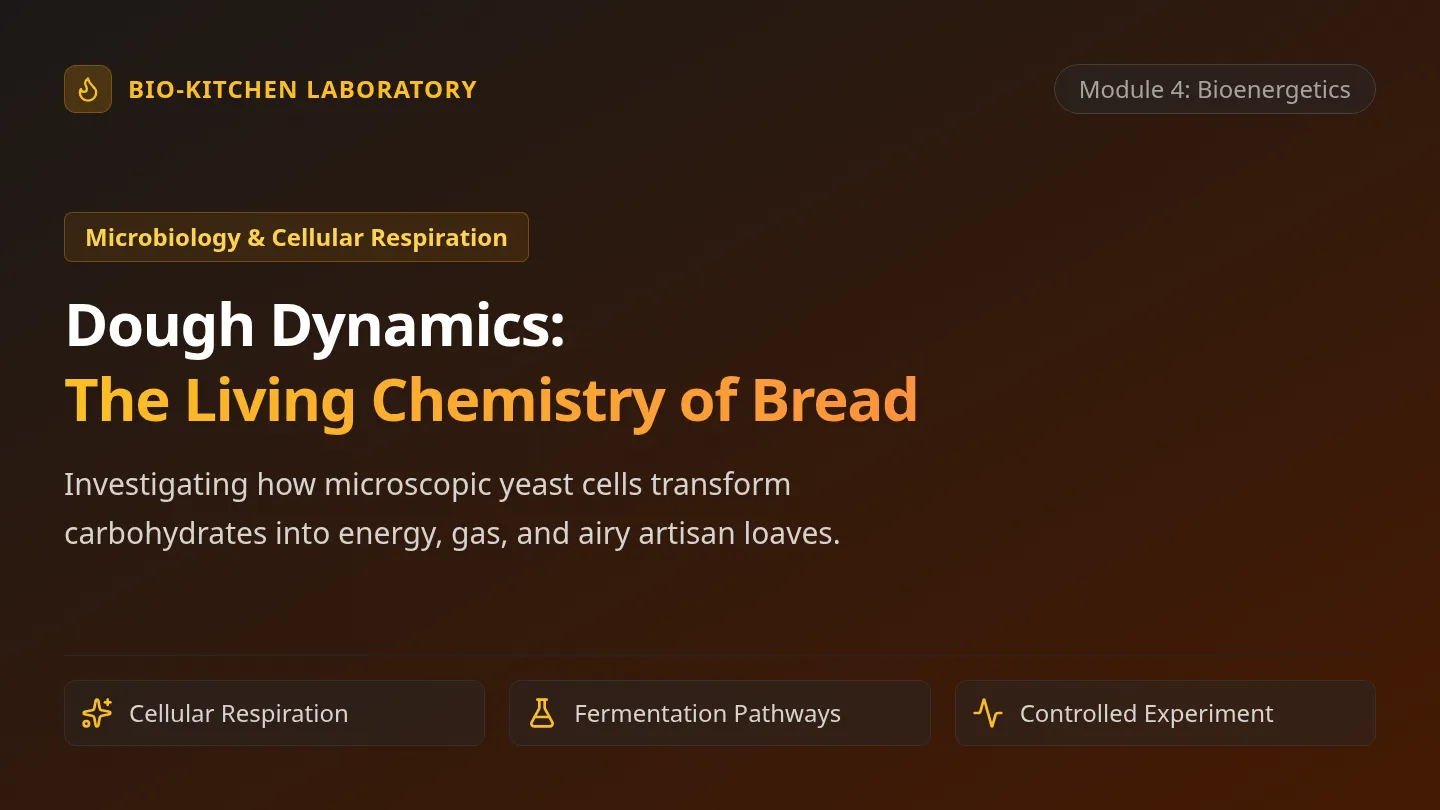
Dough Dynamics Slides

Dough Dynamics

An investigative biology project connecting the culinary science of bread making with cellular respiration and anaerobic fermentation in yeast. Students examine metabolic pathways, design and execute a controlled yeast experiment, and synthesize their findings in a comprehensive lab report.

M

Matthew.Temple

2
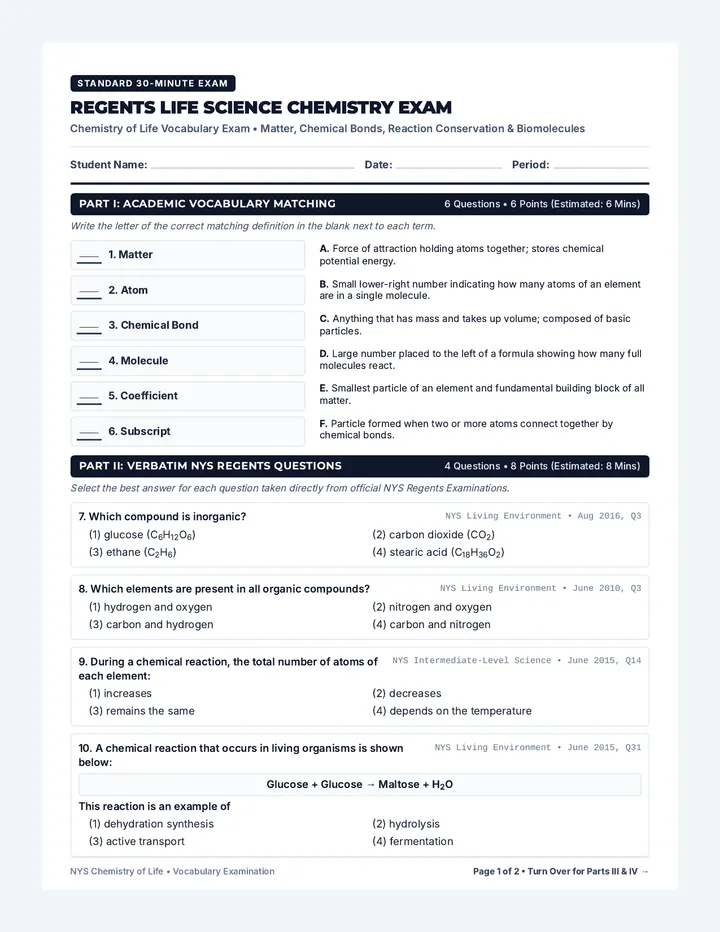
Regents Life Science Chemistry Exam

Chemistry of Life

A foundational unit exploring the chemistry of life, chemical reactions in living organisms, conservation of matter, and organic compounds.

JE

Jeffrey Elterman

3