Regents Life Science Chemistry Exam
Standard 30-Minute Exam
Regents Life Science Chemistry Exam
Chemistry of Life Vocabulary Exam • Matter, Chemical Bonds, Reaction Conservation & Biomolecules
Student Name:
Date:
Period:
Part I: Academic Vocabulary Matching
6 Questions • 6 Points (Estimated: 6 Mins)
Write the letter of the correct matching definition in the blank next to each term.
___ 1. Matter
___ 2. Atom
___ 3. Chemical Bond
___ 4. Molecule
___ 5. Coefficient
___ 6. Subscript
A. Force of attraction holding atoms together; stores chemical potential energy.
B. Small lower-right number indicating how many atoms of an element are in a single molecule.
C. Anything that has mass and takes up volume; composed of basic particles.
D. Large number placed to the left of a formula showing how many full molecules react.
E. Smallest particle of an element and fundamental building block of all matter.
F. Particle formed when two or more atoms connect together by chemical bonds.
Part II: Verbatim NYS Regents Questions
4 Questions • 8 Points (Estimated: 8 Mins)
Select the best answer for each question taken directly from official NYS Regents Examinations.
7. Which compound is inorganic?
NYS Living Environment • Aug 2016, Q3
(1) glucose (C6H12O6)
(2) carbon dioxide (CO2)
(3) ethane (C2H6)
(4) stearic acid (C18H36O2)
8. Which elements are present in all organic compounds?
NYS Living Environment • June 2010, Q3
(1) hydrogen and oxygen
(2) nitrogen and oxygen
(3) carbon and hydrogen
(4) carbon and nitrogen
9. During a chemical reaction, the total number of atoms of each element:
NYS Intermediate-Level Science • June 2015, Q14
(1) increases
(2) decreases
(3) remains the same
(4) depends on the temperature
10. A chemical reaction that occurs in living organisms is shown below:
NYS Living Environment • June 2015, Q31
Glucose + Glucose → Maltose + H2O
This reaction is an example of
(1) dehydration synthesis
(2) hydrolysis
(3) active transport
(4) fermentation
NYS Chemistry of Life • Vocabulary Examination Page 1 of 2 • Turn Over for Parts III & IV →
Regents Life Science Chemistry Exam • Section II
Chemical Formulas, Conservation & Constructed Response Prompts
Student:
Part III: Chemical Recipe & Atom Conservation Tally
6 Points (Estimated: 8 Mins)
Analyze the cellular equation below. Use coefficients and subscripts to complete the atom tally table and prove conservation.
Cellular Respiration / Photosynthesis Equilibrium Reaction
6CO2 + 6H2O → C6H12O6 + 6O2
INPUTS (Reactants) → (Yield Sign: "Reacts to Produce") OUTPUTS (Products)
| Element Symbol | INPUTS (Reactants Tally) | OUTPUTS (Products Tally) |
|---|
| Carbon (C) | 6 × 1 = 6 | 1 × 6 = 6 |
| Hydrogen (H) | | |
| Oxygen (O) | | |
11. Conclusion & Law of Conservation of Matter [2 pts]: Based on your completed tally table, explain how the total number of reactant atoms compares to the product atoms, and state whether any atoms were destroyed:
Part IV: Regents Constructed Response Prompts
3 Questions • 10 Points (Estimated: 8 Mins)
Respond completely in the provided lines. Questions are reproduced verbatim from NYS Regents examinations.
12. Identify the two chemical elements that must be present in a compound for it to be classified as organic. [2 pts]
NYS Living Environment • Jan 2014, Q56
Element 1:
Element 2:
13. Dehydration Synthesis vs. Hydrolysis Analysis [4 pts]
NYS Living Environment • June 2017, Q36-37
Base your answer on the reaction: Maltose + H2O → Glucose + Glucose
a) Identify the specific reaction type shown above (Dehydration Synthesis or Hydrolysis):
b) Describe what happens to water (H2O) and the chemical bond connecting the glucose subunits:
14. Chemical Potential Energy in Living Organisms [4 pts]
NYS Living Environment • Jan 2016, Q44
State what happens to the chemical potential energy stored in the bonds of food molecules (like glucose) when those bonds are broken during cellular digestion or respiration.
✓ Double check all work and ensure all atom tallies balance before handing in. End of Examination • 30 Minutes
Regents Chemistry Spanish Exam
Examen Estándar de 30 Minutos
Examen de Regents Química de Ciencias de la Vida
Vocabulario de la Química de la Vida • Materia, Enlaces Químicos, Conservación y Biomoléculas
Nombre del Estudiante:
Fecha:
Período:
Parte I: Vocabulario Académico
6 Preguntas • 6 Puntos (6 min)
Escribe la letra de la definición correspondiente en la línea junto a cada término.
___ 1. Materia
___ 2. Átomo
___ 3. Enlace químico
___ 4. Molécula
___ 5. Coeficiente
___ 6. Subíndice
A. Fuerza de atracción que une a los átomos; almacena energía potencial química.
B. Número inferior derecho que indica cuántos átomos hay en una sola molécula.
C. Todo lo que tiene masa y ocupa volumen; compuesto por partículas básicas.
D. Número a la izquierda de una fórmula que indica cuántas moléculas reaccionan.
E. Partícula más pequeña de un elemento y bloque de construcción de la materia.
F. Partícula formada por dos o más átomos unidos por enlaces químicos.
Parte II: Preguntas Oficiales Regents de NYS
4 Preguntas • 8 Puntos (8 min)
Selecciona la mejor respuesta para cada pregunta tomada directamente de los exámenes Regents de NYS.
7. ¿Cuál compuesto es inorgánico?
NYS Entorno Vivo • Ago 2016, P3
(1) glucosa (C6H12O6)
(2) dióxido de carbono (CO2)
(3) etano (C2H6)
(4) ácido esteárico (C18H36O2)
8. ¿Cuáles elementos están presentes en todos los compuestos orgánicos?
NYS Entorno Vivo • Jun 2010, P3
(1) hidrógeno y oxígeno
(2) nitrógeno y oxígeno
(3) carbono e hidrógeno
(4) carbono y nitrógeno
9. Durante una reacción química, el número total de átomos de cada elemento:
NYS Ciencias Intermedio • Jun 2015, P14
(1) aumenta
(2) disminuye
(3) permanece igual
(4) depende de la temperatura
10. A continuación se muestra una reacción química que ocurre en los organismos vivos:
NYS Entorno Vivo • Jun 2015, P31
Glucosa + Glucosa → Maltosa + H2O
Esta reacción es un ejemplo de
(1) síntesis por deshidratación
(2) hidrólisis
(3) transporte activo
(4) fermentación
NYS Química de la Vida • Examen de Vocabulario Página 1 de 2 • Voltee la hoja para las Partes III y IV →
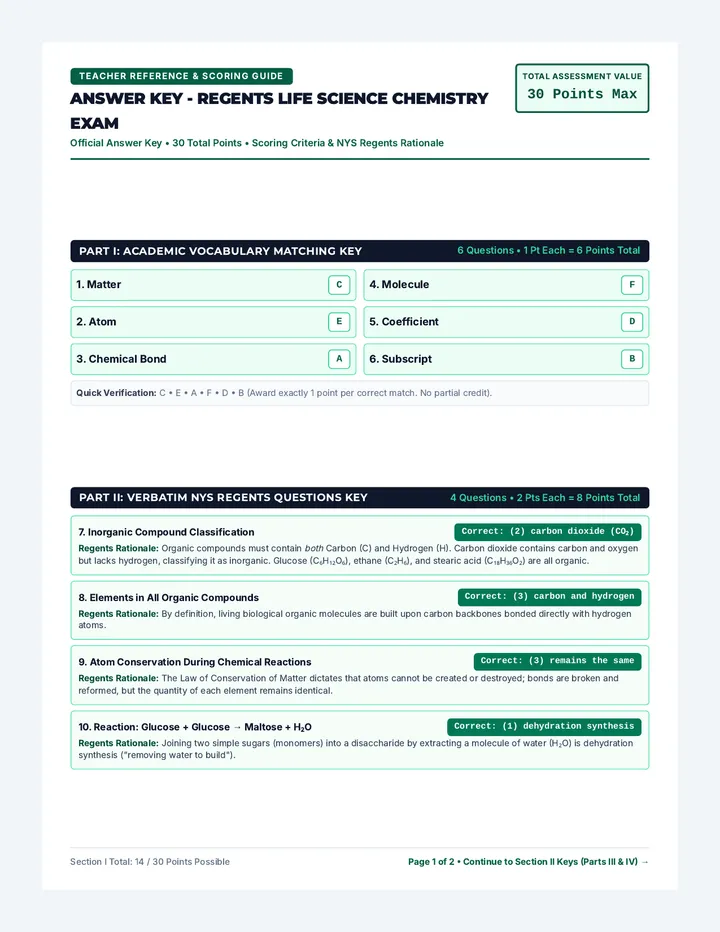
Answer Key - Regents Life Science Chemistry Exam
Teacher Reference & Scoring Guide
Answer Key - Regents Life Science Chemistry Exam
Official Answer Key • 30 Total Points • Scoring Criteria & NYS Regents Rationale
Total Assessment Value 30 Points Max
Part I: Academic Vocabulary Matching Key
6 Questions • 1 Pt Each = 6 Points Total
1. Matter C
2. Atom E
3. Chemical Bond A
4. Molecule F
5. Coefficient D
6. Subscript B
Quick Verification: C • E • A • F • D • B (Award exactly 1 point per correct match. No partial credit).
Part II: Verbatim NYS Regents Questions Key
4 Questions • 2 Pts Each = 8 Points Total
7. Inorganic Compound Classification Correct: (2) carbon dioxide (CO₂)
Regents Rationale: Organic compounds must contain both Carbon (C) and Hydrogen (H). Carbon dioxide contains carbon and oxygen but lacks hydrogen, classifying it as inorganic. Glucose (C₆H₁₂O₆), ethane (C₂H₆), and stearic acid (C₁₈H₃₆O₂) are all organic.
8. Elements in All Organic Compounds Correct: (3) carbon and hydrogen
Regents Rationale: By definition, living biological organic molecules are built upon carbon backbones bonded directly with hydrogen atoms.
9. Atom Conservation During Chemical Reactions Correct: (3) remains the same
Regents Rationale: The Law of Conservation of Matter dictates that atoms cannot be created or destroyed; bonds are broken and reformed, but the quantity of each element remains identical.
10. Reaction: Glucose + Glucose → Maltose + H₂O Correct: (1) dehydration synthesis
Regents Rationale: Joining two simple sugars (monomers) into a disaccharide by extracting a molecule of water (H₂O) is dehydration synthesis ("removing water to build").
Section I Total: 14 / 30 Points Possible Page 1 of 2 • Continue to Section II Keys (Parts III & IV) →
Answer Key - Regents Life Science Chemistry Exam • Section II
Conservation Tally & Constructed Response Scoring Rubrics (16 Points Max)
Parts III & IV Scoring
Part III: Atom Conservation Tally & Conclusion Key
6 Points Total (4 pts Table + 2 pts Q11)
6CO2 + 6H2O → C6H12O6 + 6O2
| Element | INPUTS (Reactants Tally) | OUTPUTS (Products Tally) |
|---|
| Carbon (C) | 6 × 1 = 6 [Given] | 1 × 6 = 6 [Given] |