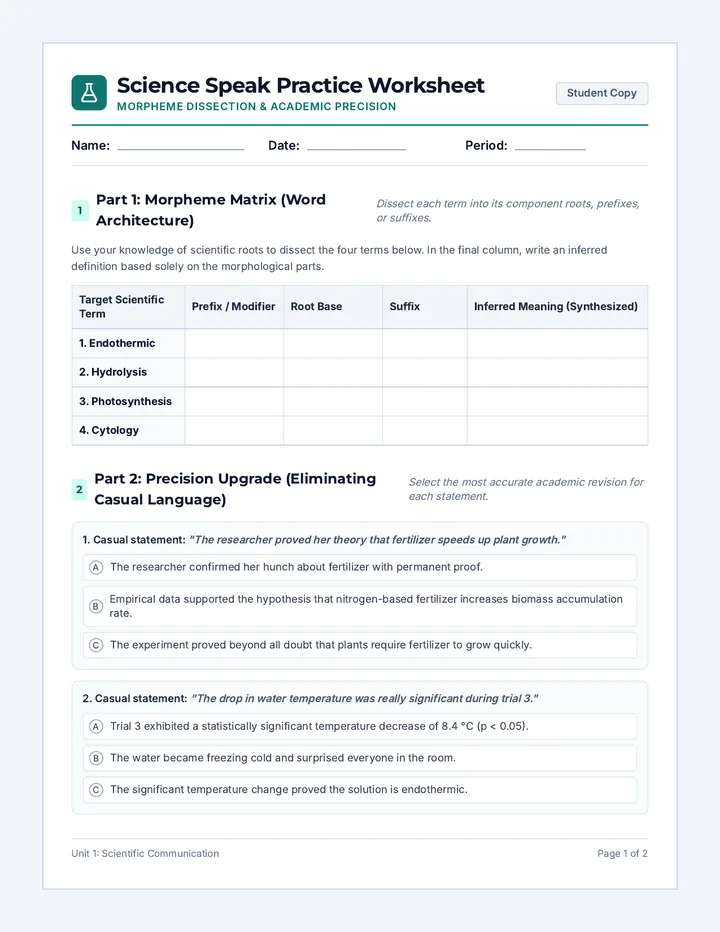
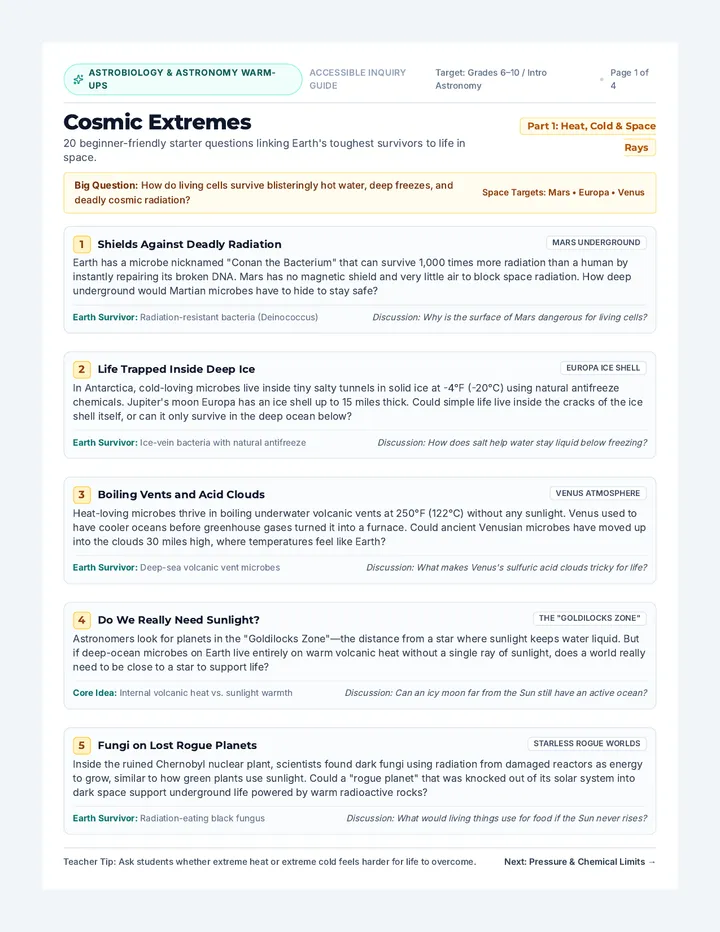
A complete instructional unit focused on mastering scientific vocabulary, Greek and Latin root deciphering, and Claim-Evidence-Reasoning communication frameworks. Students learn to translate everyday observations into rigorous scientific discourse and structured technical writing.
R Reasoning: Explain the biological principle (kinetic energy and protein denaturation). Scientific principle link
Scientific Discourse Self-Check
Exact units used (\(\text{mL/min}\), °C) No casual terms ("proved", "hunch") Mechanism explained (denature)
Science Speak • Student Handout Page 2 of 2
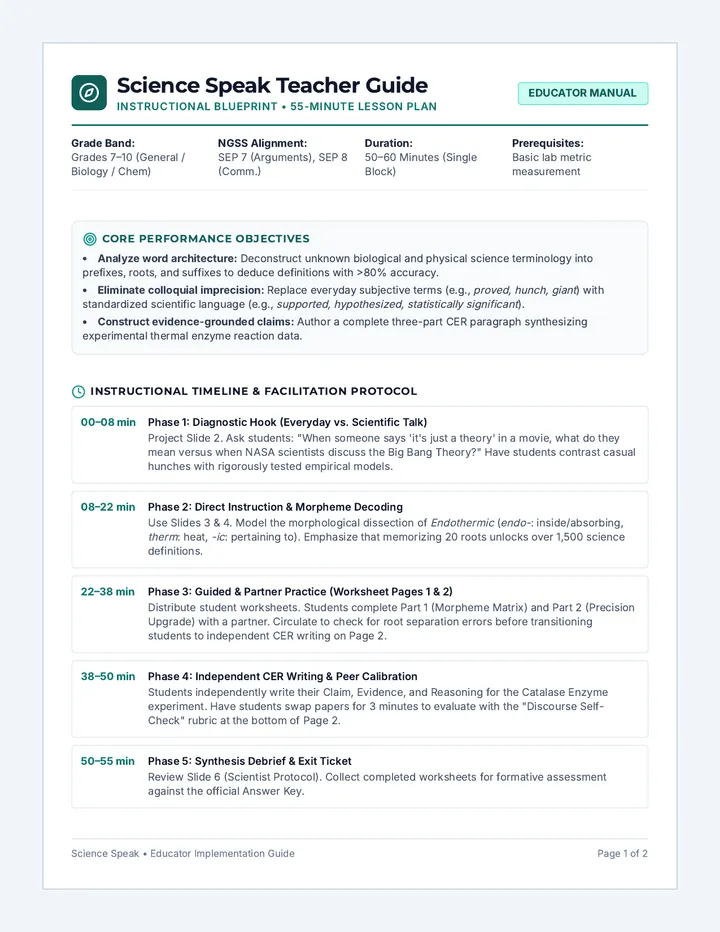
Science Speak • Educator Implementation Guide Page 1 of 2
Pedagogical Frameworks & Differentiation
Addressing Misconceptions & Tiered Scaffolding
Document Page 2
Targeted Misconception Interventions
Frequent Student Error
Root Conceptual Confusion
Teacher Coaching Prompt
"The experiment completely proved that my hypothesis is true."
Viewing science as seeking absolute mathematical certainty rather than empirical support.
"In empirical science, can future data or better instruments ever modify our findings? Replace 'proved' with 'supports' or 'corroborates'."
Writing Evidence that only lists numbers without units: "It was 9.6."
Treating experimental figures as isolated math numbers rather than physical dimensional quantities.
"9.6 what? Liters? Minutes? Every scientific value requires both magnitude and unit (\(\text{mL/min}\))."
Confusing "Reasoning" with repeating the evidence: "The reason is it went up to 9.6."
Failing to articulate the underlying scientific mechanism or natural law.
"Evidence is WHAT occurred. Reasoning explains WHY the molecule reacted that way. What happens to enzymes at high heat?"
Tiered Instructional Scaffolds
Multilingual & IEP Scaffolds
Cognate Anchor: Highlight Spanish cognates for Latin roots (e.g., foto for light, hidro for water, termo for heat).
Sentence Starters: Provide structured sentence frames for CER: "The optimal temperature is _____ because the data reveals that at this condition, _____. This occurs because enzymes denature when _____."
Word Bank Cards: Supply laminated index cards with color-coded prefixes (cyan) and suffixes (emerald).
Advanced Extension Challenges
Counterclaim Refutation: Require students to add a 4th component: Anticipate and disprove an alternative explanation (e.g., substrate limitation vs. thermal denaturation).
Morpheme Inversion: Challenge students to coin and define novel compound scientific words using Latin roots (e.g., Thermophilic cryobiology).
Statistical Discussion: Have students propose standard deviation and confidence interval requirements for the 5 trials.
Mastery Criteria (4-Point CER Assessment Scale)
Score 4 (Exemplary) Explicit claim, quantitative comparative data with units, molecular mechanism (denaturation/kinetic energy) explained.
Score 3 (Proficient) Accurate claim and data with units included; reasoning explains general trend but lacks molecular details.
Score 2 (Developing) Claim present but vague; evidence lacks units or comparative data; reasoning merely repeats evidence.
Score 1 (Beginning) Incomplete claim; colloquial phrases used ("proved", "giant"); no connection to scientific principles.
Science Speak • Educator Implementation Guide Page 2 of 2
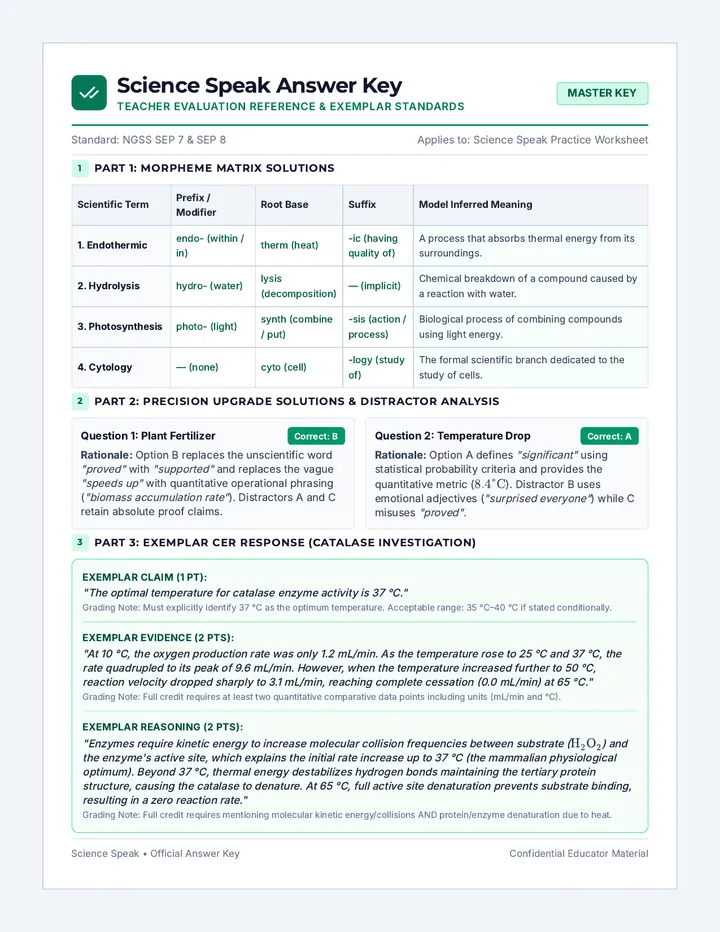
Grading Note: Full credit requires at least two quantitative comparative data points including units (mL/min and °C).
Exemplar Reasoning (2 Pts):
"Enzymes require kinetic energy to increase molecular collision frequencies between substrate (\(\text{H}_2\text{O}_2\)) and the enzyme's active site, which explains the initial rate increase up to 37 °C (the mammalian physiological optimum). Beyond 37 °C, thermal energy destabilizes hydrogen bonds maintaining the tertiary protein structure, causing the catalase to denature. At 65 °C, full active site denaturation prevents substrate binding, resulting in a zero reaction rate."
Grading Note: Full credit requires mentioning molecular kinetic energy/collisions AND protein/enzyme denaturation due to heat.
Science Speak • Official Answer Key Confidential Educator Material