Bohr Model Practice WorksheetName: Class Block: Date: BOHR MODEL PRACTICE — PART 1 Page 1 of 2 Directions: Choose a color for each subatomic particle and fill in the color key below. Complete the calculations for each atom, then draw colored dots for protons and neutrons in the nucleus and electrons on the energy rings. Color Key: Protons (p⁺) Neutrons (n⁰) Electrons (e⁻) Shell Reminder Ring 1: max 2e⁻ • Ring 2: max 8e⁻ 1 H Hydrogen Mass: 1.01 amu (≈ 1) #1 Protons (p⁺): Neutrons (n⁰): Electrons (e⁻): Valence e⁻: Period in Periodic Table: Energy Level 1 (max 2e⁻) 2 He Helium Mass: 4.00 amu (≈ 4) #2 Protons (p⁺): Neutrons (n⁰): Electrons (e⁻): Valence e⁻: Period in Periodic Table: Energy Level 1 (max 2e⁻) 3 Li Lithium Mass: 6.94 amu (≈ 7) #3 Protons (p⁺): Neutrons (n⁰): Electrons (e⁻): Valence e⁻: Period in Periodic Table: Level 2 (Outer) Level 1 4 Be Beryllium Mass: 9.01 amu (≈ 9) #4 Protons (p⁺): Neutrons (n⁰): Electrons (e⁻): Valence e⁻: Period in Periodic Table: Level 2 (Outer) Level 1 5 B Boron Mass: 10.81 amu (≈ 11) #5 Protons (p⁺): Neutrons (n⁰): Electrons (e⁻): Valence e⁻: Period in Periodic Table: Level 2 (Outer) Level 1 6 C Carbon Mass: 12.01 amu (≈ 12) #6 Protons (p⁺): Neutrons (n⁰): Electrons (e⁻): Valence e⁻: Period in Periodic Table: Level 2 (Outer) Level 1 Atomic Math Key: Protons = Atomic # • Electrons = Protons (Neutral Atom) • Neutrons = Mass # − Atomic # Name: Class Block: Date: BOHR MODEL PRACTICE — PART 2 Page 2 of 2 Directions: Continue using your color key for protons, neutrons, and electrons. Calculate the particle counts, then draw colored dots in the nucleus and on the energy rings (watch for 3-shell atoms!). Color Key: Protons (p⁺) Neutrons (n⁰) Electrons (e⁻) Shell Reminder Ring 1: ≤ 2e⁻ • Ring 2: ≤ 8e⁻ • Ring 3: ≤ 8e⁻ 8 O Oxygen Mass: 16.00 amu (≈ 16) #7 Protons (p⁺): Neutrons (n⁰): Electrons (e⁻): Valence e⁻: Period in Periodic Table: Level 2 (Outer) Level 1 10 Ne Neon Mass: 20.18 amu (≈ 20) #8 Protons (p⁺): Neutrons (n⁰): Electrons (e⁻): Valence e⁻: Period in Periodic Table: Level 2 (Outer) Level 1 11 Na Sodium Mass: 22.99 amu (≈ 23) #9 Protons (p⁺): Neutrons (n⁰): Electrons (e⁻): Valence e⁻: Period in Periodic Table: Level 3 (Outer) 14 Si Silicon Mass: 28.09 amu (≈ 28) #10 Protons (p⁺): Neutrons (n⁰): Electrons (e⁻): Valence e⁻: Period in Periodic Table: Level 3 (Outer) 16 S Sulfur Mass: 32.07 amu (≈ 32) #11 Protons (p⁺): Neutrons (n⁰): Electrons (e⁻): Valence e⁻: Period in Periodic Table: Level 3 (Outer) 17 Cl Chlorine Mass: 35.45 amu (≈ 35) #12 Protons (p⁺): Neutrons (n⁰): Electrons (e⁻): Valence e⁻: Period in Periodic Table: Level 3 (Outer) Atomic Math Key: Protons = Atomic # • Electrons = Protons (Neutral Atom) • Neutrons = Mass # − Atomic #
Bohr Model Starter WorksheetName: Class Block: Date: BUILDING ATOM MODELS — PART 1 Page 1 of 2 Steps: 1. Color the 3 circles in the key. 2. Find the parts of each atom. 3. Draw colored dots for protons and neutrons in the center circle. Draw electron dots on the rings! Color Key: Proton (p⁺) Neutron (n⁰) Electron (e⁻) Ring Rules Ring 1: fits up to 2 • Ring 2: fits up to 8 1 H Hydrogen Weight: 1.01 (round to 1) #1 Protons (top number): Neutrons (bottom − top): Electrons (same as p⁺): Outer Ring Electrons: Row on Chart (Period): Ring 1 (holds up to 2) 2 He Helium Weight: 4.00 (round to 4) #2 Protons (top number): Neutrons (bottom − top): Electrons (same as p⁺): Outer Ring Electrons: Row on Chart (Period): Ring 1 (holds up to 2) 3 Li Lithium Weight: 6.94 (round to 7) #3 Protons (top number): Neutrons (bottom − top): Electrons (same as p⁺): Outer Ring Electrons: Row on Chart (Period): Ring 2 (Outer) Ring 1 4 Be Beryllium Weight: 9.01 (round to 9) #4 Protons (top number): Neutrons (bottom − top): Electrons (same as p⁺): Outer Ring Electrons: Row on Chart (Period): Ring 2 (Outer) Ring 1 5 B Boron Weight: 10.81 (round to 11) #5 Protons (top number): Neutrons (bottom − top): Electrons (same as p⁺): Outer Ring Electrons: Row on Chart (Period): Ring 2 (Outer) Ring 1 6 C Carbon Weight: 12.01 (round to 12) #6 Protons (top number): Neutrons (bottom − top): Electrons (same as p⁺): Outer Ring Electrons: Row on Chart (Period): Ring 2 (Outer) Ring 1 Quick Clue: Protons = Top Number • Electrons = Same as Protons • Neutrons = Bottom − Top Name: Class Block: Date: BUILDING ATOM MODELS — PART 2 Page 2 of 2 Steps: Keep using your same 3 colors! Some of these bigger atoms have 3 rings. Fill the inner rings first before drawing dots on the outer ring. Color Key: Proton (p⁺) Neutron (n⁰) Electron (e⁻) Ring Rules Ring 1: fits 2 • Ring 2: fits 8 • Ring 3: fits 8 8 O Oxygen Weight: 16.00 (round to 16) #7 Protons (top number): Neutrons (bottom − top): Electrons (same as p⁺): Outer Ring Electrons: Row on Chart (Period): Ring 2 (Outer) Ring 1 10 Ne Neon Weight: 20.18 (round to 20) #8 Protons (top number): Neutrons (bottom − top): Electrons (same as p⁺): Outer Ring Electrons: Row on Chart (Period): Ring 2 (Outer) Ring 1 11 Na Sodium Weight: 22.99 (round to 23) #9 Protons (top number): Neutrons (bottom − top): Electrons (same as p⁺): Outer Ring Electrons: Row on Chart (Period): Ring 3 (Outer) 14 Si Silicon Weight: 28.09 (round to 28) #10 Protons (top number): Neutrons (bottom − top): Electrons (same as p⁺): Outer Ring Electrons: Row on Chart (Period): Ring 3 (Outer) 16 S Sulfur Weight: 32.07 (round to 32) #11 Protons (top number): Neutrons (bottom − top): Electrons (same as p⁺): Outer Ring Electrons: Row on Chart (Period): Ring 3 (Outer) 17 Cl Chlorine Weight: 35.45 (round to 35) #12 Protons (top number): Neutrons (bottom − top): Electrons (same as p⁺): Outer Ring Electrons: Row on Chart (Period): Ring 3 (Outer) Quick Clue: Protons = Top Number • Electrons = Same as Protons • Neutrons = Bottom − Top
Bohr Model Advanced AnalysisName: Class Block: Date: QUANTUM ATOMIC ARCHITECTURE — PART 1 Honors Level • Page 1 of 2 Analytical Protocol: Determine the fundamental subatomic composition (nuclear charge, neutrons, and electrons) using the periodic information provided. Model electron arrangements across quantized energy levels (\(n=1, 2\)). Construct your own nucleus and shell rings for items 2–6. Particle Key: Protons (\(p^+\), \(+1\)) Neutrons (\(n^0\), \(0\)) Electrons (\(e^-\), \(-1\)) Aufbau Limit (\(2n^2\)) \(n=1 \le 2e^-\) • \(n=2 \le 8e^-\) 1 H Hydrogen Standard Atomic Weight: 1.008 u #1 Nuclear Charge (Protons): Neutrons (Mass − Protons): # of Electrons: # of Valence Electrons: Period in Periodic Table: 2 He Helium Standard Atomic Weight: 4.003 u #2 Nuclear Charge (Protons): Neutrons (Mass − Protons): # of Electrons: # of Valence Electrons: Period in Periodic Table: Draw nucleus & shell rings 3 Li Lithium Standard Atomic Weight: 6.941 u #3 Nuclear Charge (Protons): Neutrons (Mass − Protons): # of Electrons: # of Valence Electrons: Period in Periodic Table: Draw nucleus & shell rings 4 Be Beryllium Standard Atomic Weight: 9.012 u #4 Nuclear Charge (Protons): Neutrons (Mass − Protons): # of Electrons: # of Valence Electrons: Period in Periodic Table: Draw nucleus & shell rings 5 B Boron Standard Atomic Weight: 10.81 u #5 Nuclear Charge (Protons): Neutrons (Mass − Protons): # of Electrons: # of Valence Electrons: Period in Periodic Table: Draw nucleus & shell rings 6 C Carbon Standard Atomic Weight: 12.011 u #6 Nuclear Charge (Protons): Neutrons (Mass − Protons): # of Electrons: # of Valence Electrons: Period in Periodic Table: Draw nucleus & shell rings Governing Relations: \(\text{Protons} = \text{Atomic Number}\) • \(e^- = \text{Protons (neutral)}\) • \(\text{Neutrons} = \text{Mass} - \text{Protons}\) • \(\text{Period} = n_{\text{max}}\) • \(\text{Max Shell Occupancy} = 2n^2\) Name: Class Block: Date: QUANTUM ATOMIC ARCHITECTURE — PART 2 Honors Level • Page 2 of 2 Analytical Protocol: Expand analysis to third-period elements featuring \(n=3\) energy levels. Item 7 provides the reference model; construct your own nucleus and concentric shell rings for items 8–12, then evaluate outer shell valence stability. Particle Key: Protons (\(p^+\), \(+1\)) Neutrons (\(n^0\), \(0\)) Electrons (\(e^-\), \(-1\)) Shell Capacities \(n=1 \le 2e^-\) • \(n=2 \le 8e^-\) • \(n=3 \le 8e^-\) 8 O Oxygen Standard Atomic Weight: 15.999 u #7 Nuclear Charge (Protons): Neutrons (Mass − Protons): # of Electrons: # of Valence Electrons: Period in Periodic Table: 10 Ne Neon Standard Atomic Weight: 20.180 u #8 Nuclear Charge (Protons): Neutrons (Mass − Protons): # of Electrons: # of Valence Electrons: Period in Periodic Table: Draw nucleus & shell rings 11 Na Sodium Standard Atomic Weight: 22.990 u #9 Nuclear Charge (Protons): Neutrons (Mass − Protons): # of Electrons: # of Valence Electrons: Period in Periodic Table: Draw nucleus & shell rings 14 Si Silicon Standard Atomic Weight: 28.085 u #10 Nuclear Charge (Protons): Neutrons (Mass − Protons): # of Electrons: # of Valence Electrons: Period in Periodic Table: Draw nucleus & shell rings 16 S Sulfur Standard Atomic Weight: 32.06 u #11 Nuclear Charge (Protons): Neutrons (Mass − Protons): # of Electrons: # of Valence Electrons: Period in Periodic Table: Draw nucleus & shell rings 17 Cl Chlorine Standard Atomic Weight: 35.45 u #12 Nuclear Charge (Protons): Neutrons (Mass − Protons): # of Electrons: # of Valence Electrons: Period in Periodic Table: Draw nucleus & shell rings Governing Relations: \(\text{Protons} = \text{Atomic Number}\) • \(e^- = \text{Protons (neutral)}\) • \(\text{Neutrons} = \text{Mass} - \text{Protons}\) • \(\text{Period} = n_{\text{max}}\) • \(\text{Max Shell Occupancy} = 2n^2\)
Bohr Model Standard Answer KeyTeacher: ANSWER KEY / REFERENCE Class Block: ALL PERIODS Status: SOLUTIONS BOHR MODEL PRACTICE — PART 1 [KEY] Teacher Answer Key Scoring Guide: Verify correct subatomic particle math, proper nucleus counts, correct valence electrons, and accurate energy levels. Shell Max: Ring 1 = 2 • Ring 2 = 8 1 H Hydrogen Mass: 1.01 amu (≈ 1) #1 Protons (p⁺):1 Neutrons (n⁰):0 Electrons (e⁻):1 Valence e⁻:1 Period in Periodic Table:1 1p⁺ 0n⁰ 2 He Helium Mass: 4.00 amu (≈ 4) #2 Protons (p⁺):2 Neutrons (n⁰):2 Electrons (e⁻):2 Valence e⁻:2 Period in Periodic Table:1 2p⁺ 2n⁰ 3 Li Lithium Mass: 6.94 amu (≈ 7) #3 Protons (p⁺):3 Neutrons (n⁰):4 Electrons (e⁻):3 Valence e⁻:1 Period in Periodic Table:2 3p⁺ 4n⁰ 4 Be Beryllium Mass: 9.01 amu (≈ 9) #4 Protons (p⁺):4 Neutrons (n⁰):5 Electrons (e⁻):4 Valence e⁻:2 Period in Periodic Table:2 4p⁺ 5n⁰ 5 B Boron Mass: 10.81 amu (≈ 11) #5 Protons (p⁺):5 Neutrons (n⁰):6 Electrons (e⁻):5 Valence e⁻:3 Period in Periodic Table:2 5p⁺ 6n⁰ 6 C Carbon Mass: 12.01 amu (≈ 12) #6 Protons (p⁺):6 Neutrons (n⁰):6 Electrons (e⁻):6 Valence e⁻:4 Period in Periodic Table:2 6p⁺ 6n⁰ Answer Key: Protons = Atomic # • Electrons = Protons • Neutrons = Rounded Mass − Atomic # Teacher: ANSWER KEY / REFERENCE Class Block: ALL PERIODS Status: SOLUTIONS BOHR MODEL PRACTICE — PART 2 [KEY] Teacher Answer Key Period 3 Note: Elements 9–12 require 3 rings. Verify shell limits: Ring 1 = 2e⁻, Ring 2 = 8e⁻, Ring 3 holds valence electrons. 3-Shell Configuration 8 O Oxygen Mass: 16.00 amu (≈ 16) #7 Protons (p⁺):8 Neutrons (n⁰):8 Electrons (e⁻):8 Valence e⁻:6 Period in Periodic Table:2 8p⁺ 8n⁰ 10 Ne Neon Mass: 20.18 amu (≈ 20) #8 Protons (p⁺):10 Neutrons (n⁰):10 Electrons (e⁻):10 Valence e⁻:8 Period in Periodic Table:2 10p⁺ 10n⁰ 11 Na Sodium Mass: 22.99 amu (≈ 23) #9 Protons (p⁺):11 Neutrons (n⁰):12 Electrons (e⁻):11 Valence e⁻:1 Period in Periodic Table:3 11p⁺ 12n⁰ 14 Si Silicon Mass: 28.09 amu (≈ 28) #10 Protons (p⁺):14 Neutrons (n⁰):14 Electrons (e⁻):14 Valence e⁻:4 Period in Periodic Table:3 14p⁺ 14n⁰ 16 S Sulfur Mass: 32.07 amu (≈ 32) #11 Protons (p⁺):16 Neutrons (n⁰):16 Electrons (e⁻):16 Valence e⁻:6 Period in Periodic Table:3 16p⁺ 16n⁰ 17 Cl Chlorine Mass: 35.45 amu (≈ 35) #12 Protons (p⁺):17 Neutrons (n⁰):18 Electrons (e⁻):17 Valence e⁻:7 Period in Periodic Table:3 17p⁺ 18n⁰ Answer Key: Protons = Atomic # • Electrons = Protons • Neutrons = Rounded Mass − Atomic #
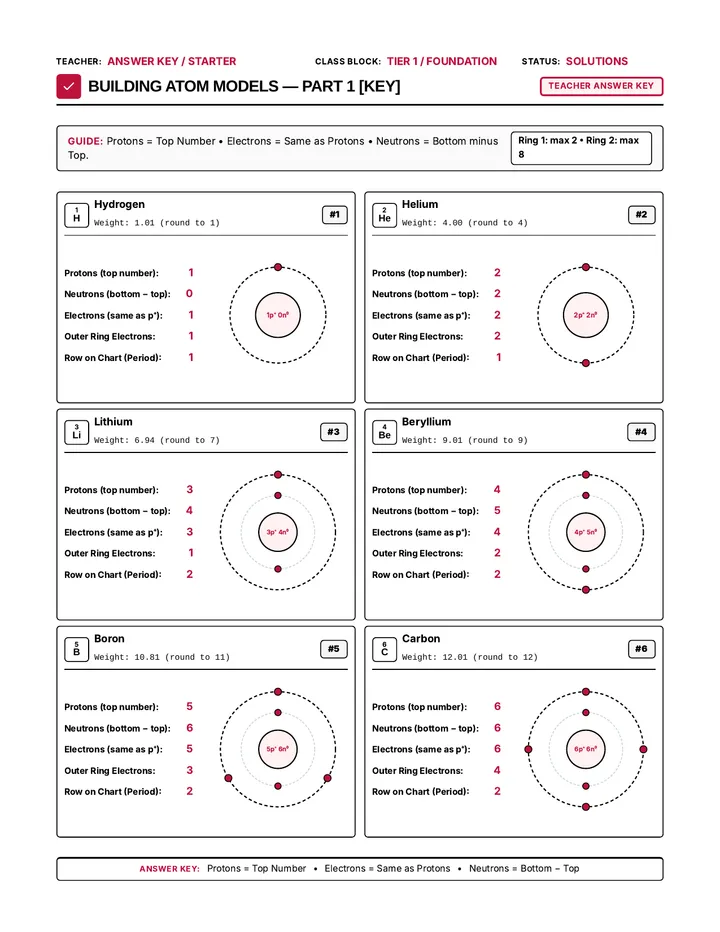
Bohr Model Starter Answer KeyTeacher: ANSWER KEY / STARTER Class Block: TIER 1 / FOUNDATION Status: SOLUTIONS BUILDING ATOM MODELS — PART 1 [KEY] Teacher Answer Key Guide: Protons = Top Number • Electrons = Same as Protons • Neutrons = Bottom minus Top. Ring 1: max 2 • Ring 2: max 8 1 H Hydrogen Weight: 1.01 (round to 1) #1 Protons (top number):1 Neutrons (bottom − top):0 Electrons (same as p⁺):1 Outer Ring Electrons:1 Row on Chart (Period):1 1p⁺ 0n⁰ 2 He Helium Weight: 4.00 (round to 4) #2 Protons (top number):2 Neutrons (bottom − top):2 Electrons (same as p⁺):2 Outer Ring Electrons:2 Row on Chart (Period):1 2p⁺ 2n⁰ 3 Li Lithium Weight: 6.94 (round to 7) #3 Protons (top number):3 Neutrons (bottom − top):4 Electrons (same as p⁺):3 Outer Ring Electrons:1 Row on Chart (Period):2 3p⁺ 4n⁰ 4 Be Beryllium Weight: 9.01 (round to 9) #4 Protons (top number):4 Neutrons (bottom − top):5 Electrons (same as p⁺):4 Outer Ring Electrons:2 Row on Chart (Period):2 4p⁺ 5n⁰ 5 B Boron Weight: 10.81 (round to 11) #5 Protons (top number):5 Neutrons (bottom − top):6 Electrons (same as p⁺):5 Outer Ring Electrons:3 Row on Chart (Period):2 5p⁺ 6n⁰ 6 C Carbon Weight: 12.01 (round to 12) #6 Protons (top number):6 Neutrons (bottom − top):6 Electrons (same as p⁺):6 Outer Ring Electrons:4 Row on Chart (Period):2 6p⁺ 6n⁰ Answer Key: Protons = Top Number • Electrons = Same as Protons • Neutrons = Bottom − Top Teacher: ANSWER KEY / STARTER Class Block: TIER 1 / FOUNDATION Status: SOLUTIONS BUILDING ATOM MODELS — PART 2 [KEY] Teacher Answer Key Guide: Sodium, Silicon, Sulfur, and Chlorine have 3 rings! Fill Ring 1 (2), Ring 2 (8), and remaining on Ring 3. 3-Ring Rule Checked 8 O Oxygen Weight: 16.00 (round to 16) #7 Protons (top number):8 Neutrons (bottom − top):8 Electrons (same as p⁺):8 Outer Ring Electrons:6 Row on Chart (Period):2 8p⁺ 8n⁰ 10 Ne Neon Weight: 20.18 (round to 20) #8 Protons (top number):10 Neutrons (bottom − top):10 Electrons (same as p⁺):10 Outer Ring Electrons:8 Row on Chart (Period):2 10p⁺ 10n⁰ 11 Na Sodium Weight: 22.99 (round to 23) #9 Protons (top number):11 Neutrons (bottom − top):12 Electrons (same as p⁺):11 Outer Ring Electrons:1 Row on Chart (Period):3 11p⁺ 12n⁰ 14 Si Silicon Weight: 28.09 (round to 28) #10 Protons (top number):14 Neutrons (bottom − top):14 Electrons (same as p⁺):14 Outer Ring Electrons:4 Row on Chart (Period):3 14p⁺ 14n⁰ 16 S Sulfur Weight: 32.07 (round to 32) #11 Protons (top number):16 Neutrons (bottom − top):16 Electrons (same as p⁺):16 Outer Ring Electrons:6 Row on Chart (Period):3 16p⁺ 16n⁰ 17 Cl Chlorine Mass: 35.45 amu (≈ 35) #12 Protons (top number):17 Neutrons (bottom − top):18 Electrons (same as p⁺):17 Outer Ring Electrons:7 Row on Chart (Period):3 17p⁺ 18n⁰ Answer Key: Protons = Top Number • Electrons = Same as Protons • Neutrons = Bottom − Top
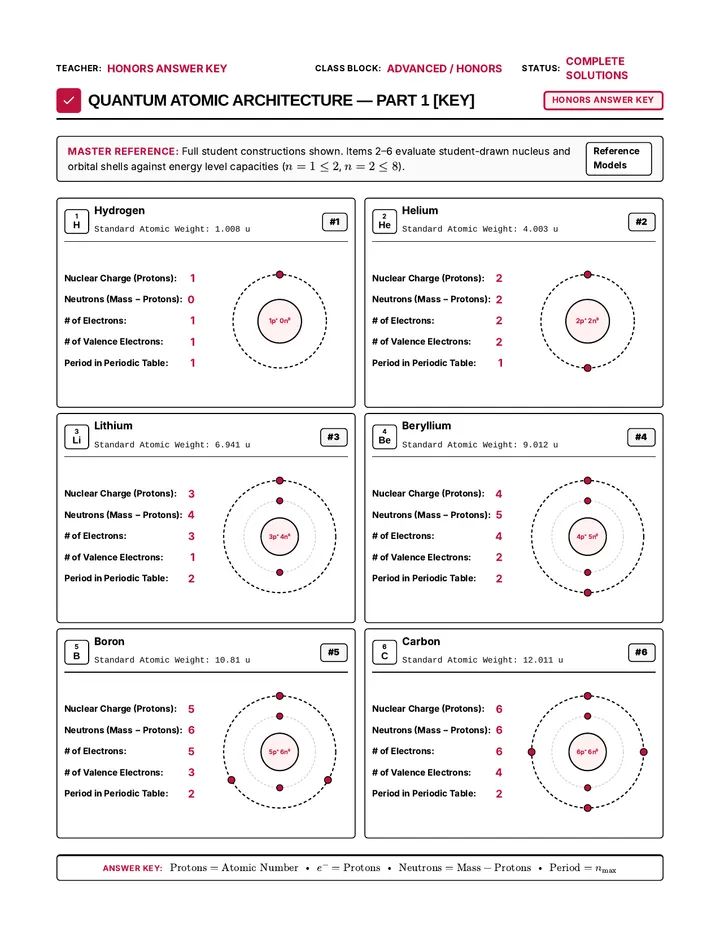
Bohr Model Advanced Answer KeyTeacher: HONORS ANSWER KEY Class Block: ADVANCED / HONORS Status: COMPLETE SOLUTIONS QUANTUM ATOMIC ARCHITECTURE — PART 1 [KEY] Honors Answer Key Master Reference: Full student constructions shown. Items 2–6 evaluate student-drawn nucleus and orbital shells against energy level capacities (\(n=1 \le 2\), \(n=2 \le 8\)). Reference Models 1 H Hydrogen Standard Atomic Weight: 1.008 u #1 Nuclear Charge (Protons):1 Neutrons (Mass − Protons):0 # of Electrons:1 # of Valence Electrons:1 Period in Periodic Table:1 1p⁺ 0n⁰ 2 He Helium Standard Atomic Weight: 4.003 u #2 Nuclear Charge (Protons):2 Neutrons (Mass − Protons):2 # of Electrons:2 # of Valence Electrons:2 Period in Periodic Table:1 2p⁺ 2n⁰ 3 Li Lithium Standard Atomic Weight: 6.941 u #3 Nuclear Charge (Protons):3 Neutrons (Mass − Protons):4 # of Electrons:3 # of Valence Electrons:1 Period in Periodic Table:2 3p⁺ 4n⁰ 4 Be Beryllium Standard Atomic Weight: 9.012 u #4 Nuclear Charge (Protons):4 Neutrons (Mass − Protons):5 # of Electrons:4 # of Valence Electrons:2 Period in Periodic Table:2 4p⁺ 5n⁰ 5 B Boron Standard Atomic Weight: 10.81 u #5 Nuclear Charge (Protons):5 Neutrons (Mass − Protons):6 # of Electrons:5 # of Valence Electrons:3 Period in Periodic Table:2 5p⁺ 6n⁰ 6 C Carbon Standard Atomic Weight: 12.011 u #6 Nuclear Charge (Protons):6 Neutrons (Mass − Protons):6 # of Electrons:6 # of Valence Electrons:4 Period in Periodic Table:2 6p⁺ 6n⁰ Answer Key: \(\text{Protons} = \text{Atomic Number}\) • \(e^- = \text{Protons}\) • \(\text{Neutrons} = \text{Mass} - \text{Protons}\) • \(\text{Period} = n_{\text{max}}\) Teacher: HONORS ANSWER KEY Class Block: ADVANCED / HONORS Status: COMPLETE SOLUTIONS QUANTUM ATOMIC ARCHITECTURE — PART 2 [KEY] Honors Answer Key Master Reference: Sodium through Chlorine require students to independently construct 3 concentric quantized shells (\(n=1, 2, 3\)). 3-Shell Validations 8 O Oxygen Standard Atomic Weight: 15.999 u #7 Nuclear Charge (Protons):8 Neutrons (Mass − Protons):8 # of Electrons:8 # of Valence Electrons:6 Period in Periodic Table:2 8p⁺ 8n⁰ 10 Ne Neon Standard Atomic Weight: 20.180 u #8 Nuclear Charge (Protons):10 Neutrons (Mass − Protons):10 # of Electrons:10 # of Valence Electrons:8 Period in Periodic Table:2 10p⁺ 10n⁰ 11 Na Sodium Standard Atomic Weight: 22.990 u #9 Nuclear Charge (Protons):11 Neutrons (Mass − Protons):12 # of Electrons:11 # of Valence Electrons:1 Period in Periodic Table:3 11p⁺ 12n⁰ 14 Si Silicon Standard Atomic Weight: 28.085 u #10 Nuclear Charge (Protons):14 Neutrons (Mass − Protons):14 # of Electrons:14 # of Valence Electrons:4 Period in Periodic Table:3 14p⁺ 14n⁰ 16 S Sulfur Standard Atomic Weight: 32.06 u #11 Nuclear Charge (Protons):16 Neutrons (Mass − Protons):16 # of Electrons:16 # of Valence Electrons:6 Period in Periodic Table:3 16p⁺ 16n⁰ 17 Cl Chlorine Standard Atomic Weight: 35.45 u #12 Nuclear Charge (Protons):17 Neutrons (Mass − Protons):18 # of Electrons:17 # of Valence Electrons:7 Period in Periodic Table:3 17p⁺ 18n⁰ Answer Key: \(\text{Protons} = \text{Atomic Number}\) • \(e^- = \text{Protons}\) • \(\text{Neutrons} = \text{Mass} - \text{Protons}\) • \(\text{Period} = n_{\text{max}}\)