Photosynthesis AP Assessment
AP Biology • Unit 3: Cellular Energetics
Photosynthesis Assessment
Topic 3.5: Light & Calvin Cycles
40 Minutes • 25 Points Total
Student:
Date:
Period:
Score: / 25
Section I: Stimulus-Based Multiple Choice Questions 1–4 • 3 pts each (12 pts total)
- An investigator treats isolated thylakoid membranes with dichlorophenyldimethylurea (DCMU), an herbicide that specifically binds to the plastoquinone \((\text{Q}_\text{B})\) binding site on Photosystem II (PSII), blocking electron flow to the cytochrome \(b_6f\) complex. Which of the following consequences will be directly observed following illumination?
A Photolysis of \(H_2O\) ceases and NADPH production drops to zero
B The thylakoid lumen pH drops rapidly below 4.0 due to proton trapping
C Oxygen evolution increases as excited P680 reaction centers release \(O_2\)
D Cyclic electron flow around Photosystem I is irreversibly disabled
- In Jagendorf’s classic acid-bath experiment, isolated chloroplast thylakoids were incubated in a pH 4.0 buffer in complete darkness until internal equilibrium was reached. The thylakoids were then rapidly transferred to a pH 8.0 buffer containing ADP and inorganic phosphate \((P_i)\), still in total darkness. Large quantities of ATP were synthesized immediately. Which statement best justifies this experimental finding?
A Dark reactions generate sufficient NADPH to power ATP synthase directly
B A proton motive force across the thylakoid membrane is sufficient for ATP generation
C The basic pH buffer denatures the \(CF_0\) base, locking ATP synthase open
D Active transport pumps protons into the stroma against their gradient
- Chlorella algae cultures actively photosynthesizing under constant illumination and high \({}^{14}\text{CO}_2\) were suddenly plunged into total darkness. Which immediate metabolic shift in Calvin cycle intermediates would be detected within 15 seconds?
A RuBP concentration spikes while 3-PGA drops sharply to baseline
B 3-PGA accumulates while RuBP concentration plummets
C Both RuBP and G3P concentrations increase exponentially
D RuBisCO reverses catalysis to regenerate \(\text{CO}_2\) and phosphoenolpyruvate
- A researcher measures the photosynthetic action spectrum of an aquatic angiosperm and observes robust \(O_2\) generation under blue light (430 nm) and red light (660 nm), but negligible \(O_2\) generation under green light (520–550 nm). What explains this discrepancy?
A Photons of green light lack the quantum energy threshold to excite any electrons
B Green wavelengths are largely reflected and transmitted by chlorophylls \(a\) and \(b\)
C Green photons stimulate RuBisCO oxygenase activity rather than carboxylation
D Water molecules in aqueous solution selectively absorb green light wavelengths
AP Biology Assessment Series • Photosynthesis & Bioenergetics Page 1 of 3 • Continue to Section II
Section II
Data Interpretation & Laboratory Analysis
6 Points Total
Investigation: The Hill Reaction with DCPIP Electron Acceptor
Students isolated functional chloroplasts from fresh spinach leaves to monitor electron transport rate using the redox dye 2,6-dichlorophenolindophenol (DCPIP). In its oxidized state, DCPIP is deep blue and strongly absorbs light at \(600\text{ nm}\). When reduced by electrons originating from light-dependent reactions, DCPIP becomes colorless, resulting in a drop in absorbance at \(600\text{ nm}\) \((A_{600})\). Spectrophotometer readings were recorded at 5-minute intervals.
| Cuvette Treatment |
0 min |
5 min |
10 min |
15 min |
20 min |
| 1: Chloroplasts + DCPIP + Light |
0.82 |
0.58 |
0.39 |
0.22 |
0.10 |
| 2: Chloroplasts + DCPIP + Dark |
0.81 |
0.81 |
0.80 |
0.80 |
0.79 |
| 3: Boiled Chloroplasts + DCPIP + Light |
0.83 |
0.82 |
0.83 |
0.82 |
0.83 |
| 4: Chloroplasts + DCPIP + DCMU + Light |
0.82 |
0.82 |
0.81 |
0.81 |
0.82 |
Question 5: Rate Calculation & Biological Control 2 Points
(a) Calculate the rate of DCPIP reduction for Cuvette 1 between \(t = 0\text{ min}\) and \(t = 15\text{ min}\). Express your answer with appropriate units. (b) Explain why Cuvette 3 was essential to establish that the observed decrease in absorbance required enzymatic/biological activity.
Rate Calculation & Units (Cuvette 1):
Rate = _______________________
Role of Boiled Chloroplast Control (Cuvette 3):
Question 6: Electron Transport Mechanism & Uncoupler Dynamics 4 Points
(a) Identify the normal in vivo terminal electron acceptor that DCPIP artificially replaces during these isolated reactions, and specify the enzyme complex responsible for reducing it in intact chloroplasts.
(b) An investigator adds an ionophore uncoupling agent (DNP) to Cuvette 1 that freely transports \(H^+\) across the thylakoid membrane, dissipating the proton gradient without blocking electron carriers. Predict whether the rate of DCPIP reduction will increase, decrease, or remain unaffected. Justify your prediction based on electron transport regulation.
Prediction: ____________________________________________________________________________________
AP Biology Assessment Series • Photosynthesis & Bioenergetics Page 2 of 3 • Continue to Section III
Section III
AP Free-Response Question (FRQ)
7 Points Total
Question 7: Thermal Stress, Stomatal Dynamics, and RuBisCO Kinetics
Under elevated summer temperatures (\(>35^\circ\text{C}\)) and soil water deficits, \(C_3\) crop plants exhibit significant reductions in net primary productivity (NPP). The plants close stomata to conserve water, which causes internal leaf \(\text{CO}_2\) partial pressure \((P_{\text{CO}_2})\) to drop while leaf \(P_{\text{O}_2}\) remains high. This shift stimulates the oxygenase activity of Ribulose-1,5-bisphosphate carboxylase-oxygenase (RuBisCO), triggering photorespiration.
(a) Identify the primary biochemical reaction catalyzed by RuBisCO under standard conditions and identify its precise compartment within the plant cell.
[2 pts]
(b) Explain why photorespiration imposes a severe energetic penalty on \(C_3\) plants in terms of carbon fixation efficiency and cellular ATP / NADPH consumption.
[2 pts]
(c) Describe one anatomical or biochemical adaptation that allows \(C_4\) plants (such as Zea mays) to suppress photorespiration under drought and high heat.
[2 pts]
(d) Agricultural scientists engineer a mutant \(C_3\) plant strain whose RuBisCO has a significantly increased specificity ratio for \(\text{CO}_2\) relative to \(O_2\) at \(38^\circ\text{C}\). Predict the effect on the mutant plant's net biomass accumulation in arid climates and justify your prediction.
[1 pt]
AP Biology Assessment Series • Photosynthesis & Bioenergetics Page 3 of 3 • End of Assessment
Photosynthesis Scoring Guide
Teacher Resource • AP Biology Scoring Guide
Photosynthesis Assessment Key
Answer Key & Rubric
25 Points Total Scoring Matrix
Unit 3: Cellular Energetics
Topic: 3.5 Light & Calvin Cycles
Cut Scores: 21–25: AP 5 | 18–20: AP 4 | 14–17: AP 3
Section I: Stimulus-Based Multiple Choice (12 Points) 3 pts per question
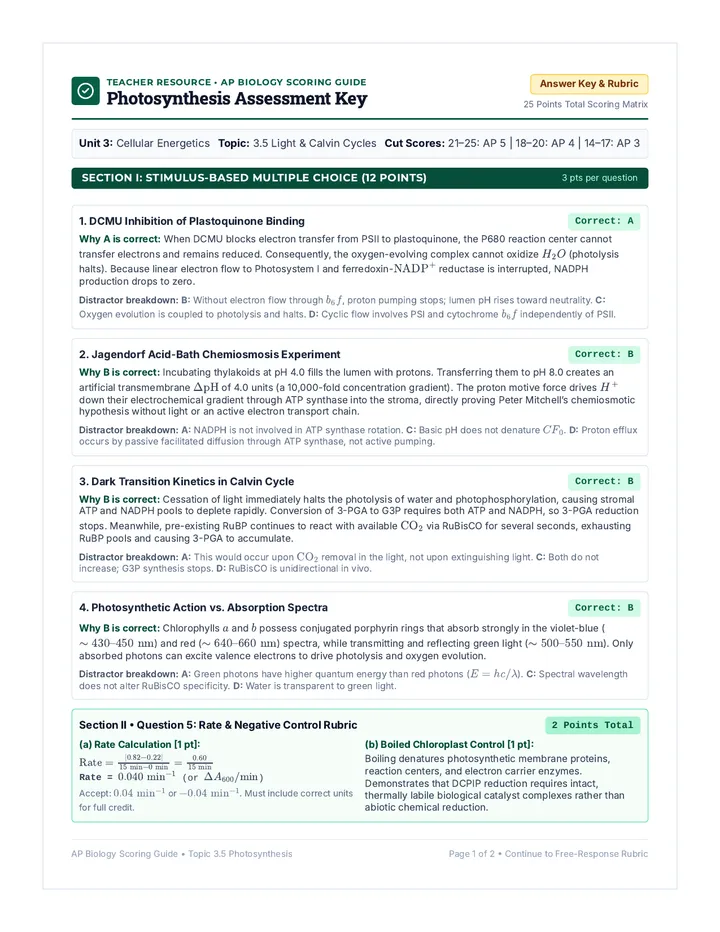
1. DCMU Inhibition of Plastoquinone Binding Correct: A
Why A is correct: When DCMU blocks electron transfer from PSII to plastoquinone, the P680 reaction center cannot transfer electrons and remains reduced. Consequently, the oxygen-evolving complex cannot oxidize \(H_2O\) (photolysis halts). Because linear electron flow to Photosystem I and ferredoxin-\(\text{NADP}^+\) reductase is interrupted, NADPH production drops to zero.
Distractor breakdown: B: Without electron flow through \(b_6f\), proton pumping stops; lumen pH rises toward neutrality. C: Oxygen evolution is coupled to photolysis and halts. D: Cyclic flow involves PSI and cytochrome \(b_6f\) independently of PSII.
2. Jagendorf Acid-Bath Chemiosmosis Experiment Correct: B
Why B is correct: Incubating thylakoids at pH 4.0 fills the lumen with protons. Transferring them to pH 8.0 creates an artificial transmembrane \(\Delta\text{pH}\) of 4.0 units (a 10,000-fold concentration gradient). The proton motive force drives \(H^+\) down their electrochemical gradient through ATP synthase into the stroma, directly proving Peter Mitchell’s chemiosmotic hypothesis without light or an active electron transport chain.
Distractor breakdown: A: NADPH is not involved in ATP synthase rotation. C: Basic pH does not denature \(CF_0\). D: Proton efflux occurs by passive facilitated diffusion through ATP synthase, not active pumping.
3. Dark Transition Kinetics in Calvin Cycle Correct: B
Why B is correct: Cessation of light immediately halts the photolysis of water and photophosphorylation, causing stromal ATP and NADPH pools to deplete rapidly. Conversion of 3-PGA to G3P requires both ATP and NADPH, so 3-PGA reduction stops. Meanwhile, pre-existing RuBP continues to react with available \(\text{CO}_2\) via RuBisCO for several seconds, exhausting RuBP pools and causing 3-PGA to accumulate.
Distractor breakdown: A: This would occur upon \(\text{CO}_2\) removal in the light, not upon extinguishing light. C: Both do not increase; G3P synthesis stops. D: RuBisCO is unidirectional in vivo.
4. Photosynthetic Action vs. Absorption Spectra Correct: B
Why B is correct: Chlorophylls \(a\) and \(b\) possess conjugated porphyrin rings that absorb strongly in the violet-blue (\(\sim 430\text{–}450\text{ nm}\)) and red (\(\sim 640\text{–}660\text{ nm}\)) spectra, while transmitting and reflecting green light (\(\sim 500\text{–}550\text{ nm}\)). Only absorbed photons can excite valence electrons to drive photolysis and oxygen evolution.
Distractor breakdown: A: Green photons have higher quantum energy than red photons (\(E = hc/\lambda\)). C: Spectral wavelength does not alter RuBisCO specificity. D: Water is transparent to green light.
Section II • Question 5: Rate & Negative Control Rubric 2 Points Total
(a) Rate Calculation [1 pt]:
\(\text{Rate} = \frac{|0.82 - 0.22|}{15\text{ min} - 0\text{ min}} = \frac{0.60}{15\text{ min}}\)
Rate = \(0.040\text{ min}^{-1}\) (or \(\Delta A_{600}/\text{min}\))
Accept: \(0.04\text{ min}^{-1}\) or \(-0.04\text{ min}^{-1}\). Must include correct units for full credit.
(b) Boiled Chloroplast Control [1 pt]:
Boiling denatures photosynthetic membrane proteins, reaction centers, and electron carrier enzymes. Demonstrates that DCPIP reduction requires intact, thermally labile biological catalyst complexes rather than abiotic chemical reduction.
AP Biology Scoring Guide • Topic 3.5 Photosynthesis Page 1 of 2 • Continue to Free-Response Rubric
Section II & III
Experimental Analysis & FRQ Scoring Rubrics
11 Points Remaining
Question 6: Electron Transport & Uncoupler Dynamics (4 Points Total) Rubric Breakdown
Part (a) Physiological Target [2 pts]:
- 1 pt: Identifies \(\text{NADP}^+\) as the physiological terminal electron acceptor.
- 1 pt: Identifies Ferredoxin-\(\text{NADP}^+\) reductase (FNR) or Photosystem I (PSI) complex.
Part (b) Ionophore Uncoupler Effect [2 pts]:
- 1 pt (Prediction): Predicts DCPIP reduction rate will increase (or stay maximal).
- 1 pt (Justification): Explains that dissipating \(\Delta\text{pH}\) eliminates back-pressure (proton motive force resistance) on the ETC, enabling electron transport to proceed uninhibited at maximal velocity.
Section III • Question 7: Thermal Stress & RuBisCO (7 Points) AP Analytic Rubric
Part (a): Biochemical Mechanism & Compartment [2 Points]
• 1 pt: Identifies carbon fixation / carboxylation of ribulose-1,5-bisphosphate (RuBP) by \(\text{CO}_2\) to yield two molecules of 3-phosphoglycerate (3-PGA).
• 1 pt: Specifies the stroma of the chloroplast as the exact cellular compartment.
Part (b): Bioenergetic Penalty of Photorespiration [2 Points]
• 1 pt (Carbon penalty): Explains that RuBisCO oxygenates RuBP to produce 2-phosphoglycolate, which must be salvaged in a pathway releasing previously fixed \(\text{CO}_2\), reducing net carbon gain without generating sugar.
• 1 pt (Energy penalty): Explains that the phosphoglycolate salvage pathway actively consumes ATP and NADPH, diverting energy away from the productive Calvin cycle.
Part (c): \(C_4\) Evolutionary Adaptation [2 Points]
• 1 pt: Describes initial carbon fixation in mesophyll cells catalyzed by PEP carboxylase, which has high affinity for \(\text{HCO}_3^-\) and zero oxygenase activity.
• 1 pt: Describes spatial segregation (Kranz anatomy) where 4-carbon organic acids (malate) are pumped into bundle-sheath cells, releasing high concentrations of \(\text{CO}_2\) around RuBisCO to outcompete \(O_2\).
Part (d): Engineered Strain Prediction & Justification [1 Point]
• 1 pt: Predicts that net primary productivity / biomass will increase AND justifies that increased \(\text{CO}_2\) specificity suppresses the oxygenase reaction even when stomata close and internal \(\text{CO}_2\) declines, drastically cutting photorespiratory carbon and ATP losses.
AP Exam Grading Watchpoints & Common Student Errors
Misconception 1: Students often claim \(O_2\) released in photosynthesis comes from \(\text{CO}_2\). Correction: Must explicitly trace \(O_2\) to the photolysis of water at PSII.
Misconception 2: Students confuse chemiosmosis with active transport. Correction: Protons diffuse passively down their electrochemical gradient through ATP synthase.
AP Biology Scoring Guide • Topic 3.5 Photosynthesis Page 2 of 2 • Assessment Scoring Complete