Vet Lingo QuizVeterinary Science • Unit D Quiz Lesson D.2.1 and D.2.2 Quiz Total: 20 Points Name: Date: Period: Score: / 20 Instructions: Read each scenario or question carefully. Choose the best answer and fill in the circle next to your choice. Which branch of study focuses specifically on the care, anatomy, and breeds of dogs? AFelinology BCynology CHippology DEthology A large-animal veterinarian who specializes in caring for horses is studying: AHerpetology BIchthyology CHippology DOdontology What is the scientific study of animal behavior called? AEthology BPathology CCytology DMyology A zoo veterinarian providing care for reptiles and amphibians (like snakes, lizards, and frogs) works in: AOrnithology BIchthyology CHerpetology DOsteology If a pet cat suffers an eye injury or loses its vision, it would be referred to a specialist in: AOtology BOphthalmology CRhinology DOdontology When a veterinary technician examines a slide under a microscope to study the structure and function of cells, they are practicing: ACytology BEmbryology CPhlebology DAngiology A student studying animal anatomy wants to learn about the skeleton and bony structures. Which field should they focus on? AKinesiology BOsteology CMyology DProctology A wildlife biologist who rescues and rehabilitates wild birds works in the field of: AIchthyology BHerpetology CFelinology DOrnithology If a family dog develops a tumor and is diagnosed with cancer, which veterinary specialist will manage its treatment? AOncology BEndocrinology CParasitology DHematology Which medical specialty deals with diseases of the ears, nose, and throat? AGastroenterology BOtorhinolaryngology CPulmonology DNephrology Vet Science Unit D • Introductory Veterinary Terminology Page 1 of 2 → Turn over for Part II Part II: Prefixes, Combining Forms & Suffixes Lesson D.2.1 and D.2.2 Quiz Name: If a patient is diagnosed with bradycardia (a slow heartbeat), what does the prefix Brady- mean? AAbnormally fast BAbnormally slow CDifficult or painful DExcessively high When an animal lacks oxygen, its gums may look cyanotic. What color does the root Cyan/o indicate? AWhite BRed CBlue DYellow Which root word or combining form refers specifically to the liver? AHepat/o BEntr/o CGingiv/o DAbdomin/o When a pet undergoes a surgical procedure ending in -ectomy (such as a splenectomy), what is being done? AExamining with a small scope BSurgically removing an organ or tissue CTreating an involuntary muscle cramp DTemporarily paralyzing a muscle In medical terms like dyspnea and tachypnea, what physiological function does -pnea describe? ASwallowing food BBreathing CBlood pumping DUrination A vet tech running a laboratory test on a stool sample knows that the root word Copr/o means: ABlood BUrine CFeces (stool) DStomach bile If an ultrasound shows that a dog has cardiomegaly or hepatomegaly, what does the suffix -megaly mean? AAbnormally large BSeverely infected CDeficient or low in cells DCompletely missing A veterinarian uses an otoscope to look inside a puppy's ear canal. Which root word means ear? AOphthalm/o BCephal/o COt/o DNas/o In medical terms like dyspnea (trouble breathing) and dysplasia (abnormal growth), what does the prefix Dys- mean? ANormal or healthy BDifficulty or painful COpposite or against DWithout or lacking Common conditions like dermatitis (skin irritation) and otitis (ear irritation) end with -itis. What does -itis mean? AInflammation of BTumor or abnormal mass CDestruction of cells DA surgical cut Check Your Work: Verify you have answered all 20 questions and written your name at the top of both pages. End of Quiz Vet Science Unit D • Introductory Veterinary Terminology Page 2 of 2 • Final Submission
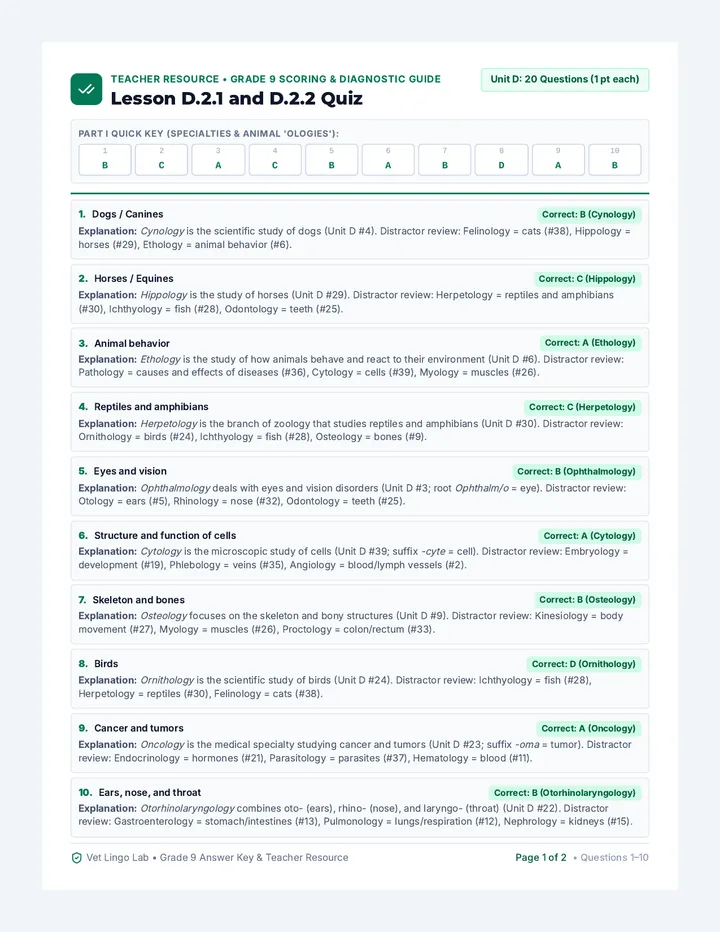
Vet Lingo Answer KeyTeacher Resource • Grade 9 Scoring & Diagnostic Guide Lesson D.2.1 and D.2.2 Quiz Unit D: 20 Questions (1 pt each) Part I Quick Key (Specialties & Animal 'Ologies'): 1B 2C 3A 4C 5B 6A 7B 8D 9A 10B 1. Dogs / Canines Correct: B (Cynology) Explanation: Cynology is the scientific study of dogs (Unit D #4). Distractor review: Felinology = cats (#38), Hippology = horses (#29), Ethology = animal behavior (#6). 2. Horses / Equines Correct: C (Hippology) Explanation: Hippology is the study of horses (Unit D #29). Distractor review: Herpetology = reptiles and amphibians (#30), Ichthyology = fish (#28), Odontology = teeth (#25). 3. Animal behavior Correct: A (Ethology) Explanation: Ethology is the study of how animals behave and react to their environment (Unit D #6). Distractor review: Pathology = causes and effects of diseases (#36), Cytology = cells (#39), Myology = muscles (#26). 4. Reptiles and amphibians Correct: C (Herpetology) Explanation: Herpetology is the branch of zoology that studies reptiles and amphibians (Unit D #30). Distractor review: Ornithology = birds (#24), Ichthyology = fish (#28), Osteology = bones (#9). 5. Eyes and vision Correct: B (Ophthalmology) Explanation: Ophthalmology deals with eyes and vision disorders (Unit D #3; root Ophthalm/o = eye). Distractor review: Otology = ears (#5), Rhinology = nose (#32), Odontology = teeth (#25). 6. Structure and function of cells Correct: A (Cytology) Explanation: Cytology is the microscopic study of cells (Unit D #39; suffix -cyte = cell). Distractor review: Embryology = development (#19), Phlebology = veins (#35), Angiology = blood/lymph vessels (#2). 7. Skeleton and bones Correct: B (Osteology) Explanation: Osteology focuses on the skeleton and bony structures (Unit D #9). Distractor review: Kinesiology = body movement (#27), Myology = muscles (#26), Proctology = colon/rectum (#33). 8. Birds Correct: D (Ornithology) Explanation: Ornithology is the scientific study of birds (Unit D #24). Distractor review: Ichthyology = fish (#28), Herpetology = reptiles (#30), Felinology = cats (#38). 9. Cancer and tumors Correct: A (Oncology) Explanation: Oncology is the medical specialty studying cancer and tumors (Unit D #23; suffix -oma = tumor). Distractor review: Endocrinology = hormones (#21), Parasitology = parasites (#37), Hematology = blood (#11). 10. Ears, nose, and throat Correct: B (Otorhinolaryngology) Explanation: Otorhinolaryngology combines oto- (ears), rhino- (nose), and laryngo- (throat) (Unit D #22). Distractor review: Gastroenterology = stomach/intestines (#13), Pulmonology = lungs/respiration (#12), Nephrology = kidneys (#15). Vet Lingo Lab • Grade 9 Answer Key & Teacher Resource Page 1 of 2 • Questions 1–10 Part II: Prefixes, Combining Forms & Suffixes Lesson D.2.1 and D.2.2 Quiz 11B 12C 13A 14B 15B 16C 17A 18C 19B 20A 11. Prefix: Brady- Correct: B (Abnormally slow) Explanation: Brady- means abnormally slow (Unit D Prefixes #3; e.g., bradycardia = slow heart rate). Distractor review: Hyper- = high (#6), Dys- = difficulty (#5). 12. Root: Cyan/o Correct: C (Blue) Explanation: Cyan/o means blue (Unit D Roots #57; cyanosis indicates lack of oxygen turning gums bluish). Distractor review: Alb/o = white (#30), Erythr/o = red blood cell (#53). 13. Combining Form: Hepat/o Correct: A (Liver) Explanation: Hepat/o refers to the liver (Unit D Roots #55; e.g., hepatitis). Distractor review: Entr/o = intestines (#58), Gingiv/o = gums (#59), Abdomin/o = abdomen (#52). 14. Suffix: -ectomy (-extomy) Correct: B (Surgically removing an organ) Explanation: -ectomy means surgical removal (Unit D Suffixes #81). Distractor review: -scope = instrument for examining (#87), Spasm = involuntary contraction (#64), -plegic = paralysis (#78). 15. Suffix: -pnea Correct: B (Breathing) Explanation: -pnea refers to breathing (Unit D Suffixes #82; dyspnea = difficult breathing, tachypnea = rapid breathing). Distractor review: Phagia = eating/swallowing (#67). 16. Root: Copr/o Correct: C (Feces / stool) Explanation: Copr/o means feces (Unit D Roots #56; e.g., coprophagy = stool eating in dogs). Distractor review: Ur/o = urinary system (#54), Hemat/o = blood (#11), Hydr/o = water (#51). 17. Suffix: Megaly (Megally) Correct: A (Abnormally large) Explanation: Megaly means abnormally large or enlarged (Unit D Suffixes #61; e.g., cardiomegaly = enlarged heart). Distractor review: -itis = inflammation (#83), -penia = deficiency (#86). 18. Combining Form: Ot/o Correct: C (Ear) Explanation: Ot/o means ear (Unit D Roots #45; otoscope = instrument to examine ear). Distractor review: Ophthalm/o = eye (#44), Cephal/o = head (#40), Nas/o = nose (#43). 19. Prefix: Dys- Correct: B (Difficulty or painful) Explanation: Dys- means difficulty, painful, or abnormal (Unit D Prefixes #5). Distractor review: Eu- = normal (#21), Contra-/Anti- = against (#2, #16), A-/An- = without (#1). 20. Suffix: -itis Correct: A (Inflammation of) Explanation: -itis signifies inflammation of an organ or tissue (Unit D Suffixes #83; e.g., dermatitis = inflamed skin). Distractor review: -oma = tumor (#85), Lysis = destruction of (#68), -tomy = cutting/incision (#88). Grade 9 Mastery Scale & Next Steps 18–20 pts (90–100%) Mastery Level: Excellent grasp of roots, prefixes, and animal specialties. Ready for clinical case scenarios. 14–17 pts (70–85%) Proficient: Good understanding. Review differences between similar word parts (-ectomy, -tomy, -megaly). 0–13 pts (<70%) Needs Support: Focus on flashcard review for core body parts (hepat/o, ot/o) and prefixes (brady-, dys-). Vet Lingo Lab • Grade 9 Answer Key & Teacher Resource Page 2 of 2 • Final Scoring Guide
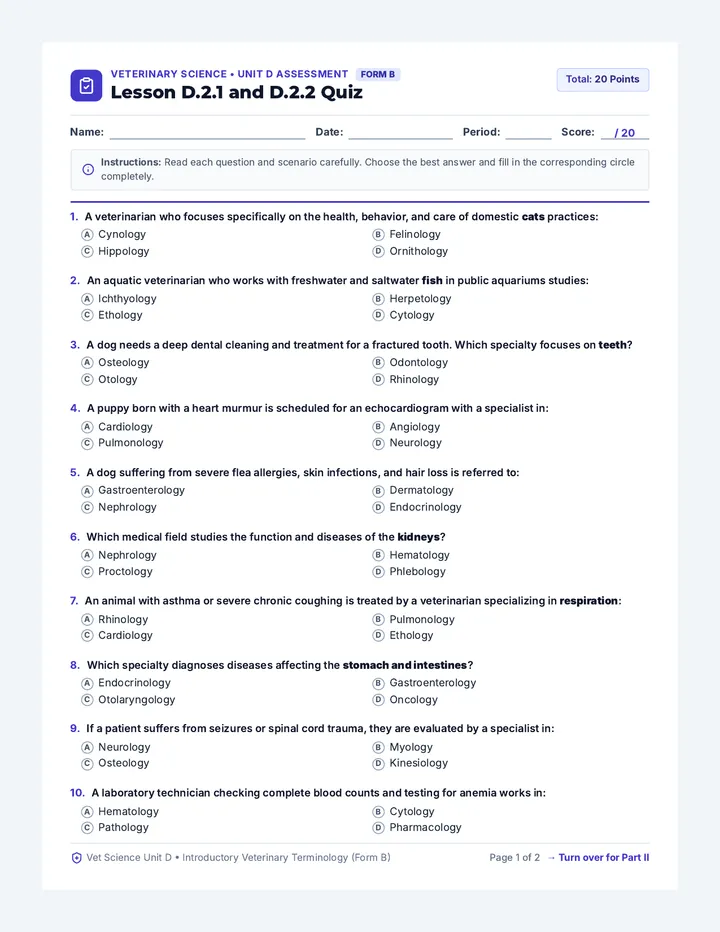
Vet Lingo Alternate QuizVeterinary Science • Unit D Assessment FORM B Lesson D.2.1 and D.2.2 Quiz Total: 20 Points Name: Date: Period: Score: / 20 Instructions: Read each question and scenario carefully. Choose the best answer and fill in the corresponding circle completely. A veterinarian who focuses specifically on the health, behavior, and care of domestic cats practices: ACynology BFelinology CHippology DOrnithology An aquatic veterinarian who works with freshwater and saltwater fish in public aquariums studies: AIchthyology BHerpetology CEthology DCytology A dog needs a deep dental cleaning and treatment for a fractured tooth. Which specialty focuses on teeth? AOsteology BOdontology COtology DRhinology A puppy born with a heart murmur is scheduled for an echocardiogram with a specialist in: ACardiology BAngiology CPulmonology DNeurology A dog suffering from severe flea allergies, skin infections, and hair loss is referred to: AGastroenterology BDermatology CNephrology DEndocrinology Which medical field studies the function and diseases of the kidneys? ANephrology BHematology CProctology DPhlebology An animal with asthma or severe chronic coughing is treated by a veterinarian specializing in respiration: ARhinology BPulmonology CCardiology DEthology Which specialty diagnoses diseases affecting the stomach and intestines? AEndocrinology BGastroenterology COtolaryngology DOncology If a patient suffers from seizures or spinal cord trauma, they are evaluated by a specialist in: ANeurology BMyology COsteology DKinesiology A laboratory technician checking complete blood counts and testing for anemia works in: AHematology BCytology CPathology DPharmacology Vet Science Unit D • Introductory Veterinary Terminology (Form B) Page 1 of 2 → Turn over for Part II Part II: Prefixes, Combining Forms & Suffixes Lesson D.2.1 and D.2.2 Quiz Name: If an animal has hypertension (high blood pressure) or hyperthermia (high fever), the prefix Hyper- means: AExcessively high BExcessively low CAbnormally slow DDifficult or painful Pugs and bulldogs are called "brachycephalic" because they have short muzzles. What does the prefix Brachy- mean? ALong BShort CWide DTwisted Which root word or combining form refers specifically to the head? ACephal/o BThorac/o CAbdomin/o DTrache/o When a veterinarian diagnoses a cat with gingivitis, which anatomical part is inflamed? ATongue BGums CStomach DThroat In medical terms like enteritis, which internal organ does the combining form Entr/o represent? AIntestines BLiver CKidneys DHeart In diagnostic clinical equipment, what does the suffix -scope indicate (such as in otoscope or stethoscope)? AAn instrument used for examining BA surgical removal CA cutting or incision DA painful sensation When a veterinary surgeon performs a gastrotomy or laparotomy, what does the suffix -tomy mean? AComplete surgical removal BCutting or incision CInstrument to view DEnlargement of an organ If an animal's lab report shows leukopenia (a shortage of white blood cells), what does -penia mean? AAbnormally high number BDeficiency or lack of CInflammation of DDestruction of Which root word means white, as seen in the term albino (an animal lacking normal pigment)? AAlb/o BCyan/o CErythr/o DCopr/o In oncology and veterinary pathology, what does the suffix -oma describe (as in melanoma or lipoma)? AInflammation BTumor or abnormal mass CInvoluntary contraction DParalysis Check Your Work: Verify you have answered all 20 questions and filled out your name at the top of both pages. End of Form B Vet Science Unit D • Introductory Veterinary Terminology (Form B) Page 2 of 2 • Final Submission
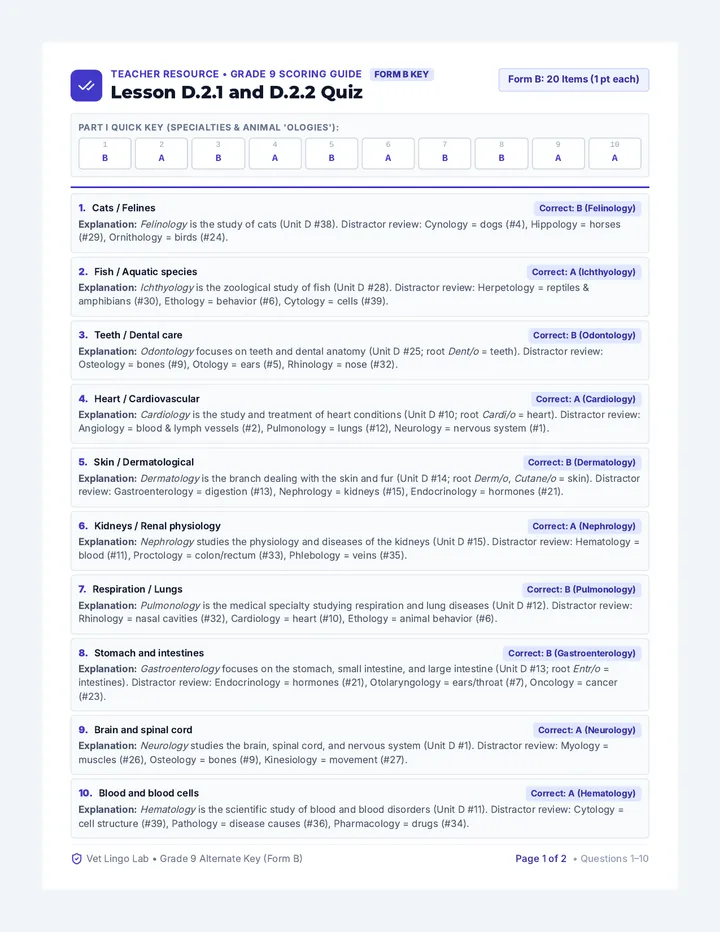
Vet Lingo Alternate KeyTeacher Resource • Grade 9 Scoring Guide FORM B KEY Lesson D.2.1 and D.2.2 Quiz Form B: 20 Items (1 pt each) Part I Quick Key (Specialties & Animal 'Ologies'): 1B 2A 3B 4A 5B 6A 7B 8B 9A 10A 1. Cats / Felines Correct: B (Felinology) Explanation: Felinology is the study of cats (Unit D #38). Distractor review: Cynology = dogs (#4), Hippology = horses (#29), Ornithology = birds (#24). 2. Fish / Aquatic species Correct: A (Ichthyology) Explanation: Ichthyology is the zoological study of fish (Unit D #28). Distractor review: Herpetology = reptiles & amphibians (#30), Ethology = behavior (#6), Cytology = cells (#39). 3. Teeth / Dental care Correct: B (Odontology) Explanation: Odontology focuses on teeth and dental anatomy (Unit D #25; root Dent/o = teeth). Distractor review: Osteology = bones (#9), Otology = ears (#5), Rhinology = nose (#32). 4. Heart / Cardiovascular Correct: A (Cardiology) Explanation: Cardiology is the study and treatment of heart conditions (Unit D #10; root Cardi/o = heart). Distractor review: Angiology = blood & lymph vessels (#2), Pulmonology = lungs (#12), Neurology = nervous system (#1). 5. Skin / Dermatological Correct: B (Dermatology) Explanation: Dermatology is the branch dealing with the skin and fur (Unit D #14; root Derm/o, Cutane/o = skin). Distractor review: Gastroenterology = digestion (#13), Nephrology = kidneys (#15), Endocrinology = hormones (#21). 6. Kidneys / Renal physiology Correct: A (Nephrology) Explanation: Nephrology studies the physiology and diseases of the kidneys (Unit D #15). Distractor review: Hematology = blood (#11), Proctology = colon/rectum (#33), Phlebology = veins (#35). 7. Respiration / Lungs Correct: B (Pulmonology) Explanation: Pulmonology is the medical specialty studying respiration and lung diseases (Unit D #12). Distractor review: Rhinology = nasal cavities (#32), Cardiology = heart (#10), Ethology = animal behavior (#6). 8. Stomach and intestines Correct: B (Gastroenterology) Explanation: Gastroenterology focuses on the stomach, small intestine, and large intestine (Unit D #13; root Entr/o = intestines). Distractor review: Endocrinology = hormones (#21), Otolaryngology = ears/throat (#7), Oncology = cancer (#23). 9. Brain and spinal cord Correct: A (Neurology) Explanation: Neurology studies the brain, spinal cord, and nervous system (Unit D #1). Distractor review: Myology = muscles (#26), Osteology = bones (#9), Kinesiology = movement (#27). 10. Blood and blood cells Correct: A (Hematology) Explanation: Hematology is the scientific study of blood and blood disorders (Unit D #11). Distractor review: Cytology = cell structure (#39), Pathology = disease causes (#36), Pharmacology = drugs (#34). Vet Lingo Lab • Grade 9 Alternate Key (Form B) Page 1 of 2 • Questions 1–10 Part II: Prefixes, Combining Forms & Suffixes Lesson D.2.1 and D.2.2 Quiz 11A 12B 13A 14B 15A 16A 17B 18B 19A 20B 11. Prefix: Hyper- Correct: A (Excessively high) Explanation: Hyper- means excessively high or elevated (Unit D Prefixes #6). Distractor review: Hypo- = low (#7), Brady- = slow (#3), Dys- = difficulty (#5). 12. Prefix: Brachy- Correct: B (Short) Explanation: Brachy- means short (Unit D Prefixes #14; brachycephalic = short head structure as seen in bulldogs and pugs). 13. Combining Form: Cephal/o Correct: A (Head) Explanation: Cephal/o refers to the head (Unit D Roots #40). Distractor review: Thorac/o = chest/thorax (#47), Abdomin/o = abdomen (#52), Trache/o = trachea (#48). 14. Root: Gingiv/o Correct: B (Gums) Explanation: Gingiv/o means gums (Unit D Roots #59; gingivitis = inflammation of the gums). Distractor review: Dent/o = teeth (#41). 15. Root: Entr/o Correct: A (Intestines) Explanation: Entr/o indicates the intestines (Unit D Roots #58; enteritis = intestinal inflammation). Distractor review: Hepat/o = liver (#55), Ur/o = urinary system (#54). 16. Suffix: -scope Correct: A (Instrument used for examining) Explanation: -scope refers to an instrument used for examining or viewing (Unit D Suffixes #87; e.g., stethoscope, otoscope). Distractor review: -ectomy = surgical removal (#81). 17. Suffix: -tomy Correct: B (Cutting or incision) Explanation: -tomy means cutting or making a surgical incision (Unit D Suffixes #88). Contrasted with -ectomy (which means removal). 18. Suffix: -penia Correct: B (Deficiency of) Explanation: -penia means deficiency or lack of (Unit D Suffixes #86; e.g., osteopenia, leukopenia). Distractor review: Megaly = large (#61), -itis = inflammation (#83). 19. Combining Form: Alb/o Correct: A (White) Explanation: Alb/o means white (Unit D Roots #30; e.g., albino). Distractor review: Cyan/o = blue (#57), Erythr/o = red blood cell (#53), Copr/o = feces (#56). 20. Suffix: -oma Correct: B (Tumor or abnormal mass) Explanation: -oma denotes a tumor or swelling/mass (Unit D Suffixes #85; e.g., adenoma, lymphoma). Distractor review: Spasm = involuntary contraction (#64), -plegic = paralysis (#78). Form B Mastery Scale & Instructional Next Steps 18–20 pts (90–100%) Mastery Level: Outstanding recall of roots and specialties. Ready for clinical abbreviation drills. 14–17 pts (70–85%) Proficient: Solid knowledge. Review surgical suffixes (-ectomy vs. -tomy) and prefixes (hyper- vs. hypo-). 0–13 pts (<70%) Needs Support: Focus on organ combining forms (entr/o, cephal/o, gingiv/o) using flashcard sorting games. Vet Lingo Lab • Grade 9 Alternate Key (Form B) Page 2 of 2 • Final Scoring Guide