Gravity Scaling Worksheet
Newton's Gravitational Force
Proportional Reasoning & Bertha's Law of 1's
Name:
Date:
Period:
The Physics: Universal Gravitation
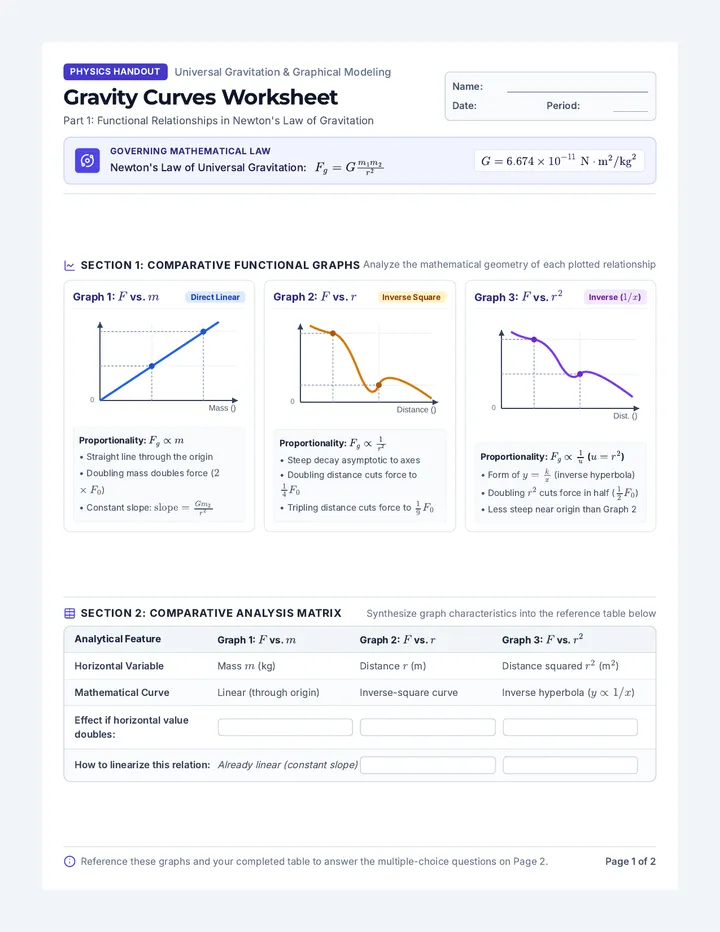
Newton's Law: \( F_g = G \frac{m_1 m_2}{r^2} \). Force is directly proportional to mass (\( F \propto m_1, F \propto m_2 \)) and inversely proportional to distance squared (\( F \propto \frac{1}{r^2} \)).
Direct Proportionality: Multiply mass by \( k \rightarrow \) Force multiplies by \( k \).
Inverse-Square Law: Multiply distance by \( k \rightarrow \) Force scales by \( \frac{1}{k^2} \).
Bertha's Law of 1's Method
- Start with base force = 1: \( \frac{(1)(1)}{1^2} = 1 \)
- Replace changed values with their multiplier factors (keep unchanged as 1).
- Evaluate arithmetic to find the new force factor!
Example Problem
Tripling Mass 1 and Doubling Separation Distance
Baseline Force = \( F_0 \)
Scenario: Two astronomical bodies experience gravitational attraction \( F_0 \). What is the new force if Mass 1 is tripled (\( m_1 \rightarrow 3 \)), Mass 2 is unchanged (\( m_2 \rightarrow 1 \)), and their separation distance is doubled (\( r \rightarrow 2 \))?
1. Identify Multipliers
\( m_1 \text{ factor} = \mathbf{3} \)
\( m_2 \text{ factor} = \mathbf{1} \) (unchanged)
\( r \text{ factor} = \mathbf{2} \)
2. Bertha's 1's Setup
\( F_{new} = \frac{(m_1)(m_2)}{r^2} \)
\( F_{new} = \frac{(3)(1)}{(2)^2} = \frac{3}{4} \)
3. Proportionality Meaning
Mass triples \( \rightarrow \times 3 \) (Direct). Distance doubles \( \rightarrow \times \frac{1}{4} \) (Inverse square). The new gravitational force is \( \frac{3}{4} F_0 \) (or 0.75 \( F_0 \)).
1
Direct Proportionality: Doubling Both Masses
Distance Remains Constant
Two identical planetary moons exert a mutual gravitational force \( F \) on each other. If the mass of Moon 1 is doubled (\( \times 2 \)) and the mass of Moon 2 is also doubled (\( \times 2 \)), while the distance between their centers remains constant:
Multipliers:
\( m_1 \text{ factor} = \text{______} \)
\( m_2 \text{ factor} = \text{______} \)
\( r \text{ factor} = \text{______} \)
Relationship Type:
Direct or Inverse?
Bertha's Law of 1's Work Area:
New Force in terms of \( F \):
Newton's Universal Gravitation & Bertha's Law of 1's Page 1 of 3
Gravitational Scaling Practice
Bertha's Law of 1's: \( F_{new} = \frac{m_1 \cdot m_2}{r^2} \)
2
Inverse-Square Proportionality: Tripling Separation Distance
Masses Remain Constant
Two communication satellites in deep space experience gravitational attraction \( F \). Thrusters fire, pushing them further apart until their separation distance is tripled (\( 3 \times \) original distance). Both satellite masses remain unchanged.
Multipliers:
\( m_1 \text{ factor} = \text{______} \)
\( m_2 \text{ factor} = \text{______} \)
\( r \text{ factor} = \text{______} \)
Relationship Type:
Direct or Inverse Square?
Bertha's Law of 1's Work Area:
New Force in terms of \( F \):
3
Compound Proportions: Halving Masses and Doubling Distance
Multiple Variables
A scientific probe orbits an asteroid with gravitational force \( F \). During an operation, the asteroid fragments, halving its mass (\( \times \frac{1}{2} \)), the probe releases cargo, halving its own mass (\( \times \frac{1}{2} \)), and the orbital distance doubles (\( \times 2 \)).
Multipliers:
\( m_1 \text{ factor} = \text{______} \)
\( m_2 \text{ factor} = \text{______} \)
\( r \text{ factor} = \text{______} \)
Force Direction:
Increases or Decreases?
Bertha's Law of 1's Work Area:
New Force in terms of \( F \):
4
Fractional Distance: Compressing Orbital Separation
Distance Compressed
Two dense binary stars experience gravitational force \( F \). Their masses do not change, but their orbital radius shrinks to one-third of its original distance (\( r \rightarrow \frac{1}{3} \)).
Multipliers:
\( m_1 \text{ factor} = \text{______} \)
\( m_2 \text{ factor} = \text{______} \)
\( r \text{ factor} = \text{______} \)
Denominator Tip:
Calculate \( (\frac{1}{3})^2 \), then invert!
Bertha's Law of 1's Work Area:
New Force in terms of \( F \):
Newton's Universal Gravitation & Bertha's Law of 1's Page 2 of 3
Balancing Proportions & Synthesis
Concept Mastery & Review
5
Target Force Challenge: Balancing Mass and Distance
Inverse Challenge
An aerospace engineer replaces a small satellite with an orbital habitat that has 16 times the original mass (\( m_1 \rightarrow 16 \)). Earth's mass (\( m_2 \)) is constant. By what factor must the distance \( r \) be changed so that the gravitational force remains completely unchanged (\( F_{new} = 1 F \))?
Known Factors:
\( m_1 \text{ factor} = \mathbf{16} \)
\( m_2 \text{ factor} = \mathbf{1} \)
\( F_{target} \text{ factor} = \mathbf{1} \)
Solve for factor \( r \)!
Set: \( 1 = \frac{16 \cdot 1}{r^2} \)
Bertha's Law of 1's Work Area:
Required Distance Factor \( r \):
Synthesis Matrix: Proportionality Summary
Complete the table below to summarize how changing mass versus distance impacts Newton's Gravitational Force.
| Variable Changed |
Type of Proportionality |
Algebraic Relationship |
If Value Triples (\( \times 3 \)), Force... |
| Mass 1 (\( m_1 \)) |
Direct or Inverse? |
\( F \propto \text{______} \) |
Multiplies by: ______ |
| Mass 2 (\( m_2 \)) |
Direct or Inverse? |
\( F \propto \text{______} \) |
Multiplies by: ______ |
| Distance (\( r \)) |
Direct or Inverse? |
\( F \propto \text{______} \) |
Multiplies by: ______ |
Conceptual Reflection
1. Sensitivity Check: Which variable has a greater impact on the gravitational force when doubled: mass or separation distance? Explain using your calculations.
2. Infinite Range: According to the inverse-square law, does the gravitational attraction between two objects ever truly reach zero at any finite distance? Explain why or why not.
Newton's Universal Gravitation & Bertha's Law of 1's Page 3 of 3